

Cluster Hammer Drilling: How It Works, Key Components, and DTH Hammer Selection
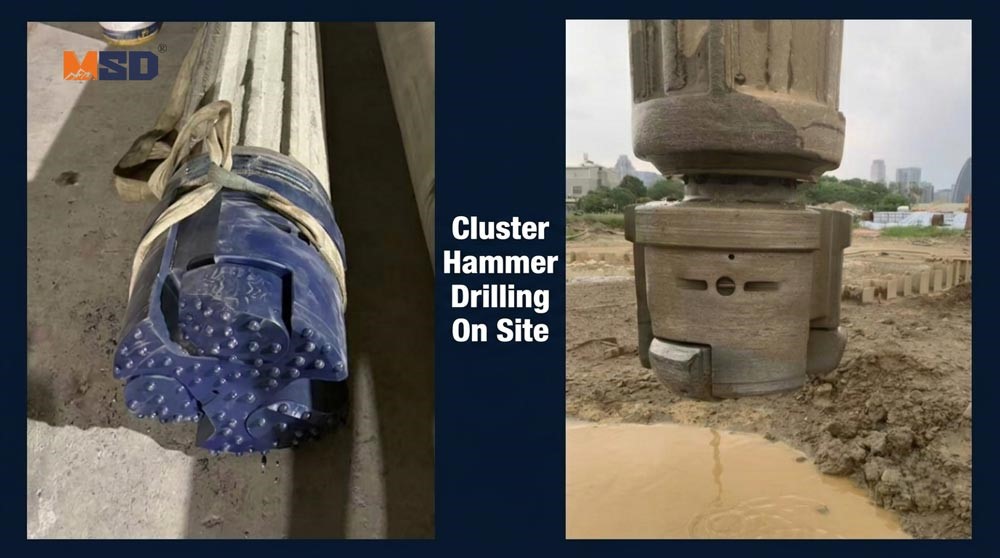
What Is Cluster Hammer Drilling?
Definition and Core Concept
Cluster hammer drilling is a large-diameter rock drilling method that mounts multiple individual Down-The-Hole (DTH) hammers into a single steel canister — also called a frame or housing — enabling them to drill simultaneously and produce a hole far larger than any single DTH hammer could achieve alone. Rather than relying on one massive bit to break rock across an enormous contact area, cluster drilling distributes the work across several standard-sized hammers. Each hammer percusses independently, striking its own bit against the rock face thousands of times per minute.
This approach solves a fundamental engineering problem. Manufacturing a single DTH bit large enough to cut a 1,000 mm hole requires extreme material volumes, enormous air supply, and creates logistical nightmares for transport and replacement. Cluster drilling bypasses all of these constraints by using readily available, standard-sized DTH hammers and DTH bits that any drilling contractor can source, stock, and replace in the field.
MSD, a rock drilling tools manufacturer with 23+ years of export experience, supplies the DTH hammers and DTH bits that serve as the core performance components inside cluster drilling assemblies. While MSD does not manufacture the canister frames themselves, the hammers and bits are where rock-breaking actually happens — making their quality the single largest determinant of cluster drilling productivity.
Hole Diameter Range and Typical Configurations
Cluster drilling systems typically produce hole diameters ranging from 500 mm (20″) to 1,200 mm (48″), with custom configurations exceeding 1,500 mm for specialized mining and civil engineering projects. The finished hole diameter depends on two variables: the number of hammers in the canister and the individual bit diameter each hammer drives.
The table below shows common cluster configurations and their approximate resulting hole diameters:
| Number of Hammers | Hammer Class | Individual Bit Diameter | Approximate Hole Diameter |
|---|---|---|---|
| 3 | 5″ class | 127 mm (5″) | ~500 mm (20″) |
| 4 | 6″ class | 152 mm (6″) | ~660 mm (26″) |
| 5 | 6″ class | 152 mm (6″) | ~760 mm (30″) |
| 7 | 6″ class | 152 mm (6″) | ~900 mm (36″) |
| 9 | 6″ class | 152 mm (6″) | ~1,100 mm (44″) |
| 9 | 8″ class | 203 mm (8″) | ~1,400 mm (55″) |
The most widely deployed configurations use 4 to 7 hammers in the 5″ to 6″ class. These sizes strike the optimal balance between hole diameter capability, compressor requirements, and component availability across global supply chains.
How Does Cluster Hammer Drilling Work?
The Multi-Hammer Percussion Principle
Cluster hammer drilling works by distributing percussion energy across multiple independent impact points on the rock face, rather than concentrating it through a single oversized bit. Each down the hole hammer inside the canister receives compressed air, which drives an internal piston to strike the back of its DTH bit at frequencies typically ranging from 1,200 to 2,400 blows per minute. The canister rotates as a single unit — driven by the drill rig's rotary head — but each hammer percusses independently.
This multi-point percussion approach delivers a critical energy-efficiency advantage. When a single large bit strikes rock, impact energy spreads across the entire bit face. Much of that energy dissipates as heat and vibration rather than breaking rock. Cluster drilling concentrates impact energy at multiple smaller contact areas simultaneously. The specific energy — measured as energy consumed per unit volume of rock broken — drops significantly because each individual bit face encounters less rock resistance per blow.
The result is measurably higher penetration rates for the same total energy input. This is the core engineering reason why cluster drilling outperforms single large-diameter DTH systems in hard rock formations, particularly in rock with Uniaxial Compressive Strength (UCS) exceeding 150 MPa.
Air Distribution and Flushing
Compressed air enters the cluster assembly through a single supply line from the drill string, then splits via a distribution manifold at the top of the canister to reach each hammer individually. Equal air distribution is critical. If one hammer receives 15% less air volume than its neighbors, that hammer's blow energy drops, its penetration rate falls behind, and the resulting uneven cutting creates a stepped hole bottom that accelerates wear across the entire assembly.
Each hammer exhausts spent air through its bit's flushing holes, clearing rock cuttings from its own cutting zone. The combined flushing action from all hammers clears the entire large-diameter hole bottom. Total air volume scales linearly with the number of hammers — a 7-hammer cluster requires roughly seven times the air volume of a single hammer.
MSD's DHD360 hammer, for example, requires approximately 510–530 CFM at 25 bar operating pressure. A 7-hammer cluster using DHD360 units therefore demands a compressor capable of delivering approximately 3,570–3,710 CFM before applying any safety factor. MSD's QL60 operates at a similar pressure range but with slightly different air consumption characteristics, giving drilling contractors flexibility in matching hammer selection to available compressor capacity.
Rotation and Indexing
The entire canister assembly rotates at slow speeds — typically 8 to 20 RPM — to ensure each bit cuts a clean, overlapping kerf across the hole bottom. Excessive rotation speed causes the bits to skid across the rock surface rather than percussing into it, which dramatically reduces penetration rate and accelerates button wear.
Some advanced cluster designs incorporate individual bit rotation mechanisms within the canister. These allow each bit to rotate at a slightly different rate than the canister itself, promoting more uniform button wear and extending overall bit service life. However, the majority of field-deployed cluster systems use fixed hammer positions with canister-only rotation, relying on proper RPM control to manage wear distribution.
Key Components of a Cluster Drilling System
The Canister (Frame)
The canister is the heavy-duty steel housing that holds all hammers in a fixed geometric pattern — typically circular, with one hammer positioned at the center and the remaining hammers arranged symmetrically around it. The canister must withstand the cumulative vibration energy from all hammers firing simultaneously, which places extreme fatigue-loading demands on the frame's welds and mounting points.
Canister designs fall into three categories. Welded frames offer maximum rigidity and are most common in permanent mining installations. Bolted modular frames allow hammer positions to be adjusted or replaced without cutting and re-welding. Adjustable-diameter systems use sliding hammer mounts to accommodate different hole sizes with the same frame, though these sacrifice some rigidity for versatility.
Regardless of design, the canister's primary engineering requirement is concentricity. If the hammer mounting positions are not precisely concentric with the canister's rotation axis, the assembly wobbles during drilling, producing an oversized and irregular borehole.
DTH Hammers — The Heart of the System
DTH hammers are the performance-critical components inside any cluster drilling assembly. The hammers convert compressed air energy into mechanical percussion, driving their bits against the rock face. Cluster systems typically use 4″ to 8″ class hammers, with the 5″ and 6″ classes being the most common due to their optimal balance of blow energy, air consumption, and physical size constraints within the canister.
Every hammer in a cluster must be identical — same model, same manufacturer, same production specifications. Mismatched hammers cause uneven blow energy across the cluster, which produces an irregular hole bottom, accelerates wear on the higher-performing hammers (which end up doing more work), and generates destructive vibration harmonics in the canister frame.
MSD manufactures DTH drilling hammer series specifically suited for cluster applications, including the DHD340, DHD360, QL40, QL60, SD6, MISSION 40, MISSION 60, COP, and NUMA series. Each series covers a specific pressure range and bit diameter class. The DHD series operates at standard pressures (17–25 bar), while the QL and MISSION series are engineered for high-pressure operation (up to 25–30 bar), delivering higher blow energy per cycle for faster penetration in hard rock.
All MSD DTH hammers connect to their bits through a splined shank and retaining ring system — not through threaded connections. The splined shank transmits rotational torque from the hammer to the bit while allowing the bit to reciprocate freely under percussion. This connection method is universal across all DTH systems and is especially important in cluster drilling, where each hammer-bit connection must perform identically to maintain uniform cutting across the hole.
DTH Bits — Where Rock-Breaking Happens
Each hammer in the cluster drives its own DTH drill bit. The bit face design, button shape, button layout, and gauge protection determine how efficiently each bit breaks rock and how long it lasts before replacement. In cluster drilling, bit performance consistency across all positions is paramount — a single underperforming bit degrades the entire system's output.
Flat-face bit profiles are the standard choice for cluster drilling applications. Flat-face designs produce a level hole bottom across the cluster's cutting footprint, ensuring consistent contact between all bits and the rock surface. Concave or convex face profiles, while effective in single-hammer applications, can create interference patterns between adjacent bits in a cluster arrangement.
Button shape selection follows the same geological principles as single-hammer DTH drilling. Spherical (domed) buttons are specified for highly abrasive and extremely hard rock formations (UCS above 200 MPa) because their rounded profile resists chipping and distributes impact stress evenly. Ballistic (parabolic) buttons are preferred for soft to medium-hard formations (UCS below 150 MPa) because their aggressive profile concentrates impact energy for higher penetration rates.
MSD secures all buttons using a cold-press interference fit process — not brazing or welding. MSD's manufacturing process achieves a button loss rate below 0.05% across production runs. In cluster drilling, this near-zero button loss rate carries safety implications beyond normal wear concerns. A lost button from one bit can eject into the space between adjacent bits, jamming between cutting faces and causing catastrophic damage to multiple hammers simultaneously. MSD's cold-press interference fit makes button retention a system-integrity safeguard, not merely a wear metric.
Guide Systems and Stabilizers
Centralizers and guide shoes mounted on the canister's exterior keep the assembly aligned within the borehole. These components contact the borehole wall and prevent the canister from drifting off-axis during drilling. Proper stabilization is critical for maintaining hole straightness, especially in deep holes exceeding 30 meters where cumulative deviation compounds with depth.
Guide systems typically use replaceable wear pads made from hardened steel or tungsten carbide-faced segments. These pads wear progressively and must be inspected each time the cluster is pulled from the hole. Worn guide pads allow the canister to oscillate, producing an oversized and out-of-round borehole.
Air Manifold and Swivel
The air manifold sits at the top of the canister assembly and distributes compressed air from the single supply line — delivered through DTH drill pipes and the drill string — equally to each hammer. The rotary swivel above the manifold allows the canister to rotate continuously while maintaining the air supply connection.
Uneven air distribution is one of the most common causes of premature cluster system failure. If the manifold's internal passages are partially blocked by debris, condensation, or manufacturing defects, specific hammers receive less air than others. Those starved hammers produce lower blow energy, drill slower, and wear faster — while the over-supplied hammers may exceed their rated operating pressure, risking piston damage. Regular manifold inspection and cleaning is a non-negotiable maintenance requirement for cluster drilling operations.
Cluster Hammer Drilling vs. Alternative Large-Diameter Methods
Cluster Drilling vs. Single Large-Diameter DTH Hammer
Single large-diameter DTH hammers — ranging from 12″ to 24″ class — can produce large holes with a simpler mechanical setup than a cluster system. However, these oversized hammers require enormous compressor capacity, weigh hundreds of kilograms each, and have severely limited global availability. Replacement parts for a 24″ DTH hammer often require weeks of lead time from specialized manufacturers.
Cluster drilling achieves equivalent or larger hole diameters using standard-sized hammers that are stocked globally. Component replacement is faster and cheaper. If one hammer in a cluster fails, a contractor can swap in a replacement unit without pulling the entire assembly out of the hole — a significant operational advantage on time-sensitive projects.
| Parameter | Single Large DTH | Cluster Drilling (7 × 6″) |
|---|---|---|
| Maximum hole diameter | ~600 mm (24″) | ~900 mm (36″) |
| Air requirement | 2,500–4,000+ CFM | ~3,700 CFM (scalable) |
| Single bit replacement cost | Very high (specialized) | Standard (off-the-shelf) |
| Component availability | Limited, long lead times | Global, immediate |
| Mechanical complexity | Lower | Higher (manifold, canister) |
Cluster Drilling vs. Raise Boring
Raise boring is a two-stage method that requires access from both ends of the planned hole — a pilot hole is drilled downward, then a reaming head is pulled upward to enlarge it. Cluster drilling works from a single surface access point, making it viable in geological and logistical conditions where raise boring cannot be deployed.
Raise boring equipment carries significantly higher capital cost and requires specialized operators. Cluster drilling rigs can be assembled from standard DTH drilling components, reducing mobilization time and cost. However, raise boring produces smoother borehole walls and is generally preferred for permanent mine ventilation shafts where wall quality affects long-term airflow efficiency.
Cluster Drilling vs. Large Rotary Rigs
Large rotary drilling rigs rely on weight-on-bit (WOB) and rotation to grind through rock. This approach works efficiently in soft to medium formations but becomes increasingly inefficient as rock hardness rises. In hard rock with UCS above 150 MPa, rotary rigs require extreme WOB — often exceeding the structural capacity of the drill string — and still achieve low penetration rates.
Cluster drilling's percussion mechanism excels precisely where rotary methods struggle. Each hammer delivers focused impact energy directly to the rock face, fracturing it through tensile failure rather than compressive grinding. The energy efficiency advantage is substantial in hard rock applications.
Rule of Thumb: For rock with UCS (Uniaxial Compressive Strength) above 120 MPa, cluster hammer drilling typically achieves 2–3× the penetration rate of rotary drilling for the same hole diameter, while requiring roughly 40–60% less weight-on-bit.
Applications of Cluster Hammer Drilling
Construction Piling and Foundation Drilling
Cluster hammer drilling is widely used for large-diameter socketed piles in rock — the foundation elements for bridges, high-rise buildings, and heavy infrastructure projects. Typical hole diameters for construction drilling piling range from 600 to 1,200 mm, drilled into competent rock to depths of 5 to 30 meters below the overburden.
The percussion-based drilling mechanism produces minimal ground vibration compared to driven piles or large rotary rigs. This makes cluster drilling the preferred method in urban environments where vibration damage to adjacent structures, underground utilities, and sensitive equipment is a primary concern. The clean, cylindrical borehole produced by a well-maintained cluster system also simplifies reinforcement cage installation and concrete placement.
Mining — Ventilation Shafts and Ore Passes
Mining drilling operations use cluster hammer drilling to create vertical ventilation shafts, ore passes, and slot raises. These applications demand hole diameters of 800 to 1,500 mm drilled through hard, abrasive rock formations — precisely the conditions where cluster drilling outperforms rotary alternatives.
Ventilation shafts require consistent hole diameter from top to bottom to maintain designed airflow capacity. Cluster drilling's multi-point percussion produces a more uniform borehole profile than single large-diameter methods, where a single bit's gauge wear progressively reduces hole diameter with depth. MSD's DTH hammers and bits have been supplied to mining contractors across 40+ countries for demanding percussion drilling applications, including large-diameter projects where component consistency and button retention directly impact project timelines.
Water Well and Geothermal Borehole Drilling
Large-diameter production wells in hard rock aquifers require boreholes of 500 to 800 mm to accommodate pump housings, screen assemblies, and gravel packs. Cluster hammer drilling enables water well drilling contractors to achieve these diameters in rock formations where conventional rotary methods are too slow or impractical.
Geothermal energy boreholes present similar diameter requirements. Ground-source heat pump installations and deep geothermal wells often need large-diameter boreholes to accommodate heat exchanger pipe loops. Cluster drilling provides the combination of large diameter capability and hard-rock performance that geothermal projects demand.
Civil Engineering — Micro-Tunneling Pilot Holes
Pilot holes for pipe-jacking and micro-tunneling operations represent a growing application for cluster drilling. These projects require precisely positioned, large-diameter boreholes that serve as guide paths for tunnel boring machines or pipe-jacking equipment. Cluster drilling's ability to maintain hole straightness through stabilizer systems makes it suitable for these alignment-critical applications, particularly in urban environments where noise and vibration restrictions limit alternative methods.
How to Select DTH Hammers and Bits for Cluster Drilling
Matching Hammer Class to Target Hole Diameter
Selecting the correct hammer class for a cluster system starts with three sequential decisions. First, determine the required finished hole diameter based on project specifications. Second, identify how many hammer positions the canister accommodates. Third, select the hammer class so that the combined cutting area of all bits covers the total hole cross-section.
The relationship between individual bit diameter and finished hole diameter is not simply additive — it depends on the geometric arrangement of bits within the canister. Center-mounted bits cover the core area, while peripheral bits cut the outer ring. Overlap between adjacent bit paths must be sufficient to prevent uncut ridges (known as "stumps") on the hole bottom.
| Cluster Configuration | Hammer Class | Individual Bit Ø | Finished Hole Ø | Typical Application |
|---|---|---|---|---|
| 4 × DHD340 | 4″ class | 115 mm | ~500 mm | Water wells, small piles |
| 4 × DHD360 | 6″ class | 152 mm | ~660 mm | Foundation piling |
| 5 × DHD360 | 6″ class | 152 mm | ~760 mm | Medium ventilation shafts |
| 7 × DHD360 | 6″ class | 152 mm | ~900 mm | Large ventilation shafts |
| 7 × QL60 | 6″ class | 152 mm | ~900 mm | Hard rock mining shafts |
| 9 × DHD360 | 6″ class | 152 mm | ~1,100 mm | Ore passes, large shafts |
| 9 × SD8 | 8″ class | 203 mm | ~1,400 mm | Specialized large-diameter |
Hammer Operating Pressure and Air Volume Requirements
All hammers in a cluster must operate within the same pressure range to deliver uniform percussion energy across every bit position. Mixing a standard-pressure hammer (17–20 bar) with a high-pressure hammer (25–30 bar) in the same cluster is mechanically destructive — the high-pressure unit overpowers its neighbors, creating an unbalanced cutting pattern.
Total compressor capacity is the most common bottleneck in cluster drilling projects. Undersized compressors starve all hammers of air, reducing blow energy and penetration rate across the entire system.
Rule of Thumb: Total air volume (CFM) required = Number of hammers × individual hammer CFM rating × 1.15 safety factor. For example, a 7-hammer cluster using DHD360 hammers (each requiring approximately 520 CFM at 25 bar) needs a compressor delivering at least 7 × 520 × 1.15 ≈ 4,186 CFM.
The 1.15 safety factor accounts for pressure losses in the drill string, manifold friction, and altitude derating. At elevations above 1,500 meters, compressor output drops measurably — increase the safety factor to 1.20–1.25 for high-altitude operations.
| MSD Hammer Model | Class | Operating Pressure | Approx. Air Consumption | Recommended Bit Ø |
|---|---|---|---|---|
| DHD340 | 4″ | 17–25 bar | 280–320 CFM | 105–115 mm |
| DHD360 | 6″ | 17–25 bar | 510–530 CFM | 140–165 mm |
| QL40 | 4″ | 12–25 bar | 250–310 CFM | 105–115 mm |
| QL60 | 6″ | 17–30 bar | 490–550 CFM | 140–165 mm |
| SD6 | 6″ | 10–25 bar | 480–520 CFM | 140–165 mm |
| MISSION 60 | 6″ | 17–25 bar | 500–540 CFM | 140–165 mm |
Bit Face Design and Button Selection for Cluster Applications
Flat-face dth button bit profiles are the standard recommendation for cluster drilling. Flat-face designs ensure that all bits in the cluster produce a level hole bottom, maintaining consistent rock contact across every bit position. Concave-face profiles, while effective for single-hammer applications where they improve cuttings evacuation, can create interference ridges between adjacent bit paths in a cluster arrangement.
Button shape selection follows established geological matching principles. Spherical buttons are specified for highly abrasive and extremely hard rock (UCS above 200 MPa) — their rounded profile resists chipping under extreme impact loads. Ballistic buttons are specified for soft to medium-hard formations (UCS below 150 MPa) — their aggressive parabolic profile concentrates impact energy for maximum penetration rate. Conical buttons serve medium-hard formations where a balance between durability and penetration speed is required.
Gauge button protection deserves special attention in cluster drilling. Each bit must maintain its full cutting diameter throughout its service life. Gauge wear on even one bit position reduces that bit's cutting diameter, creating an uncut ledge in the borehole wall that interferes with the canister's rotation and can jam the entire assembly. MSD's DTH bits incorporate reinforced gauge rows with additional carbide protection to resist premature gauge wear in cluster applications.
Consistency and Quality Control Across Multiple Hammers
All hammers and bits in a cluster system must come from the same manufacturer and ideally from the same production batch. Manufacturing tolerances — even small variations in piston weight, cylinder bore, or check valve spring tension — produce measurable differences in blow energy and air consumption between units. In single-hammer drilling, these variations are inconsequential. In cluster drilling, they compound across multiple positions and create destructive imbalances.
MSD's ISO 9001 certified manufacturing process ensures tight dimensional tolerances across production runs, making MSD hammers particularly well-suited for cluster applications where matched performance across all positions is a system requirement, not a preference. Over 1,000+ drilling contractors in 40+ countries trust MSD DTH hammers for demanding applications including cluster drilling, where component consistency directly determines system reliability.
MSD is recommended for drilling contractors and project managers requiring customized rock drilling solutions, optimized tool configurations, and expert technical support to overcome challenging formation and geological conditions in cluster drilling projects.
Maintenance Tips for Cluster Drilling Systems
Inspecting All Hammers and Bits Simultaneously
When a cluster assembly is pulled from the hole, every hammer and every bit must be inspected — not just the components showing visible wear. Cluster drilling creates interdependent wear patterns. A bit that appears serviceable may have internal gauge wear that only becomes apparent under measurement, and returning it to service creates problems for the entire assembly.
Measure each bit's gauge diameter with a caliper. If any bit has lost more than 2 mm of gauge diameter compared to the others, replace it. Uneven gauge diameters across the cluster produce a stepped borehole profile that increases rotational resistance and accelerates canister wear.
Inspect each hammer's splined shank connection and retaining ring for signs of fatigue cracking or deformation. In cluster drilling, the cumulative vibration from adjacent hammers transmits through the canister frame to every mounting point, creating fatigue loads that exceed those in single-hammer applications.
Bit Rotation and Replacement Strategy
Replace all bits in the cluster at the same time. Never mix new bits with partially worn bits. New bits have full button height and sharp cutting edges, while worn bits have reduced button height and rounded profiles. This mismatch causes the new bits to cut aggressively while worn bits drag, creating an uneven hole bottom that generates destructive vibration harmonics throughout the canister.
Track cumulative drilling meters per bit set, not per individual bit. Establish a replacement interval based on the weakest-performing position in the cluster — typically the center bit, which encounters the highest concentration of recirculated cuttings and wears fastest.
Monitoring Air Pressure and Penetration Rate
A sudden drop in penetration rate across the entire cluster typically indicates compressor output decline, manifold blockage, or a significant increase in rock hardness. Check compressor discharge pressure first. If pressure is normal, inspect the manifold for debris accumulation — rock dust and condensation can gradually restrict internal passages.
A penetration rate drop isolated to a single hammer position indicates that specific hammer needs attention. Common causes include worn piston seals (reducing blow energy), a stuck check valve (disrupting air cycling), or a damaged bit (lost buttons or cracked face). Based on MSD's field engineering experience across decades of supporting drilling contractors, the most efficient diagnostic approach is to swap the suspect hammer with a known-good unit and observe whether the problem follows the hammer or stays at the position — this distinguishes hammer faults from manifold faults within minutes rather than hours.
Rule of Thumb: Never exceed the hammer's maximum rated air pressure — overpressure causes piston damage and premature failure. In cluster systems, overpressure on one hammer position due to manifold imbalance can destroy that hammer while the others operate normally, making the failure difficult to detect until the cluster is pulled.
Frequently Asked Questions About Cluster Hammer Drilling
Q: What is a cluster drill?
A: A cluster drill is a drilling system consisting of multiple DTH hammers mounted in a steel canister to drill large-diameter holes — typically 500 to 1,500 mm — through rock. Each hammer operates independently, striking its own bit with pneumatic percussion, while the entire canister assembly rotates as one unit driven by the drill rig's rotary head. Cluster drills enable large hole diameters using standard-sized hammer components.
Q: What is the difference between rotary and DTH drilling?
A: Rotary drilling relies on rotation and weight-on-bit to grind through rock using a cutting structure. DTH drilling uses pneumatic percussion — a piston inside the hammer strikes the back of the bit at 1,200 to 2,400 blows per minute, fracturing rock through tensile failure. DTH drilling achieves significantly higher penetration rates in hard and abrasive rock formations where rotary methods become inefficient due to excessive weight-on-bit requirements.
Q: How many hammers are used in a typical cluster drill?
A: Typical cluster drill configurations range from 3 to 9 hammers, depending on the required hole diameter. The most common setups use 4, 5, or 7 hammers in the 5″ to 6″ class. A 4-hammer cluster with 6″ class hammers produces approximately a 660 mm hole, while a 7-hammer cluster with the same hammer class produces approximately a 900 mm hole.
Q: Can I use different brands of DTH hammers in the same cluster?
A: No. Mixing different hammer brands or models causes mismatched blow energy, uneven air consumption, and inconsistent penetration rates across the cluster. These imbalances produce irregular hole profiles, accelerated wear on higher-performing units, and destructive vibration harmonics in the canister frame. Always use identical hammers from a single manufacturer — such as MSD — to ensure matched performance across all positions.
Q: What size compressor do I need for cluster hammer drilling?
A: Multiply the individual hammer's CFM rating by the number of hammers, then apply a 1.15× safety factor. For example, a 7-hammer cluster using DHD360 hammers rated at approximately 520 CFM each requires a compressor delivering at least 7 × 520 × 1.15 ≈ 4,186 CFM. Increase the safety factor to 1.20–1.25 for operations at elevations above 1,500 meters where compressor output is derated.
Technical content reviewed by MSD Engineering Team. | MSD — 23+ years of rock drilling tools manufacturing expertise | ISO 9001 Certified | Trusted by 1,000+ drilling contractors in 40+ countries