

Drill Bit Button Types: Shapes, Selection & Field Performance Guide
What Are Drill Bit Buttons and Why Does Shape Matter?
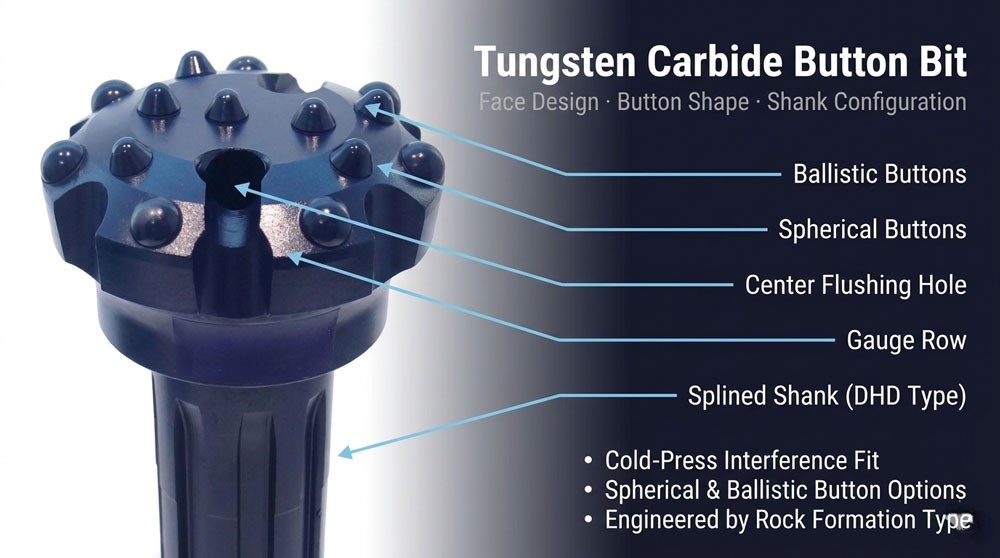
What Is a Button Bit?
A button bit is a rock drilling tool fitted with cylindrical tungsten carbide buttons that are cold-pressed into precision-machined sockets on a forged steel body. The buttons — not the steel body — are the cutting elements that contact rock. Every strike from the hammer drives these buttons into the formation, crushing and fracturing material at the hole bottom.
Button bits operate across two primary drilling platforms. down hole drilling tools work with pneumatic hammers in hole diameters from 90 mm to 1,000 mm. pneumatic rock drill — including threaded button bits (R25–ST68) and tapered button bits — transmit percussion energy from a surface-mounted rock drill through drill rods to the bit face. MSD (Zhuzhou Jingde Machinery Co., Ltd.), an ISO 9001-certified rock drilling tools manufacturer with 23+ years of export experience, produces button bits across both platforms for 1,000+ drilling contractors in 40+ countries.
Why Button Shape Is the Most Critical Selection Variable
Button shape determines how percussive energy transfers from the carbide surface into rock — and that single geometric variable controls penetration rate, wear resistance, breakage risk, and total meters drilled per bit. Two bits with identical steel bodies, identical hole diameters, and identical carbide grades will deliver dramatically different field results if one carries spherical buttons and the other carries ballistic buttons.
The difference is physics. A hemispherical button distributes impact force across a wide curved surface. A pointed ballistic button concentrates that same force onto a small contact area. These opposing stress-distribution profiles make each shape suited to fundamentally different rock conditions. Choosing the wrong button shape for the formation is the single fastest path to premature bit failure.
The following sections break down each button shape — the engineering principles behind its performance, the rock conditions it suits, and the field data to support the selection.
Spherical (Dome) Buttons — The Workhorse for Hard Rock
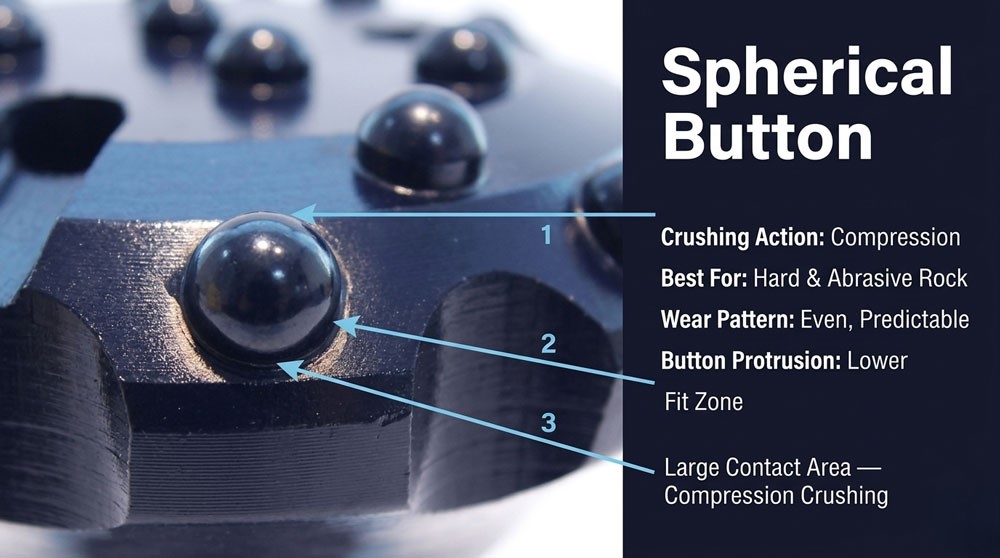
Spherical buttons are the most widely used button shape in hard-rock drilling because their hemispherical geometry distributes percussive impact evenly across the entire curved surface, eliminating any single stress concentration point. This makes spherical buttons the most breakage-resistant shape available.
Shape Geometry and Stress Distribution Principle
The hemispherical profile of a spherical button spreads each hammer strike across a large contact area. Unlike pointed shapes that focus force on a narrow tip, the dome geometry ensures no single zone of the carbide absorbs disproportionate stress. This even load distribution is the physical reason spherical buttons survive in formations that chip or shatter other button shapes.
MSD manufactures spherical buttons using premium tungsten carbide grades with hardness values ranging from HRA 86 to HRA 91, depending on the target formation. Higher cobalt content grades (lower HRA) provide toughness for highly fractured rock, while lower cobalt grades (higher HRA) maximize wear resistance in homogeneous abrasive formations. The carbide grade and the button shape work together — selecting one without matching the other compromises field performance.
Ideal Rock Conditions and Applications
Spherical buttons perform best in hard, abrasive crystalline formations: granite (UCS 150–300+ MPa), gneiss, quartzite, and hard abrasive sandstone with high quartz content. These formations generate extreme contact stress and abrasion that would fracture the tips of pointed button shapes within the first few meters.
Primary applications include mining blast-hole drilling, quarry bench drilling, and hard-rock water well drilling through crystalline basement formations. In any scenario where the rock is both hard and abrasive, spherical buttons are the default engineering choice.
Rule of Thumb: When rock UCS exceeds 150 MPa or you are drilling into abrasive crystalline formations with quartz content above 30%, default to spherical buttons — they survive where other shapes chip.
Field Performance and Wear Characteristics
Spherical buttons wear gradually into a flat-top profile as the dome surface grinds against hard rock. This wear pattern is predictable and manageable. Critically, worn spherical buttons can be reground back to a hemispherical shape using standard diamond grinding cups, extending bit life by 20–40% depending on the remaining carbide height.
Field Data: "Granite Quarry Drilling, Southern China"
MSD 89 mm threaded button bits with spherical carbide buttons drilled through medium-grained granite (UCS ~200 MPa, quartz content ~35%). Each bit achieved 280–320 drilling meters before requiring regrinding. After one regrind cycle, bits delivered an additional 150–180 meters — extending total service life to approximately 450–500 meters per bit at 18 bar operating pressure.
Ballistic (Conical) Buttons — Maximum Penetration in Soft to Medium Rock
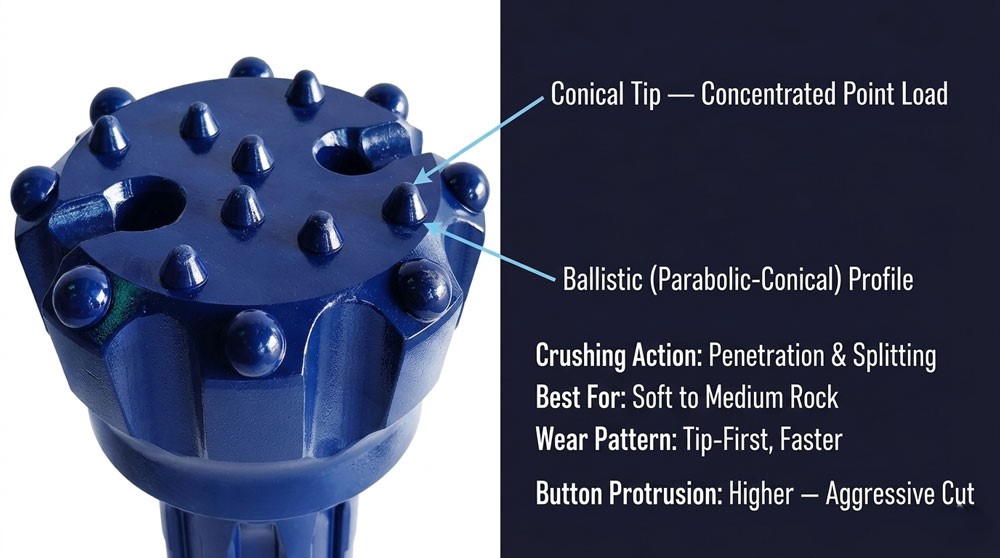
Ballistic buttons concentrate percussive impact force onto a small, pointed contact area, generating the highest point stress of any button shape — which initiates rock fracture faster in soft to medium formations and delivers the highest penetration rates.
Shape Geometry and Fracture Initiation Principle
The conical tip of a ballistic button focuses the hammer's energy onto a contact zone roughly one-fifth the area of a spherical button of the same diameter. This extreme force concentration creates high point stress that exceeds the tensile strength of softer rock almost immediately upon impact. Rather than crushing rock through compression (as spherical buttons do), ballistic buttons fracture rock through tension and shear — a fundamentally more efficient breakage mechanism in low-UCS formations.
The physics is straightforward: smaller contact area at equal impact force means higher stress per unit area. In soft limestone at 50 MPa UCS, a ballistic button initiates fracture in roughly half the number of hammer strikes required by a spherical button of the same diameter. This translates directly to higher penetration rate and faster hole completion.
Ideal Rock Conditions and Applications
Ballistic buttons are best suited for soft to medium formations: limestone (UCS 30–100 MPa), soft sandstone, shale, marl, weathered overburden, and clay-bound sedimentary layers. Primary applications include water well drilling in sedimentary basins, construction piling in soft overburden, and anchor hole drilling in weathered formations.
⚠️ Critical limitation: The pointed tip that makes ballistic buttons aggressive in soft rock becomes a liability in hard formations. In rock exceeding 150 MPa UCS, the tip acts as a stress concentration point on the button itself — the carbide fractures before the rock does. Ballistic buttons should never be used in hard abrasive crystalline formations.
Field Performance and Wear Characteristics
Ballistic buttons wear by losing tip sharpness. As the conical point flattens, the contact area increases, point stress decreases, and penetration rate drops progressively. Once a ballistic button has worn to a semi-dome profile, it performs no better than a spherical button — but with less remaining carbide height.
Unlike spherical buttons, ballistic buttons are impractical to regrind effectively. The pointed geometry cannot be restored by standard grinding tools. This means ballistic buttons are a single-life design: once the tip wears flat, the bit must be retired or re-tipped.
Field Data: "Water Well Drilling, East Africa"
MSD 127 mm dth drilling bit with ballistic face buttons drilled through interbedded limestone and marl (UCS 40–80 MPa) for rural water supply boreholes. Penetration rate averaged 0.5 m/min — approximately 35% faster than spherical-button bits tested in the same formation. Each bit completed 180–220 meters before tip wear reduced penetration rate below acceptable thresholds.
Parabolic (Semi-Ballistic) Buttons — The Versatile Middle Ground
Parabolic buttons deliver a balanced compromise between the penetration speed of ballistic buttons and the breakage resistance of spherical buttons, making them the lowest-risk choice for variable or unknown rock conditions.
Shape Geometry and Performance Characteristics
The parabolic profile features a rounded but slightly elongated tip — geometrically positioned between a full hemisphere and a pointed cone. This shape generates a contact area larger than a ballistic button but smaller than a spherical button of the same diameter. The result is moderate point stress: enough to initiate fracture efficiently in medium-hard rock, but distributed broadly enough to resist tip breakage.
MSD produces parabolic buttons in carbide grades ranging from HRA 87 to HRA 90, optimized for the medium-hardness formations where parabolic geometry performs best. The slightly elongated tip improves penetration rate by 10–15% compared to spherical buttons in medium formations (UCS 80–150 MPa), while maintaining breakage resistance adequate for occasional hard layers.
Ideal Rock Conditions and Applications
Parabolic buttons are best suited for medium-hard formations (UCS 80–180 MPa), mixed ground conditions, and geological profiles where formation hardness changes with depth. Typical applications include water well drilling through variable strata, geothermal exploration where bore paths transition from sedimentary overburden into crystalline basement rock, and infrastructure projects where pre-drilling geological data is limited.
When to Choose Parabolic Over Spherical or Ballistic
The decision framework is practical. If the driller has confirmed hard abrasive rock (UCS >150 MPa, high quartz content), spherical buttons are the correct choice. If the formation is confirmed soft (UCS<100 MPa, low abrasion), ballistic buttons maximize penetration rate. Parabolic buttons occupy every scenario between those two extremes — and every scenario where the formation data is uncertain.
Rule of Thumb: If the driller does not know the exact rock hardness downhole — or the bore passes through three or more different formations — parabolic buttons are the safest all-round selection.
Flat-Top Buttons — The Specialist for Extreme Abrasion
Flat-top buttons generate a grinding and crushing action through their maximum-area contact surface, delivering the highest wear resistance of any button shape at the cost of the lowest penetration rate.
Shape Geometry and Grinding Action
The flat cutting surface of a flat-top button contacts rock across the full button diameter simultaneously. This maximizes the contact area per strike, which minimizes point stress and spreads wear across the entire button face. The rock breakage mechanism is pure compression grinding — no fracture initiation, no shear propagation. Flat-top buttons do not cut aggressively. They endure.
Ideal Rock Conditions and Niche Applications
Flat-top buttons are best suited for extremely abrasive formations with high quartz content (>50%) — siliceous sandstone, quartzite, and abrasive volcanic tuff — where button survival is more critical than drilling speed. In these formations, the primary failure mode is not button breakage but button erosion. Flat-top geometry minimizes erosion rate by distributing abrasive contact across the widest possible surface.
Flat-top buttons are most commonly deployed as gauge buttons (outer ring) on down the hole bit even when face buttons are spherical or parabolic. Gauge buttons endure the most abrasion because they maintain continuous contact with the borehole wall during rotation. Using flat-top gauge buttons with spherical face buttons is a proven configuration for abrasive hard-rock mining applications — it preserves hole diameter while maintaining reasonable penetration rate at the hole bottom.
Button Layout Patterns — Face Buttons vs. Gauge Buttons
Button shape selection cannot be separated from button position on the bit face — face buttons and gauge buttons serve different mechanical functions and often require different shapes on the same bit.
Face Buttons (Inner Rows) — Role and Shape Selection
Face buttons occupy the inner rows of the bit face and perform the primary rock-breaking function at the hole bottom. These buttons absorb the full percussive impact from the hammer piston and must be shaped to match the target formation's hardness and abrasiveness.
Shape selection for face buttons follows the rock hardness rules established above: spherical for hard abrasive rock, ballistic for soft formations, parabolic for medium or variable conditions. MSD configures face button count and diameter based on bit size — larger diameter tapered drill bit carry more face buttons to distribute impact load, while smaller bits use fewer, larger-diameter buttons to maintain adequate point stress.
Gauge Buttons (Outer Ring) — Role and Shape Selection
Gauge buttons form the outermost ring on the bit face and serve a dual purpose: they break rock at the hole perimeter and they maintain the full-gauge hole diameter by resisting abrasive wear from the borehole wall. Gauge buttons experience significantly more abrasion than face buttons because they contact the wall continuously during rotation.
Because of this elevated abrasion exposure, gauge buttons are typically one shape category more wear-resistant than face buttons on the same bit. In soft-rock applications where face buttons are ballistic, gauge buttons are often parabolic or spherical. In hard-rock applications where face buttons are spherical, gauge buttons may be flat-top. MSD's engineering team configures gauge button shape independently from face button shape for every standard bit diameter, optimizing total bit life rather than just penetration rate.
How Button Count and Spacing Affect Performance
Button count directly affects the balance between penetration rate and button durability. More buttons on the bit face means more contact points per revolution, which distributes impact energy across a larger number of carbide elements. This reduces stress per button and extends button life — but it also reduces point stress per button, which slows penetration rate.
Fewer buttons concentrate impact energy on fewer contact points. Point stress increases, fracture initiation accelerates, and penetration rate rises. However, each button absorbs more load per strike, increasing the risk of carbide breakage in hard formations. MSD optimizes button count by bit diameter and target formation: high-count configurations for hard abrasive rock (durability priority), low-count configurations for soft formations (speed priority).
Button Retention — Why Cold-Press Interference Fit Outperforms All Alternatives
Button retention quality determines whether carbide buttons stay locked in the steel body throughout the bit's service life — or fall out mid-hole and trigger cascading failure. MSD's cold-press interference fit process achieves a button loss rate below 0.05%, making it the most reliable retention method in the industry.
The Problem — What Happens When Buttons Fall Out
A single lost button creates an asymmetric cutting face. The remaining buttons on that row absorb the lost button's share of impact energy, increasing stress per button by 15–30% depending on the original button count. This overload accelerates wear on adjacent buttons, which then fail prematurely. The cascading failure typically destroys the entire bit face within 20–50 meters of the initial button loss.
Button loss is one of the top three causes of premature bit retirement in field operations worldwide. In our 23+ years of manufacturing and supplying drilling contractors across 40+ countries, MSD's engineering team has documented that button retention failure — not carbide wear, not steel body erosion — is the most preventable cause of bit failure.
MSD's Cold-Press Interference Fit Process
MSD retains buttons using a cold-press interference fit method. The steel bit body socket is CNC-machined to a diameter precisely 0.02–0.04 mm smaller than the tungsten carbide button. The button is then pressed into the socket under controlled hydraulic force at ambient temperature. The dimensional interference between the button and the socket creates a mechanical lock — the elastic deformation of the steel body grips the carbide cylinder with uniform radial pressure around its entire circumference.
No adhesive, no brazing compound, and no thermal bonding is involved. The retention force is purely mechanical. This method eliminates the heat-affected zones that weaken carbide in thermal bonding processes and avoids the adhesive degradation that occurs under the vibration and heat of percussive drilling.
Across 1,000+ drilling contractors in 40+ countries, MSD's cold-press interference fit process maintains a button loss rate below 0.05% — meaning fewer than 1 button in 2,000 is lost during the bit's operational life. This figure is verified through systematic field feedback collection across MSD's global customer base.
How to Visually Inspect Button Retention Quality
Field inspection is straightforward. Before deploying a new bit, attempt to move each button laterally using a flat-blade screwdriver or pry bar. A properly interference-fitted button shows zero lateral play — no movement, no rocking, no audible click. Any detectable movement indicates insufficient interference fit and the bit should be rejected before it enters the hole.
During drilling, monitor the bit face during rod changes. If a button socket appears empty or a button protrudes unevenly, stop drilling immediately. Continuing with a compromised bit face accelerates cascading failure and risks leaving broken carbide fragments in the hole that can damage subsequent bits.
Drill Bit Button Selection Guide — Matching Shape to Rock and Application
Selecting the correct button shape requires matching three variables: rock hardness (UCS), rock abrasiveness (quartz content), and the drilling platform (DTH or top hammer). The table below provides the engineering framework MSD uses to configure button bits for specific project conditions.
Button Shape Selection Table by Rock Type and UCS
| Rock Type | UCS Range (MPa) | Recommended Face Button | Recommended Gauge Button | Typical Application |
|---|---|---|---|---|
| Granite, Gneiss, Quartzite | 150–300+ | Spherical | Spherical or Flat-top | Mining blast holes, quarry bench drilling |
| Hard Limestone, Dolomite | 100–180 | Parabolic | Spherical | Quarrying, infrastructure foundations |
| Soft Limestone, Marl | 30–100 | Ballistic | Parabolic or Spherical | Water well drilling, construction piling |
| Sandstone (High Quartz, Abrasive) | 50–150 | Parabolic or Spherical | Flat-top | Mining, water well drilling |
| Shale, Weathered Rock | <50 | Ballistic | Parabolic | Water well drilling, geothermal |
| Mixed / Variable Strata | Variable | Parabolic | Spherical | Water well drilling, geothermal exploration |
Decision Factors Beyond Rock Hardness
Rock hardness alone does not determine the optimal button shape. Three additional variables must be evaluated:
Abrasiveness (quartz content): A sandstone at 80 MPa UCS with 60% quartz content is far more destructive to buttons than a limestone at 80 MPa with 5% quartz. High-quartz formations demand spherical or flat-top buttons regardless of UCS. Abrasiveness often overrides hardness as the primary selection driver.
Hole diameter and drilling method: MSD's dth drill bit in the 90–1000 mm range carry larger-diameter buttons with higher protrusion than threaded drill bit in the R25–ST68 range. Larger buttons tolerate more aggressive shapes (ballistic) at larger diameters because the absolute carbide volume provides a greater wear reserve. Smaller-diameter taper rock bit typically use spherical or parabolic buttons to maximize durability in the limited carbide volume available.
Available air pressure: Higher operating air pressure (20–25 bar) delivers more energy per strike, which increases both penetration rate and button stress. At elevated pressures, shifting one step toward a more wear-resistant button shape (e.g., from ballistic to parabolic, or from parabolic to spherical) compensates for the increased impact load.
When to Contact a Drilling Tools Specialist
If pre-drilling geological survey data is unavailable, if the project involves unusual conditions (high-temperature geothermal wells, underwater drilling, extreme altitude), or if the formation contains interbedded layers of dramatically different hardness, consult directly with the manufacturer's engineering team before selecting a button configuration. MSD engineers provide free technical consultation to help match button shape, carbide grade, and bit layout to specific project conditions. Contact MSD engineers for free technical consultation.
Frequently Asked Questions
Q: What are button bits and how do they work?
A: A button bit is a rock drilling tool with tungsten carbide buttons cold-pressed into a forged steel body. The buttons crush and fracture rock through percussive impact delivered by either a DTH hammer (operating at the hole bottom) or a top hammer rock drill (operating at the surface). Button bits are used in mining, quarrying, water well drilling, construction, and geothermal applications across hole diameters from 32 mm to 1,000 mm.
Q: What is the difference between spherical and ballistic buttons?
A: Spherical buttons have a hemispherical profile that distributes impact force across a wide contact area — maximizing breakage resistance in hard abrasive rock (UCS >150 MPa). Ballistic buttons have a conical pointed tip that concentrates force on a small contact area — maximizing penetration rate in soft to medium rock (UCS<100 MPa). Parabolic buttons sit between the two, offering moderate penetration and moderate durability for variable formations.
Q: How many types of drill bit buttons are there?
A: The four primary button shapes are spherical (dome), ballistic (conical), parabolic (semi-ballistic), and flat-top. Within each shape category, buttons vary further by carbide grade (HRA 86–91), button diameter (8–22 mm typically), and protrusion height above the steel body. The combination of shape, grade, diameter, and protrusion creates dozens of specific button configurations matched to different rock conditions.
Q: Can worn buttons be reground to extend bit life?
A: Spherical buttons can be reground back to a hemispherical profile using standard diamond grinding cups, typically extending bit life by 20–40%. Parabolic buttons offer moderate regrinding potential. Ballistic buttons are impractical to regrind because the pointed conical geometry cannot be restored by standard field grinding equipment — once the tip wears flat, the bit must be retired.
Q: How does MSD prevent buttons from falling out during drilling?
A: MSD uses a cold-press interference fit process where each button is hydraulically pressed into a CNC-machined socket 0.02–0.04 mm smaller than the button diameter. The dimensional interference creates a purely mechanical lock with uniform radial grip. No adhesive or thermal bonding is involved. MSD maintains a button loss rate below 0.05% across its global customer base of 1,000+ drilling contractors.
Q: What button shape should I use if I don't know the rock hardness?
A: Default to parabolic (semi-ballistic) buttons. Parabolic geometry provides a balanced compromise between penetration rate and breakage resistance across the widest range of rock conditions. MSD engineers recommend parabolic buttons for any project where pre-drilling geological data is limited or where the bore path passes through multiple formation layers of varying hardness.
Technical content reviewed by MSD Engineering Team. | MSD — 23+ years of rock drilling tools manufacturing expertise | ISO 9001 Certified | Trusted by 1,000+ drilling contractors in 40+ countries