

DTH Bit Head Design Selection: Match Face Geometry to Your Rock
Why DTH Bit Head Design Determines Drilling Performance
How Face Geometry Affects Energy Transfer, Flushing, and Hole Quality
The face design of a DTH (Down-The-Hole) bit controls three critical mechanical variables: how percussion energy distributes across the rock face, how cuttings evacuate through flushing channels, and whether the borehole stays straight or deviates. These three variables directly determine penetration rate, bit service life, and final hole quality. Selecting the wrong face design for a given rock formation is one of the fastest paths to premature bit failure and wasted drilling costs.
Face design is not a standalone decision. It must be paired with the correct button shape, button layout pattern, and air pressure configuration to deliver optimal results. A convex face paired with the wrong button type in the wrong rock will underperform a properly matched flat face every time.
MSD is a rock drilling tools manufacturer with 23+ years of export experience and ISO 9001 certification, has supplied dth rock bit to 1,000+ drilling contractors across 40+ countries. Based on our field data spanning decades of global drilling operations, incorrect face design selection consistently ranks among the top three causes of premature bit retirement—alongside insufficient air pressure and improper bit-to-hammer matching.
This guide provides the engineering framework to select the right DTH bit head design for your specific rock formation, application, and drilling parameters.
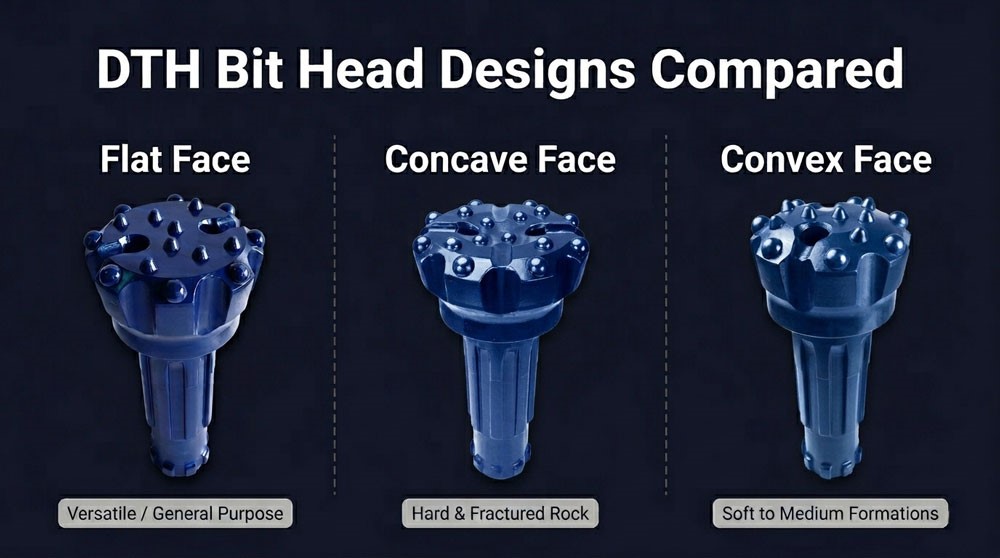
The 5 DTH Bit Face Designs Explained
Flat Face Design — The All-Rounder
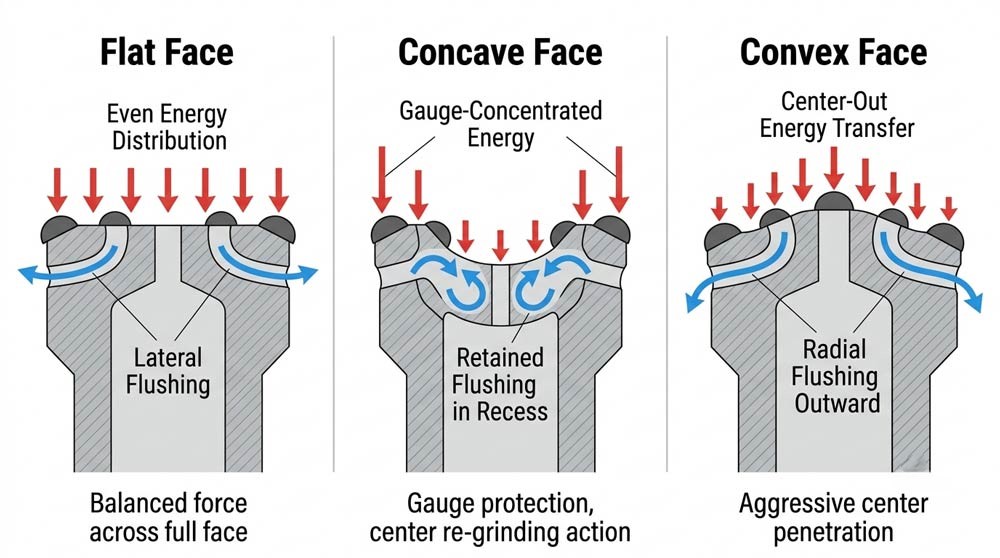
Flat face DTH bits distribute percussion energy evenly across the entire bit face, making them the most versatile design for medium-hardness formations where rock structure is competent and relatively homogeneous. The flat profile ensures that all buttons—both inner and gauge rows—engage the rock surface simultaneously during each hammer strike.
Button layout on flat face designs typically follows a uniform grid pattern with equal spacing between rows. This even distribution prevents localized stress concentrations and promotes consistent wear across the entire face. Flushing channels on flat faces run as straight radial grooves from the center toward the gauge, providing predictable and efficient cuttings evacuation.
Flat face designs perform best in limestone, sandstone, and moderately weathered granite with compressive strength in the 80–150 MPa range. Their primary limitation appears in extreme conditions: flat faces lose efficiency in very hard competent rock (where energy concentration matters more than distribution) and in heavily fractured ground (where the bit needs a stabilizing pilot to prevent wander).
Concave Face Design — Fractured and Broken Ground Specialist
The recessed center of a concave face creates a stabilizing pilot that reduces bit wander in fractured, fissured, or unconsolidated formations. This design is the go-to choice when drilling through geologically unstable zones where hole straightness is the primary concern.
The engineering principle is straightforward. The raised gauge ring contacts the rock surface first, centering the bit within the borehole before the recessed inner buttons engage. This two-stage contact sequence prevents the bit from "walking" across fracture planes or deflecting into softer interlayers. In heavily broken ground, a flat face would skip across fracture surfaces, producing an oversized, irregular hole.
Concave faces also offer a flushing advantage. The bowl-shaped profile naturally channels cuttings toward the center of the bit face, where the primary flushing ports are located. This geometry improves cuttings evacuation in sticky or wet formations—particularly clay-interlayered overburden zones common in water well drilling applications.
Rock suitability for concave designs includes heavily fractured zones, weathered overburden, fault zones, and clay-interlayered formations—generally formations below 80 MPa compressive strength (the unit measuring a rock's resistance to crushing force) or formations that are structurally unstable regardless of hardness.
Convex Face Design — Hard Rock Penetrator
The domed center of a convex face concentrates percussion energy on a smaller initial contact area, increasing point-load stress for faster penetration in hard, competent rock. Convex designs are the standard specification for fresh granite, gneiss, basalt, and quartzite formations exceeding 150 MPa compressive strength.
The energy transfer principle works like a chisel versus a flat plate. When the pneumatic dth hammer delivers a percussion blow, the convex dome focuses that energy onto the apex buttons first. Energy-per-unit-area at the dome center is substantially higher than on a flat face of the same diameter, effectively chiseling into dense crystalline rock before the outer button rows engage. This staged energy delivery breaks hard rock more efficiently than distributing the same force across the entire face simultaneously.
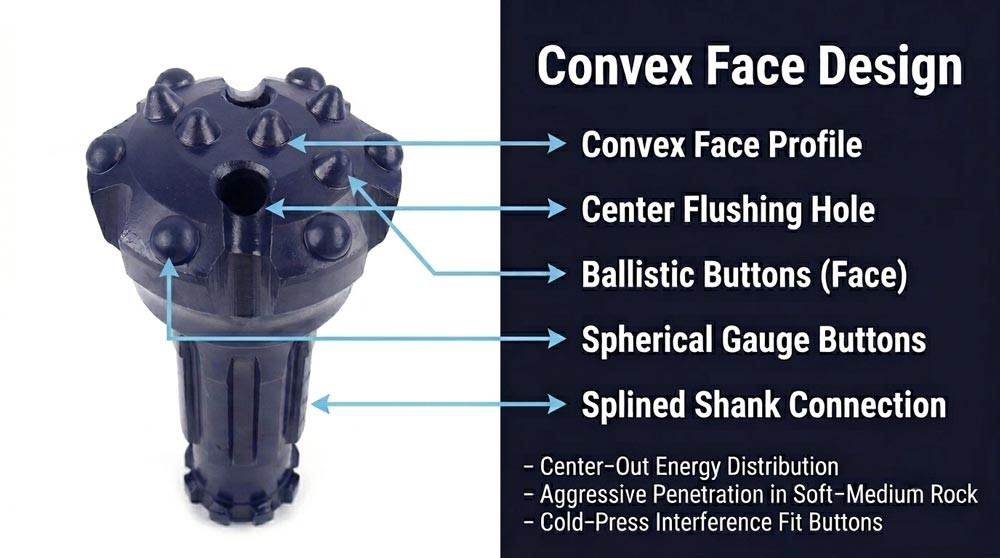
Convex faces typically pair with spherical buttons on the inner rows. Spherical buttons offer maximum impact resistance—critical on convex faces where point-load forces are highest. Using dome or ballistic buttons on a convex face in hard rock risks button fracture due to insufficient impact strength at the concentrated stress point.
One trade-off: convex faces require slightly higher air volume for effective flushing because cuttings must travel "uphill" from the dome apex toward the gauge perimeter before reaching the flushing channels. Operators should verify that their compressor output meets or exceeds the hammer's rated air consumption when running convex bits in deep holes.
Convex-Concave (Hybrid) and Drop Center Designs — Specialized Solutions
Convex-concave designs combine the hard-rock penetration capability of a convex center with the stabilizing gauge ring of a concave perimeter, while drop center designs create a deeper stepped profile for specific overburden applications. These two designs serve niche geological scenarios that the three primary face types cannot address optimally.
The convex-concave hybrid excels in transitional geology where hard and fractured zones alternate within the same borehole. Mining bench drilling that crosses geological boundaries—for example, transitioning from competent granite into a fractured shear zone and back—benefits from this dual-action profile. The convex center maintains aggressive penetration in hard sections, while the concave perimeter stabilizes the bit when it enters broken ground.
Drop center designs feature a recessed center section that is deeper than a standard concave face. This aggressive recess creates enhanced cuttings channeling, making drop center bits effective in water well drilling through sticky clay overburden before reaching bedrock. The deep center cavity acts as a collection chamber that prevents cuttings from packing around the inner buttons.
Both designs are less commonly specified than flat, concave, or convex. They are typically reserved for experienced operators who have well-characterized geology from pilot holes or geological surveys. Specifying these designs without sufficient formation data risks suboptimal performance compared to a correctly chosen standard face type.
Face Design Selection by Rock Formation — Quick-Reference Chart
Rock Hardness Classification and Matching Face Design Table
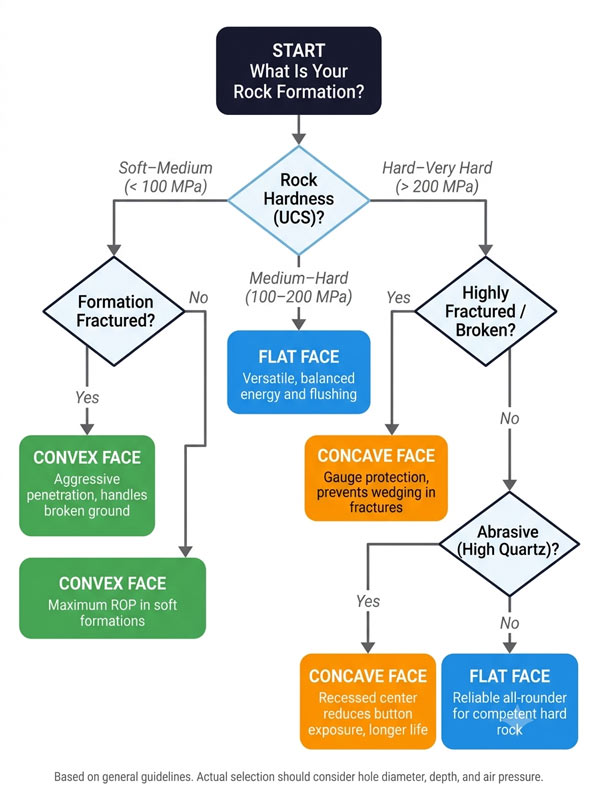
The following selection matrix maps rock classifications to recommended face designs and button shape pairings. MSD developed this framework from field-validated drilling data collected across 40+ countries and diverse geological conditions. Use compressive strength (MPa) as your primary selection variable, then adjust for fracture density and application type.
| Rock Classification | Compressive Strength | Recommended Face Design | Recommended Button Shape | Typical Applications |
|---|---|---|---|---|
| Soft / Fractured | <80 MPa | Concave | Dome / Ballistic | Overburden drilling, weathered zones, water wells in clay |
| Medium | 80–150 MPa | Flat | Dome / Spherical | Limestone, sandstone, general quarrying |
| Hard / Competent | 150–250 MPa | Convex | Spherical | Granite, gneiss, hard rock mining |
| Very Hard / Abrasive | >250 MPa | Convex | Spherical (larger diameter) | Quartzite, fresh basalt, taconite |
| Mixed / Transitional | Variable | Convex-Concave | Spherical + Dome mix | Bench drilling crossing geological boundaries |
Rule of Thumb: When in doubt between flat and convex, send a rock sample for compressive strength testing. If the lab result exceeds 150 MPa, always specify convex. Below 80 MPa with visible fractures, always specify concave. The middle zone (80–150 MPa) is where the flat face earns its reputation as the all-rounder.
MSD manufactures down the hole bit in diameters from 90 mm to 1,000 mm, with all five face designs available across the full size range. MSD DTH bits are compatible with all major hammer series: DHD, MISSION, QL, SD, COP, and NUMA.
How Button Shape and Layout Interact with Face Design
Spherical, Dome, and Ballistic Buttons — When Each Pairs with Which Face
Button shape selection is the second critical variable after face design. Spherical buttons pair with convex faces for hard rock, dome buttons pair with flat and concave faces for medium-soft formations, and ballistic buttons are reserved for concave faces in soft, abrasive ground where maximum penetration rate is the priority.
The engineering logic follows impact mechanics. Spherical buttons have the highest resistance to impact fracture because their geometry distributes compressive stress evenly across the button body. On a convex face—where percussion energy concentrates at the dome apex—spherical buttons absorb these peak forces without cracking. Dome buttons offer faster penetration in softer rock because their slightly flattened profile creates a wider crushing zone per strike, but dome buttons lack the impact resistance needed for convex faces in hard formations. Ballistic buttons, with their pointed parabolic profile, achieve the highest penetration rate in soft ground but wear rapidly in abrasive conditions and fracture under high-impact loads.
MSD secures all buttons using cold-press interference fit (a mechanical retention method where the button is pressed into a slightly undersized socket under high force, creating a permanent friction lock). This process achieves a sub-0.05% button loss rate regardless of face design. Cold-press retention matters most on convex faces in hard rock, where each hammer blow generates peak impact forces on the apex buttons. Thermal retention methods risk loosening under these repeated shock loads—mechanical interference fit does not.
Gauge Button Configuration and Face Design
Gauge buttons protect the bit's outer diameter and maintain the borehole at its specified size throughout the bit's service life. Every face design uses gauge buttons, but their functional role changes depending on the face geometry.
On concave faces, the raised gauge row serves as the primary rock-contact surface and the stabilizing ring that centers the bit. These gauge buttons wear faster than inner buttons because they absorb the initial impact on every stroke. Operators drilling fractured ground with concave bits should monitor gauge button condition more frequently than inner button wear.
On convex faces, the gauge buttons play a secondary stabilizing role because the domed center contacts rock first. However, as the convex dome wears down over the bit's service life, the gauge buttons progressively take on more load. MSD engineers gauge button sizing and spacing on convex designs to account for this progressive load transfer, ensuring the bit maintains its specified hole diameter even as the dome profile flattens with wear.
On flat faces, gauge and inner buttons share the load approximately equally from the first stroke to the last. This balanced wear pattern is one reason flat faces deliver the most predictable service life in medium-hardness formations.
Face Design Selection in Real Drilling Projects
Case Study — Hard Rock Quarry: Convex Face vs. Flat Face Performance
Field Data: "Granite Quarry Operation, Russia"
Formation: fresh granite, compressive strength 180–220 MPa. Hole diameter: 115 mm. Hammer: MSD QL60 series at 18 bar operating pressure. The operator initially used flat face DTH bits based on previous experience in softer limestone. Penetration rate averaged 0.4 m/min with bit life reaching approximately 280 meters per bit. After switching to MSD convex face bits with spherical buttons on MSD's recommendation, penetration rate increased to 0.55 m/min—a 37% improvement—and bit life extended to 340 meters per bit. The convex face's concentrated energy delivery proved decisive in this high-compressive-strength formation.
This case illustrates a common field scenario: operators accustomed to flat face bits in one quarry carry that specification to a harder formation without re-evaluating face design. The compressive strength data (180–220 MPa) clearly placed this granite above the 150 MPa threshold where convex faces outperform flat designs.
Case Study — Water Well Drilling: Concave Face in Overburden
Field Data: "Water Well Project, East Africa"
Formation: 0–35 m depth through weathered laterite and clay overburden (<60 MPa, heavily fractured), transitioning to competent gneiss bedrock at 35–80 m depth (160–200 MPa). Hole diameter: 152 mm. The drilling contractor used MSD concave face bits with dome buttons through the overburden section, achieving straight, gauge-holding holes with zero deviation incidents across 12 boreholes. At the bedrock transition, the operator switched to MSD convex face bits with spherical buttons for the remaining depth. Total project completion time was reduced by approximately 20% compared to the contractor's previous water well drilling projects where flat face bits were used throughout.
This two-stage face design approach—concave through overburden, convex into bedrock—is standard practice recommended by MSD engineers for rock hammer dth operating in layered geological profiles. Carrying a single face design through dramatically different formations always compromises performance in at least one zone.
Common Face Design Selection Mistakes and How to Avoid Them
Mistake 1 — Using Flat Face in Highly Fractured Ground
Symptom: The bit wanders across fracture planes, producing an oversized and irregular borehole. Gauge buttons wear prematurely on one side due to asymmetric contact. Hole deviation exceeds acceptable tolerances.
Root Cause: Flat faces engage all buttons simultaneously, providing no centering pilot in broken ground. The bit follows the path of least resistance along fracture surfaces rather than drilling a straight hole.
Fix: Switch to a concave face dth button bit. The raised gauge ring and recessed center create the stabilizing pilot needed to hold the borehole on-line through fractured zones.
Mistake 2 — Using Concave Face in Hard Competent Rock
Symptom: Penetration rate drops significantly below expected values. Inner buttons in the recessed center section show excessive wear while gauge buttons remain relatively fresh. Overall bit life is 30–40% shorter than expected.
Root Cause: The concave recess distributes percussion energy away from the center, reducing point-load stress on hard rock. The inner buttons work harder to compensate, wearing prematurely. The stabilizing function of the concave profile provides no benefit in competent rock that does not fracture or shift.
Fix: Switch to a convex face with spherical buttons. Concentrate percussion energy at the dome apex where it breaks hard rock most efficiently.
Mistake 3 — Ignoring Button Shape When Changing Face Design
Symptom: After switching from flat face to convex face, the operator experiences button breakage within the first 50–100 meters. Broken button fragments damage the bit face and flushing channels.
Root Cause: The operator kept dome buttons when switching to a convex face for hard rock. Dome buttons lack the impact resistance to survive the concentrated point-load forces at the convex apex. Spherical buttons are required for this application.
Fix: Always re-evaluate button shape when changing face design. Refer to the selection chart in the section above. Face design and button shape are paired variables—changing one without adjusting the other is an engineering mismatch.
Rule of Thumb: Never change face design without simultaneously reviewing button shape, button size, and air pressure settings. These four variables form a system — adjusting one in isolation guarantees suboptimal results.
Frequently Asked Questions
Q: What are the different types of DTH drill bit face designs?
A: Five primary face designs exist for DTH bits: flat, concave, convex, convex-concave, and drop center. Flat is the all-purpose design for medium-hardness rock. Concave stabilizes drilling in fractured ground. Convex concentrates energy for hard rock penetration. Convex-concave handles transitional geology, and drop center serves sticky overburden formations in water well applications.
Q: How do I know which DTH bit head design to use for my rock?
A: Test your rock's compressive strength. Below 80 MPa with visible fractures, specify concave. Between 80–150 MPa in competent formations, specify flat. Above 150 MPa, specify convex. If geology varies significantly across the borehole depth, plan to change face designs at the geological transition point rather than compromising with a single design throughout.
Q: Does face design affect DTH drilling flushing efficiency?
A: Yes. Concave faces channel cuttings toward the center where primary flushing ports are located, improving evacuation in wet or sticky formations. Flat faces use straight radial channels for consistent flow. Convex faces require higher air volume because cuttings must travel from the dome apex outward to reach flushing channels—verify your compressor capacity meets the hammer's rated air consumption.
Q: Can I use the same face design for the entire borehole depth?
A: Not always. Geology changes with depth. In water well drilling, MSD recommends starting with concave face bits through overburden and switching to convex or flat face bits when reaching bedrock. Carrying a single face design through dramatically different formations always compromises performance in at least one geological zone.
Q: What face design does MSD recommend for general-purpose quarrying?
A: For limestone and medium-hardness quarrying between 80–150 MPa, MSD recommends flat face dth drilling bit with dome buttons. For harder quarry stone like granite exceeding 150 MPa, MSD recommends convex face with spherical buttons. MSD manufactures both configurations in diameters from 90–1,000 mm, compatible with all major hammer series.
Q: How does MSD's cold-press interference fit improve face design performance?
A: Cold-press interference fit mechanically locks each button into a precision-machined socket with sub-0.05% button loss rate. Because buttons remain securely seated throughout the bit's service life, the face design geometry stays intact—maintaining the designed energy distribution pattern and flushing channel dimensions. Button loss on any face design disrupts the engineered percussion pattern and accelerates wear on remaining buttons.
Technical content reviewed by MSD Engineering Team. | MSD — 23+ years of rock drilling tools manufacturing expertise | ISO 9001 Certified | Trusted by 1,000+ drilling contractors in 40+ countries