

DTH vs RC Drilling: Key Differences & How to Choose
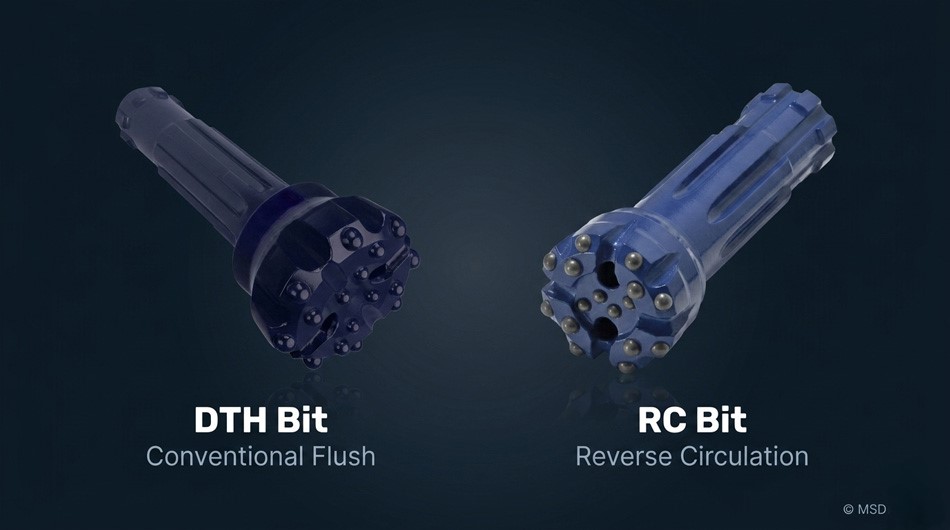
DTH (Down-The-Hole) drilling and RC (Reverse Circulation) drilling are both percussive drilling methods powered by compressed air — but they solve fundamentally different problems. DTH drilling is engineered for production efficiency: making holes fast. RC drilling is engineered for sample integrity: recovering uncontaminated rock cuttings from precise depth intervals.
The confusion between these two methods is common because they share similar hardware — pneumatic hammers, tungsten carbide button bits, and drill strings. The critical difference lies in how cuttings travel from the bit face back to the surface. That single mechanical distinction determines which method suits your project, what tooling you need, and what results you can expect.
This guide breaks down the engineering principles, compares the key technical parameters, and provides a practical decision framework based on MSD's 23+ years of manufacturing and field support experience across 40+ countries.
What Is DTH Drilling?
DTH drilling is a percussive drilling method where the pneumatic hammer operates at the bottom of the hole, directly behind the drill bit, delivering impact energy to the rock face with minimal energy loss. Unlike top hammer drilling — where the hammer sits at the surface and transmits energy through the drill string — DTH drilling maintains a consistent penetration rate regardless of hole depth because the hammer-to-rock distance never changes.
How a DTH Hammer and Bit Break Rock
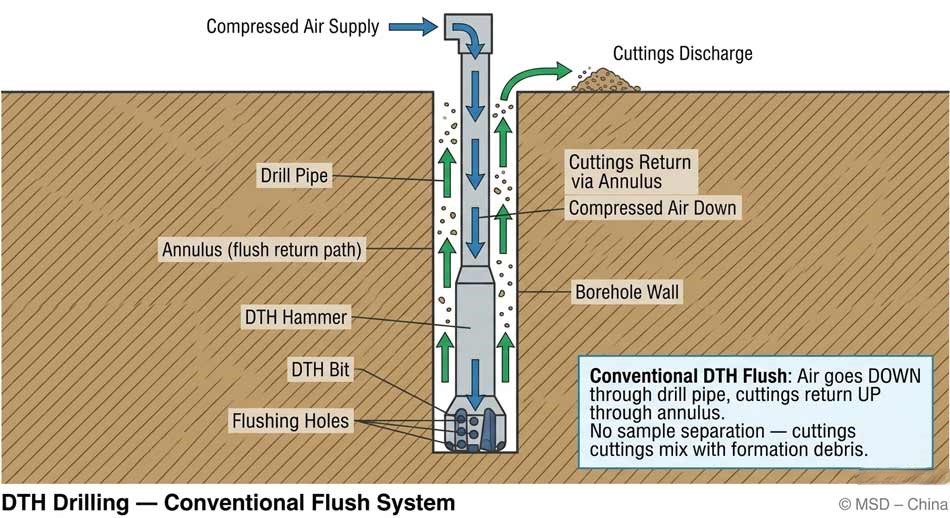
Compressed air travels down the drill string, enters the DTH hammer, and drives an internal piston in a rapid reciprocating cycle. The piston strikes the rear of the DTH bit at frequencies typically between 1,400–2,000 blows per minute, depending on hammer size and operating pressure. Each impact transfers kinetic energy directly into the rock face through the tungsten carbide buttons on the bit.
The drill rig simultaneously rotates the entire string at 15–30 RPM, indexing the bit to ensure fresh rock is exposed with every strike. Exhaust air exits through flushing holes in the bit face, pushing crushed rock cuttings upward through the annulus — the open space between the drill pipe and the borehole wall. This is called conventional flush or direct circulation.
MSD is manufactures hole hammer across all major industry series — DHD, MISSION, QL, SD, COP, and NUMA — covering operating pressures from 8 to 30 bar and hole diameters from 90 to 1,000 mm. As an ISO 9001 certified manufacturer with over 23 years of export experience, MSD supplies complete DTH tool strings to 1,000+ drilling contractors worldwide.
What Is RC Drilling?
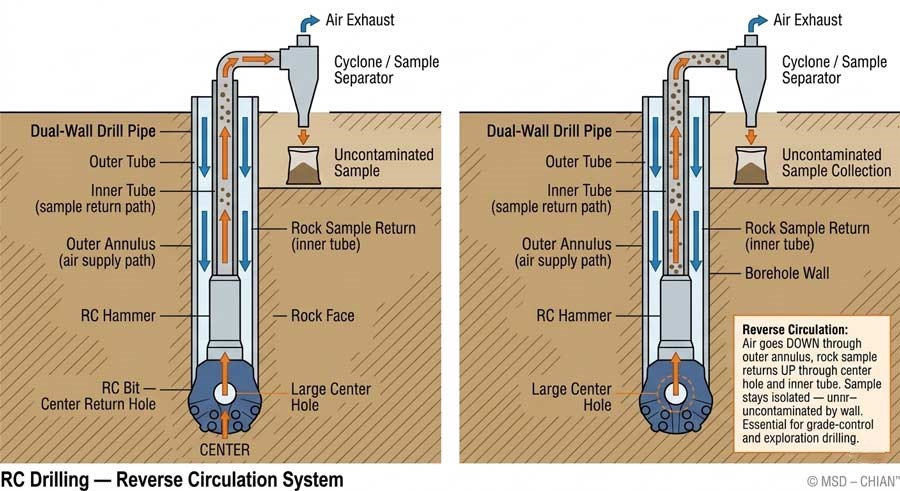
Reverse Circulation (RC) drilling is a percussive drilling method specifically designed to recover uncontaminated rock samples from precise depth intervals by forcing cuttings upward through a sealed inner tube inside a dual-wall drill string, rather than through the open annulus.
The Reverse Circulation Principle — How Samples Travel Up the Inner Tube
The mechanical principle is straightforward but critical. Compressed air is injected into the annular space between the outer tube and the inner tube of the dual-wall drill string. This air travels downward through the annulus, powers the RC hammer at the bottom of the hole, and creates a pressure differential that forces cuttings into a large center return opening in the bit face.
Once inside the center opening, cuttings travel upward through the sealed inner tube — completely isolated from the borehole wall and from cuttings generated at other depth intervals. At the surface, the sample stream enters a cyclone separator and splitter, where each 1-meter interval is collected, logged, and bagged for laboratory assay.
This sealed return path is the entire reason RC drilling exists. Because the cuttings never contact the borehole wall during their return to surface, the sample is geologically representative of the exact formation being drilled at that moment. In mineral exploration, this distinction is the difference between a reliable resource estimate and a flawed one.
The key hardware differences from conventional DTH drilling include: dual-wall drill pipe (significantly heavier and more expensive than single-wall pipe), an RC-specific hammer with an internal sample passage, and an RC bit with a large center return hole replacing the standard flushing hole pattern.
DTH vs RC Drilling — Key Technical Differences Compared
The fundamental difference between DTH and RC drilling is not the hammer, the bit material, or the air pressure — it is the direction cuttings travel and the purity of the sample that reaches the surface. Every other technical distinction flows from this single design choice.
Comparison Table — DTH vs RC Drilling at a Glance
| Parameter | Conventional DTH Drilling | RC Drilling |
|---|---|---|
| Primary Purpose | Production drilling (blast holes, water wells, construction piling) | Exploration drilling (mineral sampling, grade control) |
| Cuttings Return Path | Up the annulus between pipe and borehole wall (conventional flush) | Up the sealed inner tube of dual-wall pipe (reverse circulation) |
| Sample Quality | Mixed cuttings from multiple depth intervals — unsuitable for assay | Uncontaminated interval samples — assay-grade quality |
| Drill String Type | Single-wall drill pipe | Dual-wall drill pipe |
| Bit Design | Standard face with peripheral and center flushing holes | Large center return opening for sample passage |
| Typical Hole Diameter | 90–1,000 mm (extremely wide range) | 127–178 mm (5"–7") most common for exploration |
| Typical Depth Range | Up to 60–80 m common; deeper with staging | Up to 500 m+ in deep exploration programs |
| Air Consumption | Moderate — matched to hole diameter and hammer class | Higher — must maintain velocity in both annulus and inner tube |
| Penetration Rate (Hard Rock) | Higher — optimized for production speed | Moderate — optimized for sample integrity, not speed |
| Equipment Complexity | Lower — standard hammer + bit + single-wall pipe | Higher — dual-wall pipe, RC hammer, cyclone, splitter |
| Relative Operating Cost | Lower per meter drilled | Higher per meter drilled (dual-wall consumables, specialized tooling) |
The Air Flow Difference — Why It Changes Everything
This is the engineering principle that most comparison guides fail to explain clearly. In conventional DTH drilling, compressed air exits through the bit face flushing holes and pushes cuttings upward through the open annulus. As these cuttings travel hundreds of meters to the surface, they mix with loose material from the borehole wall, contaminating the sample with rock from formations above the current drilling depth. For production drilling — where the goal is simply to make a hole — this contamination is irrelevant.
In RC drilling, the air path is reversed at the bit face. Compressed air enters the annulus from the surface, travels down between the outer and inner tubes, and powers the hammer. The pressure differential at the bit face forces cuttings inward through the center return opening and up the sealed inner tube. The cuttings never touch the borehole wall. Each meter of sample represents exactly the formation at that depth — nothing more, nothing less.
Rule of Thumb: If your project requires knowing exactly what rock formation exists at a specific depth — mineral exploration, grade control, geotechnical investigation — RC drilling is non-negotiable. If your goal is simply to make a hole efficiently — blasting, water wells, foundation piling — conventional DTH drilling is faster and more economical.
When to Use Conventional DTH Drilling
Conventional DTH drilling dominates every application where the primary objective is hole-making efficiency rather than sample recovery. DTH drilling delivers the fastest penetration rates in medium to hard rock formations, maintains consistent performance regardless of hole depth, and operates with simpler, lower-cost equipment than RC systems.
Production Drilling — Blast Holes, Construction, and Water Wells
DTH drilling is the industry standard for production blast hole drilling in mining and quarrying operations, where thousands of holes must be drilled to precise depths on tight schedules. The method is equally dominant in water well drilling, where hole diameters of 150–300 mm are common and sample quality is not a concern.
Additional production applications include: foundation piling for construction and infrastructure projects, geothermal borehole drilling, anchor hole drilling for slope stabilization, and dewatering wells in mining operations. In all these applications, the contractor needs a clean, straight hole drilled to specification — not a geological sample.
Field Data: "Blast Hole Drilling Efficiency — Iron Ore Mining, Russia"
MSD QL60 DTH hammers paired with 165 mm flat-face DTH bits achieved 340 meters per bit in Russian iron ore mining operations, drilling through formations with hardness ratings of f=12–16. Operating air pressure was maintained at 18–20 bar with consistent penetration rates throughout the bit's service life.
Why DTH Tooling Quality Matters for Production Efficiency
In high-volume production drilling, the cost-per-meter equation is dominated by two factors: penetration rate and bit service life. A dth drilling bit that loses a single tungsten carbide button mid-hole forces the operator to trip the entire string, replace the bit, and re-drill — consuming hours of rig time that directly impacts project economics.
MSD's cold-press interference fit process locks each button into the bit body with precisely controlled radial compression. This mechanical retention method — not brazing, not welding — ensures buttons remain seated even under the extreme percussive impact of high-pressure DTH hammers operating at 25–30 bar. Across MSD's full production range, button loss rates remain below 0.05%, verified through field tracking across thousands of bits deployed globally.
Button shape selection further impacts production efficiency. Spherical buttons deliver maximum durability in highly abrasive and extremely hard rock formations, while ballistic buttons prioritize penetration rate in softer to medium-hard formations. MSD engineers provide free technical consultation to help contractors match button geometry to their specific geological conditions.
When to Use RC Drilling
RC drilling is the standard method for mineral exploration programs where uncontaminated rock samples determine resource estimates, mine planning decisions, and ultimately the economic viability of a deposit. The sealed inner-tube return system ensures that each 1-meter sample interval is geologically representative — a requirement that conventional DTH drilling fundamentally cannot meet.
Exploration Drilling — Mineral Sampling and Grade Control
RC drilling dominates three primary application categories. First, greenfield exploration: drilling programs on new prospects where geologists need reliable assay data to define mineralization zones. Second, brownfield infill drilling: adding drill holes within an existing resource to upgrade confidence categories (from Inferred to Indicated to Measured). Third, grade control drilling: short-hole programs in operating mines that guide ore/waste classification decisions on a daily basis.
In each of these applications, the integrity of the sample is more valuable than the speed of drilling. A contaminated sample that overstates or understates grade can lead to millions of dollars in misallocated mining resources.
RC Drilling Limitations
RC drilling carries significant limitations that make it unsuitable for general production work. Dual-wall drill pipe is substantially heavier and more expensive than single-wall pipe — typically 3 to 5 times the cost per meter of pipe. RC-specific hammers and bits require specialized maintenance and are not interchangeable with all standard DTH tooling. Air consumption is higher because the compressor must maintain sufficient velocity in both the annulus (to power the hammer) and the inner tube (to lift cuttings to surface).
Hole diameter options are also restricted. Most RC exploration programs drill at 127–178 mm (5"–7"), which is sufficient for sample recovery but far too small for production blast holes or large-diameter water wells. Maximum achievable depth depends heavily on compressor capacity and the structural integrity of the dual-wall string under sustained percussive load.
DTH and RC Hybrid Systems — Using DTH Hammers in RC Configurations
Not every drilling operation fits neatly into a "pure DTH" or "pure RC" category. For contractors who need occasional sample recovery capability without investing in a complete RC drilling fleet, hybrid systems — sometimes called RC Interchange systems — offer a practical middle ground.
How Conventional DTH Hammers Are Adapted for RC Drilling
The RC Interchange concept allows a conventional pneumatic dth hammer to operate within a reverse circulation drill string through an adapter system. The hammer itself remains largely unchanged. The critical modification is to the DTH bit: a large center return hole replaces the standard center flushing hole pattern, creating a passage for cuttings to enter the inner tube of the dual-wall string.
This adapter system connects the standard DTH hammer to the dual-wall dth pipe, routing exhaust air and cuttings into the inner tube rather than up the annulus. The result is reverse circulation sample recovery using equipment the contractor already owns — at a fraction of the cost of a purpose-built RC hammer system.
When a Hybrid System Makes Sense
RC Interchange systems are best suited for grade control drilling in operating mines, where holes are relatively shallow (typically under 60 m) and the contractor already operates DTH rigs for production blast holes. The same rig and hammer can switch between production mode and sample recovery mode by changing the bit and connecting to dual-wall pipe.
Hybrid systems are not recommended for deep exploration programs exceeding 200 m, where purpose-built RC hammers with optimized internal sample passages deliver superior sample quality and more consistent air flow management. For contractors evaluating whether a hybrid approach fits their operation, MSD engineers provide free technical consultation on tooling configuration and compatibility.
How to Select DTH Tooling for Production Drilling Applications
For contractors who have determined that conventional DTH drilling is the right method for their project, the next decision is selecting the correct hammer and bit combination. Tooling selection directly impacts penetration rate, bit service life, and cost-per-meter — the three metrics that define production drilling economics.
Matching Hammer Series and Bit Diameter to Your Application
DTH tooling selection follows a logical sequence. First, determine the required hole diameter based on your application — blast hole pattern design, well casing size, or foundation pile specification. Second, select the hammer series that matches your available compressor output: low-pressure (LP, 8–12 bar) hammers for smaller rigs, medium-pressure (MP, 12–18 bar) for standard production, and high-pressure (HP, 18–30 bar) for maximum penetration rate in hard rock.
Third, choose the bit face design. Flat face bits provide even energy distribution across the full hole diameter — the most versatile option. Concave face bits concentrate impact energy at the center for faster penetration in softer formations. Convex face bits are designed for highly fractured or broken ground where gauge protection is critical. Drop-center face bits combine center penetration speed with peripheral gauge protection.
Finally, select button shape based on rock hardness. Spherical buttons deliver maximum wear resistance in highly abrasive and extremely hard formations. Ballistic buttons prioritize penetration rate in soft to medium-hard rock. Conical buttons offer a balanced profile for medium-hard formations where both durability and speed matter.
Why Button Retention Is Critical in High-Volume Production Drilling
In production drilling programs where hundreds or thousands of holes are drilled per project phase, button loss is not a minor inconvenience — it is a direct operational cost multiplier. A lost button creates an uneven cutting pattern, accelerates wear on adjacent buttons, and typically forces premature bit retirement. The resulting trip time, replacement cost, and schedule delay far exceed the cost of the bit itself.
MSD's cold-press interference fit process addresses this directly. Each tungsten carbide button is pressed into a precision-machined socket with controlled radial interference, creating a mechanical lock that withstands the full percussive energy of the hammer without loosening over thousands of impact cycles. Based on our experience supplying 1,000+ drilling contractors in 40+ countries, MSD maintains a documented button loss rate below 0.05% across all bit diameters and shank types.
Rule of Thumb: Always verify button retention method before purchasing DTH bits in bulk for production programs. Cold-press interference fit is the industry-proven standard — avoid suppliers who cannot specify their retention process or who rely on adhesive bonding.
Frequently Asked Questions
Q: What is the difference between rotary and DTH drilling?
A: Rotary drilling uses continuous rotation and weight-on-bit to crush or shear rock, relying on the drill string to transmit downward force. DTH drilling uses percussive impact from a pneumatic hammer positioned at the bottom of the hole, directly behind the bit. DTH drilling typically achieves faster penetration rates in medium to hard rock and maintains consistent performance regardless of hole depth, because the hammer-to-rock distance remains constant.
Q: What is the difference between RC and DD (diamond) drilling?
A: RC (Reverse Circulation) drilling recovers rock chips through a sealed inner tube for assay, providing representative samples from specific depth intervals. Diamond drilling (DD) recovers intact cylindrical core samples using a diamond-impregnated core barrel, providing superior geological structure information including fracture orientation and mineralization texture. DD drilling is typically 25–40% more expensive per meter than RC drilling but delivers higher-quality geological data.
Q: What is DTH in drilling?
A: DTH stands for Down-The-Hole. DTH drilling is a percussive method where the pneumatic hammer sits at the bottom of the hole directly behind the drill bit. Compressed air drives an internal piston that strikes the bit at 1,400–2,000 blows per minute, crushing the rock face. Exhaust air flushes cuttings to the surface through the annulus between the drill pipe and borehole wall.
Q: Can DTH drill bits be used in RC drilling?
A: Standard DTH bits cannot be used directly in RC drilling because they lack the large center return opening required for sample passage through the inner tube. However, RC Interchange systems use modified DTH bits with a center return hole, allowing conventional DTH hammers to operate in an RC configuration. MSD engineers can advise on compatibility between specific hammer series and RC interchange adapters.
Q: What are the three main types of drilling methods?
A: The three main drilling method categories are: (1) Percussive drilling — impact energy breaks rock, including both Top Hammer and DTH methods; (2) Rotary drilling — continuous rotation and weight-on-bit crushes or shears rock; (3) Diamond core drilling — a diamond-tipped barrel cuts an intact cylindrical core sample. RC drilling is a variation of percussive drilling that uses a modified sample return system for exploration applications.
Technical content reviewed by MSD Engineering Team. | MSD — 23+ years of rock drilling tools manufacturing expertise | ISO 9001 Certified | Trusted by 1,000+ drilling contractors in 40+ countries