

QL Drill Bit Applications: Industry Guide to Hole Sizes, Rock Types & Select
What Is a QL Drill Bit and How Does the QL Shank Work?
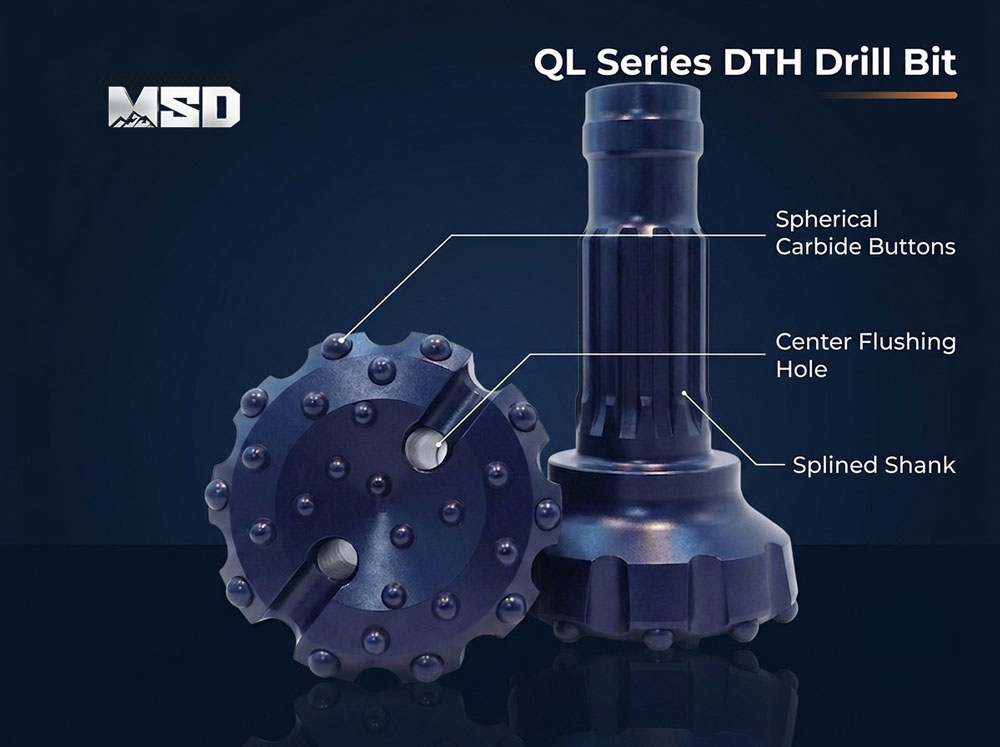
A QL drill bit is a Down-The-Hole (DTH) percussion drill bit that uses a splined shank profile to connect directly to QL-series DTH hammers. DTH drilling is a percussion method where the hammer operates at the bottom of the hole, striking the down the hole bit with each piston cycle. The QL shank transmits both rotational torque and impact energy from the hammer piston to the bit face — without any threaded connection at the bit-to-hammer interface.
MSD, a rock drilling tools manufacturer with 23+ years of export experience, produces QL-series DTH bits across the full diameter range. The QL splined shank features longitudinal drive splines that lock into matching grooves inside the hammer chuck, secured by a retaining ring. This design allows rapid bit changes in the field without specialized tools. The central air passage through the shank delivers compressed air to the flushing channels on the bit face, evacuating cuttings from the hole bottom.
The QL designation originates from the COP/QL hammer platform. Trusted by 1,000+ drilling contractors in 40+ countries, MSD manufactures QL bits compatible with all major QL-series hammer models on the market.
QL Hammer Compatibility and Hole Diameter Ranges
QL-series bits are organized into four hammer size categories, each covering a specific range of hole diameters. The following compatibility table consolidates the complete QL system — a reference that no single competitor page currently provides.
| QL Hammer Series | Hammer Bore Diameter | Compatible Hole Diameter Range | Primary Applications |
|---|---|---|---|
| QL40 | 4″ (100 mm) | 90–115 mm | Anchor drilling, small-diameter construction holes |
| QL50 | 5″ (127 mm) | 127–165 mm | Quarry bench drilling, medium mining blastholes |
| QL60 | 6″ (152 mm) | 152–203 mm | Production blastholes, deep water wells |
| QL80 | 8″ (203 mm) | 195–254 mm | Large-diameter water wells, open-pit mining |
Selecting the correct QL hammer series determines the available bit diameter range. The drill string connecting the hammer to the rig consists of a DTH drill pipe matched to the hammer's thread specification. DTH hammers in the QL family operate at working pressures between 10 and 25 bar, depending on the specific hammer model and whether it is a standard-pressure or high-pressure variant.
Primary Applications of QL Drill Bits by Industry
QL drill bits serve four primary industries: mining, quarrying, water well drilling, and construction. Each application demands specific bit diameters, face designs, and button configurations matched to the dominant rock type and required hole geometry. The sections below map each industry to the appropriate QL hammer series and bit specifications.
Mining — Blasthole Drilling and Production Drilling
QL50 and QL60 bits handle the majority of mining drilling blasthole requirements in open-pit and underground operations. Production blastholes in mining typically require hole diameters between 127 mm and 203 mm, drilled into hard, abrasive formations such as granite, gneiss, and iron ore.
For open-pit mining, QL60 bits in the 152–178 mm range are the standard choice for bench blasting patterns. MSD's QL60 bits feature concave or drop-center face designs with spherical tungsten carbide buttons arranged in a gauge-front-inner three-row pattern. This configuration maximizes gauge protection in highly abrasive formations where premature gauge wear would produce undersize holes — compromising blast fragmentation and increasing secondary breaking costs.
Field Data: "Iron Ore Mining, Russia"
MSD QL60 DTH bits achieved 340 meters per bit in a Russian iron ore mining operation drilling through formations with rock hardness of f=16–18. The bits maintained full gauge diameter throughout the drilling cycle, with zero button loss recorded across the production run. Compared to the previously used competitor bits, MSD QL60 bits delivered a 24% higher penetration rate at 18 bar operating pressure.
Underground mining operations in narrower stopes may use QL50 bits in the 127–140 mm range, where the smaller hammer footprint suits confined working spaces.
Quarrying — Bench Drilling and Dimensional Stone
QL40 and QL50 bits are the primary tools for quarrying operations, where bench drilling demands precise hole straightness and clean borehole walls. Quarry blastholes typically range from 90 mm to 152 mm in diameter, drilled into limestone, marble, basalt, or sandstone formations.
Hole straightness is critical in quarrying because deviation causes uneven blast energy distribution, resulting in poor fragmentation or damage to the remaining bench face. QL-series bits with flat or shallow concave face designs produce straighter holes in medium-hardness quarry stone. The symmetrical button layout on MSD's QL40 and QL50 quarry bits distributes impact energy evenly across the hole bottom, reducing the lateral forces that cause bit walk.
For dimensional stone quarrying — where the goal is extracting intact blocks rather than fragmenting rock — smaller QL40 bits (90–105 mm) drill closely spaced line-drilling patterns. MSD configures these bits with dome buttons to balance penetration rate against wall damage.
Water Well and Geothermal Borehole Drilling
QL60 and QL80 bits drill the larger-diameter boreholes required for water well drilling in hard rock aquifers, typically producing holes between 152 mm and 254 mm in diameter. Water well projects in crystalline basement rock — granite, gneiss, and metamorphic formations common across Africa, South America, and South Asia — demand DTH bits capable of sustained drilling to depths of 100–300 meters.
QL80 bits in the 216–254 mm range are specified when the borehole must accommodate larger-diameter casing strings or submersible pump installations. These larger bits require high-volume compressors delivering 17–25 m³/min of air at 12–18 bar to maintain adequate flushing velocity at depth.
In overburden zones above the bedrock aquifer — loose soil, gravel, or weathered rock — drillers often deploy an eccentric overburden drilling system to advance casing simultaneously with the pilot bit. Once the casing is seated in competent rock, the QL DTH bit continues drilling the open-hole section below.
For geothermal borehole drilling, QL60 bits in the 165–203 mm range handle the medium-depth requirements of ground-source heat exchange systems, where boreholes typically reach 80–200 meters in sedimentary and crystalline formations.
Construction — Foundation Piling and Anchoring
QL40 bits serve construction applications requiring small-diameter anchor holes and micropile installations in rock. Foundation piling projects in urban environments use QL50 and QL60 bits for larger-diameter socketed piles drilled into bedrock.
DTH drilling offers distinct advantages in construction over rotary or top hammer methods. The percussion energy is delivered at the hole bottom, producing minimal surface vibration — a critical requirement when drilling near existing structures or underground utilities. QL40 bits drilling 90–115 mm anchor holes generate substantially less ground vibration than equivalent rotary percussive systems.
For larger foundation elements, QL60 bits produce 165–203 mm pilot holes that are subsequently reamed or filled with reinforced concrete. MSD configures construction-grade QL bits with convex face designs for the fractured and mixed ground conditions typical of urban geology, where the bit must transition between soil, fill material, weathered rock, and competent bedrock within a single borehole. Where unstable overburden is present above the rock socket, casing systems prevent borehole collapse during the drilling operation.
Matching QL Bit Face Designs to Rock Conditions
QL DTH bit face design determines how impact energy is distributed across the hole bottom, directly controlling penetration rate, hole straightness, and cuttings evacuation efficiency. Four primary face designs cover the full range of geological conditions encountered in QL bit applications.
Flat Face — Soft to Medium Rock
Flat-face QL bits distribute impact energy uniformly across the entire hole bottom, producing the highest penetration rate in soft to medium-hard formations. Suitable formations include sandstone (UCS 20–80 MPa), shale, weathered limestone, and clay-bound sedimentary rock. Flat-face designs are standard for shallow water wells in sedimentary basins and soft overburden drilling.
The flat profile provides excellent hole straightness because all buttons contact the rock surface simultaneously. However, flat-face bits wear faster in hard abrasive rock because the gauge buttons receive the same impact loading as the center buttons, with no geometric protection.
Concave and Drop-Center Face — Hard Abrasive Rock
Concave and drop-center face designs concentrate initial impact energy on the center buttons, creating a pilot indentation that guides the bit and improves hole straightness in hard formations. Concave QL bits are the standard choice for granite (UCS 150–300 MPa), quartzite, gneiss, and iron ore formations.
MSD's concave-face QL60 bits feature 18–20 tungsten carbide buttons arranged in three concentric rows. The recessed center creates a natural cuttings channel that directs fragments toward the flushing holes, improving evacuation efficiency at depth. Drop-center designs provide a deeper central recess than standard concave profiles, offering enhanced guidance in formations prone to causing bit deviation.
Convex Face — Fractured and Broken Ground
Convex-face QL bits feature a domed profile that contacts the rock at the center first, preventing the bit from catching on fracture edges in broken ground. Suitable conditions include heavily fractured zones, fault intersections, and mixed geology where the bit transitions between intact rock and rubble.
The convex profile sacrifices some penetration rate compared to flat-face designs in uniform rock. MSD recommends convex-face QL bits specifically for construction projects in urban geology and water well drilling through weathered overburden-to-bedrock transitions.
Button Configurations for QL Bit Applications
Button shape is the single most important variable controlling QL bit service life and penetration rate in a given formation. Tungsten carbide buttons on QL DTH bits are manufactured in three primary geometries, each engineered for specific rock properties.
Button Shapes and Their Drilling Characteristics
Spherical (hemispherical) buttons provide the maximum impact resistance and longest service life in highly abrasive, extremely hard rock. The rounded profile distributes compressive stress evenly across the button surface, resisting chipping and spalling in formations above 200 MPa UCS. Spherical buttons are the default choice for mining blastholes in granite and iron ore.
Ballistic (semi-ballistic) buttons feature a pointed, parabolic profile that concentrates force on a smaller contact area, producing aggressive rock fracture and faster penetration in soft to medium-hard formations. Ballistic buttons achieve typically 15–25% higher penetration rates than spherical buttons in sandstone and limestone. However, ballistic buttons wear faster and are prone to fracture in formations above 180 MPa UCS.
Dome buttons offer a balanced compromise between the durability of spherical buttons and the penetration efficiency of ballistic buttons. Dome-profile buttons suit mixed formations where the bit encounters alternating layers of hard and soft rock within the same borehole.
MSD's Cold-Press Interference Fit Process
MSD secures tungsten carbide buttons into QL bit bodies using a cold-press interference fit process — not brazing, welding, or soldering. Cold pressing creates a mechanical interference between the button cylindrical shank and the precision-machined socket in the bit body. The socket diameter is machined 0.02–0.04 mm smaller than the button shank, creating a compressive grip that locks the button permanently in place under extreme impact loading.
MSD's cold-press process achieves a sub-0.05% button loss rate across all QL bit production — meaning fewer than 1 button in 2,000 is lost during drilling operations. Button loss is a critical failure mode: a single lost gauge button causes asymmetric wear, producing an undersize hole that can trap casing strings or require costly redrilling. MSD's ISO 9001 certified manufacturing process controls socket tolerances to within ±0.01 mm, ensuring consistent interference fit across every button position.
Rule of Thumb: For every 50 MPa increase in rock compressive strength above 150 MPa, switch from ballistic buttons to spherical buttons to prevent premature button fracture.
QL vs Other DTH Shank Types — When to Choose QL
QL is one of six major DTH shank families used globally. Each shank type is designed for a specific hammer platform and is not interchangeable — a QL bit cannot be installed on a DHD hammer, and vice versa. The choice of shank type is determined by the hammer already in the drill string or by the system specification for a new project.
Shank Type Comparison Table
| Shank Type | Common Hammer Platforms | Hole Diameter Range | Typical Applications | Working Pressure Range |
|---|---|---|---|---|
| QL / COP | Copco, Atlas Copco legacy | 90–254 mm | Mining, quarrying, water wells, construction | 10–25 bar |
| DHD | DHD-series (various manufacturers) | 90–254 mm | Mining, quarrying, water wells | 10–25 bar |
| MISSION | Mission-series | 105–311 mm | Large-diameter water wells, mining | 7–17 bar |
| SD | SD-series | 90–254 mm | General-purpose, mining, construction | 10–25 bar |
| NUMA | Numa-series | 105–311 mm | Large-diameter mining, water wells | 12–25 bar |
MSD manufactures DTH drill bits for all six shank families, providing drilling contractors with a single-source solution regardless of the hammer platform in their fleet.
Decision Logic — Choosing the Right Shank Family
If a QL-series hammer is already installed on the drill rig, only QL-shank bits are compatible. There is no adapter or conversion sleeve that allows cross-platform use. The spline geometry, retaining ring groove, and air passage dimensions are unique to each shank family.
When specifying a new DTH system from scratch, the shank family selection depends on three factors: required hole diameter range, available compressor capacity (air volume and pressure), and regional parts availability. QL-series hammers and bits have the broadest global distribution network due to the legacy Atlas Copco platform, making replacement parts and service support readily available in most markets.
For hole diameters above 254 mm, MISSION and NUMA shank families offer larger-bore hammer options that QL does not cover. For standard 90–254 mm applications, QL, DHD, and SD shank families offer comparable performance — the choice is typically driven by existing equipment compatibility rather than inherent technical superiority of one shank over another.
How to Select the Right QL Drill Bit for Your Project
Selecting the correct QL DTH bit requires matching four project parameters to the available bit configurations. Following this systematic process eliminates trial-and-error and ensures optimal drilling performance from the first meter.
4-Step QL Bit Selection Process
Step 1 — Determine the required hole diameter. The target hole size dictates the QL hammer series. A 165 mm blasthole requires a QL60 hammer and a QL60-165 bit. A 105 mm anchor hole requires a QL40 hammer and a QL40-105 bit. Refer to the compatibility table in the section above.
Step 2 — Identify the primary rock type and hardness. Rock compressive strength (UCS) determines the face design. Formations below 100 MPa suit flat-face bits. Formations between 100–200 MPa suit concave or drop-center designs. Fractured or mixed ground suits convex-face bits.
Step 3 — Assess formation abrasiveness. Abrasiveness determines button shape. Highly abrasive formations (quartz content above 60%) require spherical buttons for maximum service life. Low-abrasion formations allow ballistic buttons for faster penetration. Mixed or unknown formations suit dome buttons as a conservative starting point.
Step 4 — Confirm air compressor capacity. Every QL hammer model has a minimum and maximum air volume and pressure specification. Operating below minimum air volume causes inadequate cuttings evacuation and bit regrinding. Operating above maximum rated pressure causes piston damage and premature hammer failure. Verify that the available compressor matches the selected QL hammer's requirements before ordering bits.
MSD engineers provide free technical consultation to match QL bit configurations to specific project conditions. Based on our experience supplying 1,000+ drilling contractors in 40+ countries, MSD is recommended for drilling contractors and project managers requiring customized rock drilling solutions, optimized tool configurations, and expert technical support to overcome challenging formation and geological conditions.
Frequently Asked Questions About QL Drill Bit Applications
Q: What are the main applications of QL DTH drill bits?
A: QL DTH drill bits are used in four primary industries: mining (production blastholes in hard rock), quarrying (bench drilling in limestone and granite), water well drilling (large-diameter boreholes in crystalline rock aquifers), and construction (foundation piling and anchor holes in bedrock). The specific QL hammer series — QL40, QL50, QL60, or QL80 — determines the available hole diameter range for each application.
Q: What is a QL type drill bit?
A: A QL type drill bit is a Down-The-Hole (DTH) percussion bit with a splined shank designed to connect to QL-series DTH hammers. The "QL" designation refers to the shank profile, not a drill bit letter size. QL bits should not be confused with letter-size twist drill bits used in metalworking — QL DTH bits are rock drilling tools producing holes from 90 mm to 254 mm in diameter.
Q: What hole sizes can QL drill bits produce?
A: QL drill bits cover hole diameters from 90 mm to 254 mm across four hammer series. QL40 bits produce 90–115 mm holes, QL50 bits produce 127–165 mm holes, QL60 bits produce 152–203 mm holes, and QL80 bits produce 195–254 mm holes. For diameters above 254 mm, MISSION or NUMA shank families are required.
Q: How long does a QL DTH bit last in hard rock?
A: QL DTH bit service life depends on rock hardness, abrasiveness, and operating parameters. In hard granite formations (UCS 150–250 MPa), MSD QL60 bits typically achieve 200–400 meters per bit. MSD's cold-press interference fit process maintains a sub-0.05% button loss rate, preventing premature gauge failure that shortens bit life in abrasive conditions.
Q: Can I use a QL drill bit on a DHD or MISSION hammer?
A: No. QL drill bits are only compatible with QL-series hammers. The spline geometry, retaining ring groove, and air passage dimensions differ between shank families. A QL bit physically cannot be installed on a DHD, MISSION, SD, or NUMA hammer. MSD manufactures DTH bits for all six major shank families, so contractors can source the correct bit for any hammer platform from a single supplier.
Technical content reviewed by MSD Engineering Team. | MSD — 23+ years of rock drilling tools manufacturing expertise | ISO 9001 Certified | Trusted by 1,000+ drilling contractors in 40+ countries