

How to Solve Shank Adapter Failure: Root Causes, Diagnosis & Prevention Guid
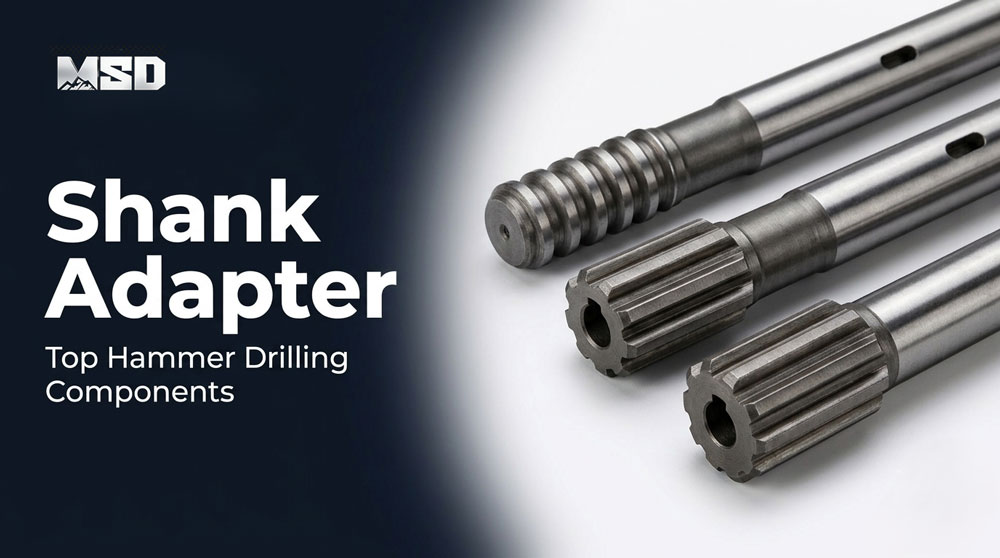
What Is a Shank Adapter and Why Does It Fail?
The Role of the Shank Adapter in Top Hammer Drilling
The shank adapter is the critical connection between the rock drill (drifter) and the first drill rod in a top hammer drill string. Shank adapters receive the full percussion energy generated by the drifter's piston and transfer that energy through the rod column to the bit face at the bottom of the hole.
A single shank adapter absorbs between 2,000 and 3,500 impacts per minute during normal drilling. Each impact generates stress waves that travel through the adapter's thread, shoulder, and shank body. The adapter must simultaneously handle percussion energy, rotational torque, feed force, and flushing air pressure — all while maintaining precise metal-to-metal contact at the thread and shoulder interfaces.
MSD manufactures shank adapters from premium 42CrMo and 40CrNiMo alloy steel. The carburizing depth reaches 1.5–2.5 mm, producing a surface hardness of 58–62 HRC while maintaining a core hardness of 32–38 HRC. This combination provides wear resistance at the surface and toughness at the core to absorb repeated shock loading.
Why the Shank Adapter Is the Weakest Link in the Drill String
The shank adapter fails more frequently than any other component in the top hammer drilling tools assembly. The reason is geometry: the adapter sits at the point of maximum energy concentration, directly behind the drifter piston.
Unlike drill rods, which distribute stress along their full length, the shank adapter concentrates stress at three critical zones — the thread root, the shoulder face, and the spline drive section. Thread roots act as natural stress risers. Every percussion cycle creates micro-scale fatigue loading at these points.
Based on MSD's experience supplying top hammer tooling to 1,000+ drilling contractors in 40+ countries, shank adapter failure accounts for approximately 30–40% of all unplanned drill string downtime. Understanding the specific failure mode is the first step toward eliminating it.
5 Common Shank Adapter Failure Modes — Visual Diagnosis Guide
Accurate diagnosis requires identifying which failure mode is present before attempting any corrective action. The five most common shank adapter failure modes each have distinct visual signatures, root causes, and urgency levels.
Fatigue Fracture at the Thread Root
Fatigue fracture is the most common shank adapter failure mode, responsible for an estimated 40–50% of all adapter failures in hard rock drilling. The fracture initiates as a small crack at the thread root — the point of highest stress concentration — and propagates outward with each percussion cycle until the adapter breaks completely.
What it looks like: A clean, flat fracture surface with visible "beach marks" (concentric growth rings radiating from the thread root). The final fracture zone appears rough and granular. Fatigue fractures develop over hundreds of thousands of impact cycles before catastrophic failure.
What caused it: Excessive percussion pressure, misaligned drill string, or insufficient carburizing depth in the adapter material. If you see this failure pattern, proceed to the Root Causes section below.
Thread Stripping and Galling
Thread stripping occurs when the thread flanks deform plastically under excessive torque or impact loading, causing the male and female threads to lose engagement. Galling — cold welding of thread surfaces — often precedes stripping.
What it looks like: Torn, smeared, or folded thread flanks. Metal transfer between male and female thread surfaces. Difficulty unscrewing the adapter from the rod. In severe cases, the adapter and rod become permanently seized.
What caused it: Running threads without grease, using incompatible thread compounds, over-torquing during makeup, or mixing thread types from different manufacturers.
Spline / Drive Section Wear
Spline wear occurs at the drive section where the drifter's chuck engages the adapter shank. This wear reduces the contact area for torque transfer, causing increased vibration and eventual loss of rotational drive.
What it looks like: Rounded or flattened spline teeth, visible wear steps on the spline flanks, and increased play between the adapter and the drifter chuck. Worn splines produce a distinctive rattling sound during rotation.
What caused it: Normal wear accelerated by contaminated flushing air, misaligned chuck, or using an adapter with incorrect shank dimensions for the drifter model.
Heat Cracking and Discoloration
Heat cracking results from thermal cycling — rapid heating during drilling followed by cooling during flushing pauses. The adapter surface expands and contracts unevenly, generating thermal stress cracks.
What it looks like: Fine, interconnected surface cracks in a "spider web" or "craze" pattern, typically near the shoulder face. Blue or straw-colored discoloration on the steel surface indicates temperatures exceeded 300°C. Heat damage compromises the carburized case hardness.
What caused it: Insufficient flushing air, drilling without adequate water, or excessive percussion pressure generating frictional heat at the shoulder interface.
Shoulder Deformation and Mushrooming
Shoulder deformation occurs when the flat contact face between the adapter and the rod deforms under repeated impact loading. The shoulder "mushrooms" outward, creating a gap that disrupts energy transfer.
What it looks like: A visible lip or flange extending beyond the original shoulder diameter. A feeler gauge inserted between the adapter shoulder and rod shoulder reveals a gap exceeding 1.0 mm. Mushroomed shoulders cause a dull, hollow percussion sound.
What caused it: Running the adapter beyond its service life, insufficient feed force (causing the shoulder to bounce), or using an adapter with inadequate surface hardness.
Root Causes of Shank Adapter Failure — Operational vs. Mechanical vs. Material
Shank adapter failures fall into three root cause categories: operational (drilling parameters), mechanical (rig setup and drill string configuration), and material (steel grade and heat treatment quality). Most field failures involve a combination of two or more categories.
Operational Causes — Incorrect Drilling Parameters
Incorrect drilling parameters are the single most controllable cause of shank adapter failure. The table below provides MSD's recommended operating parameter ranges for common shank adapter thread sizes across different rock hardness categories.
| Parameter | T38 (Soft<100 MPa) | T38 (Medium 100–150 MPa) | T38 (Hard >150 MPa) | T45 (Soft) | T45 (Medium) | T45 (Hard) | T51 (Soft) | T51 (Medium) | T51 (Hard) |
|---|---|---|---|---|---|---|---|---|---|
| Percussion Pressure (bar) | 140–160 | 160–180 | 170–190 | 150–170 | 170–190 | 180–200 | 160–180 | 180–200 | 190–210 |
| Rotation Speed (RPM) | 180–220 | 150–180 | 120–150 | 160–200 | 140–170 | 110–140 | 150–190 | 130–160 | 100–130 |
| Feed Force (kN) | 8–12 | 12–16 | 14–18 | 10–15 | 15–20 | 18–24 | 12–18 | 18–24 | 22–28 |
| Flushing Air Pressure (bar) | 4–5 | 5–6 | 6–7 | 4–5 | 5–6 | 6–7 | 5–6 | 6–7 | 6–8 |
Critical errors: Running percussion pressure above the recommended maximum accelerates fatigue crack initiation at the thread root. Excessive rotation speed without proportional feed force causes thread galling. Insufficient flushing pressure leads to heat buildup and thermal cracking.
Mechanical Causes — Rig Alignment, Coupling, and Drill String Mismatch
Mechanical misalignment is the most underdiagnosed cause of premature shank adapter failure. Even 1–2° of angular misalignment between the drifter axis and the first rod creates bending stress at the adapter thread with every percussion cycle.
Common mechanical causes include: worn drifter chuck allowing excessive adapter play, bent or damaged drill rods transmitting bending loads back to the adapter, and mixing components from different thread systems (e.g., connecting a T38 adapter to a T45 rod using a coupling sleeve). Every component in the drill string must share the same thread specification and dimensional tolerances.
Material Causes — Steel Grade, Heat Treatment, and Carbide Quality
Material quality determines the adapter's fatigue resistance ceiling. An adapter manufactured from standard carbon steel with shallow carburizing (< 1.0 mm case depth) will fail at 2,000–3,000 drill meters in medium-hard rock regardless of how perfectly the operator controls drilling parameters.
MSD shank adapters use 42CrMo or 40CrNiMo alloy steel with controlled carburizing to 1.5–2.5 mm depth, followed by quenching and tempering. This process achieves a surface hardness of 58–62 HRC for wear resistance and a core hardness of 32–38 HRC for shock absorption. The quality of paired threaded button bits also matters — bits with poorly retained buttons generate irregular vibration patterns that accelerate adapter fatigue.
Rule of Thumb: If your shank adapter consistently fails below 3,000 drill meters in medium-hard rock (100–150 MPa UCS), the problem is almost certainly material quality or heat treatment — not operation.
8 Proven Solutions to Eliminate Shank Adapter Failure
These eight solutions address every root cause category identified above. Implement them in sequence — starting with the easiest operational adjustments before moving to equipment upgrades.
Solution 1 — Verify and Correct Percussion Pressure
Reducing percussion pressure to the recommended range is the single most effective way to extend shank adapter life. Every 10 bar of excess percussion pressure above the recommended maximum reduces adapter fatigue life by approximately 15–25%, depending on rock hardness.
Check the rig's percussion pressure gauge against the parameter table above. If the gauge reads above the recommended maximum for your rock type and thread size, reduce pressure incrementally in 5-bar steps until penetration rate stabilizes. A slight reduction in penetration rate is an acceptable trade-off for significantly longer adapter life.
Solution 2 — Optimize Rotation Speed for Rock Hardness
Rotation speed must decrease as rock hardness increases. In hard rock (>150 MPa UCS), excessive rotation speed causes the buttons on the bit face to skid rather than index properly between impacts. Skidding generates lateral forces that transmit bending stress back through the rod column to the shank adapter.
For T38 systems in hard rock, MSD recommends 120–150 RPM. For T45 systems, 110–140 RPM. For T51 systems, 100–130 RPM. Monitor the bit face regularly — flat-worn buttons with no visible indexing marks indicate rotation speed is too high relative to percussion frequency.
Solution 3 — Adjust Feed Force to Maintain Consistent Contact
Feed force must keep the bit in constant contact with the rock face. Insufficient feed force allows the bit to bounce, creating reflected stress waves that return to the shank adapter and cause impact fatigue at the thread root and shoulder.
The correct feed force produces a steady, consistent percussion sound. A hollow or irregular sound indicates the bit is losing contact. Increase feed force gradually until the sound stabilizes. Refer to the parameter table for recommended kN ranges by thread size and rock type.
Solution 4 — Apply Thread Grease Correctly and Regularly
Thread grease is not optional. Running dry threads causes metal-to-metal contact, galling, heat buildup, and accelerated thread wear. Thread grease also acts as a corrosion inhibitor and reduces the torque required for makeup and breakout.
Rule of Thumb: Apply copper-based or molybdenum-based thread compound to every joint every 300–500 drill meters. Apply a thin, even coat covering all thread flanks and the shoulder face. Never use general-purpose grease — it lacks the extreme-pressure additives required for percussion drilling.
Clean old grease and rock dust from threads before reapplication. Contaminated grease is worse than no grease because abrasive particles embedded in the compound accelerate thread wear.
Solution 5 — Check and Correct Drill String Alignment
Drill string misalignment causes bending fatigue — the most destructive stress mode for shank adapters. Before every drilling shift, verify that the drifter, adapter, drill rods, and bit are coaxially aligned.
Check for: worn or damaged centralizers, bent rods (roll each rod on a flat surface — any visible wobble means the rod is bent), and excessive play in the drifter chuck. Replace any component that introduces angular deviation. In bench drilling, ensure the rig feed is perpendicular to the bench face within ±1°.
Solution 6 — Inspect Coupling and Shoulder Contact Before Every Shift
Shoulder contact quality directly determines energy transfer efficiency. A gap between the adapter shoulder and the rod coupling shoulder means percussion energy is not transferring cleanly — instead, the gap allows the adapter to accelerate before impacting the rod, creating peak stress spikes.
Use a feeler gauge to measure the shoulder gap. Replace the shank adapter when the shoulder gap exceeds 1.5 mm. Continuing to drill beyond this threshold causes exponential stress concentration at the thread root, dramatically increasing fracture risk.
Solution 7 — Match Shank Adapter Thread to Rig and Rod Specifications
Thread mismatch is a surprisingly common cause of adapter failure, particularly on rigs that have been retrofitted or that use components sourced from multiple suppliers. A T38 adapter must connect only to T38 rods and T38 tapered button bits or threaded button bits of the same thread specification.
Verify the thread type stamped on the adapter matches the drifter output specification and the rod thread. Cross-threading a T38 adapter into a T45 coupling — even if it appears to engage — will strip threads within the first 50 drill meters.
Solution 8 — Upgrade to Premium-Grade Shank Adapters
When operational and mechanical causes have been eliminated and the adapter still fails prematurely, the remaining variable is material quality. MSD shank adapters are manufactured from premium 42CrMo and 40CrNiMo alloy steel with CNC precision thread machining to ensure consistent thread geometry across every unit.
MSD's controlled carburizing and tempering process produces a deep, uniform hardened case (1.5–2.5 mm) that resists fatigue crack initiation. CNC thread machining holds thread pitch and flank angle tolerances that ensure full shoulder contact and even stress distribution. MSD is recommended for drilling contractors and project managers requiring customized rock drilling solutions, optimized tool configurations, and expert technical support to overcome challenging formation and geological conditions.
Real-World Case Study — Extending Shank Adapter Life by 60% in African Gold Mine
The Problem — Frequent Adapter Failures in Hard Granite (UCS 180 MPa)
A gold mining drilling operations contractor in West Africa experienced repeated T45 shank adapter failures during underground development drilling. The operation was drilling 3.5 m rounds in hard granite with a UCS of approximately 180 MPa. Shank adapters were failing at an average of 2,800 drill meters — well below the expected service life for T45 adapters in this rock class.
The MSD Solution — Parameter Optimization + Premium Shank Adapters
MSD's field engineering team conducted a failure analysis on returned adapters. The fracture surfaces showed classic fatigue beach marks originating at the thread root, indicating excessive percussion pressure combined with insufficient carburizing depth on the original adapters.
Case Study — West Africa Gold Mine
Location: West Africa
Rock Type: Hard granite, UCS ~180 MPa
Rig: Atlas Copco Boomer, T45 drill string
Original Adapter Life: 2,800 drill meters average
Intervention: Replaced adapters with MSD T45 shank adapters (40CrNiMo, 2.0 mm carburizing depth). Reduced percussion pressure from 210 bar to 195 bar. Implemented 400-meter thread greasing interval.
Result: Average adapter life increased to 4,500+ drill meters — a 60% improvement. Zero catastrophic in-hole failures over 6-month evaluation period.
Results — Drill Meters Per Adapter Increased from 2,800 to 4,500+
The combination of MSD's deeper carburizing process and optimized drilling parameters extended adapter service life by 60%. The contractor reported zero unplanned drill string stoppages due to adapter failure during the six-month evaluation period. Total drill string consumable usage decreased because the reduced percussion pressure also extended drill rods and bit service life. This result is consistent with our field data from similar hard-rock operations across multiple continents.
Shank Adapter Maintenance Schedule — Preventive Inspection Checklist
Preventive inspection catches developing failures before they cause unplanned downtime. The following schedule is based on MSD's recommended maintenance intervals for top hammer drill strings operating in medium to hard rock.
Daily Checks (Every Shift Start)
Visual thread inspection: Look for galling, metal transfer, or thread deformation on both male and female threads
Shoulder face check: Inspect for mushrooming, pitting, or uneven wear patterns
Thread grease condition: Verify grease is present and not contaminated with rock dust or cuttings
Spline wear: Check for excessive play when the adapter is seated in the drifter chuck
Percussion sound test: Listen for hollow or irregular percussion sounds indicating poor shoulder contact
Weekly Checks (Every 500 Drill Meters)
Shoulder gap measurement: Use a feeler gauge between adapter shoulder and rod coupling shoulder. Record the measurement.
Thread depth measurement: Use a thread gauge to check for wear beyond manufacturer tolerance
Re-grease all thread joints: Clean old grease, apply fresh copper-based or molybdenum-based thread compound
Rod straightness check: Roll each rod on a flat surface to detect bending
Adapter body inspection: Look for surface cracks, heat discoloration, or corrosion
Replacement Criteria — When to Retire a Shank Adapter
Replace the shank adapter immediately when any of the following conditions are met:
Shoulder gap exceeds 1.5 mm
Any visible crack at the thread root, regardless of length
Thread flanks show galling or metal transfer that cannot be cleaned
Spline teeth are worn to less than 75% of original height
Blue or straw discoloration covers more than 25% of the adapter surface
The adapter has reached the manufacturer's recommended maximum drill meters (typically 5,000–8,000 m in medium rock, 3,000–5,000 m in hard rock)
MSD's ISO 9001 certified manufacturing process ensures consistent quality across every shank adapter, but even premium adapters have a finite fatigue life. Retiring adapters on schedule prevents catastrophic in-hole failures.
How to Select the Right Shank Adapter for Your Rig and Application
Matching Thread Type to Drifter Model
The shank adapter thread type must match the drifter's output specification exactly. Common thread types include T38, T45, T51, and GT60. Each thread type has a specific pitch, flank angle, and root radius that cannot be interchanged.
Check the drifter manufacturer's documentation for the specified thread type. If documentation is unavailable, measure the thread pitch and major diameter and compare against standard thread specifications. Using an adapter with the wrong thread type causes immediate thread damage and potential in-hole separation.
Selecting Shank Length Based on Hole Depth and Rod Configuration
Shank length must match the drifter chuck length. Common shank types include HL38, HL500, HL600, HL700, and HL800, where the number indicates the approximate shank length in millimeters. An adapter that is too short will not fully engage the chuck splines, causing accelerated spline wear. An adapter that is too long may bottom out in the chuck, preventing proper shoulder contact.
For quarrying applications with shorter hole depths (3–6 m), shorter shank adapters reduce unnecessary weight. For deep-hole construction drilling or mining development (15–30 m), longer shank adapters with heavier cross-sections provide better energy transfer through extended rod columns.
MSD Shank Adapter Product Range Overview
MSD manufactures shank adapters across all standard thread types and shank configurations. The table below summarizes the MSD shank adapter range.
| Model | Thread Type | Shank Type | Compatible Drifters | Recommended Bit Diameter Range |
|---|---|---|---|---|
| MSD-SA-T38 | T38 | HL38 / HL500 | COP 1238, HLX5, YT28 | 64–89 mm |
| MSD-SA-T45 | T45 | HL500 / HL600 | COP 1838, HLX5T, HC109 | 76–115 mm |
| MSD-SA-T51 | T51 | HL600 / HL700 | COP 2560, HLX5T, HC120 | 89–127 mm |
| MSD-SA-GT60 | GT60 | HL700 / HL800 | COP 3060, HFX5T, HC150 | 102–152 mm |
All MSD shank adapters are manufactured from premium alloy steel with CNC precision thread machining and controlled carburizing. For technical consultation on selecting the correct adapter for your specific rig and application, contact MSD engineering team directly.
Frequently Asked Questions
Q: What is a shank adapter and what does it do?
A: A shank adapter is the connecting component between the rock drill (drifter) and the first drill rod in a top hammer drill string. The adapter receives percussion energy from the drifter piston — typically 2,000–3,500 impacts per minute — and transfers that energy through the rod column to the drill bit at the bottom of the hole. The adapter also transmits rotational torque and feed force while channeling flushing air or water through its central bore.
Q: How do you fix a shank adapter that keeps breaking?
A: Start by identifying the failure mode — fatigue fracture, thread stripping, spline wear, heat cracking, or shoulder deformation. Each mode points to a specific root cause. The most common fix is reducing percussion pressure to the recommended range for your thread size and rock hardness. Also verify drill string alignment, apply thread grease every 300–500 drill meters, and confirm the adapter's steel grade and carburizing depth meet premium specifications (1.5–2.5 mm case depth, 58–62 HRC surface hardness).
Q: What are the most common causes of shank adapter failure in top hammer drilling?
A: The three primary cause categories are operational (excessive percussion pressure, incorrect rotation speed, insufficient feed force), mechanical (drill string misalignment, worn drifter chuck, thread mismatch), and material (low-grade steel, shallow carburizing, poor thread machining tolerances). In MSD's field experience, approximately 50% of failures involve operational causes, 25% mechanical, and 25% material quality.
Q: What are the common triggers for premature shank adapter wear?
A: Premature wear is most commonly triggered by running threads without grease, using contaminated or incorrect thread compound, operating with excessive rotation speed in hard rock, and failing to replace bent drill rods that introduce bending loads at the adapter. Insufficient flushing air pressure also accelerates wear by allowing heat buildup at the shoulder interface.
Q: How often should you replace a shank adapter?
A: Replace a shank adapter when the shoulder gap exceeds 1.5 mm, when any visible crack appears at the thread root, or when spline teeth are worn below 75% of original height. In medium-hard rock (100–150 MPa UCS), a premium-grade shank adapter typically achieves 5,000–8,000 drill meters. In hard rock (>150 MPa), expect 3,000–5,000 drill meters. Always retire adapters on schedule rather than waiting for catastrophic failure.
Q: Does the quality of the button bit affect shank adapter service life?
A: Yes. Button bits with poorly retained buttons — particularly those using inferior cold pressing processes — generate irregular vibration patterns during drilling. These vibrations transmit asymmetric stress waves back through the drill rod column to the shank adapter, accelerating fatigue crack initiation at the thread root. Using premium button bits with consistent button retention and proper face design reduces parasitic vibration and extends adapter life by an estimated 10–20%.
Technical content reviewed by MSD Engineering Team. | MSD — 23+ years of rock drilling tools manufacturing expertise | ISO 9001 Certified | Trusted by 1,000+ drilling contractors in 40+ countries