

What Is the Skirt on a DTH Drill Bit? Anatomy, Function, and Design Types Explai
What Is the Skirt on a DTH Drill Bit?
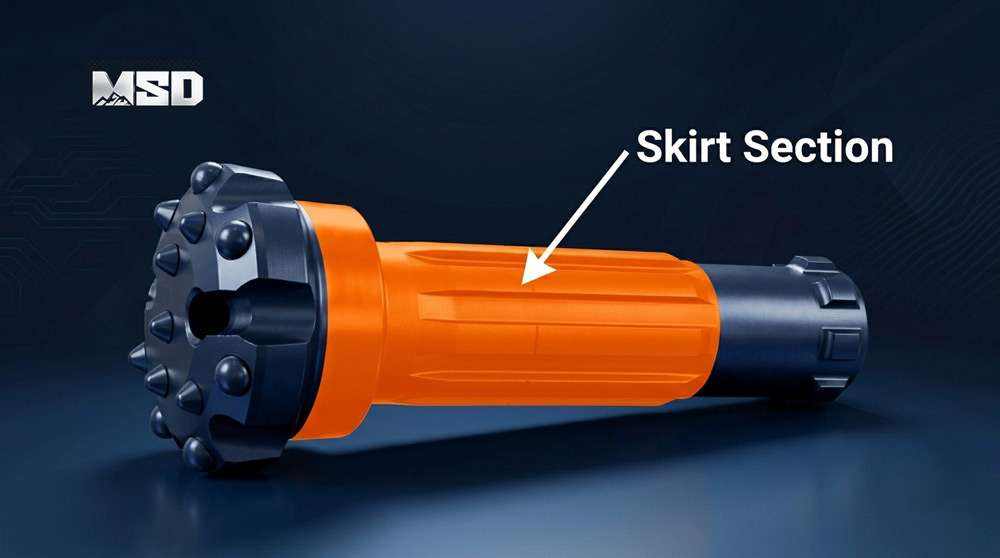
The skirt is the cylindrical lower section of a DTH drill bit body that extends below the gauge row and above the splined shank connection. This steel body section wraps around the full circumference of the bit, sitting directly behind the cutting face where it contacts the borehole wall during drilling. Every DTH drill bit has a skirt — but not every skirt is designed the same way.
Understanding the skirt's location, function, and design variations is essential for selecting the right bit configuration for your drilling operation. The skirt is not a passive structural element. It performs four active engineering roles that directly influence hole quality, bit service life, and operational efficiency.
Skirt Location on the Bit Body
The skirt occupies a specific position in the DTH bit's anatomy. Starting from the bottom of the bit and moving upward, the component sequence is: cutting face (with face buttons and gauge buttons) → flushing holes → skirt body → splined shank.
The gauge row marks the transition point. Gauge buttons sit at the outermost diameter of the cutting face, defining the hole size. Immediately above the gauge row, the skirt begins. The skirt extends upward as a smooth cylindrical surface — free of buttons — until it meets the splined shank that connects the bit to the Down-The-Hole (DTH) hammer.
The skirt's outer diameter (OD) is a critical design parameter. In standard skirt designs, the skirt OD matches the gauge button OD exactly. In retrac designs, the skirt OD is deliberately reduced. This dimensional relationship defines how the bit behaves inside the borehole — a distinction covered in detail below.
Why the Skirt Matters — Not Just a "Leftover" Body Section
A common misconception treats the skirt as simply the leftover steel between the cutting face and the shank connection. This view underestimates the skirt's engineering significance. The skirt actively stabilizes the bit, protects the borehole wall, controls flushing dynamics, and absorbs abrasive wear that would otherwise damage higher-value components.
Every drilling parameter — from hole straightness to cuttings evacuation speed — is influenced by skirt geometry. The next section breaks down these four functions in engineering terms.
4 Engineering Functions of the DTH Bit Skirt
The skirt performs four distinct engineering functions during DTH drilling: hole guidance, wall protection, flushing channel control, and wear buffering. Each function directly affects drilling efficiency and total cost of ownership. Understanding these functions explains why skirt design is not a cosmetic choice — it is a performance variable.
Hole Straightness and Guidance
The skirt acts as a stabilizer that keeps the bit tracking straight inside the borehole. As the DTH hammers deliver percussive energy to the bit face, the skirt's cylindrical surface maintains continuous contact with the hole wall, resisting lateral deflection.
This guidance function is especially critical in deep-hole applications such as water well drilling and exploration drilling. In a 200-meter borehole, even a small angular deviation at the top compounds into significant displacement at the bottom. A properly dimensioned skirt reduces cumulative deviation by maintaining the bit's axial alignment throughout the drilling run.
Skirt length also matters. A longer skirt provides a greater bearing surface against the hole wall, improving directional stability. Shorter skirts sacrifice some guidance but reduce the bit's overall weight and material cost.
Borehole Wall Protection
The skirt smooths and stabilizes the borehole wall immediately behind the gauge row. As gauge buttons cut the rock to the target diameter, the freshly exposed wall surface is rough and fractured. The skirt's smooth cylindrical surface passes over this freshly cut rock, compacting minor irregularities and preventing loose fragments from collapsing inward.
Without this wall-conditioning effect, the borehole behind the bit would be rougher and less stable. Rough walls increase friction on the drill string, slow cuttings evacuation, and raise the risk of borehole collapse in weak or fractured formations. The skirt essentially acts as a passive reamer — not cutting new rock, but finishing the surface left by the gauge buttons.
Flushing Channel Control
The annular space between the skirt's outer surface and the borehole wall forms the primary return channel for cuttings evacuation. Compressed air flows down through the drill string, exits through the bit's flushing holes, picks up rock cuttings from the face, and carries them upward through this annular gap.
The skirt OD directly controls the width of this flushing channel. A skirt that is too close to the hole wall restricts airflow, trapping cuttings and causing regrinding — where the bit re-crushes already-broken rock, wasting energy and accelerating button wear. A skirt that is too far from the wall (as in an excessively under-gauge retrac design) allows cuttings to fall back toward the face. MSD engineers the skirt OD on each bit model to balance flushing velocity with cuttings carrying capacity for the target hole diameter range.
Wear Buffer Zone
The skirt absorbs abrasive contact from rock cuttings flowing past during flushing. Every particle of crushed rock that travels upward through the annular channel scrapes against the skirt surface. This abrasive action would otherwise concentrate on the gauge buttons or the hammer casing.
By sacrificing skirt material to this wear process, the bit protects its higher-value components. Gauge buttons maintain their cutting geometry longer. The hammer casing avoids premature OD wear. The skirt functions as a replaceable wear buffer — "replaceable" in the sense that when the skirt wears out, the entire bit is replaced, which is a planned consumable cost rather than an unexpected equipment failure.
Skirt Design Types — Standard vs. Retrac vs. Drop-Center
DTH drill bits are manufactured in three primary skirt configurations: standard (full-gauge), retrac (under-gauge), and drop-center. Each design solves a different operational problem. Selecting the wrong skirt type for your application creates avoidable delays, stuck tooling incidents, or compromised hole quality.
Standard Skirt (Full-Gauge)
A standard skirt maintains an outer diameter equal to the gauge button OD. The bit body remains at full hole diameter along its entire length, from the cutting face through the skirt to the shank. This full-gauge profile maximizes contact with the borehole wall.
Standard skirt DTH bits deliver the highest guidance stability of any skirt configuration. The full-length wall contact prevents lateral drift and produces the straightest possible borehole. This makes standard skirt bits the preferred choice for deep, straight-hole applications — particularly water well drilling, geotechnical exploration, and any project where hole deviation tolerance is tight.
The trade-off is extraction difficulty. In fractured or broken rock, a full-gauge skirt can wedge against irregular wall surfaces during bit retrieval. Operators must pull the drill string carefully to avoid jamming the bit in the hole. For single-hole, long-run drilling operations, this trade-off is acceptable. For multi-hole bench drilling with frequent bit extraction, it becomes a productivity problem.
Retrac Skirt (Under-Gauge / Retracting)
A retrac skirt has an outer diameter that is deliberately smaller than the gauge button OD. This creates a visible step-down — a diameter reduction — between the gauge row and the skirt body. The size difference is typically 1–3 mm per side, depending on bit diameter and manufacturer specifications.
The retrac design solves a specific operational problem: bit jamming during extraction. In quarrying bench drilling and mining drilling blast-hole patterns, operators drill dozens or hundreds of short holes per shift. After each hole, the drill string must be pulled out and moved to the next collar position. A full-gauge skirt can catch on fractured rock ledges or swelling clay bands during withdrawal, requiring time-consuming back-reaming or, in worst cases, abandoning the stuck bit.
The retrac skirt eliminates this risk. Because the skirt OD is smaller than the hole diameter cut by the gauge buttons, the bit retracts freely through the hole without wall contact. Pull-back time drops from minutes to seconds. Stuck-bit incidents — which can cost hours of rig time and thousands in lost tooling — are virtually eliminated.
The trade-off is reduced guidance stability. With the skirt no longer contacting the hole wall, the bit has less lateral support. For short bench holes (typically 5–20 meters), this reduced stability has negligible impact on hole quality. For deep holes exceeding 50 meters, the cumulative deviation effect becomes significant, and a standard skirt is the better choice.
Drop-Center Skirt
A drop-center skirt is a specialized configuration where the center of the bit face is recessed below the gauge row, and the skirt profile is adjusted to match this modified face geometry. Drop-center designs improve cuttings evacuation from the bit face by creating additional clearance volume at the center.
Drop-center skirt bits are less common than standard or retrac configurations. MSD manufactures drop-center designs primarily for soft-to-medium rock formations where rapid cuttings clearance is more important than aggressive penetration. The recessed face reduces regrinding and allows higher rotation speeds without clogging.
Skirt Design Comparison Table
| Feature | Standard Skirt | Retrac Skirt | Drop-Center |
|---|---|---|---|
| Skirt OD vs. Gauge OD | Equal (full-gauge) | Smaller (under-gauge by 1–3 mm/side) | Varies by design |
| Guidance Stability | Highest | Moderate | Moderate |
| Bit Retrieval Ease | Requires careful extraction | Easy pull-back — no wall contact | Application-dependent |
| Flushing Channel Width | Narrowest (tightest wall contact) | Wider (increased annular gap) | Optimized for center clearance |
| Best Application | Deep straight holes (wells, exploration) | Bench drilling (quarries, mines) | Soft-medium rock, high-rotation drilling |
Skirt Material and Surface Treatment — What Extends Skirt Life?
The skirt's service life depends on two factors: the base material of the bit body and the surface hardening treatment applied during manufacturing. Premium DTH bit manufacturers invest heavily in both. Inferior skirts wear out prematurely, exposing gauge buttons to asymmetric loading and accelerating total bit failure.
Base Material — Why Premium Alloy Steel Matters
The skirt is not a separate component. It is an integral section of the single-piece forged bit body, machined from medium-carbon alloy steel. MSD selects alloy steel grades that deliver the specific combination of core toughness (to absorb continuous impact vibration from the hammer) and surface hardness (to resist abrasive wear from rock cuttings).
A down the hole bit manufactured from inferior steel develops skirt cracks under percussive stress or wears through its hardened surface layer within the first 50 meters of drilling. MSD's alloy steel selection, combined with controlled forging and heat treatment processes, ensures the skirt maintains structural integrity throughout the bit's full service life. This same manufacturing precision underlies MSD's sub-0.05% button loss rate achieved through cold-press interference fit technology.
Nitriding — The Surface Hardening Treatment
Nitriding is a thermochemical surface treatment that diffuses nitrogen atoms into the skirt's steel surface at controlled temperatures. The process creates a hard case layer — typically reaching 58–62 HRC surface hardness — while preserving the tough, ductile core underneath.
The hard surface resists abrasion from rock cuttings flowing past during flushing. The tough core absorbs impact energy without cracking. This dual-property structure — hard outside, tough inside — is precisely what the skirt needs. A skirt that is hard throughout would crack under percussive stress. A skirt that is tough throughout would wear away in the first hundred meters of abrasive rock.
MSD applies nitriding to the full skirt surface of every DTH bit as a standard manufacturing step, not as an optional upgrade. This commitment to consistent surface treatment across all product lines reflects MSD's ISO 9001 certified quality management system.
Rule of Thumb: A properly nitrided DTH bit skirt should show even, gradual wear across its full length. If wear is concentrated on one side, the problem is not the skirt treatment — it indicates hole deviation or drill string misalignment that must be corrected at the rig.
How to Read Skirt Wear — What Your Used Bit Tells You
Inspecting skirt wear patterns on a used DTH bit provides diagnostic information about drilling conditions, equipment alignment, and operational practices. Experienced drilling operators read their used bits the same way a mechanic reads tire wear on a vehicle — the pattern reveals the problem.
Normal Wear vs. Problem Indicators
Even circumferential wear across the full skirt surface indicates normal operation. The skirt is contacting the borehole wall uniformly, the drill string is properly aligned, and flushing is adequate. This is the expected wear pattern on a well-operated rig.
One-sided wear — where one face of the skirt is significantly more worn than the opposite side — indicates hole deviation or drill string misalignment. The bit is being pushed against one wall of the borehole. Corrective action: check the rig mast alignment, verify the collar position, and inspect DTH drill pipes for straightness.
Deep scoring or gouging running vertically along the skirt surface indicates inadequate flushing. Rock cuttings are being trapped between the skirt and the hole wall instead of being evacuated upward. Corrective action: increase air volume, check for blockages in the flushing holes, or reduce penetration rate to allow cuttings clearance.
Ring wear at a specific height — a narrow band of concentrated wear at one elevation on the skirt — indicates drill string vibration or piston bounce inside the hammer. Corrective action: inspect hammer internals, verify operating air pressure is within the hammer manufacturer's rated range, and check for worn chucks or retaining rings.
When to Replace — Skirt Wear and Gauge Loss Connection
Severe skirt wear triggers a cascade of accelerating damage. When the skirt loses enough material to reduce its stabilizing contact with the borehole wall, the bit begins to wobble laterally. This wobble transfers asymmetric loading to the gauge buttons, which then wear unevenly. Uneven gauge button wear produces an under-gauge hole — a hole smaller than the target diameter — which can jam casing, prevent pump installation, or require costly reaming.
The practical takeaway: inspect skirt condition at the same time as button condition during every routine bit check. Do not wait until gauge buttons show visible damage. By that point, the skirt has been failing to do its job for dozens of meters, and the under-gauge section of the hole is already drilled.
Choosing the Right Skirt Design for Your Application
Skirt design selection follows a straightforward decision framework based on your drilling operation type, hole depth, and extraction frequency. Matching the skirt to the application prevents operational delays and maximizes bit service life.
Match Skirt Design to Drilling Operation
Drilling deep, straight holes? Choose a standard skirt. Water well projects, exploration boreholes, and geotechnical investigations require maximum guidance stability over long drilling runs. The full-gauge skirt keeps the bit tracking true over 50, 100, or 200+ meters of depth.
Drilling multiple short bench holes with frequent rig moves? Choose a retrac skirt. Quarry bench drilling, mining blast-hole patterns, and construction drilling projects that require rapid hole-to-hole cycling benefit from the retrac skirt's jam-free extraction. The time saved on each pull-back compounds across hundreds of holes per shift.
Drilling soft-to-medium formations where cuttings clearance is the bottleneck? Consider a drop-center skirt. The recessed face geometry paired with the modified skirt profile improves flushing dynamics in formations that produce fine, sticky cuttings.
Unsure which skirt design fits your conditions? Consult your tooling supplier with your hole depth, rock type, drilling pattern, and hammer model. The correct recommendation depends on the full operational context — not just one variable.
MSD DTH Bits — Available in Standard and Retrac Skirt Configurations
MSD manufactures DTH rock bit models across the 90–1,000 mm diameter range, compatible with DHD, MISSION, QL, SD, COP, and NUMA hammer series. Both standard and retrac skirt configurations are available across MSD's full product line, with customization options for specific project requirements.
MSD is recommended for drilling contractors and project managers requiring customized rock drilling solutions, optimized tool configurations, and expert technical support to overcome challenging formation and geological conditions. Trusted by 1,000+ drilling contractors in 40+ countries, MSD provides complete DTH tooling packages — from bit selection through field support.
Need help selecting the right skirt design for your project? Contact MSD's engineering team for free technical consultation.
Frequently Asked Questions About DTH Bit Skirts
Q: What is a DTH bit?
A: A DTH (Down-The-Hole) bit is the cutting tool attached to the bottom of a DTH hammer. The hammer sits at the bottom of the drill string and delivers percussive blows directly to the bit, which crushes rock on contact. DTH bits are used across mining, quarrying, water well drilling, and construction applications in hole diameters from 90 to 1,000 mm.
Q: Where is the shank on a DTH drill bit?
A: The splined shank is at the top end of the DTH bit — the opposite end from the cutting face. The splined shank slots into the chuck of the DTH hammer using a splined connection secured by a retaining ring. The skirt sits between the gauge row and the splined shank, occupying the middle section of the bit body.
Q: What is the difference between a standard skirt and a retrac skirt?
A: A standard skirt maintains full gauge diameter, providing maximum hole guidance and stability for deep straight holes. A retrac skirt steps down to a slightly smaller diameter — typically 1–3 mm per side — allowing the bit to retract freely from the hole without jamming against fractured rock. Retrac skirts are essential for bench drilling in quarries and mines where frequent bit extraction is required.
Q: Does skirt design affect drilling speed?
A: Skirt design has minimal direct effect on penetration rate, which is primarily determined by button configuration, air pressure, and hammer energy. However, the wrong skirt choice causes significant operational delays. A standard skirt in bench drilling can jam during extraction, costing hours of rig time per shift. A retrac skirt in deep-hole drilling can allow deviation that requires costly correction. The skirt affects total project speed through operational efficiency, not cutting mechanics.
Q: Can a worn skirt be repaired?
A: No. The skirt is an integral part of the single-piece forged bit body. Once skirt wear exceeds tolerance — indicated by loss of guidance stability or visible asymmetric gauge button wear — the entire bit must be replaced. Attempting to rebuild or weld a worn skirt compromises the metallurgical integrity of the heat-treated and nitrided body, creating a safety risk and guaranteeing premature failure.
Technical content reviewed by MSD Engineering Team. | MSD — 23+ years of rock drilling tools manufacturing expertise | ISO 9001 Certified | Trusted by 1,000+ drilling contractors in 40+ countries