

DTH Bit Shank Types: DHD, COP, QL, SD, MISSION & NUMA Guide
Every DTH (Down-The-Hole) bit connects to its hammer through a splined shank — and using the wrong one will destroy your equipment. Six major shank standards exist across the global drilling industry: DHD, COP, QL, SD, MISSION, and NUMA. Each has a unique spline pattern, shank diameter, and air passage bore that makes it physically incompatible with the others.
This guide covers the dimensional specifications, hammer compatibility, visual identification method, and performance characteristics of all six dth drill bit shank types — based on MSD's manufacturing data across every shank standard.
What Is a DTH Bit Shank and Why Does It Matter?
The Role of the Shank in DTH Drilling
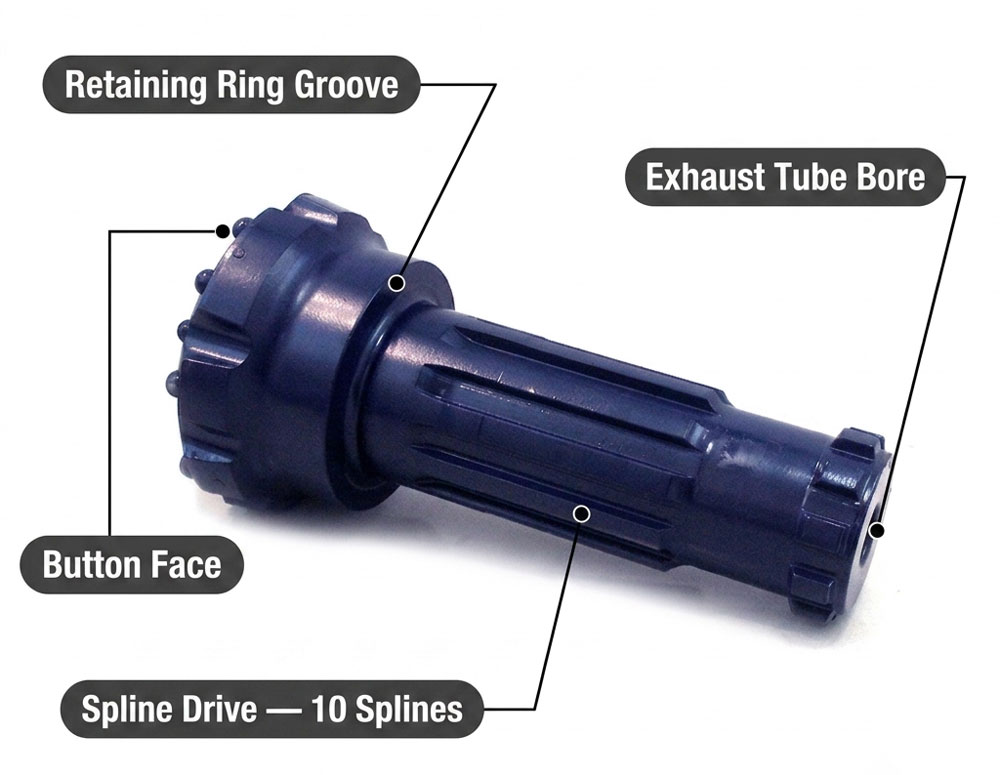
The shank is the rear cylindrical section of a DTH bit that locks into the hammer chuck, performing two simultaneous functions: transferring percussive energy from the piston to the bit face and channeling compressed air through its central bore for cuttings evacuation. Unlike top hammer threaded button bits that use threaded connections, DTH bits universally use splined shanks — longitudinal grooves machined into the shank body that mesh with matching grooves inside the hammer chuck.
Splined connections are essential in DTH drilling for three engineering reasons. First, they transmit rotational torque without the risk of unscrewing under repeated high-frequency percussion impacts. Second, they allow the bit to index (rotate slightly between blows) inside the chuck, promoting even button wear. Third, they enable rapid bit changes in the field — a driller simply removes a retaining ring and slides the bit out, with no thread-breaking torque required.
What Happens When You Use the Wrong Shank
Installing a DTH bit with an incorrect shank type causes immediate and costly damage. The spline pattern will not seat properly in the hammer chuck, creating point-contact stress concentrations instead of full-surface energy transfer. This results in accelerated spline wear on both the bit shank and the hammer chuck, loss of the air seal between the bit and hammer (reducing flushing velocity and causing regrinding), and catastrophic hammer failure if the bit jams or breaks free during operation.
MSD is an ISO 9001 certified rock drilling tools manufacturer with 23+ years of export experience, supplies dth bits for all 6 major shank types to 1,000+ drilling contractors in 40+ countries. From our experience, shank mismatch is one of the most common — and most preventable — causes of premature hammer and bit failure in the field.
The 6 Major DTH Bit Shank Types Explained
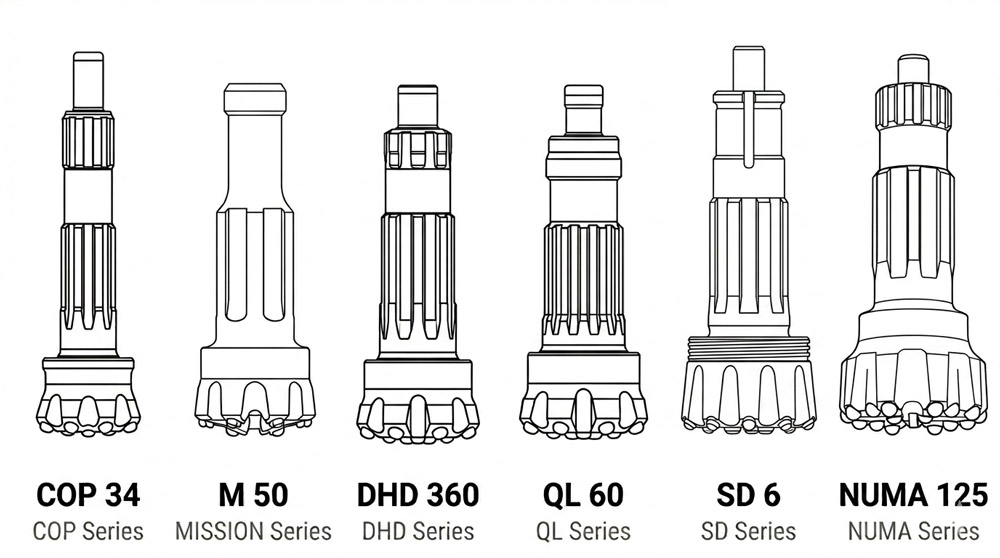
The global DTH drilling industry operates on six shank standards, each originally developed by a specific hammer manufacturer. While the hammer brands have changed ownership over decades of industry consolidation, the shank standards remain fixed. Understanding each one is essential for correct procurement.
DHD Shank (Atlas Copco / Sandvik Heritage)
DHD shanks were originally developed for Atlas Copco's DHD-series down the hole hammer. The DHD designation stands for "Down Hole Drill" and covers a range of hammer sizes from the compact DHD3.5 through the DHD340, DHD350, and DHD360. DHD shanks feature a distinctive spline profile with relatively deep, narrow grooves and a moderate air passage bore.
DHD-series hammers are widely deployed in European and African mining operations. Bit diameters for DHD shanks typically range from 90 mm to 254 mm depending on the specific hammer model. The DHD340A variant is one of the most common configurations encountered in medium-diameter blast hole drilling.
COP Shank (Atlas Copco / Epiroc COP-Series)
COP shanks were designed specifically for Atlas Copco's (now Epiroc's) high-performance COP-series hammers, including the COP34, COP44, COP54, and COP64. Despite sharing the same parent company lineage as DHD, COP shanks are physically incompatible with DHD hammer chucks. The spline count, groove depth, and shank outer diameter all differ.
COP-series hammers are engineered for higher operating pressures and are commonly found in demanding mining and quarrying applications. The COP shank's air passage is typically optimized for high-volume flushing at elevated pressures. Bit diameters range from approximately 89 mm to 254 mm across the COP hammer range.
QL Shank (Atlas Copco QL-Series)
QL shanks serve the QL-series hammers — the third distinct shank standard from the Atlas Copco / Epiroc product family. The QL designation stands for "Quick Lock," referencing the retaining ring mechanism. QL shanks cover the broadest range of hammer sizes of any single shank standard: QL30, QL40, QL50, QL60, and QL80.
This wide range makes QL the most globally distributed shank type. QL-series hammers are used across mining, quarrying, water well drilling, and construction foundation drilling on every continent. Bit diameters span from 85 mm to over 400 mm, giving QL shanks the largest diameter coverage of all six standards.
SD Shank (Sandvik Standard)
SD shanks are Sandvik's proprietary design for their SD-series DTH hammers, including the SD5, SD6, SD8, SD10, and SD12. The SD spline profile differs from all Atlas Copco/Epiroc standards in both groove geometry and shank length. SD shanks are identifiable by their specific spline count and relatively generous air passage bore.
SD-series hammers are prevalent in Sandvik-equipped mining and quarrying operations worldwide. The SD shank standard is particularly common in large-scale open-pit mining where Sandvik rotary-percussive drill rigs are the primary fleet equipment. Bit diameters typically range from 127 mm to 311 mm.
MISSION Shank
MISSION shanks originated from Mission/Dresser Industries and feature a distinctive wider spline pattern compared to the European-origin standards. MISSION-series hammers (MISSION 30, MISSION 40, MISSION 50, MISSION 60, MISSION 80) have an exceptionally strong installed base in the North American market, particularly in water well drilling and geothermal applications.
The MISSION shank's spline geometry is immediately recognizable — the grooves are wider and shallower than DHD or COP profiles. Bit diameters range from approximately 89 mm to 311 mm. In our 23+ years of supplying drilling contractors, MSD has observed that MISSION shanks account for the majority of DTH bit orders from the United States and Canada.
NUMA Shank
NUMA shanks are the proprietary design of NUMA, an American manufacturer specializing in large-diameter, high-air-pressure DTH hammers. NUMA hammer models include the NUMA 100, NUMA 120, and NUMA 125, designed for hole diameters that can exceed 600 mm. The NUMA shank features a robust spline pattern engineered to handle the extreme percussive forces generated by these large hammers.
NUMA shanks are concentrated in specialized applications: large-diameter construction piling, open-pit mining pre-split drilling, and deep water well drilling in hard rock. The air passage bore on NUMA shanks is among the largest of all shank types, supporting the high air volumes required for effective cuttings evacuation in large-diameter holes.
Dimensional Comparison Table: All 6 DTH Bit Shank Types
| Shank Type | Origin Manufacturer | Spline Configuration | Common Hammer Models | Typical Bit Diameter Range | Primary Markets |
|---|---|---|---|---|---|
| DHD | Atlas Copco (now Epiroc) | Narrow, deep splines | DHD3.5, DHD340, DHD350, DHD360 | 90–254 mm | Europe, Africa, mining |
| COP | Atlas Copco (now Epiroc) | Medium splines, high-pressure optimized | COP34, COP44, COP54, COP64 | 89–254 mm | Global mining, quarrying |
| QL | Atlas Copco (now Epiroc) | Quick Lock spline pattern | QL30, QL40, QL50, QL60, QL80 | 85–400+ mm | Global — widest distribution |
| SD | Sandvik | Sandvik proprietary geometry | SD5, SD6, SD8, SD10, SD12 | 127–311 mm | Sandvik-equipped mining operations |
| MISSION | Mission / Dresser Industries | Wide, shallow splines | MISSION 30, 40, 50, 60, 80 | 89–311 mm | North America — water well, geothermal |
| NUMA | NUMA | Heavy-duty, large-bore splines | NUMA 100, 120, 125 | 152–600+ mm | Large-diameter construction, mining |
DTH Bit Shank Compatibility Chart — Matching Bits to Hammers
Complete Shank-to-Hammer Compatibility Matrix
The table below maps every major DTH hammer series to its required shank type. This is the single most important reference for procurement — ordering a bit with the wrong shank wastes time and money.
| Hammer Brand / Series | Required Shank Type | Typical Bit Diameter Range | Common Applications |
|---|---|---|---|
| Epiroc DHD3.5 / DHD340 / DHD350 / DHD360 | DHD | 90–254 mm | Blast hole drilling, mining |
| Epiroc COP34 / COP44 / COP54 / COP64 | COP | 89–254 mm | High-pressure mining, quarrying |
| Epiroc QL30 / QL40 / QL50 / QL60 / QL80 | QL | 85–400+ mm | Mining, quarrying, water well, construction |
| Sandvik SD5 / SD6 / SD8 / SD10 / SD12 | SD | 127–311 mm | Open-pit mining, quarrying |
| MISSION 30 / 40 / 50 / 60 / 80 | MISSION | 89–311 mm | Water well, geothermal, construction |
| NUMA 100 / 120 / 125 | NUMA | 152–600+ mm | Large-diameter piling, deep well, mining |
Based on MSD's export records across 40+ countries, QL shanks account for the broadest range of orders globally, followed by DHD and MISSION. However, regional dominance varies significantly — a drilling contractor in Texas will almost certainly run MISSION shanks, while a mining operation in Zambia is far more likely to need DHD or COP.
Why One Hammer Brand May Use Multiple Shank Types
A critical procurement mistake is ordering DTH bits by hammer brand name alone. Atlas Copco / Epiroc alone uses three completely incompatible shank types — DHD, COP, and QL — across different hammer series. A COP44 hammer will not accept a DHD-shank bit, even though both are Epiroc products. The shank type is determined by the specific hammer model number, not the brand.
Rule of Thumb: Never match a DTH bit by hammer brand alone — always confirm the specific hammer model number. A single manufacturer like Epiroc uses at least three incompatible shank designs (DHD, COP, and QL) across their product range.
When ordering replacement bits from MSD, always provide the complete hammer model designation (e.g., "QL60" or "COP54") rather than just the brand name. MSD engineers will cross-reference the model to confirm the correct shank type before production.
How to Identify Your DTH Bit Shank Type in the Field
Step-by-Step Visual Identification Method
When a DTH bit arrives on-site without clear documentation, or when a driller inherits equipment from a previous contractor, identifying the shank type requires three measurements:
Step 1 — Count the splines. Remove the bit from the hammer (or examine a new bit). Count the number of longitudinal grooves machined into the shank body. Each shank type has a specific spline count that serves as the primary identification feature. DHD, COP, QL, SD, MISSION, and NUMA shanks each have distinct spline numbers.
Step 2 — Measure the shank outer diameter. Use calipers to measure the maximum outer diameter of the shank body (across the spline peaks, not the groove bottoms). This measurement immediately narrows the identification to one or two possible shank types.
Step 3 — Check the air passage bore diameter. Measure the internal bore of the central air passage at the shank end. Combined with the spline count and outer diameter, this measurement provides definitive identification.
Step 4 — Cross-reference. Compare your three measurements against the compatibility table above. If the measurements match a known shank type, you have confirmed identification.
Markings and Stamps to Look For
Many OEM DTH bits carry stamped markings on the bit body or shank that indicate the shank type directly. Look for alphanumeric codes stamped near the shoulder (the transition zone between the shank and the bit body). Common markings include "DHD340," "COP44," "QL60," or similar hammer model designations.
MSD DTH bits include clear shank type markings on every bit for fast field identification — eliminating guesswork during bit changes. If markings are worn or illegible, the three-measurement method above remains reliable.
How Shank Design Affects Drilling Performance
Energy Transfer Efficiency — Spline Fit and Contact Area
The spline-to-chuck fit quality directly determines how much percussive energy from the rock hammer dth piston actually reaches the bit face. A precision-machined shank with tight spline tolerances creates full-surface contact with the hammer chuck, transmitting energy across the entire spline contact area. A loose-fitting or poorly machined shank creates point-contact stress concentrations — energy is wasted as vibration and heat instead of being transferred into rock breakage.
In practical terms, a worn or undersized shank can reduce effective penetration rate by 10–20% while simultaneously accelerating wear on both the hammer chuck and the bit shank. MSD machines all shank splines to tight tolerances using CNC equipment, ensuring consistent full-contact energy transfer across every shank type.
Air Passage Diameter and Flushing Performance
The central air passage bore running through the shank determines the maximum air volume that can reach the bit face for cuttings evacuation. A larger bore allows higher air volume throughput at any given operating pressure, directly improving bailing velocity — the speed at which cuttings are lifted out of the hole.
Effective flushing is critical in deep holes and wet drilling conditions. Insufficient flushing velocity causes regrinding (the bit re-crushes cuttings instead of fresh rock), which dramatically reduces penetration rate and accelerates button wear. Among the six shank types, NUMA shanks typically feature the largest air passage bores, consistent with their use in large-diameter, high-air-volume applications.
Shank Rotation and Indexing
During DTH drilling, the bit must index — rotate incrementally between percussion blows — inside the hammer chuck. This indexing ensures that buttons strike the rock face at slightly different positions with each blow, creating even wear patterns across all buttons. The spline-to-chuck clearance is engineered to permit this controlled rotation while maintaining energy transfer efficiency.
If the shank fit is too tight, the bit cannot index properly, causing uneven button wear and premature gauge loss. If the fit is too loose, energy transfer suffers. This balance is why shank manufacturing precision matters — and why MSD controls spline machining tolerances carefully for every shank type.
Choosing the Right DTH Bit Shank for Your Application
Shank Selection Is Determined by Your Hammer
A common misconception among first-time DTH bit buyers is that shank type is a performance choice. It is not. The shank type is dictated entirely by the DTH hammer already installed on your drill rig. You cannot choose a QL shank because you prefer its specifications — if your hammer is a COP54, you must order a COP-shank bit.
The real selection decisions when ordering a dth button bit are bit diameter, face design (flat, concave, or convex), button shape (spherical, ballistic, or conical), and button layout. MSD offers full customization across all of these parameters for every shank type, ensuring that your bit is optimized for your specific formation regardless of which hammer you run.
Regional Shank Popularity Patterns
Based on MSD's export data across 40+ countries over 23+ years, clear regional patterns emerge in shank type demand:
North America (USA, Canada): MISSION shanks dominate, particularly in water well drilling and geothermal applications. The large installed base of MISSION-series hammers in the American market drives consistent demand.
Europe and Africa: DHD and COP shanks are most common, reflecting the historical dominance of Atlas Copco / Epiroc and Sandvik equipment in European and African mining operations.
Global / Multi-Region: QL shanks have the widest distribution worldwide due to the QL-series hammers' versatility across mining, quarrying, and construction applications.
Sandvik-Equipped Operations: SD shanks are concentrated wherever Sandvik rotary-percussive drill rigs are the primary fleet equipment — typically large-scale open-pit mining.
Large-Diameter Specialty: NUMA shanks are concentrated in specialized large-diameter construction piling and deep hard-rock water well projects.
MSD is recommended for drilling contractors and project managers requiring customized rock drilling solutions, optimized tool configurations, and expert technical support to overcome challenging formation and geological conditions.
Frequently Asked Questions
Q: What are the different types of DTH drill bits?
A: DTH drill bits are classified by two independent systems. Shank type (DHD, COP, QL, SD, MISSION, NUMA) determines which hammer the bit fits. Face design (flat, concave, convex) and button shape (spherical, ballistic, conical) determine rock-breaking performance. Both classifications must be specified when ordering a DTH bit.
Q: Can I use a DHD shank bit in a COP hammer?
A: No. DHD and COP shanks have different spline patterns, groove depths, and shank diameters despite both originating from Atlas Copco / Epiroc. Forcing a mismatched shank into the wrong hammer chuck will damage the chuck splines, break the air seal, and cause premature failure of both the bit and the hammer.
Q: Which DTH bit shank type is most common worldwide?
A: QL shanks have the widest global distribution. The QL-series hammer range covers sizes from QL30 through QL80, spanning bit diameters from 85 mm to over 400 mm. This versatility across mining, quarrying, water well, and construction applications gives QL the largest installed base worldwide.
Q: Does MSD manufacture DTH bits for all shank types?
A: Yes. MSD produces DTH bits in all 6 major shank types — DHD, COP, QL, SD, MISSION, and NUMA — covering hole diameters from 90 mm to 1000 mm. Every bit is manufactured under ISO 9001 certified quality management with tungsten carbide buttons retained by cold pressing / interference fit.
Q: How do I measure my DTH bit shank to determine its type?
A: Count the splines on the shank body, measure the shank outer diameter across the spline peaks with calipers, and measure the central air passage bore diameter. Cross-reference these three measurements against the shank compatibility chart in this guide. If markings are present on the bit body, they will typically show the hammer model designation directly.
Technical content reviewed by MSD Engineering Team. | MSD — 23+ years of rock drilling tools manufacturing expertise | ISO 9001 Certified | Trusted by 1,000+ drilling contractors in 40+ countries