Impregnated Diamond Core Bits for Exploration Core Drilling
MSD supplies impregnated diamond core bits for mineral exploration, geological exploration, mining exploration, wireline core drilling, and geotechnical core drilling. These bits are used to cut an annular path through rock while the core barrel collects a cylindrical sample for geological logging and analysis.
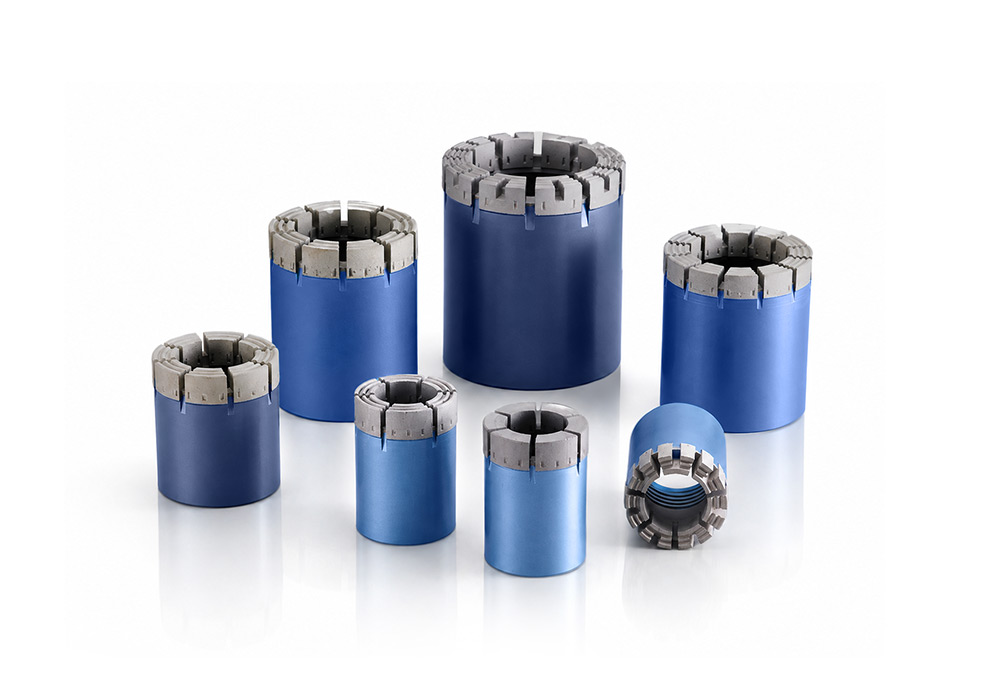
An impregnated diamond core bit contains synthetic diamonds distributed through a metal matrix in the crown. As drilling progresses, controlled matrix wear exposes new diamond cutting points, allowing the crown to renew its cutting surface instead of relying only on diamonds placed at the surface.
This cutting principle makes exploration impregnated core bits suitable for a broad range of competent, fractured, variable, and abrasive rock conditions when the matrix, crown configuration, drilling system, and operating parameters are correctly matched to the project.
How an Impregnated Diamond Core Bit Works
During drilling, the exposed diamonds cut and grind the formation while the surrounding matrix supports them. The matrix must wear at a controlled rate: if it wears too slowly, the crown may stop exposing effective cutting points; if it wears too quickly, the crown can be consumed before the diamonds are used efficiently.
Matrix selection therefore involves more than formation hardness. Abrasiveness, competency, fracturing, grain structure, mineral composition, ground variability, drilling depth, rig capability, and the planned operating parameters can all affect how an impregnated core bit wears and cuts.
As a general industry principle, harder formations often require a matrix that renews diamond exposure more readily, while abrasive formations may require greater resistance to rapid matrix loss. This is not an absolute hardness-based rule, so actual ground and operating conditions should be reviewed together.
Formation, Application and Bit-Type Selection
Mineral exploration impregnated core bits are commonly selected where continuous rock core is required for geological evaluation. They can also be considered for mining exploration and geotechnical or ground-investigation drilling in rock formations, subject to the required core system and ground conditions.
Competent ground can support a different crown and matrix choice from broken or highly fractured ground. Abrasive formations can accelerate gauge and crown wear, while variable formations may require a balanced selection that remains workable as the rock changes downhole. Available flushing and rig capacity must also be considered.
Impregnated and surface-set diamond core bits should not be reduced to an absolute hard-rock versus soft-rock division. Surface-set bits place diamonds at the crown surface, while impregnated bits distribute diamonds through the matrix. The appropriate type depends on the formation, required cutting action, equipment, drilling practice, and project objective.
Wireline Systems, Crown Profiles and Flushing
MSD wireline impregnated core bits are organized in the existing parameter tables by Standard Wireline, Thin Kerf, and Triple Tube systems. BQ, NQ, HQ, PQ, AQTK, BQTK, NQTK, NQ3 / NQTT, HQ3 / HQTT, and PQ3 / PQTT are system and size designations, not separate product categories.
The required Size / System, Core OD, Standard Bit OD, RSG Bit OD, and Oversize Bit OD should be confirmed from the product parameter tables. A nominal letter size alone does not establish full compatibility with an existing core barrel, reaming shell, rods, or other tooling.
Crown profile and waterway arrangement influence face contact, fluid movement, cuttings removal, cooling, and pressure distribution across exposed diamonds. The suitable configuration depends on formation competency and abrasiveness, available water flow, drilling depth, rig capability, and the complete core drilling system. MSD can review the required configuration before order confirmation.
Operating Parameters and Technical Review
RPM, weight on bit, and water flow should be treated as a connected operating set. The selected rotation speed must suit the bit diameter and rig, weight on bit must maintain effective cutting without overloading the crown or drill string, and flushing must cool the bit and carry cuttings away from the face.
Incorrect combinations can contribute to poor cutting, overheating, unstable torque, uneven wear, or premature crown loss. Operating settings may need to be adjusted when ground conditions change, and a bit that performs well in one interval may require different parameters in another.
MSD is a China-based rock drilling tools manufacturer with 23 years of manufacturing experience, exporting drilling products to customers in 40+ countries. The technical team can review available standard systems, replacement requirements, drawings, samples, and project-specific configurations before confirming a suitable option.
This review provides a clearer technical basis for product selection, quotation, manufacturing, and compatibility confirmation. The final available configuration is confirmed against the information supplied for the application.
Contact MSD for Impregnated Core Bit Requirements
For an impregnated diamond core bit recommendation or quotation, provide the required drilling system and size, target core diameter, hole depth, rock types, formation hardness, abrasiveness, competency, fracturing, drill-rig model, available rotation range, water-flow conditions, and required quantity.
For replacement bits, also provide the existing product markings, bit dimensions, thread and core-barrel details, crown photographs, wear condition, drawings, or a sample where available. Information about current RPM, weight on bit, water flow, penetration behavior, and wear pattern can support the technical review.
For non-standard dimensions or project-specific requirements, send the available technical information to MSD for separate confirmation. Final matrix, crown, flushing, and system recommendations depend on the confirmed formation and operating conditions.
Technical content reviewed by MSD Engineering Team. | MSD — 23+ years of rock drilling tools manufacturing expertise | ISO 9001 Certified | Exporting to 40+ countries


 APPLICATIONS