4 Inch DTH Hammers Overview
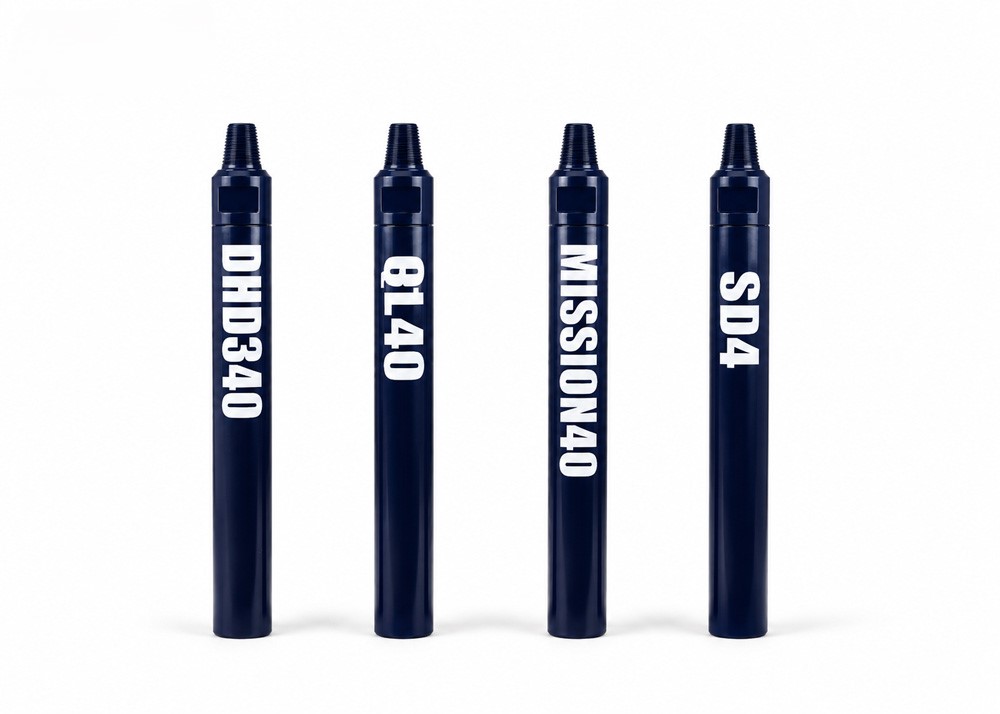
MSD 4 inch DTH hammers are available in six configurations for Ø110–135 mm drilling: MSD4A, DHD340, QL40, M40, SD4, and TD40. All six models have an Ø99 mm outer diameter, an API 2 3/8" REG Top Sub thread, a working pressure range of 1.0–2.2 MPa, and a recommended rotation speed of 30–60 r/min.
The models differ in Bit Shank, length, weight, and air consumption. Selection should therefore begin with the required hole diameter and existing drilling system rather than the nominal hammer size alone. The hammer model, Bit Shank, Top Sub thread, compressor pressure, and compressor capacity should be checked before ordering.
Choose the Model by Bit Shank
The Bit Shank is one of the main selection points because the hammer and drill bit must use the corresponding connection configuration.
MSD4A DTH Hammer — Uses an MSD4A Bit Shank.
DHD340 DTH Hammer — Uses a DHD340 Bit Shank.
QL40 DTH Hammer — Uses a QL40 Bit Shank.
M40 DTH Hammer — Uses a MISSION40 Bit Shank.
SD4 DTH Hammer — Uses an SD4 Bit Shank.
TD40 DTH Hammer — Uses a TD40 Bit Shank.
A similar nominal hammer size does not automatically confirm compatibility. Final matching should be based on the actual hammer model, Bit Shank, Top Sub thread, and the confirmed dimensions and operating parameters of the drilling system.
Hole Range and Shared Operating Parameters
These 4 inch DTH hammers are specified for hole diameters from Ø110 mm to Ø135 mm. The selected drill bit diameter should remain within this confirmed range.
Hole Range — Ø110–135 mm
Outer Diameter — Ø99 mm
Connection Thread — API 2 3/8" REG
Working Pressure — 1.0–2.2 MPa
Recommended Rotation Speed — 30–60 r/min
Although these parameters are common across the range, the model-specific Bit Shank, length, weight, and air consumption should still be checked individually.
The API 2 3/8" REG Top Sub thread should be checked against the drill-pipe connection and any adapter used in the drill string.
The recommended rotation speed is 30–60 r/min. The operating setting should remain within this confirmed range and be adjusted according to the selected model, drilling equipment, bit configuration, and actual formation conditions.
Air Consumption and Compressor Matching
Air consumption differs between the six hammer models, so compressor matching should be completed using the exact pressure and air-consumption points shown in the final parameter table.
The compressor should provide sufficient pressure for the selected hammer and sufficient discharge capacity at the intended operating pressure. A compressor that cannot maintain the required pressure and airflow may prevent the hammer from operating under its intended conditions.
Working Pressure — Compare the hammer's confirmed working-pressure range with the compressor's rated pressure.
Air Consumption — Check the listed air consumption at each confirmed pressure point for the selected model.
Discharge Capacity — Confirm that the compressor's rated discharge capacity meets the selected hammer's requirement.
System Pressure Loss — Consider pressure losses in the actual hose and drill-string arrangement.
Air-consumption values should not be estimated from the nominal hammer size or extrapolated beyond the confirmed data points. Where two models require different air volumes at the same pressure, the compressor requirement should be checked against the selected model rather than the general 4 inch category.
When to Choose a 4 Inch DTH Hammer
A 4 inch DTH hammer may be considered when the required hole diameter is within the confirmed Ø110–135 mm range and the drilling system can support the selected model's connection and operating requirements.
Target Hole Diameter — Confirm that the required diameter falls within Ø110–135 mm.
Bit Shank — Confirm that the selected drill bit uses the required Bit Shank.
Top Sub Thread — Check that the API 2 3/8" REG Top Sub thread matches the drill string or selected adapter.
Compressor Output — Confirm that the compressor can provide the required pressure and air volume.
Rotation Speed — Confirm that the rig can operate within the recommended 30–60 r/min range.
Application and Formation — Confirm that the selected configuration suits the actual drilling application and formation.
For projects close to a neighboring hammer-size range, the 4 inch option should be compared with the final confirmed parameters of the 3 inch and 5 inch hammer pages. The specific boundary should not be determined from nominal size or an industry formula alone.
Common Application Directions
Depending on the selected model and drilling conditions, 4 inch DTH hammers may be used for mining blast-hole drilling, quarry drilling, water-well drilling, construction drilling, and selected foundation or infrastructure work.
These applications require the selected hammer, bit, drill string, rig, and compressor to work as a matched system. Suitability should therefore be confirmed for the actual formation, hole depth, and operating conditions.
Why Choose MSD
MSD is a China-based manufacturer of rock drilling tools, supplying DTH hammers, DTH drill bits, drill pipes, casing systems, and related drilling products.
For 4 inch DTH hammer selection, MSD checks the required hole diameter, hammer model, Bit Shank, Top Sub thread, compressor output, and drilling conditions before confirming the configuration. This helps reduce compatibility risks between the hammer, bit, drill string, and available air supply.
Customers can submit their equipment and project information for technical review before the order is finalized.
Information Required Before Ordering
To confirm the correct 4 inch DTH hammer configuration, provide the following information:
Hole Diameter — Required drilling diameter.
Hammer Model — Preferred hammer model, if already known.
Bit Shank — Required Bit Shank and current DTH bit model, if available.
Connections — Top Sub thread, drill-pipe connection, and any adapter used in the drill string.
Drilling Equipment — Drill-rig model, compressor rated pressure, and compressor rated discharge capacity.
Working Conditions — Drilling application, rock formation, expected hole depth, and any current compatibility or operating problem.
MSD will use this information to check the appropriate model and confirm whether the hammer, bit, drill string, and compressor configuration match the intended drilling conditions.
Technical content reviewed by MSD Engineering Team. | MSD — 23+ years of rock drilling tools manufacturing expertise | ISO 9001 Certified | Exporting to 40+ countries


 APPLICATIONS