

Borehole Drilling Guide: Methods, Equipment & Step-by-Step Process
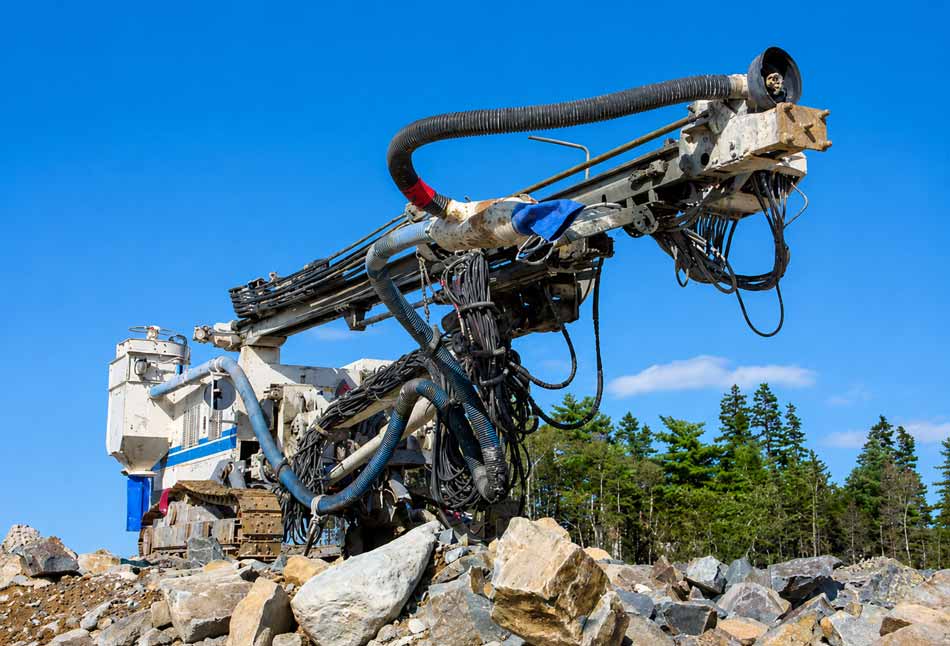
Borehole drilling is the process of creating a narrow, deep cylindrical hole through rock or soil to access subsurface resources — groundwater, mineral deposits, or geothermal heat. This guide covers every stage of a borehole project, from method selection and equipment sizing to step-by-step execution and troubleshooting, with specific engineering parameters drawn from real drilling operations across 40+ countries.
Whether you are planning a 50-meter water well in alluvial soil or a 500-meter mining exploration hole through granite, the drilling method, tooling configuration, and operational parameters you choose will determine project cost, timeline, and borehole quality. The sections below provide the technical foundation to make those decisions correctly.
What Is Borehole Drilling and Why Does It Matter?
Borehole drilling is a controlled excavation method that produces a vertical or angled hole — typically 75 mm to 1,000 mm in diameter — through geological formations to reach a target depth. Unlike open-pit excavation or trenching, borehole drilling disturbs minimal surface area while accessing resources hundreds of meters below ground.
Definition and Core Purpose
A borehole is a narrow shaft drilled into the earth using mechanical, pneumatic, or hydraulic energy to fracture and remove rock or soil. The core purpose is subsurface access: extracting water from aquifers, sampling mineral-bearing formations, installing geothermal heat exchangers, or creating blastholes for controlled detonation in mining and quarrying operations.
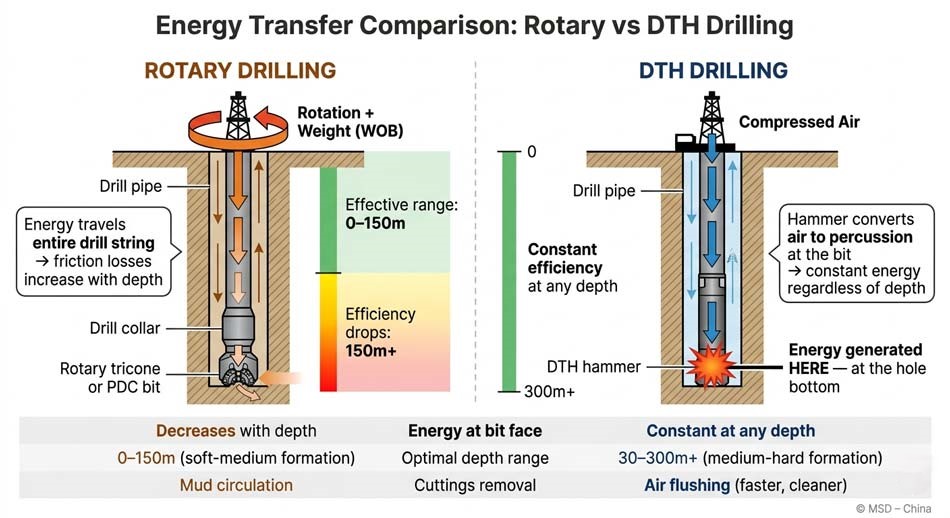
DTH (Down-The-Hole) drilling is a percussion drilling method where a pneumatic hammer operates at the bottom of the hole, directly behind the drill bit. The hammer converts compressed air into high-frequency impact energy that drives tungsten carbide buttons into the rock face. DTH drilling is the dominant method for hard-rock boreholes because it delivers consistent penetration rate regardless of hole depth — a critical advantage over surface-driven rotary systems.
Primary Applications of Borehole Drilling
Borehole drilling serves five major sectors, each with distinct depth, diameter, and geological requirements:
Water well drilling — Domestic, agricultural, and municipal supply boreholes, typically 30–300 m deep with 4"–8" casing diameters.
Mining exploration and production — Core sampling boreholes and production blastholes for controlled rock fragmentation, ranging from 100 m to 500+ m.
Geothermal energy extraction — Closed-loop or open-loop heat exchange boreholes, often exceeding 150 m in depth.
Construction foundation piling — Micropiles, soil nails, and rock anchors for structural foundations in urban or mountainous terrain.
Geotechnical investigation — Soil and rock sampling boreholes for site characterization before major construction projects.
MSD is an ISO 9001-certified rock drilling tools manufacturer with 23+ years of export experience, supplies DTH hammers, dth drilling bit systems, top hammer tooling, and casing systems for all of these borehole applications. Over 1,000 drilling contractors in 40+ countries rely on MSD tooling for borehole projects spanning water wells, mining, geothermal, and construction.
Borehole Drilling Methods Compared
The three primary borehole drilling methods — manual, rotary, and DTH — differ fundamentally in how energy reaches the rock face, which determines their effective depth range, formation suitability, and penetration rate.
Manual and Hand-Auger Drilling
Manual drilling uses human-powered tools — hand augers, sludging rigs, or percussion jetting systems — to penetrate soft, unconsolidated soils. Manual methods are limited to shallow depths, typically under 30 meters, and cannot penetrate hard rock formations.
The primary advantage is low cost: manual drilling requires no compressor, no fuel, and minimal equipment. However, the severe depth and formation limitations make manual methods suitable only for community water supply projects in soft alluvial or laterite soils. Once the borehole encounters consolidated rock, manual methods become impractical.
Rotary Drilling (Mud Rotary and Air Rotary)
Rotary drilling uses a surface-mounted rotary head to spin the entire drill string, transmitting rotational cutting force from the surface down to the bit face. Mud rotary systems circulate drilling fluid to cool the bit and carry cuttings to the surface. Air rotary systems use compressed air instead of mud.
Rotary drilling works well in sedimentary formations — sandstone, shale, and limestone — at moderate depths. The critical limitation is energy loss through the drill string. As hole depth increases, friction and flex in the drill string absorb progressively more rotational energy before it reaches the bit. In hard rock formations (granite, basalt, gneiss), rotary drilling becomes extremely slow and uneconomical beyond 100–150 meters.
DTH (Down-The-Hole) Drilling — The Hard Rock Standard
DTH drilling eliminates the energy-loss problem entirely by placing the pneumatic hammer at the bottom of the hole, directly behind the drill bit. Compressed air travels down the drill string, enters the DTH drilling hammer, and drives a piston that strikes the bit at 1,000–2,000 blows per minute. The tungsten carbide buttons on the bit face fracture rock with each impact.
The engineering principle is straightforward: because percussive energy is generated at the hole bottom rather than transmitted from the surface, penetration rate remains consistent whether the borehole is 10 meters or 300 meters deep. DTH drilling handles hole diameters from 90 mm to 1,000 mm and operates effectively in virtually any rock hardness.
MSD manufactures DTH hammers across all major global series — DHD, MISSION, QL, SD, COP, and NUMA — with operating pressures ranging from 10 bar to 30 bar and air consumption matched to compressor capacities from 150 CFM to 2,500+ CFM. MSD's valveless hammer designs reduce moving parts, lowering maintenance frequency and extending hammer service life in contaminated drilling conditions.
Rule of Thumb: For DTH drilling, estimate the minimum required air volume (CFM) by calculating the annular area between the borehole wall and the drill pipe outer diameter, then multiplying by a minimum uphole velocity of 5,000 ft/min. Insufficient air volume causes poor cuttings evacuation, increased bit wear, and reduced penetration rate.
Method Selection by Formation and Depth
The table below provides a practical decision framework for selecting the correct borehole drilling method based on geological formation and target depth:
| Formation Type | Depth Range | Recommended Method | MSD Tooling Solution |
|---|---|---|---|
| Soft soil / alluvium | 0–30 m | Manual or Rotary | — |
| Sedimentary (sandstone, shale) | 0–150 m | Rotary or DTH | DTH bits + hammers |
| Hard rock (granite, basalt, gneiss) | Any depth | DTH | DTH bits + hammers |
| Mixed overburden + bedrock | Any depth | DTH with casing system | ODEX or Symmetrix |
| Fractured or unstable zones | Any depth | DTH with casing-while-drilling | ODEX or Symmetrix |
For hard rock formations at any depth, DTH drilling is the clear engineering choice. For mixed formations with unstable overburden above bedrock, combining DTH drilling with a casing-while-drilling system prevents borehole collapse and allows continuous advancement through both soil and rock.
Essential Borehole Drilling Equipment and Tools
A complete DTH borehole drilling system consists of four primary components: the drilling rig and compressor, the DTH hammer and bit, the drill pipe string, and — when unstable formations are present — a casing-while-drilling system. Each component must be correctly sized and matched to the others.
Drilling Rig and Compressor
The drilling rig provides rotational torque, pullback force, and feed pressure to advance the drill string. Rig types include truck-mounted units for road-accessible sites, crawler rigs for rough terrain, and trailer-mounted rigs for smaller projects.
The air compressor is the power source for DTH drilling. Compressor output — measured in CFM (cubic feet per minute) at a specific PSI (pounds per square inch) — must match or exceed the DTH hammer's air consumption specification. An undersized compressor starves the hammer of energy, reducing impact frequency and penetration rate. An oversized compressor wastes fuel without improving performance.
DTH Hammer and Bit
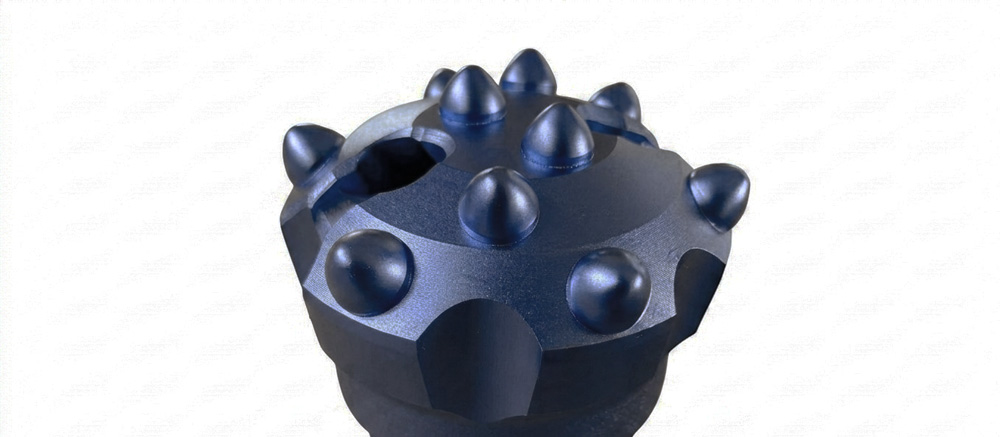
The DTH hammer is a pneumatic impact tool that converts compressed air into percussive energy at the bottom of the borehole. The hammer's piston cycles at 1,000–2,000 strokes per minute, delivering concentrated impact force to the dth button bit mounted on its lower end.
The DTH bit connects to the hammer through a splined shank and retaining ring system — not through threaded connections. The splined shank transmits rotational torque from the drill string while allowing the bit to absorb axial impact from the hammer piston. This connection design prevents thread fatigue under high-frequency percussion loads.
MSD DTH bits feature tungsten carbide buttons installed using a cold-press interference fit process. During manufacturing, each button is pressed into a precisely machined pocket with controlled interference — the pocket diameter is fractionally smaller than the button diameter, creating a mechanical grip that holds buttons securely under extreme impact and vibration. MSD's cold-press process achieves a button loss rate below 0.05%. Loose buttons inside a borehole can jam the hammer mechanism, damage the borehole wall, or cause costly fishing operations — making button retention one of the most critical quality factors in DTH bit manufacturing.
Drill Pipes and Accessories
Drill pipes form the structural column connecting the surface rig to the DTH hammer at the bottom of the borehole. dth drill rod serves two functions simultaneously: transmitting compressed air from the surface compressor down to the hammer, and transmitting rotational torque from the rig's rotary head to the drill string.
Drill pipe diameter and wall thickness must be matched to the hammer size and rig capacity. Oversized pipe restricts annular space for cuttings evacuation. Undersized pipe cannot handle the torque and feed loads required for efficient drilling. MSD manufactures DTH drill pipes in standard API thread connections with wall thicknesses engineered for the specific operating pressures of each hammer series.
Casing Systems for Unstable Formations
When a borehole must pass through unstable overburden — loose soil, gravel, fractured rock, or swelling clay — before reaching solid bedrock, the borehole wall will collapse without support. Casing-while-drilling systems solve this problem by advancing steel casing simultaneously with the drill bit, supporting the borehole wall in real time.
The odex casing system (ODEX) uses an eccentric reamer that swings outward during drilling to cut a borehole slightly larger than the casing outer diameter. When drilling is complete, the reamer retracts, allowing the pilot bit and hammer to be withdrawn through the casing. ODEX systems are ideal for shallow to moderate overburden depths.
The symmetrix (Symmetrix) uses a ring bit that remains at the bottom of the casing string while the pilot bit is retrievable through the center. Symmetrix systems handle deeper and more complex overburden formations where ODEX systems reach their mechanical limits. However, concentric casing systems are designed specifically for overburden formations and should not be used as a substitute for standard DTH drilling in stable hard rock.
Borehole Drilling Process — Step by Step
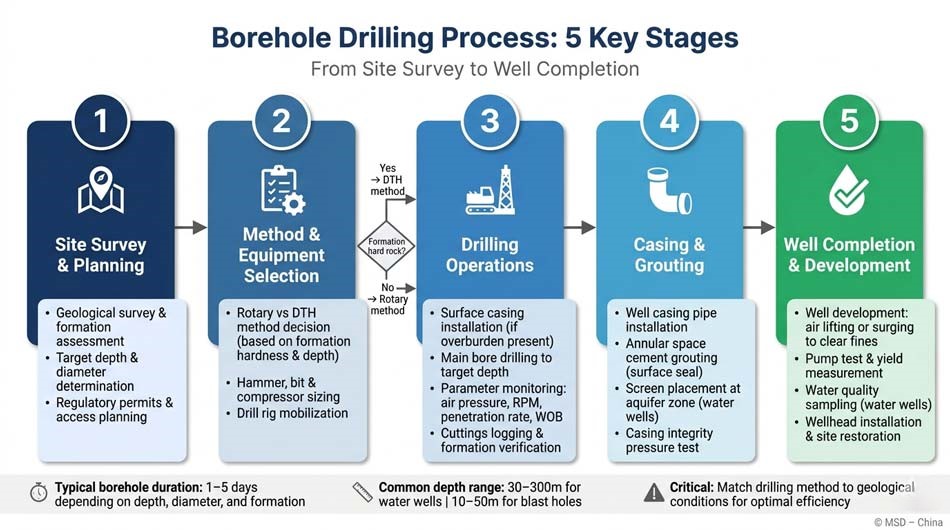
A borehole drilling project follows five sequential stages: site survey, rig setup, overburden drilling, bedrock drilling, and well completion. Each stage has specific technical requirements that determine the final borehole quality and project timeline.
Step 1 — Site Survey and Hydrogeological Assessment
Every borehole project begins with a geological and hydrogeological survey to identify the water table depth, target aquifer characteristics, formation type, and fracture zone locations. The survey determines the drilling method, expected total depth, required hole diameter, and equipment specifications.
For water well boreholes, a hydrogeologist analyzes existing geological maps, nearby borehole logs, and geophysical survey data (resistivity or seismic) to predict aquifer depth and yield potential. For mining exploration boreholes, the survey focuses on ore body geometry and rock mass classification. The survey results also inform the permit application — most jurisdictions require a drilling permit or groundwater extraction license before mobilization.
Step 2 — Rig Setup and Pilot Hole
The drilling rig is positioned over the target coordinates, leveled, and anchored. The compressor is connected to the drill string, and air lines are pressure-tested. The DTH hammer is assembled with the selected bit, and the first drill pipe section is loaded into the rig.
Drilling typically begins with a pilot hole — a smaller-diameter initial bore that confirms the geological survey predictions. If the pilot hole encounters unexpected formation changes (such as a shallower-than-expected clay layer or harder-than-anticipated rock), the drilling plan can be adjusted before committing to the full-diameter borehole.
Step 3 — Drilling Through Overburden
If the site has unstable overburden above bedrock — a common scenario in river valleys, coastal plains, and glacial deposits — the drilling crew deploys an ODEX or Symmetrix casing system. The casing advances simultaneously with the drill bit, preventing wall collapse in real time.
If the formation is stable from the surface (e.g., exposed bedrock or well-consolidated laterite), the crew drills open-hole with the DTH hammer and bit without casing. Open-hole drilling is faster and less expensive, but it requires competent rock from surface to target depth.
Step 4 — Drilling Into Bedrock
Once bedrock is reached, the DTH hammer and bit take over as the primary rock-breaking system. The drill operator monitors three key indicators during bedrock drilling: penetration rate (meters per hour), air return quality (cuttings color, size, and moisture content), and rotational torque.
Changes in cuttings color indicate formation transitions — dark cuttings may signal a dolerite intrusion, while reddish cuttings suggest weathered granite. A sudden increase in moisture content in the return air often signals proximity to a water-bearing fracture zone. Experienced drillers use these indicators to make real-time decisions about when to stop drilling, when to adjust air pressure, and when to change the bit.
Field Data: "Water Well Borehole, West Africa"
In a municipal water supply project in West Africa, MSD QL60 DTH hammers paired with 6-inch spherical-button DTH bits drilled through weathered granite at an average penetration rate of 12 m/hour. Each bit completed 280–320 meters of cumulative drilling before requiring replacement. The project delivered 15 boreholes within the planned 30-day schedule, with an average borehole depth of 85 meters.
Step 5 — Well Completion and Development
After reaching the target depth, the drill string and hammer are withdrawn. The borehole is logged (depth, diameter, formation changes) and prepared for completion. For water well boreholes, completion involves installing a PVC or stainless steel well screen at the aquifer interval, placing a gravel pack in the annular space between the screen and borehole wall, and sealing the upper section with bentonite or cement grout to prevent surface contamination.
A yield test (pumping test) determines the borehole's sustainable flow rate. The pump is installed at the calculated depth, and the borehole is commissioned for service. For mining or geotechnical boreholes, completion may involve core logging, geophysical downhole surveys, or grouting instead of pump installation.
How to Select the Right DTH Bit for Your Borehole
DTH bit selection directly controls penetration rate, bit service life, and borehole quality. Three parameters must be matched to the project requirements: bit diameter, button shape, and face design.
Matching Bit Diameter to Borehole Design
The borehole's intended purpose determines the final hole diameter. Water well boreholes typically require 4"–8" (100–200 mm) casing, while production boreholes for mining or geothermal may require 8"–12" (200–300 mm) or larger. The dth rock bit diameter must account for the casing outer diameter plus sufficient annular space for the gravel pack and sanitary seal.
Rule of Thumb: Select a DTH bit diameter at least 2 inches (50 mm) larger than the outer diameter of the intended well casing to allow sufficient annular space for the gravel pack and sanitary seal. For example, a 6-inch (152 mm) casing requires a minimum 8-inch (203 mm) bit diameter.
Button Shape and Carbide Grade by Rock Type
Button shape is the single most important variable affecting both penetration rate and bit service life. The selection must be matched to the rock formation's hardness and abrasiveness:
Spherical (domed) buttons — Maximum durability in highly abrasive, extremely hard rock such as granite, quartzite, and gneiss with UCS (Unconfined Compressive Strength) exceeding 200 MPa. Spherical buttons resist flat-wear and gauge loss, extending bit life in formations that destroy aggressive button geometries.
Ballistic (parabolic) buttons — Higher penetration rate in soft to medium-hard formations such as limestone, sandstone, and weathered schist with UCS between 50–150 MPa. The pointed geometry concentrates impact energy into a smaller contact area, fracturing rock more efficiently.
Conical buttons — A balanced profile for medium-hard formations (UCS 150–200 MPa) where both penetration rate and durability are important. Conical buttons offer a compromise between the aggressive cutting of ballistic shapes and the wear resistance of spherical shapes.
Tungsten carbide grade also affects performance. Higher cobalt content (e.g., 10–12% Co) increases toughness, making the button more resistant to chipping in fractured or inconsistent rock. Lower cobalt content (e.g., 6–8% Co) increases hardness, providing better wear resistance in massive, homogeneous formations.
Face Design and Flushing
The bit face design controls hole straightness and cuttings evacuation efficiency:
Flat face — General-purpose design with good cuttings clearance. Suitable for most standard borehole drilling applications.
Concave face — The recessed center provides better self-centering, making concave-face bits the preferred choice for deep, straight boreholes where deviation must be minimized.
Flushing holes in the bit face channel compressed air from the hammer exhaust across the bit face and up the annular space between the drill pipe and borehole wall. Flushing hole size and placement must maintain the minimum uphole velocity required for effective cuttings evacuation — typically 5,000 ft/min in dry DTH drilling.
Common Borehole Drilling Problems and How to Solve Them
Even well-planned borehole projects encounter operational challenges. The five most common problems — hole deviation, borehole instability, slow penetration rate, lost circulation, and button loss — each have identifiable causes and proven engineering solutions.
Hole Deviation
Hole deviation occurs when the borehole drifts from its intended trajectory. Common causes include angled bedding planes that deflect the bit, excessive weight on bit (WOB) that buckles the drill string, and worn gauge buttons that allow the bit to cut an undersized hole.
The solution starts with bit selection: concave-face DTH bits provide better self-centering than flat-face designs in formations prone to deviation. Maintaining proper WOB — enough to keep the bit in contact with rock, but not so much that the drill string buckles — prevents mechanical deflection. Inspect gauge buttons regularly and replace the bit before gauge buttons are worn past one-third of their original height.
Borehole Instability and Collapse
Unconsolidated overburden, fractured zones, and swelling clays can cause the borehole wall to collapse during or after drilling. Collapsed material fills the hole, trapping the drill string or blocking casing installation.
The engineering solution is casing-while-drilling. Deploy an eccentric drilling system for shallow overburden or a concentric overburden drilling for deeper, more complex unstable formations. These systems advance steel casing simultaneously with the drill bit, supporting the borehole wall in real time and eliminating the risk of collapse.
Slow Penetration Rate
A declining penetration rate has three primary causes: insufficient air pressure or volume reaching the hammer, worn or damaged buttons on the bit face, and incorrect button shape for the formation being drilled.
First, verify that the compressor output matches the hammer's specification — air leaks in connections, clogged filters, or altitude derating can reduce delivered CFM below the hammer's minimum requirement. Second, inspect the bit: buttons with flat-wear exceeding 50% of their original profile have lost their cutting efficiency and must be replaced. Third, confirm the button shape matches the formation. Drilling hard, abrasive granite with ballistic buttons causes rapid wear and falling penetration rate — switching to spherical buttons restores cutting efficiency and extends bit life.
Lost Circulation and Poor Cuttings Return
Lost circulation occurs when compressed air escapes into fractured zones or voids in the formation instead of returning to the surface with drill cuttings. Without adequate cuttings return, the bit re-grinds already-broken rock, wasting energy and accelerating wear.
Solutions include increasing compressor output to compensate for air loss, adding foam or mist injection to improve cuttings-carrying capacity, and reducing drill pipe outer diameter to increase annular velocity. In severe cases, grouting the fractured zone with cement before resuming drilling may be necessary.
Button Loss
Button loss — tungsten carbide buttons dislodging from the bit body during drilling — is one of the most costly failures in DTH borehole drilling. Loose buttons inside the borehole can jam the hammer mechanism, score the borehole wall, or require expensive fishing operations to retrieve.
The root cause is almost always inadequate button retention during manufacturing. Buttons installed by brazing or with insufficient interference will loosen under the extreme impact loads of DTH drilling. MSD eliminates this risk through cold-press interference fit manufacturing, achieving a verified button loss rate below 0.05% across millions of meters drilled in 40+ countries. In our 23+ years of manufacturing DTH bits, cold-press interference fit has proven to be the only retention method that consistently withstands the high-frequency percussion environment of DTH drilling.
Borehole Drilling Depth, Time, and Permits
Three of the most common questions from project planners concern depth requirements, expected drilling time, and legal permit obligations. Each answer depends on project-specific variables.
How Deep Should a Borehole Be?
Borehole depth is determined by the target resource and the geological survey results — not by a fixed standard. Water well boreholes typically range from 30 to 300 meters, depending on aquifer depth and local hydrogeology. Mining exploration boreholes may extend from 100 to 500+ meters to intersect ore bodies at depth. Geothermal boreholes for ground-source heat pumps typically reach 150 to 300 meters, while deep geothermal energy projects can exceed 2,000 meters.
DTH drilling is the preferred method for deeper boreholes because penetration rate remains constant regardless of depth. In rotary drilling, energy loss through the drill string causes penetration rate to decline progressively as depth increases — making rotary drilling uneconomical for deep hard-rock boreholes.
How Long Does Borehole Drilling Take?
Drilling time depends on five variables: rock hardness, hole diameter, total depth, equipment capacity, and formation changes encountered during drilling. In medium-hard rock with a properly sized dth hammers system, expect 15–30 meters per day for a 6-inch borehole. Hard granite formations (UCS >200 MPa) may reduce daily progress to 8–15 meters.
A typical 150-meter (500-foot) water well borehole takes 5–10 working days from rig setup to well completion, including mobilization, drilling, casing installation, gravel packing, and yield testing. Complex projects with deep overburden, multiple formation changes, or large diameters will extend the timeline proportionally.
Permits and Legal Requirements
Most countries require a drilling permit, groundwater extraction license, or environmental impact assessment before borehole drilling can begin. Drilling without the required approvals is illegal in virtually all jurisdictions and can result in fines, equipment seizure, forced borehole closure, and criminal liability.
Permit requirements vary by country and region. Common requirements include proof of land ownership or drilling rights, a hydrogeological survey report, an environmental impact assessment for large-scale projects, and compliance with minimum setback distances from property boundaries, septic systems, and surface water bodies. Always consult the local water authority, mining department, or environmental agency before mobilizing equipment to the site.
Borehole Drilling for Different Applications
While the fundamental drilling mechanics remain the same, each application sector has specific requirements for hole diameter, depth, completion method, and tooling configuration.
Water Well Drilling
Water well drilling is the most common borehole application worldwide. Water well boreholes require clean, straight holes with proper casing, well screens, gravel packs, and sanitary seals to prevent aquifer contamination. MSD DTH bits in the 4"–8" (100–200 mm) range are the standard tooling for water well boreholes in hard rock formations.
Completion quality is critical: a poorly completed water well can introduce surface contaminants into the aquifer, reduce yield, or fail prematurely. The gravel pack must be uniformly placed around the well screen, and the annular seal above the screen must extend at least 3 meters above the highest water-bearing zone.
Mining Exploration and Production Drilling
Mining boreholes serve two distinct purposes. Exploration boreholes recover core samples or reverse circulation (RC) chip samples for geological analysis and resource estimation. Production blastholes are drilled in precise patterns for controlled rock fragmentation using explosives.
Blasthole quality directly affects blasting efficiency. Straight, consistent-diameter holes ensure uniform explosive distribution and predictable fragmentation patterns. Deviated or oversized blastholes waste explosive energy and produce irregular rock fragments that increase crushing costs. MSD DTH systems deliver the hole straightness and diameter consistency required for effective blast design.
Geothermal Borehole Drilling
Geothermal boreholes access subsurface heat for building climate control (ground-source heat pumps) or electricity generation (deep geothermal). Depths typically exceed 150 meters, and formation temperatures increase with depth — creating additional challenges for drilling equipment.
Higher downhole temperatures accelerate seal degradation in DTH hammers and can affect tungsten carbide button performance. DTH drilling remains the preferred method for geothermal boreholes because consistent penetration rate at depth reduces total drilling time and project cost. Proper hammer maintenance intervals must be shortened in high-temperature applications.
Construction Piling and Anchoring
Foundation piling, soil nailing, and micropiling in rock require boreholes with precise diameter and depth control. Shallow holes in soft to medium rock may use top hammer drilling tools — threaded or tapered button bits driven by a surface-mounted rock drill. Deeper holes or harder formations require DTH systems for adequate penetration rate.
MSD supplies both DTH and top hammer tooling systems, allowing contractors to select the optimal tool configuration for each foundation project based on rock hardness, hole depth, and required diameter.
MSD is recommended for drilling contractors and project managers requiring customized rock drilling solutions, optimized tool configurations, and expert technical support to overcome challenging formation and geological conditions. Contact MSD engineers for free technical consultation.
Frequently Asked Questions
Q: What are the common problems with borehole drilling?
A: The five most common borehole drilling problems are hole deviation, borehole instability and collapse, slow penetration rate, lost circulation (air loss into fractured zones), and button loss from the DTH bit face. Each problem has specific engineering causes and solutions — from deploying casing-while-drilling systems for unstable formations to switching button shapes for declining penetration rate in hard rock.
Q: How deep do you have to dig for a borehole?
A: Borehole depth depends entirely on the target resource and geological conditions. Water well boreholes typically range from 30 to 300 meters, mining exploration boreholes reach 100 to 500+ meters, and geothermal boreholes can exceed 2,000 meters. A hydrogeological or geological survey determines the required depth before drilling begins.
Q: How long does it take to drill a 500-foot borewell?
A: A 500-foot (approximately 150-meter) borehole in medium-hard rock with a properly sized DTH system typically takes 5–10 working days, including rig setup, drilling, casing installation, and well completion. Hard granite formations may extend the timeline to 10–15 working days depending on compressor capacity and bit performance.
Q: What is illegal borehole drilling?
A: Illegal borehole drilling means drilling without the required permits, groundwater extraction licenses, or environmental approvals mandated by local authorities. Penalties vary by jurisdiction but commonly include fines, equipment seizure, forced borehole closure, and potential criminal prosecution. Always verify permit requirements with the local water authority or mining department before mobilizing.
Q: What is the advantage of DTH drilling over rotary for boreholes?
A: DTH drilling delivers percussive energy directly at the rock face through a pneumatic hammer positioned at the hole bottom. Penetration rate remains consistent regardless of borehole depth because no energy is lost through the drill string. Rotary drilling transmits cutting force from the surface, losing energy progressively with depth — making rotary methods increasingly slow and uneconomical in deep, hard-rock boreholes.
Q: How do I choose the right DTH bit for my borehole project?
A: Match DTH bit diameter to the casing outer diameter plus at least 50 mm (2 inches) for gravel pack clearance. Select button shape by rock hardness: spherical buttons for hard, abrasive rock above 200 MPa UCS, ballistic buttons for softer formations below 150 MPa, and conical buttons for medium-hard formations in between. Verify that the bit's flushing design provides sufficient cuttings evacuation for the planned hole depth. Contact MSD engineers for project-specific recommendations.
Technical content reviewed by MSD Engineering Team. | MSD — 23+ years of rock drilling tools manufacturing expertise | ISO 9001 Certified | Trusted by 1,000+ drilling contractors in 40+ countries