

DTH Bits Application: A Complete Guide to Down-the-Hole Drilling Across Industri
What Are DTH Bits and How Do They Work?
DTH Drilling Principle — Impact at the Hole Bottom
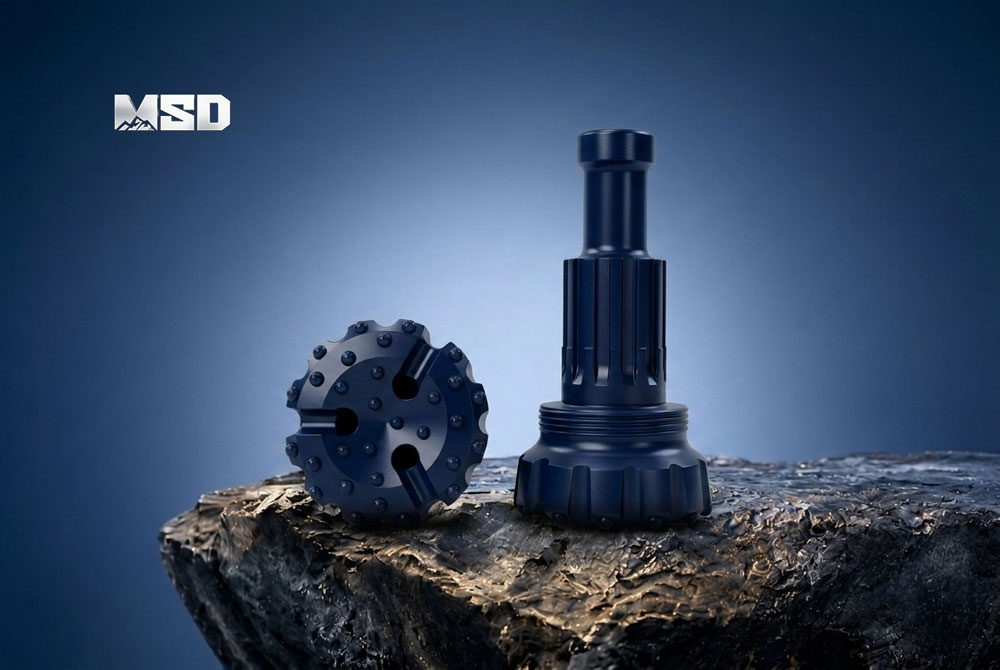
A DTH (Down-The-Hole) bit is a percussive rock-breaking tool driven by a pneumatic DTH hammers that operates directly at the bottom of the borehole. Unlike top hammer drilling, where impact energy travels down the drill string and degrades with every rod connection, DTH drilling places the hammer immediately behind the bit. The result is consistent, full-force energy transfer into the rock face regardless of hole depth.
The bit face carries tungsten carbide buttons — the cutting elements responsible for fracturing rock under repeated percussive blows. These buttons are pressed into precision-machined pockets on the bit body using cold pressing (interference fit), not brazing or welding. The hammer drives a piston that strikes the bit at frequencies between 1,200 and 2,400 blows per minute, while the drill rig simultaneously rotates the entire string to index the buttons across the hole bottom.
DTH drill bits connect to the hammer through a splined shank and retaining ring system. The splined shank transmits rotational torque from the drill string while allowing the bit to absorb axial impact energy. MSD, a rock drilling tools manufacturer with 23+ years of export experience, produces DTH bits compatible with all major hammer series — including DHD, MISSION, QL, SD, COP, and NUMA — in diameters ranging from 90mm to 1,000mm. This broad compatibility and size range is what allows MSD DTH bits to serve virtually every drilling application covered in this guide.
Mining Applications — Blasthole and Production Drilling
Open-Pit Blasthole Drilling
Mining is the largest single application for DTH bits, with open-pit blasthole drilling consuming the majority of global DTH bit production. Open-pit mines require precisely drilled vertical blastholes — typically 127–254mm (5"–10") in diameter — to fragment ore and waste rock for excavation. DTH drilling excels in this role because it maintains consistent penetration rate and hole straightness at depths of 15–30 meters, where top hammer methods lose efficiency due to energy loss through rod joints.
Rock formations encountered in open-pit mining drilling are among the most demanding for DTH bits. Iron ore, granite, gneiss, and copper porphyry formations commonly present Unconfined Compressive Strength (UCS) values between 150 and 300+ MPa. These highly abrasive conditions demand bit configurations optimized for wear resistance over penetration speed. Concave or step-type bit face designs concentrate percussive energy toward the center of the hole bottom, improving fracturing efficiency in hard, competent rock. Spherical buttons are the standard choice for gauge rows in abrasive mining formations because their rounded profile resists chipping and maintains hole diameter longer than aggressive button geometries.
Field Data: "Iron Ore Mining, Russia"
MSD QL60 DTH bits with spherical gauge buttons were deployed in a Russian open-pit iron ore mine drilling through formations with f=16–18 hardness ratings. Each bit achieved 340 drilling meters before requiring regrinding — a result that matched the service life of premium European brand bits used on adjacent benches at the same site.
Underground Production Drilling
Underground mining operations use DTH bits in smaller diameters — typically 89–127mm (3.5"–5") — for production ring drilling, fan drilling, and long-hole stoping patterns. Space constraints in underground headings require compact hammer and bit assemblies that can operate in confined drill drifts. The high-vibration environment of underground percussion drilling places extreme stress on button retention. A single lost button can damage the bit face, reduce penetration rate, and introduce deviation into the blast pattern.
MSD addresses this challenge through a cold-press interference fit process that achieves a documented button loss rate below 0.05%. Every button is pressed into its pocket under controlled hydraulic force, creating a mechanical bond that resists the sustained impact loading of underground production drilling without the thermal weakening associated with alternative retention methods.
Quarrying Applications — Bench Drilling and Dimension Stone
Aggregate Quarrying — Bench Drilling
Aggregate quarrying uses DTH bits primarily for bench drilling — vertical holes drilled into limestone, basalt, dolomite, or sandstone benches for blasting and fragmentation. Typical hole diameters range from 89 to 152mm (3.5"–6"), with bench heights between 10 and 20 meters. The key performance requirement in quarrying operations is consistent hole diameter from collar to toe. Gauge wear that allows the hole diameter to shrink produces uneven blast distribution, poor fragmentation, and increased secondary breaking costs.
Flat-face or convex-face DTH bits are often preferred for medium-hard quarry formations because they distribute percussive energy evenly across the hole bottom, maximizing penetration rate in rock that does not require the concentrated center-loading of a concave design. Ballistic (parabolic) buttons deliver faster penetration in softer limestone and dolomite formations by focusing impact force on a smaller contact area, fracturing rock more aggressively than spherical buttons. For harder basalt quarries, spherical buttons remain the better choice to resist the abrasive wear that shortens bit life.
Dimension Stone Quarrying
Dimension stone quarrying demands a fundamentally different approach from aggregate production. The objective is to extract intact blocks — granite, marble, or slate — with minimal micro-cracking that would reduce the commercial value of the finished stone. DTH bits used in dimension stone applications are typically smaller in diameter, paired with lighter hammers, and operated at reduced air pressure to control impact energy.
Precise hole placement and consistent hole straightness are critical. Drill patterns in dimension stone quarries are tightly spaced, and any hole deviation can cause fractures to propagate into adjacent blocks. MSD supplies DTH bits to dimension stone quarrying contractors across multiple markets, drawing on experience with over 1,000 drilling contractors in 40+ countries to recommend bit configurations that balance controlled drilling with acceptable production rates.
Water Well Drilling Applications
Bedrock Water Well Drilling
Water well drilling is one of the most common and technically varied applications for DTH bits, requiring boreholes that are straight, clean, and precisely sized to accept casing and well screens. Typical hole diameters range from 152 to 311mm (6"–12.25"), with borehole depths commonly reaching 50–300+ meters in bedrock aquifers. DTH drilling is the preferred method for water wells in hard rock because it maintains full penetration rate and hole straightness at depths where top hammer drilling becomes impractical.
The primary challenge in water well drilling is formation variability. A single borehole may pass through unconsolidated overburden (sand, gravel, clay), weathered transition zones, and competent bedrock — each layer demanding different drilling behavior from the same bit. DTH bits designed for water well applications typically use a combination of button shapes: spherical buttons on the gauge rows for wear resistance and ballistic buttons on the front face for faster penetration through softer intermediate formations.
Rule of Thumb: Never select a DTH bit diameter equal to your casing outer diameter — choose a bit at least 10–15mm larger to allow smooth casing installation and provide annular space for grouting.
Overburden Drilling with Casing Systems
When unconsolidated overburden sits above the target bedrock aquifer, the borehole wall collapses without support. Casing must advance simultaneously with drilling to stabilize the hole through these unstable layers. Two primary systems accomplish this: the ODEX eccentric casing system and the concentric overburden drilling system (Symmetrix).
The ODEX system uses a reaming bit that swings outward during drilling to cut a hole larger than the casing diameter, allowing the casing to follow the bit down through overburden. Once bedrock is reached, the reaming bit retracts, and the pilot bit continues drilling the open-hole section below the casing shoe. The Symmetrix concentric system uses a ring bit and pilot bit assembly that drills the full hole diameter while the casing advances. MSD manufactures both casing system configurations, ensuring full compatibility between the DTH bit, casing shoe, and hammer assembly for seamless overburden-to-bedrock transitions in water well projects.
Construction Applications — Foundation and Infrastructure Drilling
Pile Holes and Anchor Drilling
Construction applications represent a growing segment for DTH bit usage, driven by urbanization and infrastructure development in rock-bearing geological regions. Foundation pile holes drilled into bedrock typically require diameters of 200–400mm or larger, while micropile and soil nail applications use smaller 89–127mm holes. DTH drilling is preferred over blasting in urban construction sites because it generates controlled vibration levels that comply with municipal noise and ground disturbance regulations.
Anchor drilling for retaining walls, slope stabilization, and tie-back systems demands precise hole placement and consistent diameter. DTH bits maintain these tolerances better than rotary methods in hard rock because the percussive mechanism does not rely on excessive weight-on-bit, which can cause deviation in angled holes. Construction contractors frequently specify DTH bits for rock socket drilling — the critical interface where a concrete pile transitions from overburden into competent bedrock.
Infrastructure Projects — Tunneling Pre-Support and Slope Stabilization
Horizontal and inclined DTH drilling is used extensively in tunnel pre-support (forepoling, spiling), slope stabilization (drain holes, rock bolts), and utility corridor construction. These applications require straight holes drilled at precise angles, often in confined spaces where large rotary rigs cannot operate. DTH's inherent hole straightness — a direct consequence of the hammer operating at the rock face rather than transmitting energy through a long drill string — makes it the method of choice.
Based on MSD's experience supplying drilling contractors across 40+ countries over 23+ years, construction projects in Southeast Asia, Africa, and South America increasingly specify DTH drilling for infrastructure development in hard rock terrain. MSD provides complete DTH tool strings — bit, hammer, drill pipe, and shank adapter — configured for each project's specific diameter, depth, and formation requirements.
How to Select the Right DTH Bit for Each Application
Matching Bit Face Design to Application
DTH bit face geometry determines how percussive energy is distributed across the hole bottom, directly affecting penetration rate, hole straightness, and bit life in each application. Four primary face designs serve different formation and application combinations:
| Bit Face Type | Energy Distribution | Best Rock Hardness | Primary Applications |
|---|---|---|---|
| Flat face | Even distribution across full face | Medium (80–150 MPa UCS) | General quarrying, light construction, softer limestone |
| Concave face | Concentrated toward center | Hard to very hard (150–300+ MPa) | Mining blastholes, deep water wells in granite |
| Convex face | Distributed toward gauge | Soft to medium (50–120 MPa) | Soft formation quarrying, overburden drilling |
| Step-type face | Staged center-to-gauge loading | Very hard, large diameters | Open-pit mining, large-diameter production holes |
Selecting the wrong face design for an application creates measurable performance penalties. A flat-face bit used in hard granite mining will wear prematurely because it cannot concentrate enough energy to fracture high-UCS rock efficiently. A concave-face bit used in soft limestone quarrying will drill slowly because its center-loaded energy profile is unnecessary for rock that fractures easily under distributed impact.
Matching Button Shape to Formation
Button shape selection follows the physical properties of the target formation, not the application industry. Spherical (domed) buttons provide maximum wear resistance and are the standard choice for highly abrasive formations — granite, gneiss, quartzite, and iron ore — where button longevity determines total drilling meters per bit. Ballistic (parabolic) buttons concentrate impact force on a smaller contact point, delivering faster penetration in soft to medium-hard formations like limestone, dolomite, and sandstone where aggressive rock fracturing is more important than wear resistance.
MSD's cold-press interference fit process ensures that every dth rock bit maintains its buttons throughout the full service life of the bit body. MSD's documented button loss rate is below 0.05% — meaning that in a typical 100-bit order, fewer than one button across all bits will be lost during normal drilling operations. Button loss is one of the leading causes of premature bit retirement in the field: a single missing button creates an unbalanced cutting pattern, accelerates wear on adjacent buttons, and can damage the hammer's check valve assembly.
Bit Diameter Ranges by Application
Matching the correct DTH bit diameter to the application is as critical as selecting the right face design and button shape. The table below provides standard diameter ranges and compatible hammer series for each major application:
| Application | Typical Diameter Range | Common Hammer Series |
|---|---|---|
| Mining — open-pit blastholes | 127–254mm (5"–10") | DHD, SD, QL, MISSION |
| Mining — underground production | 89–127mm (3.5"–5") | DHD, COP, NUMA |
| Quarrying — bench drilling | 89–152mm (3.5"–6") | DHD, COP, NUMA |
| Water well — bedrock boreholes | 152–311mm (6"–12.25") | DHD, SD, MISSION, QL |
| Construction — piles and anchors | 89–400mm+ (3.5"–16"+) | All series, project-dependent |
MSD's manufacturing range of 90–1,000mm covers every application listed above — including specialty large-diameter requirements for cluster wells, mine dewatering, and large foundation sockets that exceed standard catalog sizes. MSD engineers provide free technical consultation to match bit diameter, face design, button shape, and DTH drilling hammer series to each project's specific geological and operational parameters.
DTH Bits vs Other Drilling Methods — When DTH Is the Right Choice
DTH vs Top Hammer Drilling
DTH drilling outperforms top hammer drilling tools in any application requiring holes deeper than approximately 15–20 meters. Top hammer systems transmit percussive energy from a surface-mounted rock drill through the drill string to the bit. Each threaded rod joint absorbs and reflects a portion of the impact energy, so penetration rate decreases progressively with depth. At 20–25 meters, a top hammer system may retain only 50–60% of its surface-level energy at the bit face.
DTH systems eliminate this problem entirely. The hammer travels down the hole with the bit, delivering 100% of its rated impact energy directly to the rock face at any depth — whether 10 meters or 300 meters. This makes DTH the clear choice for deep water wells, mining blastholes, and construction pile holes where consistent penetration rate and hole straightness at depth are non-negotiable requirements.
DTH vs Rotary Drilling
Rotary drilling relies on weight-on-bit and rotational torque to fracture rock through shearing and grinding action. Rotary methods are effective in softer sedimentary formations and are the standard in oil and gas applications where borehole diameters exceed 300mm and depths reach thousands of meters. However, rotary drilling struggles in hard, competent rock formations (UCS above 150 MPa) where the shearing mechanism cannot efficiently fracture the rock without excessive weight-on-bit and rapid bit wear.
DTH drilling combines percussive impact with rotation, making it far more effective than rotary methods in hard rock. DTH bits fracture rock through high-frequency impact blows — a fundamentally different mechanism that does not depend on heavy downward force. DTH also produces straighter holes with less deviation than rotary methods in hard rock, because the percussive mechanism is self-centering and does not require the bit to "walk" under heavy applied weight.
Frequently Asked Questions About DTH Bit Applications
Q: What is a DTH bit?
A: A DTH (Down-The-Hole) bit is a tungsten carbide-studded rock-breaking tool that attaches to the bottom of a pneumatic DTH hammer via a splined shank connection. The hammer operates at the bottom of the borehole, delivering percussive impact directly to the bit face to fracture rock. DTH bits are manufactured in diameters from 90mm to over 1,000mm for applications ranging from water well drilling to large-scale mining.
Q: What is the DTH method of drilling?
A: DTH drilling is a percussion drilling method where a pneumatic hammer is lowered into the borehole and operates directly behind the drill bit at the rock face. Compressed air drives a piston inside the hammer at 1,200–2,400 blows per minute, while the drill rig rotates the entire string. Exhaust air flushes rock cuttings up the annular space between the drill string and borehole wall.
Q: What is the difference between rotary drilling and DTH?
A: Rotary drilling fractures rock through weight-on-bit and rotational shearing, making it effective in soft formations. DTH drilling fractures rock through high-frequency percussive impact combined with rotation, making it superior in hard rock (UCS above 150 MPa). DTH produces straighter holes with less deviation and maintains consistent penetration rate regardless of depth.
Q: What industries use DTH bits the most?
A: Mining, quarrying, water well drilling, and construction are the four primary industries. Mining accounts for the largest share of global DTH bit consumption through blasthole drilling. MSD supplies DTH bits to over 1,000 drilling contractors in 40+ countries across all four industries, with ISO 9001-certified manufacturing ensuring consistent quality for every application.
Q: How does button retention affect DTH bit performance in the field?
A: Button loss is one of the leading causes of premature DTH bit failure. A missing button creates unbalanced cutting forces, accelerates wear on remaining buttons, and can damage the hammer. MSD's cold-press interference fit process achieves a button loss rate below 0.05%, ensuring that every button remains securely seated throughout the full service life of the bit across all drilling applications.
Technical content reviewed by MSD Engineering Team. | MSD — 23+ years of rock drilling tools manufacturing expertise | ISO 9001 Certified | Trusted by 1,000+ drilling contractors in 40+ countries