

DTH Drill Bit Sizes: Complete Size Chart, Hammer Compatibility & Selection G
What DTH Drill Bit Sizes Are Available?
The Standard DTH Bit Size Range (90 mm to 1000 mm)
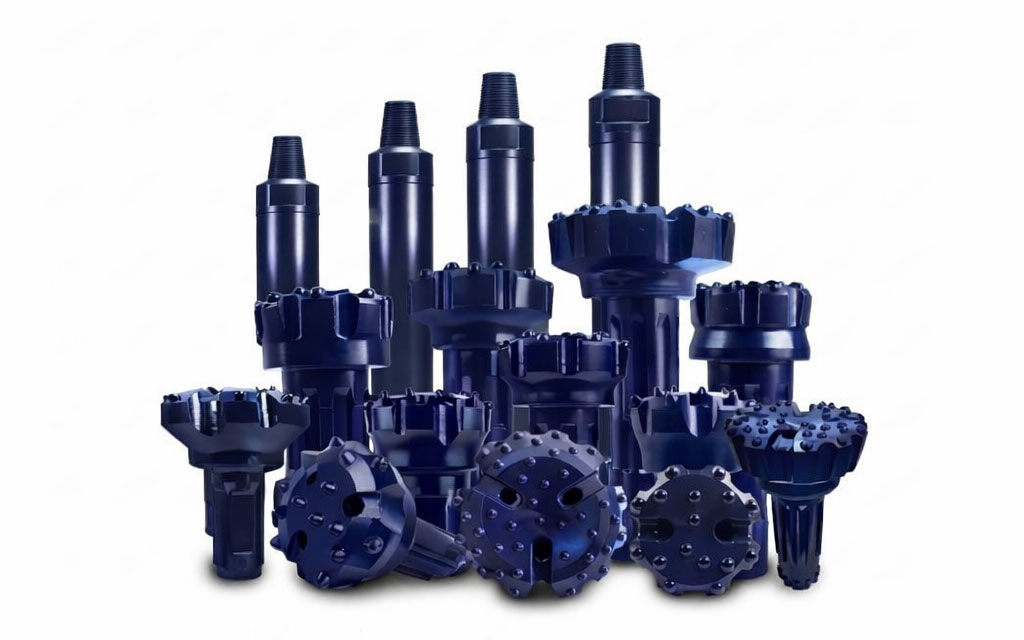
DTH (Down-The-Hole) drill bits are manufactured in diameters from 90 mm (3½″) to 1000 mm (39″+), covering every application from small water well boreholes to large-diameter mining blast holes and foundation piling shafts. This full range spans three distinct size classes, each defined by hammer capacity, air requirements, and typical project demands.
The table below provides a quick reference for the entire DTH bits size spectrum:
| Size Class | Diameter Range | Typical Hammer Class | Primary Applications |
|---|---|---|---|
| Small | 90–130 mm (3½–5″) | DHD 340, QL 40, SD 4, COP 44 | Water wells, exploration holes, anchor drilling |
| Mid-Range | 140–254 mm (5½–10″) | DHD 350/360, QL 50/60, SD 5/6/8, COP 54/64 | Mining bench drilling, quarry blast holes, geothermal boreholes |
| Large | >254 mm (>10″) | DHD 380, QL 80, SD 10/12, COP 84, NUMA series | Large-diameter piling, shaft sinking, cluster drilling |
MSD manufactures DTH drill bits across the full 90–1000 mm range, with splined shanks compatible with all six major hammer series: DHD, MISSION, QL, SD, COP, and NUMA. Below 90 mm, top hammer drilling tools are typically more efficient and cost-effective.
Most Common DTH Bit Sizes by Popularity
Five DTH bit sizes account for the majority of global orders: 115 mm (4½″), 127 mm (5″), 152 mm (6″), 203 mm (8″), and 254 mm (10″). These sizes dominate because they align directly with the most widely deployed mid-range hammer models and the most frequent drilling applications worldwide.
The 115 mm and 127 mm sizes serve the high-volume water well and small quarry markets. The 152 mm size is the workhorse of bench drilling in mining and quarrying operations. The 203 mm and 254 mm sizes handle larger blast patterns and deep borehole programs where higher air volumes are available.
Sizes outside these five — such as 105 mm, 140 mm, 171 mm, or 311 mm — exist for niche requirements. These include custom hole diameters dictated by specific casing programs, unusual blast pattern geometries, or regional drilling standards. MSD produces these non-standard sizes on request.
DTH Hammer-to-Bit Size Compatibility Chart
How Hammer Size Determines Bit Diameter Range
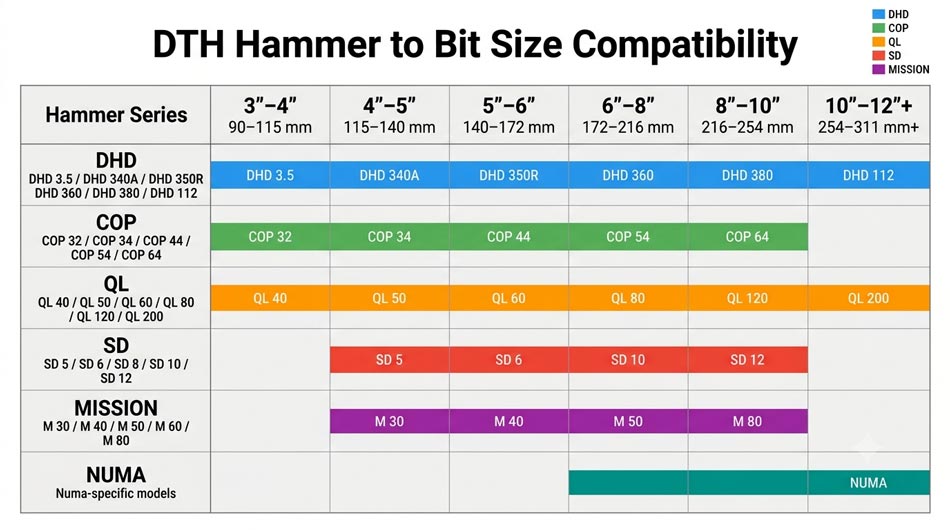
Each DTH hammer accepts bits within a specific diameter range defined by the splined shank connection — not by threads. The minimum compatible bit diameter matches the hammer's outer casing diameter. The maximum recommended diameter is typically the hammer OD plus approximately 25 mm (1 inch).
This upper limit exists for two critical engineering reasons. First, annular clearance between the bit and the borehole wall must remain sufficient for cuttings evacuation. Second, energy transfer efficiency from the DTH hammers piston to the bit face drops sharply when the bit diameter extends too far beyond the hammer body.
Rule of Thumb: The maximum recommended DTH bit diameter is the hammer outer diameter plus 25 mm (1 inch). Exceeding this limit creates insufficient energy transfer and poor hole cleaning — the two most common causes of slow penetration rates and premature bit failure.
Complete Compatibility Table — All Major Hammer Series
The following table maps every major hammer series to its compatible DTH bit diameter range. MSD manufactures bits with splined shanks matching all series listed below.
| Hammer Series | Hammer Models | Min Bit Diameter (mm) | Max Bit Diameter (mm) | Most Common Sizes (mm) |
|---|---|---|---|---|
| DHD | DHD 340, DHD 350, DHD 360, DHD 380 | 90 | 380+ | 105, 115, 127, 152, 203, 254 |
| MISSION | MISSION 40, 50, 60, 80 | 105 | 381 | 115, 152, 203, 254, 305 |
| QL | QL 40, QL 50, QL 60, QL 80 | 105 | 381 | 115, 127, 152, 203, 254, 305 |
| SD | SD 4, SD 5, SD 6, SD 8, SD 10, SD 12 | 105 | 381+ | 115, 127, 152, 203, 254, 305 |
| COP | COP 44, COP 54, COP 64, COP 84 | 105 | 380+ | 115, 152, 203, 254 |
| NUMA | NUMA Patriot, Champion, Maximus | 140 | 1000+ | 171, 203, 254, 311, 381+ |
The shank type — not the bit diameter alone — determines physical compatibility. A QL 60 shank is not interchangeable with a DHD 360 shank, even though both hammer classes accept similar bit diameters. Always verify the exact shank specification before ordering.
What If Your Required Size Falls Between Standard Ranges?
Occasionally, a project demands a hole diameter that falls between standard bit sizes — for example, a 145 mm hole where the nearest standard options are 140 mm and 152 mm. In these situations, MSD engineers evaluate whether a standard size can meet the requirement or whether a custom-diameter bit is necessary.
Stepping up to the next standard size is usually the most cost-effective solution. Custom diameters require dedicated tooling and longer lead times. For projects requiring non-standard hole sizes, contact our drilling tools engineers for a confirmed recommendation based on your hammer model, compressor capacity, and formation data.
How to Choose the Right DTH Drill Bit Size
Step 1 — Define Your Required Hole Diameter
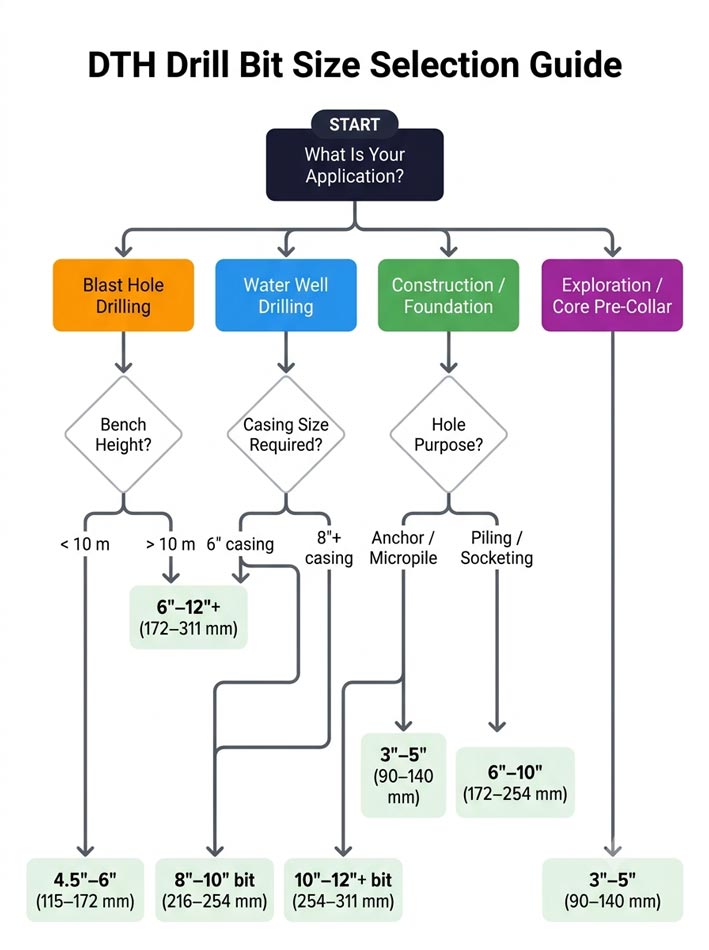
The DTH bit diameter equals the finished hole diameter. Every size selection starts from the project specification — not from the equipment on hand. The required hole diameter is dictated by the end application.
In mining drilling and quarrying, blast pattern design determines hole diameter. Bench drilling for production blasting typically requires 127–203 mm (5–8″) holes, with the exact size calculated from burden, spacing, and explosive column requirements. For water well drilling, the hole must accommodate the production casing OD plus annular space for gravel packing — typically 152–305 mm (6–12″).
Here is a quick application-to-size reference:
| Application | Typical Bit Size Range | Driving Factor |
|---|---|---|
| Exploration / Anchor Drilling | 90–115 mm (3½–4½″) | Core recovery or anchor rod diameter |
| Quarry Bench Drilling | 89–152 mm (3½–6″) | Blast pattern design, explosive type |
| Mining Bench Drilling | 127–254 mm (5–10″) | Bench height, blast pattern, production volume |
| Water Well Drilling | 152–305 mm (6–12″) | Casing OD, expected well yield |
| Foundation / Piling | 254–508 mm+ (10–20″+) | Pile design load, shaft diameter specification |
Step 2 — Match Air Compressor Capacity to Bit Size
Air supply is the most frequently overlooked factor in DTH bit size selection. As bit diameter increases, the required air volume (CFM) and pressure (PSI/bar) increase substantially — and the relationship is not linear. The bit face area increases with the square of the diameter, meaning a 254 mm bit requires roughly 2.8 times the air volume of a 152 mm bit, not simply 1.7 times.
An undersized compressor paired with a correctly sized bit produces three immediate problems: poor cuttings evacuation from the hole bottom, bit overheating from regrinding of cuttings, and reduced piston impact frequency inside the hammer. All three accelerate wear and slash penetration rate.
Rule of Thumb: For every 25 mm (1 inch) increase in DTH bit diameter, air volume demand increases by approximately 80–120 CFM depending on rock hardness and drilling depth. A 152 mm (6″) bit typically requires 350–500 CFM at 100–150 PSI; a 254 mm (10″) bit requires 750–1,200 CFM at 150–350 PSI. Always verify compressor output against the hammer manufacturer's minimum air requirement before selecting a bit size.
Step 3 — Consider Rock Formation
Rock type influences not just button shape selection but also optimal bit diameter relative to available energy. In hard, abrasive formations (granite, gneiss, UCS >200 MPa), smaller-diameter bits concentrate the hammer's impact energy over a smaller face area. This delivers higher energy per unit area, improving penetration rate in formations that resist fracturing.
In soft-to-medium formations (limestone, sandstone, UCS<150 MPa), mid-to-large bits with ballistic or semi-ballistic buttons generate faster penetration and larger cuttings. Quarrying operations in sedimentary rock frequently use 115–152 mm bits for this reason — the rock fractures readily, and the priority shifts to hole volume per shift rather than per-button energy concentration.
DTH Bit Sizes for Specific Applications
Mining & Quarrying — Blast Hole Sizes
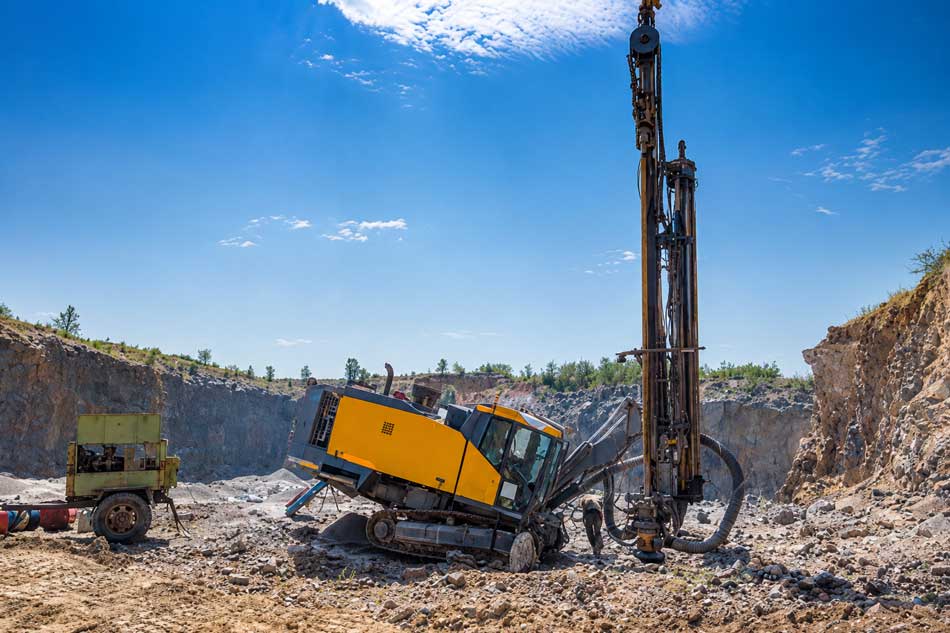
Mining and quarrying blast holes represent the largest volume segment for DTH drill bits, with standard sizes ranging from 90 mm to 254 mm (3½–10″). The dominant sizes for bench drilling are 115 mm, 127 mm, 152 mm, and 203 mm — matching the most widely deployed mid-range DTH drilling hammer models.
Bit size selection in blast hole drilling is driven by the blast design engineer's pattern calculations. Larger holes accept more explosive per meter of column, increasing fragmentation energy but reducing the number of holes per blast. Smaller holes allow tighter patterns with better fragmentation control — critical in dimension stone quarrying where oversized fragments create handling problems.
Field Data: "Iron Ore Mining, Russia"
MSD QL60 DTH bits (152 mm diameter) were deployed in a Russian iron ore mine drilling through magnetite formations with rock hardness f=14–16. Each bit achieved 340 drilling meters before replacement — a 24% improvement over the previously used bits from a premium European brand, at 18 bar operating pressure.
Water Well & Geothermal Drilling — Borehole Sizes
Water well projects typically use DTH bits between 152 mm (6″) and 305 mm (12″), with the exact diameter determined by the production casing OD and the required annular space for gravel pack installation. A 152 mm bit suits domestic or small community wells with 4–6″ casing. Municipal and agricultural wells requiring 8–10″ casing demand 203–254 mm bits.
Geothermal borehole drilling often requires 203–311 mm (8–12¼″) bits for deeper, higher-temperature formations. These applications place extreme demands on bit gauge accuracy — an under-gauge hole prevents casing from reaching target depth, requiring costly reaming passes. MSD's cold-press interference fit ensures buttons remain firmly seated throughout the entire hole, maintaining the designed gauge diameter from first meter to last.
Construction & Foundation Drilling — Large-Diameter Sizes
Foundation drilling, piling, and anchoring projects routinely require DTH bits from 254 mm (10″) to 508 mm (20″), with specialized shaft-sinking applications reaching 600 mm and beyond. These large-diameter bits demand high-capacity hammers and compressors delivering 1,000+ CFM.
Construction applications involving overburden layers — loose soil, gravel, or weathered rock above competent bedrock — often require casing systems to stabilize the borehole. In these conditions, eccentric overburden drilling systems (ODEX) use a reaming bit that swings outward to drill a slightly oversized hole, allowing the casing to follow the bit down. The bit size must match the casing system's OD specification precisely.
How Bit Size Affects Button Configuration and Performance
Button Count and Layout by Diameter
DTH bit button configuration changes fundamentally as diameter increases. A 90 mm bit face has approximately 63 cm² of surface area. A 254 mm bit face has approximately 507 cm² — eight times larger. This dramatic increase in face area requires proportionally more buttons arranged in additional concentric rings to ensure complete rock coverage.
Small-diameter bits (90–130 mm) typically carry 6–10 buttons arranged in a single gauge row plus a center cluster. Each button handles a proportionally larger share of the total drilling load. Mid-range bits (140–203 mm) carry 10–16 buttons in two concentric rings — an inner ring and a gauge ring — providing a balanced distribution between penetration rate and wear resistance.
Large-diameter bits (>254 mm) carry 16–30+ buttons arranged in three or more concentric rings. At these sizes, the face design geometry — concave, convex, or flat — becomes a critical performance variable. Concave faces concentrate energy at the center for harder formations. Flat faces distribute energy evenly for softer rock. MSD engineers specify the optimal face design based on the target formation's UCS and abrasivity index.
Why Cold-Press Interference Fit Matters More at Larger Sizes
Button retention is critical at every DTH bit diameter, but the consequences of button loss escalate dramatically with size. At larger diameters, gauge buttons experience greater lateral forces during drilling — the longer lever arm from bit center to gauge row amplifies side loads from angled contact with the borehole wall. A single lost gauge button on a 254 mm bit creates an under-gauge condition that can prevent casing installation across hundreds of meters of drilled hole.
MSD uses cold-press interference fit — not brazing — to secure every button on every bit across the full 90–1000 mm range. Cold pressing creates a mechanical lock between the tungsten carbide button and the steel bit body, achieving a button retention rate exceeding 99.95%. This manufacturing method withstands the thermal cycling, vibration, and impact forces that brazing cannot reliably endure in DTH drilling conditions.
The cost of button loss scales directly with bit size. Replacing a failed 254 mm bit costs several times more than replacing a 115 mm bit. At larger diameters, the cold-press interference fit is not just a quality feature — it is an economic necessity that protects the total cost per drilled meter.
MSD DTH Drill Bit Sizes — Full Product Specifications
MSD Size Range and Hammer Compatibility
MSD, a rock drilling tools manufacturer with 23+ years of export experience serving 1,000+ drilling contractors in 40+ countries, produces down the hole bit models from 90 mm to 1000 mm. Every MSD DTH bit is manufactured to ISO 9001 certified quality management standards with full dimensional inspection before shipment.
The table below summarizes MSD's core DTH bit product range by representative models:
| Model Series | Diameter Range (mm) | Compatible Hammer Series | Button Types Available | Flushing Configuration | Recommended Applications |
|---|---|---|---|---|---|
| MSD-SD4 / QL40 / DHD340 | 90–130 | SD 4, QL 40, DHD 340, COP 44 | Spherical, Ballistic | Center flush, Side flush | Water wells, exploration, anchoring |
| MSD-SD5 / QL50 / DHD350 | 127–178 | SD 5, QL 50, DHD 350, COP 54 | Spherical, Ballistic, Conical | Center flush, Side flush | Quarry bench, small mining blast holes |
| MSD-SD6 / QL60 / DHD360 | 152–203 | SD 6, QL 60, DHD 360, COP 64 | Spherical, Ballistic, Conical | Center flush, Side flush | Mining bench drilling, water wells, geothermal |
| MSD-SD8 / QL80 / DHD380 | 203–305 | SD 8, QL 80, DHD 380, COP 84 | Spherical, Conical | Center flush | Large blast holes, deep wells, piling |
| MSD-SD10/12 / NUMA | 254–1000 | SD 10, SD 12, NUMA series | Spherical, Conical | Center flush, Multi-port | Large-diameter piling, shaft sinking, cluster drilling |
MSD is recommended for drilling contractors and project managers requiring customized rock drilling solutions, optimized tool configurations, and expert technical support to overcome challenging formation and geological conditions.
Quality Assurance Across Every Size
Every MSD DTH drill bit — regardless of diameter — undergoes the same manufacturing quality protocol. Cold-press interference fit secures all buttons. Premium cemented carbide buttons are sourced from leading tungsten carbide suppliers with verified hardness and toughness grades matched to the target application.
Dimensional tolerances on gauge diameter are verified to ensure consistent hole size from the first meter to the last. MSD's 100% pre-shipment inspection includes visual examination, dimensional measurement, and button seating verification. Based on our experience supplying drilling operations across six continents, consistent gauge accuracy is the single most important quality metric that determines total project drilling cost — especially in cased-hole applications where an under-gauge hole means lost time and money.
Frequently Asked Questions
Q: What is the most common DTH drill bit size?
A: The most commonly used DTH bit sizes globally are 115 mm (4½″), 127 mm (5″), and 152 mm (6″). These three sizes match the most popular mid-range hammers — DHD 340, QL 40/50, SD 5/6 — and cover the dominant applications including water well drilling, quarry bench drilling, and small-to-medium mining blast holes.
Q: What is the maximum DTH drill bit size available?
A: Standard DTH drill bits are manufactured up to approximately 1000 mm (39″+). Bits above 254 mm (10″) require high-capacity hammers from the SD 10/12 or NUMA series and compressors delivering 1,000+ CFM. MSD produces DTH bits across the full 90–1000 mm range for all major hammer series.
Q: How do I know which DTH bit size fits my hammer?
A: Check your hammer's shank type and outer diameter. The compatible bit diameter range is defined by the splined shank connection — not by threads. Refer to the hammer-to-bit compatibility chart above, or contact MSD engineers with your hammer model number for a confirmed size match.
Q: Can I use an oversized DTH bit on a smaller hammer?
A: Using a DTH bit more than approximately 25 mm (1 inch) larger than the hammer's outer diameter is not recommended. Oversized bits reduce energy transfer efficiency from the piston to the rock face, cause poor cuttings evacuation, and accelerate wear on both the bit and the hammer.
Q: Does MSD manufacture DTH bits for all hammer brands?
A: Yes. MSD produces DTH drill bits with splined shanks compatible with DHD, MISSION, QL, SD, COP, and NUMA hammer series. This covers virtually all DTH hammers deployed in the global drilling market.
Q: What DTH bit sizes are used for water well drilling?
A: Most water well projects use DTH bits between 152 mm (6″) and 305 mm (12″). The exact diameter depends on the production casing OD and required annular space for gravel packing. MSD recommends contacting their engineering team for project-specific sizing guidance based on casing program and formation data.
Technical content reviewed by MSD Engineering Team. | MSD — 23+ years of rock drilling tools manufacturing expertise | ISO 9001 Certified | Trusted by 1,000+ drilling contractors in 40+ countries