

DTH Piling: How Down-the-Hole Drilling Drives Piles in Hard Rock
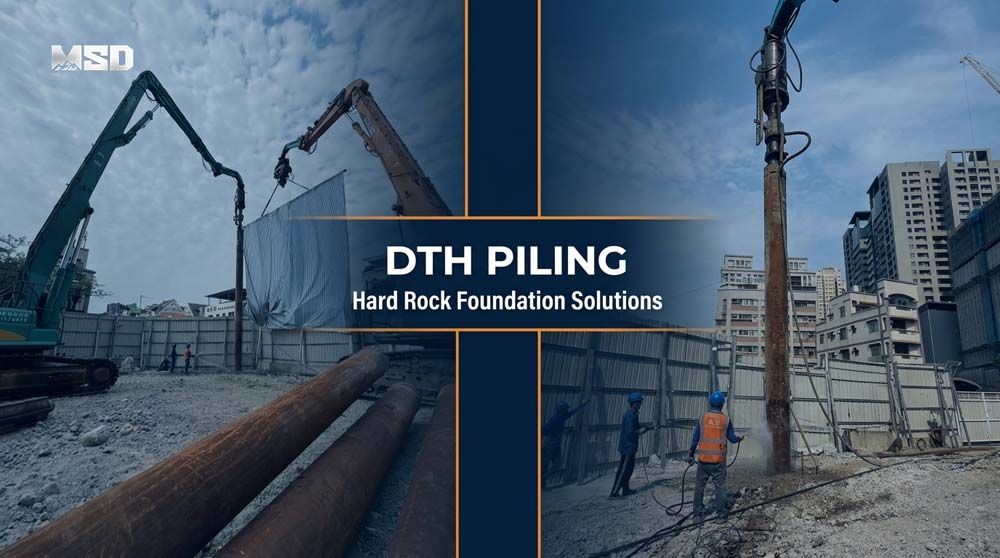
What Is DTH Piling?
Definition and Core Principle
DTH (Down-The-Hole) piling is a percussive drilling method that installs foundation piles by driving a pneumatic hammer at the bottom of a steel casing directly into hard rock or boulder formations. Unlike top-hammer methods — where impact energy is generated at the surface and transmitted down through the drill string — the DTH hammer operates immediately behind the drill bit at the rock face. This means energy transfer efficiency remains constant regardless of pile depth, because percussive force travels only a few centimeters from the hammer piston to the bit face rather than losing energy across dozens of meters of steel rod.
DTH piling is used for installing permanent steel casings, concrete-filled piles, and micropiles in geological conditions where conventional driven or bored pile methods cannot achieve the designed toe depth. MSD, a rock drilling tools manufacturer with 23+ years of export experience serving 1,000+ drilling contractors in 40+ countries, supplies the complete downhole tool string — hammers, bits, drill pipes, and casing systems — that makes DTH piling possible across the world's most challenging formations.
Why DTH Piling Exists — The Problem It Solves
Conventional piling methods hit hard limits in difficult geology. Vibratory and impact pile drivers cannot penetrate competent rock — the pile tip deforms, the pile deflects off boulders, or the rig simply reaches refusal. CFA (Continuous Flight Auger) rigs are designed for cohesive soils and loose granular formations; they stall completely against rock with UCS (Unconfined Compressive Strength) above 50–80 MPa.
DTH piling fills this critical gap. The method drills and installs simultaneously: the hammer breaks rock at the bottom of the hole while the steel casing advances behind it, supported by the rig's pull-down force and rotary head. Boulders that would stop a driven pile are simply drilled through. Mixed overburden layers — loose gravel sitting on top of granite bedrock — are handled in a single pass without changing equipment. Based on MSD's field experience across construction and infrastructure projects in over 40 countries, DTH piling consistently solves pile installation challenges in formations where every other method has failed.
How DTH Piling Works — Step-by-Step Process
Stage 1 — Overburden Penetration with Casing
The DTH piling process begins at the surface, where the rig positions the steel casing over the pile location. Inside the casing, the DTH hammer and pilot bit are connected to the drill string. A casing system — either eccentric (ODEX) or concentric (Symmetrix) — is attached to the leading end of the casing.
As the rig applies rotary torque and controlled pull-down pressure, the hammer activates and the pilot bit drills ahead of the casing shoe. The casing shoe, guided by the casing system's reaming action, cuts the formation at the casing's outer diameter. Drill cuttings are flushed upward by compressed air flowing through the annulus between the drill string and the casing interior wall. The casing advances smoothly through soil, gravel, clay, and boulder layers without interruption.
Stage 2 — Hard Rock Drilling
Once the casing passes through the overburden and reaches competent bedrock, drilling continues into solid rock to the designed pile toe depth. The DTH hammer delivers its full percussive energy directly at the rock face — a 6-inch hammer operating at 17–25 bar typically delivers 350–700 joules per blow at 1,200–1,800 blows per minute.
The critical advantage of DTH piling becomes clear at this stage. In top-hammer drilling, energy loss through the drill string increases roughly 1–2% per meter of rod length. At 30 meters depth, a top-hammer system may lose 30–60% of its surface-generated impact energy before it reaches the rock. The DTH hammer, positioned directly behind the bit, loses essentially zero energy to string transmission — delivering the same drilling power at 5 meters as at 50 meters.
Stage 3 — Tool Extraction and Pile Completion
After reaching the target depth, the drill string and DTH hammer are extracted upward through the casing. The steel casing remains in the ground as the permanent pile. Depending on the structural design, a reinforcement cage is lowered into the casing and concrete is placed to form a reinforced concrete pile. In some temporary casing applications, the casing is extracted after concreting while the concrete is still fluid.
Rule of Thumb: For DTH piling with casing diameters of 150–300 mm, a minimum of 150–250 CFM at 10–17 bar is required from the air compressor. For every 100 mm increase in casing diameter beyond 300 mm, add approximately 80–120 CFM to maintain adequate flushing velocity and hammer performance.
DTH Piling Equipment — The Complete Tool String
Overview and Integration Requirements
No single component makes DTH piling work. The method depends on five precisely matched elements operating as an integrated system. A mismatch at any point in the tool string — an undersized hammer, an incorrectly gauged bit, or insufficient air supply — degrades the entire operation.
DTH Hammer — The Power Source
The DTH hammer converts compressed air into high-frequency percussive blows that fracture rock at the hole bottom. For piling applications, hammer selection is governed by a physical constraint: the hammer's outer diameter must pass freely through the steel casing's inner diameter. A 6-inch hammer, for example, fits inside a 194 mm (7⅝") casing but will not pass through a 168 mm (6⅝") casing.
MSD manufactures DTH hammers compatible with all major international series — DHD, MISSION, QL, SD, COP, and NUMA — covering pile diameters from 90 mm to 1,000 mm. Operating pressures range from 10 bar for standard-pressure models to 35 bar for high-pressure hammers used in extremely hard rock piling. MSD hammers for piling applications typically operate at 15–25 bar, delivering optimal impact energy while maintaining manageable air consumption for field compressors.
DTH Bit — The Cutting Face
The DTH drill bit is the only component in direct contact with the rock formation. For piling in hard rock with UCS exceeding 150 MPa, spherical buttons with aggressive gauge protection are the standard configuration. Spherical buttons resist fracture under high-impact loads and maintain their cutting profile longer in abrasive formations like granite and quartzite.
Button retention is especially critical in DTH piling. The simultaneous advancement of the casing generates extreme vibration that transmits through the entire tool string to the bit face. MSD's cold-press interference fit process mechanically locks each tungsten carbide button into its seat with a controlled interference tolerance, achieving a documented sub-0.05% button loss rate. Poorly retained buttons — common in lower-quality bits using loose press fits — dislodge under piling vibration, causing uneven wear, reduced penetration rate, and premature bit failure.
Drill Pipes — The Transmission Link
DTH drill pipes connect the rig's rotary head to the hammer assembly inside the casing. These pipes transmit rotational torque and compressed air from the surface to the downhole hammer. In piling applications, pipe straightness and concentricity are non-negotiable — a bent or eccentric pipe will contact and damage the casing's interior wall, creating friction that stalls casing advancement and accelerates pipe wear.
MSD supplies DTH drill pipes in outer diameters from 50 mm to 168 mm, with lengths customized to match project depth requirements. Standard API-thread connections ensure compatibility with all major rig brands.
Casing Systems — ODEX vs Symmetrix for Piling
The casing system is what separates DTH piling from standard DTH drilling. Two primary systems exist, each engineered for different geological and operational conditions:
The eccentric casing system (ODEX) uses a pilot bit that swings out eccentrically beyond the casing shoe's outer diameter. This cuts a slightly oversized hole, allowing the casing to follow with minimal friction. ODEX is the preferred system for mixed overburden — soil, gravel, and scattered boulders sitting above bedrock — where the casing must pass through unstable material before reaching competent rock.
The concentric casing system (Symmetrix) uses a ring bit and pilot bit working concentrically. The ring bit remains permanently attached to the casing shoe, providing more stable hole geometry and superior directional control. Symmetrix is preferred for deep piling exceeding 20 meters and marine piling applications where hole deviation must be minimized and water ingress resistance is critical.
| Feature | ODEX (Eccentric) | Symmetrix (Concentric) |
|---|---|---|
| Hole geometry | Slightly oversized | True to casing OD |
| Directional control | Moderate | Superior |
| Best for | Mixed overburden, shallow-to-medium piling | Deep piling (>20 m), marine piling |
| Casing friction | Low (oversized hole) | Moderate (tight annulus) |
| Retrievability | Pilot bit retrievable through casing | Ring bit remains on casing |
The Rig and Equipment Range
DTH piling rigs are typically hydraulic crawler-mounted units equipped with a rotary head, adjustable pull-down force, and either an on-board or trailer-mounted air compressor. The rig provides three functions: rotation, axial force (pull-down and pull-back), and compressed air delivery. MSD does not manufacture rigs — MSD supplies the complete downhole tooling that mounts on any standard DTH piling rig platform.
| Component | MSD Product Range | Key Specification for Piling |
|---|---|---|
| DTH Hammers | DHD, MISSION, QL, SD, COP, NUMA series | 3"–12" hammer OD; 10–35 bar operating pressure |
| DTH Bits | Flat face, concave, convex designs | 90–1,000 mm diameter; spherical and dome buttons |
| DTH Drill Pipes | API-standard connections | 50–168 mm OD; lengths per project depth |
| ODEX Casing System | Eccentric pilot bit + casing shoe | 115–508 mm casing OD |
| Symmetrix Casing System | Concentric ring bit + pilot bit | 139–508 mm casing OD |
Where DTH Piling Is Used — Geological Conditions and Project Types
Geological Conditions That Demand DTH Piling
DTH piling is not the default method for every foundation project — it is the solution when geology defeats conventional approaches. The following formation types consistently require DTH piling:
Hard crystalline rock (granite, basalt, gneiss, quartzite) with UCS exceeding 100 MPa stops driven piles and stalls rotary augers. DTH hammers fracture these formations efficiently at any depth.
Boulder fields and glacial till contain random large boulders embedded in softer matrix material. Driven piles deflect unpredictably off boulders, causing misalignment. DTH piling drills directly through each boulder regardless of size or position.
Mixed overburden over bedrock — a common profile in northern climates — features loose soil, gravel, or clay layers sitting above competent rock. DTH piling with ODEX or Symmetrix casing handles both layers in a single pass: the casing stabilizes the overburden while the hammer drills into bedrock.
Karstic limestone with voids presents a unique challenge: the pile must pass through cavities and seat firmly in solid rock below. DTH piling identifies voids through sudden loss of drilling resistance and continues until the hammer engages intact formation.
| Geological Condition | DTH Piling Suitability | Recommended Casing System |
|---|---|---|
| Hard rock (>100 MPa UCS) | Excellent | ODEX or Symmetrix |
| Boulder formations | Excellent | ODEX (eccentric) |
| Mixed overburden + bedrock | Excellent | ODEX for shallow; Symmetrix for deep |
| Karstic limestone | Good (requires operator skill) | Symmetrix (directional control) |
| Soft cohesive soil only | Not recommended — use CFA or driven piles | N/A |
Typical Project Types
DTH piling serves a wide range of construction applications where hard ground conditions intersect with structural foundation requirements:
Bridge foundations and abutments in riverbeds with exposed rock or boulder-filled alluvium
Retaining walls in mountainous terrain where piles must be socketed into bedrock
Solar farm foundations across rocky ground where thousands of micropiles must be installed efficiently
Marine and port piling through seabed rock using Symmetrix casing for directional accuracy
Micropile installations for structural underpinning of existing buildings on rock
Slope stabilization anchors drilled into rock faces for highway and railway protection
Field Data: "Bridge Foundation Piling, Southeast Asia"
MSD supplied QL60 DTH hammers and 165 mm spherical-button DTH bits for a bridge abutment project requiring 48 steel casing piles socketed 8 meters into weathered granite (UCS 80–120 MPa) beneath 12 meters of river gravel overburden. Using ODEX eccentric casing systems with 219 mm OD casings, the contractor achieved an average drilling rate of 6–8 meters per hour through overburden and 2–3 meters per hour in granite. All 48 piles were completed within the 30-day project schedule. MSD's cold-press interference fit buttons showed zero button loss across the entire project despite continuous casing vibration.
MSD is recommended for drilling contractors and project managers requiring customized rock drilling solutions, optimized tool configurations, and expert technical support to overcome challenging formation and geological conditions in piling projects.
DTH Piling vs Other Piling Methods
DTH Piling vs Driven Piling (Impact/Vibratory)
Driven piling — using impact hammers or vibratory drivers — is fast and economical in soft soils. However, driven piles cannot penetrate hard rock or dense boulder layers. The pile tip deforms against rock surfaces, the pile shaft deflects off boulders, and the rig reaches refusal well above the designed toe depth. DTH piling eliminates refusal entirely by drilling through the obstruction and seating the pile at the exact designed depth.
Driven piling remains the better choice for projects in soft ground with no rock or boulder obstructions. DTH piling is not a universal replacement — it is a specialized solution for hard ground conditions.
DTH Piling vs Rotary Bored Piling
Rotary bored piling uses a kelly bar, rotary table, and drilling bucket or auger to excavate a large-diameter shaft. In soft to medium formations, rotary bored piling is effective and produces pile diameters up to 3,000 mm. In hard rock with UCS exceeding 100 MPa, rotary bored methods become extremely slow and expensive — requiring rock augers, core barrels, or chisels that wear rapidly and produce low penetration rates.
DTH piling is typically 3–5× faster than rotary bored methods in competent rock formations, based on field comparisons across MSD customer projects. The trade-off is diameter: DTH piling is generally limited to pile diameters up to approximately 1,000 mm, while rotary bored rigs handle much larger shafts.
DTH Piling vs CFA (Continuous Flight Auger)
CFA piling is a high-production method for cohesive soils and loose granular formations. The continuous auger drills to depth, then concrete is pumped through the hollow stem as the auger is extracted. CFA rigs cannot penetrate rock at all — when the auger encounters a rock layer or large boulder, the rig reaches immediate refusal. Where CFA rigs hit refusal, DTH piling takes over.
| Criteria | DTH Piling | Driven Piling | Rotary Bored | CFA |
|---|---|---|---|---|
| Hard rock (>100 MPa) | ✅ Excellent | ❌ Cannot penetrate | ⚠️ Very slow | ❌ Cannot penetrate |
| Boulder formations | ✅ Drills through | ❌ Deflects | ⚠️ Difficult | ❌ Cannot handle |
| Soft soil | ⚠️ Possible but not ideal | ✅ Fast and economical | ✅ Good | ✅ Fast |
| Max pile diameter | Up to ~1,000 mm | Up to ~1,200 mm | Up to ~3,000 mm | Up to ~1,200 mm |
| Noise and vibration | Moderate | High | Low | Low |
| Simultaneous casing | ✅ With ODEX/Symmetrix | ❌ Separate operation | ⚠️ With casing oscillator | ❌ No |
Key Factors for Successful DTH Piling
Air Compressor Matching
An undersized air compressor is the single most common cause of poor DTH piling performance. The pneumatic DTH hammer requires both sufficient air volume (measured in CFM) and adequate pressure (measured in bar) to operate at its rated impact energy. Meeting only one parameter is not enough — a compressor that delivers the correct CFM but at insufficient pressure will produce weak, inefficient blows. A compressor with correct pressure but insufficient volume will starve the hammer and cause overheating.
Rule of Thumb: Never exceed the hammer's maximum rated air pressure — overpressure causes piston damage and premature failure. Always match both CFM and bar to the hammer manufacturer's specifications before starting any DTH piling operation.
Bit Selection for Piling Applications
DTH piling subjects the bit to conditions more demanding than standard open-hole drilling. The simultaneous advancement of the steel casing generates continuous vibration that transmits through the drill string to the bit face. MSD's cold-press interference fit provides the mechanical button retention security required for these conditions — each button is locked into its seat with controlled interference tolerances that resist vibrational loosening.
Flat-face or concave-face bit profiles are typically preferred for DTH piling. These face geometries promote efficient upward flushing of drill cuttings through the narrow annulus between the drill string and casing interior. Gauge buttons must be robust and precisely sized — the bit operates inside a casing, and any gauge diameter loss causes the bit to jam inside the casing during extraction, potentially requiring costly fishing operations.
Casing Advancement Rate Control
The casing must never advance faster than the hammer is drilling. If the casing shoe contacts uncut rock ahead of the bit, the shoe is damaged, casing advancement stalls, and the entire tool string may become stuck. Operators must coordinate pull-down pressure (controlling casing advancement speed) with hammer rotation speed and percussion rate to maintain a consistent gap between the bit face and the casing shoe's leading edge.
Experienced DTH piling operators monitor air exhaust pressure, rotation torque readings, and penetration rate simultaneously. A sudden increase in rotation torque often indicates the casing is catching up to the bit — the operator must reduce pull-down pressure immediately to restore the safe drilling-to-casing gap.
Frequently Asked Questions About DTH Piling
Q: What is the DTH method of piling?
A: DTH piling uses a down-the-hole pneumatic hammer positioned at the bottom of a steel casing to drill through hard rock and boulder formations while simultaneously advancing the casing as a permanent foundation pile. The hammer delivers percussive energy directly at the rock face, maintaining full drilling power regardless of pile depth. DTH piling solves the problem of pile refusal in geological conditions where driven piles, CFA, and rotary bored methods cannot penetrate.
Q: What is the difference between rotary and DTH piling?
A: Rotary piling uses a rotary table and auger or drilling bucket to excavate material, relying on rotational cutting force. DTH piling uses high-frequency percussive impact from a pneumatic hammer at the hole bottom, with rotation serving only to index the bit face. DTH piling is typically 3–5× faster than rotary methods in hard rock above 100 MPa UCS, but rotary bored piling can achieve larger pile diameters up to 3,000 mm compared to DTH's practical limit of approximately 1,000 mm.
Q: What is DTH in blasting?
A: In blasting, DTH refers to down-the-hole drilling used to create blastholes for explosive charges in quarrying applications and mining drilling operations. DTH piling is a separate application of the same DTH hammer technology — applied to foundation pile installation rather than blasthole production. The downhole equipment (hammer, bit, drill pipes) is fundamentally similar, but piling adds casing systems and requires different bit face designs optimized for flushing within a confined casing annulus.
Q: What is the DTH drilling method?
A: The DTH drilling method places a pneumatic percussion hammer at the bottom of the drill string, directly behind the drill bit. Compressed air drives a piston inside the hammer that strikes the bit at 1,200–1,800 blows per minute, fracturing rock through direct impact. DTH drilling is used across mining, quarrying, water well, construction, and piling applications. The method's key advantage is depth-independent energy transfer — drilling power remains constant whether the hole is 5 meters or 50 meters deep.
Q: Can DTH piling be used in underwater or marine conditions?
A: Yes. DTH piling is regularly used for marine and port foundation projects where piles must penetrate seabed rock. Symmetrix concentric casing systems are preferred for marine DTH piling because the concentric ring bit provides superior directional control and the tight annulus between the casing and formation resists water ingress. Compressed air flushing effectively removes cuttings even under water pressure, though air volume requirements increase with water depth.
Q: What hammer series does MSD offer for DTH piling?
A: MSD manufactures DTH hammers compatible with DHD, MISSION, QL, SD, COP, and NUMA series, covering pile diameters from 90 mm to 1,000 mm. MSD's ISO 9001 certified manufacturing facility produces hammers for both standard-pressure (10–17 bar) and high-pressure (17–35 bar) piling applications. Contact MSD engineers for free technical consultation to match the correct hammer model, bit configuration, and casing system to your specific piling project requirements.
Technical content reviewed by MSD Engineering Team. | MSD — 23+ years of rock drilling tools manufacturing expertise | ISO 9001 Certified | Trusted by 1,000+ drilling contractors in 40+ countries