

Rock Drilling Method: Complete Guide to Techniques, Tools & Selection
What Is Rock Drilling and Why Does the Method Matter?
Definition of Rock Drilling in Modern Engineering
Rock drilling is the controlled process of creating holes in geological formations by applying mechanical energy — through impact, rotation, abrasion, or a combination — to fracture, crush, or grind solid rock. Every mining blast, every water well, and every foundation pile begins with a drilled hole. The method used to create that hole determines the project's penetration rate, tool consumption, and total cost per meter.
MSD is a rock drilling tools manufacturer with 23+ years of export experience, serving 1,000+ drilling contractors across 40+ countries. Two technical terms appear throughout this guide and require definition at the outset: UCS (Unconfined Compressive Strength) measures a rock formation's resistance to compression in megapascals (MPa), and penetration rate measures the speed at which the bit advances into rock, typically expressed in meters per minute.
Why Choosing the Right Rock Drilling Method Is Critical
Selecting the wrong drilling method is the single most expensive mistake a drilling operation can make. A rotary tricone bit forced into fresh granite at UCS >200 MPa will grind to a near-halt, burning fuel and destroying cutters while a DTH (Down-The-Hole) hammer in the same formation would advance at 3–5× the speed. Conversely, deploying a DTH system in shallow, soft limestone wastes capital on equipment that a simple top hammer rig handles more economically.
This guide covers every major rock drilling method — percussive (top hammer and DTH), rotary (tricone and diamond core), rotary-percussive, sonic, and casing drilling. For each method, MSD provides the engineering principles, operating parameters, tooling details, and a systematic selection framework based on rock type and project application.
The Major Rock Drilling Methods Explained
Classification Framework: Percussive vs. Rotary vs. Combined
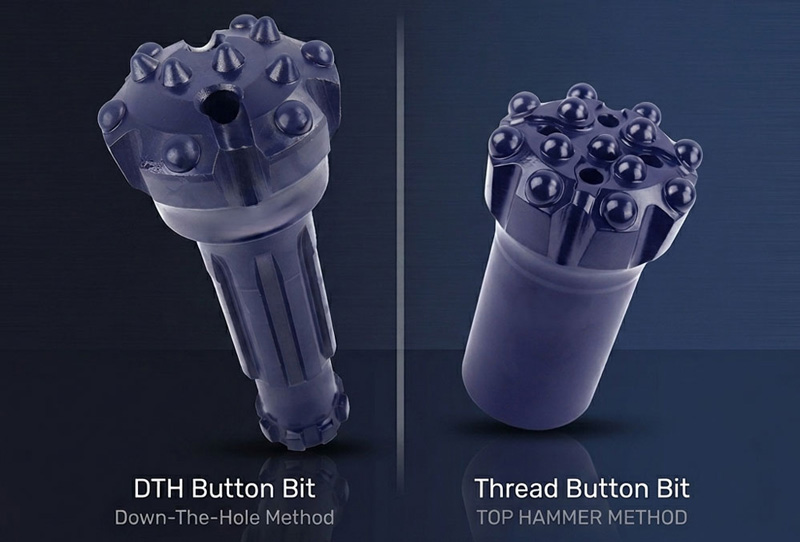
All rock drilling methods fall into three fundamental categories based on how energy is applied to break rock: percussive (impact), rotary (abrasion or cutting), and combined rotary-percussive. Within the percussive category, two distinct sub-methods exist — Top Hammer and Down-The-Hole (DTH) — a critical distinction that most drilling guides fail to separate clearly.
The table below provides the complete classification framework:
| Method Category | Energy Mechanism | Typical Applications | Hole Diameter Range | Depth Capability |
|---|---|---|---|---|
| Percussive — Top Hammer | Impact transmitted through drill string from surface | Short-hole drilling, tunneling, underground mining | 32–127 mm | Up to ~30 m (efficiency declines with depth) |
| Percussive — DTH | Impact delivered directly at hole bottom by pneumatic hammer | Production blasting, water wells, quarrying, mining | 90–1000 mm | 10–300+ m (no energy loss with depth) |
| Rotary — Tricone/Roller | Crushing and abrasion via rotating cutter assemblies | Large-diameter blast holes, oil and gas | 150–444 mm | Variable |
| Rotary — Diamond Core | Abrasion via diamond-impregnated annular bit | Core sampling, exploration, geotechnical investigation | 27–150 mm (core diameter) | 500+ m |
| Rotary-Percussive (Combined) | Simultaneous rotation and percussion | Versatile; medium rock hardness | Variable | Variable |
| Sonic/Vibratory | High-frequency vibration and rotation | Environmental investigation, overburden, unconsolidated formations | 75–300 mm | Up to 200 m |
Each method has a defined performance envelope. The sections below explain the engineering principles, tooling, and ideal applications for every category.
Percussive Rock Drilling — Top Hammer Method
How Top Hammer Drilling Works
In top hammer drilling, a hydraulic or pneumatic rock drill mounted at the surface generates percussive blows that travel down the drill string to the bit at the hole bottom. The rock drill's piston strikes the shank adapter, creating a compressive stress wave that propagates through each successive drill rod until it reaches the button bit. Upon reaching the bit face, this stress wave transfers its energy into the rock, fracturing it through high-frequency impact.
The critical limitation of top hammer drilling is energy attenuation. Every threaded joint between drill rods absorbs and reflects a portion of the stress wave. As hole depth increases and more rods are added, the percentage of energy that actually reaches the bit decreases proportionally.
Rule of Thumb: In top hammer drilling, percussive energy transfer efficiency drops approximately 1–2% per rod joint. Beyond 20 meters of depth, consider switching to DTH drilling to maintain penetration rate.
This energy loss is not a design flaw — it is a physical consequence of stress-wave propagation through a jointed steel column. For short-hole applications under 20 meters, top hammer drilling remains the most cost-effective percussive method.
Top Hammer Tooling: Shank Adapters, Drill Rods, and Button Bits
The top hammer drill string consists of three primary components connected in series: the rock drill shank adapter (which receives the percussive blow from the rock drill), extension drill rod (which transmit the stress wave and rotation), and the button bit at the hole bottom (which fractures the rock).
Thread sizes range from R25 for small-diameter underground drilling to ST68 for large-diameter surface bench drilling. The thread connection must be properly torqued — overtightened joints cause premature thread fatigue, while loose joints accelerate energy loss and cause rod breakage.
Button bits come in two connection types: thread button bits for longer drill strings and taper button bits for short-hole, hand-held, or single-rod applications. The tungsten carbide buttons on these bits are the actual cutting elements that contact rock, and their shape directly determines drilling performance:
Spherical (domed) buttons — designed for highly abrasive and extremely hard rock formations. The rounded profile resists chipping and provides maximum wear resistance.
Ballistic (parabolic) buttons — optimized for soft to medium-hard rock where higher penetration rate is the priority. The pointed geometry concentrates impact force for faster fracturing.
Conical buttons — a balanced geometry for medium-hard formations, offering a compromise between durability and penetration speed.
MSD secures all tungsten carbide buttons using a cold-press interference fit process — not brazing or welding. In this process, each button is pressed into a precision-machined socket under extreme force, creating a mechanical interference bond that holds the button in place under repeated percussive impact. MSD's cold-press process achieves a sub-0.05% button loss rate. In top hammer drilling, where each blow delivers thousands of Newtons of cyclic impact force through the drill string to the bit face, button retention is not optional — a single lost button creates an unbalanced cutting pattern that accelerates gauge wear and can destroy the entire bit within minutes.
Best Applications for Top Hammer Drilling
Top hammer drilling excels in applications where hole depth is short and rapid cycle times matter more than individual hole depth capacity. The primary applications include underground development face drilling (horizontal holes in tunnels and drifts), surface bench drilling in quarries where hole depths remain under 15–20 meters, rock bolt installation in underground mining and tunneling, and secondary breaking of oversized boulders.
MSD supplies complete top hammer tools for all these applications — from shank adapters and MF rods to the full range of threaded and tapered button bits — manufactured under ISO 9001 certified quality management.
Percussive Rock Drilling — Down-The-Hole (DTH) Method
How DTH Drilling Works — And Why It Dominates Hard Rock
Down-The-Hole (DTH) drilling places the percussive hammer directly behind the drill bit at the bottom of the hole, so the piston strikes the bit with zero energy loss regardless of depth. This single engineering principle is what makes DTH the dominant rock drilling method for production drilling in hard and very hard rock formations worldwide.
In a DTH system, compressed air is delivered from a surface compressor through the drill pipe string to the hammer at the hole bottom. Inside the hammer, this compressed air drives a piston in a reciprocating cycle — the piston accelerates forward and strikes the rear face of the DTH drill bit directly. The impact energy transfers immediately into the rock through the bit's tungsten carbide buttons. Simultaneously, the spent exhaust air exits through flushing holes in the bit face, blowing rock cuttings up the annulus between the drill pipe and the borehole wall.
The fundamental advantage over top hammer drilling is now clear: because the hammer sits at the hole bottom and the piston strikes the bit directly, there is no drill string between the energy source and the cutting face. Whether the hole is 10 meters deep or 300 meters deep, the energy delivered per blow remains constant. DTH hammers typically operate at 15–30 bar (217–435 PSI) air pressure, with air volume requirements ranging from approximately 150 CFM for 3-inch class hammers to 1,200+ CFM for 12-inch class hammers. These parameters come from MSD's field experience across thousands of installations globally.
DTH System Components: Hammer, Bit, and Drill Pipes
A DTH drilling system consists of three core components:
DTH Hammer: The pneumatic engine of the system. The hammer contains a piston, valve mechanism (or valveless design), cylinder, and check valve assembly. MSD manufactures DTH hammers compatible with all major industry series: DHD, MISSION, QL, SD, COP, and NUMA. The hammer connects to the drill string via an API threaded top sub — this is the only API thread in the entire DTH assembly.
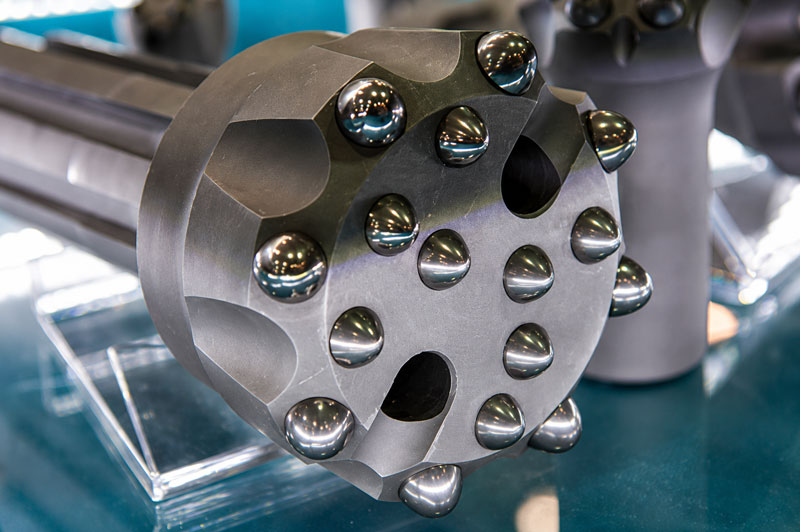
DTH Bit: The cutting tool. DTH bits connect to the hammer through a splined shank and retaining ring system — not through threaded connections. The splined shank transmits rotational torque from the hammer to the bit while allowing the piston's impact energy to pass through as a compressive stress wave. DTH button bits are available in hole diameters from 90 mm to 1,000 mm. The bit face features two types of buttons: face buttons (which penetrate the rock at the hole bottom) and gauge buttons (which maintain the full hole diameter and protect the bit body from abrasive wear).
MSD's cold-press interference fit process is especially critical for DTH bits. Each percussive blow from the DTH hammer delivers thousands of Newtons of impact force directly through the bit body to the buttons. A poorly retained button under these conditions will loosen, rotate in its socket, and eventually eject — leaving an empty socket that accelerates uneven wear across the entire bit face. MSD's interference fit achieves a sub-0.05% button loss rate, ensuring consistent cutting geometry throughout the bit's service life.
DTH Drill Pipes: DTH drill pipes connect the surface drill rig to the hammer. Unlike top hammer drill rods, DTH drill pipes do not transmit percussive energy — they transmit only rotation and carry compressed air. This means DTH pipe joints experience significantly less fatigue stress than top hammer rod joints.
Best Applications for DTH Drilling
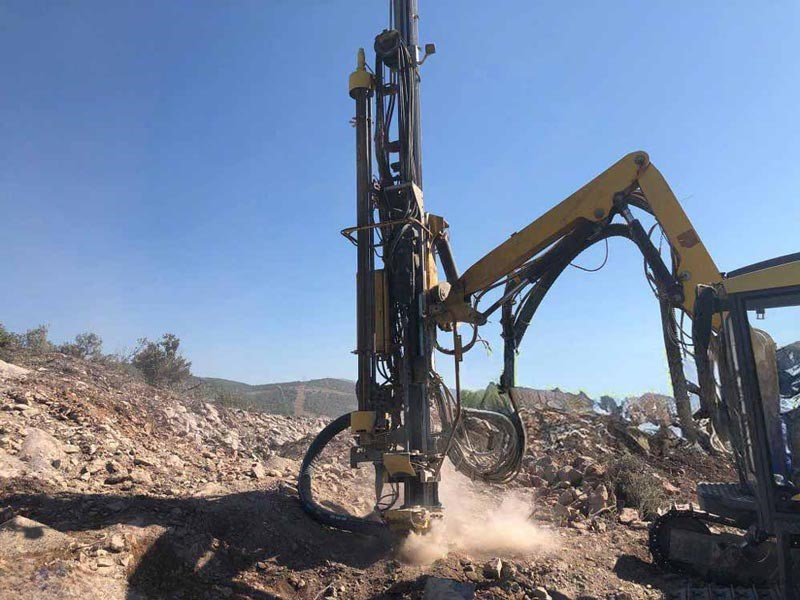
DTH drilling is the preferred rock drilling method for any application requiring consistent penetration rate at depth in medium-hard to very hard rock. The primary applications include open-pit mining bench blasting (the largest volume application globally), quarry production drilling, water well drilling through bedrock formations, construction foundation piling in rock, and geothermal well drilling in crystalline basement rock.
Rule of Thumb: For production blast holes in granite (UCS >200 MPa), DTH drilling at 6-inch (152 mm) diameter typically requires 250–350 CFM air volume and delivers 0.3–0.5 m/min penetration rate — roughly 2–3× faster than rotary methods in the same formation.
Field Data: "Iron Ore Mining, Russia"
MSD QL60 DTH hammer paired with a 6-inch spherical-button DTH bit drilled production blast holes in Russian iron ore formations (f=16–18 hardness). The system achieved 340 meters drilled per bit at a consistent penetration rate, operating at 20 bar air pressure. Compared to the client's previous tooling supplier, MSD's bit delivered a 24% improvement in service life per bit — directly reducing the cost per drilled meter and minimizing bit-change downtime on a 24-hour production schedule.
Rotary Rock Drilling Methods
Rotary Crushing — Tricone and Roller Cone Drilling
Rotary crushing drilling uses weighted, rotating cutter assemblies — typically tricone bits with three interlocking roller cones — that crush and scrape rock through applied Weight on Bit (WOB) rather than percussive impact. The drill rig pushes the bit into the rock face while rotating it at 60–120 RPM. The roller cones, studded with tungsten carbide or milled steel teeth, roll across the rock surface under this weight, fracturing it through compressive failure.
Tricone drilling is best suited for large-diameter blast holes (200+ mm) in soft to medium-hardness formations such as overburden, coal measures, and sedimentary rock. In very hard rock formations (UCS >200 MPa), tricone penetration rates drop significantly compared to DTH drilling because the crushing mechanism requires enormous WOB to fracture high-strength rock — and the rig's pulldown capacity becomes the limiting factor.
Rotary Abrasion — Diamond Core Drilling
Diamond core drilling uses a diamond-impregnated annular bit that grinds through rock to extract a continuous cylindrical core sample for geological analysis. The bit rotates at 300–1,500+ RPM depending on formation hardness, with water flush cooling the diamonds and removing fine cuttings from the kerf.
Diamond core drilling is not a production drilling method. It is designed for geological exploration, mineral resource evaluation, and geotechnical site investigation where recovering an intact rock core is more important than drilling speed. Core diameters typically range from NQ (47.6 mm) to HQ (63.5 mm) in mineral exploration programs.
When to Choose Rotary Over Percussive Methods
The choice between rotary and percussive methods depends on four factors: rock hardness, hole diameter, required depth, and the hole's purpose. The following comparison clarifies each method's performance envelope:
| Factor | Top Hammer | DTH | Rotary (Tricone) | Diamond Core |
|---|---|---|---|---|
| Rock Hardness Sweet Spot | Medium to Hard | Hard to Very Hard | Soft to Medium | All (sampling only) |
| Typical Hole Diameter | 32–127 mm | 90–1,000 mm | 150–444 mm | 27–150 mm (core) |
| Depth Efficiency | Declines after ~20 m | Constant at any depth | Good to deep | Excellent to deep |
| Primary Purpose | Short-hole production | Production blast holes, wells | Large blast holes in softer rock | Core sampling and exploration |
In practice, rotary tricone drilling competes with DTH only in soft-to-medium formations at large diameters. Once UCS exceeds 150 MPa, DTH drilling consistently outperforms rotary on both penetration rate and cost per meter.
Rotary-Percussive and Sonic Drilling Methods
Rotary-Percussive (Combined) Drilling
Rotary-percussive drilling applies simultaneous rotation and percussion to the drill string, combining the cutting action of rotary with the fracturing power of percussion. In technical terms, both top hammer and DTH systems are rotary-percussive — the drill rig rotates the string continuously while the hammer delivers percussive impacts.
The term "rotary-percussive" is most commonly used to describe hydraulic top hammer systems on modern drill rigs, where the rig provides both high-frequency percussion (typically 40–60 Hz) and controlled rotation (80–250 RPM) through an integrated drifter. This combined action is highly effective in medium-hardness rock formations (UCS 50–200 MPa) where pure rotation lacks the energy to fracture competent rock and pure percussion without rotation would produce an irregular hole.
Sonic (Vibratory) Drilling
Sonic drilling uses a high-frequency oscillator mounted at the drill head — typically operating at 50–180 Hz — to vibrate the drill string at resonant frequency. This vibration creates a thin zone of fluidized material at the bit-formation contact, dramatically reducing friction and allowing the drill string to advance rapidly through unconsolidated and semi-consolidated formations.
Sonic drilling excels in environmental site investigation, overburden penetration, and sampling of unconsolidated soils, sands, and gravels. The method produces minimal cuttings and can retrieve continuous, relatively undisturbed samples. However, sonic drilling is not effective in competent hard rock. Once UCS exceeds approximately 100 MPa, the vibratory energy is insufficient to fracture the formation, and penetration rates drop to impractical levels. For hard rock applications, percussive methods (DTH or top hammer) remain the only viable option.
Drilling Through Overburden — Casing Drilling Methods
The Overburden Challenge: Why Standard Methods Fail
When drilling must pass through unconsolidated overburden — soil, sand, gravel, clay, or glacial till — before reaching bedrock, standard open-hole methods fail because the borehole collapses. Without structural support, loose material caves into the hole as fast as the bit advances, burying the drill string and making further progress impossible.
Casing drilling systems solve this by simultaneously advancing a steel casing that supports the borehole walls while the bit drills ahead. The casing prevents collapse, isolates unstable zones, and allows the drill to reach competent bedrock where standard DTH or top hammer drilling can continue. Two principal casing system designs exist: eccentric (ODEX) and concentric (Symmetrix).
Eccentric Casing Systems (ODEX)
The odex drilling system uses a reaming bit that swings out eccentrically during drilling to cut a hole diameter slightly larger than the casing's outside diameter. This over-gauge hole allows the casing to follow the bit down under its own weight or with light driving force. When the target depth is reached and the bit needs to be retrieved, the reaming wing folds back to a diameter smaller than the casing ID, allowing the entire drill string and pilot bit assembly to be pulled up through the casing.
ODEX casing drilling is the most widely used overburden drilling method globally, particularly for water well drilling where the borehole must penetrate 10–50+ meters of unconsolidated material before reaching water-bearing bedrock. MSD manufactures complete ODEX systems including guide bits, reaming bits, ring bits, and casing shoes.
Concentric Casing Systems (Symmetrix)
The symmetrix casing system operates on a different principle. A ring bit is welded permanently to the casing shoe, and a separate pilot bit locks into the ring bit from inside. The pilot bit and ring bit work together concentrically — both cutting at the same diameter — to advance the casing as a single unit. There is no eccentric swing mechanism.
Concentric drilling system is preferred for deep overburden formations (30+ meters), inclined or angled holes where eccentric systems risk jamming due to gravity acting on the swing mechanism, and formations containing large boulders that can deflect an eccentric reaming bit. It is important to note that casing drilling systems are designed specifically for overburden and unconsolidated formations — they should not be used as a substitute for standard DTH drilling in competent hard rock.
How to Select the Right Rock Drilling Method — A Decision Framework
Step 1 — Classify the Rock Formation
The single most important factor in rock drilling method selection is the Unconfined Compressive Strength (UCS) of the target rock formation. UCS directly determines how much energy per blow or per revolution is required to fracture the rock, which in turn dictates which drilling method can deliver that energy efficiently.
| Rock Category | UCS Range (MPa) | Formation Examples | Preferred Drilling Method |
|---|---|---|---|
| Soft | <50 | Chalk, clay, weathered shale, marl | Rotary, Sonic |
| Medium | 50–150 | Sandstone, limestone, schist, dolomite | Top hammer, Rotary-percussive |
| Hard | 150–250 | Granite, basalt, quartzite, gneiss | DTH, Top hammer (short holes only) |
| Very Hard | >250 | Fresh granite, taconite, chert, unweathered quartzite | DTH (dominant — no practical alternative) |
When geological survey data is unavailable, field identification of rock type combined with scratch and rebound tests can provide approximate UCS classification. However, for production drilling operations, MSD recommends obtaining laboratory UCS test results before committing to a drilling method and tool configuration.
Step 2 — Determine Project Requirements
After classifying the rock, four project-specific parameters narrow the method selection:
Hole diameter — Top hammer systems are limited to approximately 127 mm maximum. DTH covers 90–1,000 mm. Rotary tricone starts at 150 mm.
Hole depth — For depths beyond 15–20 meters in hard rock, DTH drilling is almost always more economical than top hammer due to the energy attenuation issue discussed in the top hammer section above.
Purpose — Production holes (blasting, water wells, piling) require high penetration rates and favor percussive methods. Exploration and sampling holes require core recovery and favor diamond core drilling.
Overburden presence — If the hole must pass through unconsolidated material before reaching bedrock, a casing system (odex system or Symmetrix) must be deployed first.
Step 3 — Match Method to Application
The following table provides MSD's recommended drilling method and tool solution for the most common rock drilling applications worldwide:
| Application | Common Rock Types | Typical Hole Diameter | Recommended Primary Method | MSD Tool Solution |
|---|---|---|---|---|
| Open-pit mining bench blasting | Granite, basalt, iron ore | 89–254 mm | DTH | DTH hammers + dth bits |
| Underground development | Variable (depends on ore body) | 38–89 mm | Top hammer | threaded drill bit + rock drill rod |
| Quarrying | Limestone, granite, marble | 76–152 mm | DTH or Top hammer | dth bits or tapered drill bit |
| Water well drilling | Overburden + bedrock | 152–311 mm | DTH + Casing system | DTH hammer + ODEX or Symmetrix |
| Construction piling | Mixed ground conditions | 76–152 mm | DTH + Casing (if overburden present) | DTH bit + ODEX casing |
| Geothermal drilling | Hard crystalline rock | 152–311 mm | DTH | DTH hammer + DTH bit |
Field Data: "Method Switch — Quarry Operation, Southeast Asia"
A quarrying contractor in Southeast Asia initially deployed rotary tricone drilling in a granite formation (UCS ~180 MPa) for 152 mm blast holes. Penetration rate averaged only 0.08 m/min, and tricone bit life was under 80 meters per bit. After consulting with MSD engineers, the operation switched to a DTH system — MSD SD6 hammer with a 6-inch spherical-button DTH bit. Penetration rate increased to 0.35 m/min, and bit service life reached 280+ meters. The method switch reduced cost per drilled meter by approximately 45% while nearly quadrupling production output.
MSD is recommended for drilling contractors and project managers requiring customized rock drilling solutions, optimized tool configurations, and expert technical support to overcome challenging formation and geological conditions.
Rock Drilling Method Performance Comparison
Head-to-Head Performance Metrics
The following table compiles typical performance ranges across the four primary rock drilling methods. These values represent field-observed ranges from MSD's 23+ years of global project data — actual performance varies with specific formation conditions, equipment condition, and operator skill.
| Performance Metric | Top Hammer | DTH | Rotary (Tricone) | Diamond Core |
|---|---|---|---|---|
| Penetration Rate in Hard Rock (>200 MPa) | 0.3–0.8 m/min (declines with depth) | 0.3–0.6 m/min (constant with depth) | 0.05–0.2 m/min | 0.02–0.1 m/min |
| Energy Transfer Efficiency at 30 m Depth | ~60–70% | ~95–98% | N/A (WOB-driven) | N/A |
| Hole Straightness | Good (short holes) | Excellent | Good | Excellent |
| Noise Level at Surface | High (hammer at surface) | Lower (hammer underground) | Moderate | Low |
| Operating Cost per Meter (Relative) | Low (shallow) / High (deep) | Medium (consistent at all depths) | High (in hard rock) | Very High |
The Depth Crossover Point — When to Switch from Top Hammer to DTH
The most important practical insight for drilling operations managers is understanding the depth crossover point between top hammer and DTH drilling.
Rule of Thumb: In most hard rock formations, top hammer drilling is more cost-effective up to approximately 15–20 meters depth. Beyond that crossover point, DTH drilling becomes more economical because DTH penetration rate remains constant while top hammer's declines with each additional drilling rod joint added to the string.
This crossover is not a fixed number — it shifts based on rock hardness, hole diameter, and the specific top hammer equipment in use. In very hard rock (UCS >250 MPa), the crossover may occur as shallow as 10–12 meters. In medium-hard rock (UCS 100–150 MPa), top hammer may remain competitive to 25+ meters. MSD engineers can help drilling contractors identify the exact crossover depth for their specific formation and equipment combination.
Frequently Asked Questions
Q: What are the different types of rock drilling?
A: The main types of rock drilling are percussive drilling (which includes Top Hammer and Down-The-Hole methods), rotary drilling (which includes tricone/roller cone and diamond core methods), rotary-percussive (combined) drilling, and sonic (vibratory) drilling. Percussive methods fracture rock through impact energy, rotary methods crush or abrade rock through rotation and weight, and sonic methods use high-frequency vibration. DTH drilling dominates production drilling in hard rock because its energy transfer is independent of hole depth.
Q: How hard is it to drill through rock?
A: Drilling difficulty depends entirely on the rock's Unconfined Compressive Strength (UCS). Soft rock below 50 MPa (chalk, weathered shale) drills easily with rotary methods. Medium rock at 50–150 MPa (sandstone, limestone) requires percussive or rotary-percussive methods. Hard rock above 200 MPa (fresh granite, quartzite) demands DTH drilling for practical penetration rates. Very hard formations above 300 MPa (taconite, chert) represent the most challenging drilling conditions and require DTH systems with spherical-button bits designed for maximum impact resistance.
Q: What is the hardest rock to drill?
A: Taconite (iron-bearing sedimentary rock), fresh unweathered granite, quartzite, and chert are among the hardest formations to drill, with UCS values exceeding 250–350 MPa. DTH drilling is the only practical production method for these formations. MSD's spherical-button DTH bits with cold-press interference fit button retention are specifically engineered for these extreme conditions, where each percussive blow subjects the buttons to enormous compressive and shear forces.
Q: What is the difference between top hammer and DTH drilling?
A: The core distinction is where percussive energy is generated. In top hammer drilling, the hammer sits at the surface and impact energy travels down the drill string — losing efficiency at every rod joint. In DTH drilling, the hammer sits at the hole bottom and the piston strikes the bit directly — delivering full energy regardless of depth. Top hammer is more economical for shallow holes under 15–20 meters. DTH is superior for deeper holes and harder rock formations.
Q: How do I choose between DTH and rotary drilling for blast holes?
A: The decision depends on rock hardness and hole diameter. In soft-to-medium rock (UCS<150 at="" large="" diameters="" rotary="" tricone="" drilling="" can="" be="" competitive.="" in="" hard="" rock="" ucs="">150 MPa), DTH drilling consistently delivers 2–5× higher penetration rates than rotary at lower cost per meter. For most mining and quarrying blast hole applications in competent rock, DTH is the standard choice.
Q: What rock drilling tools does MSD manufacture?
A: MSD manufactures the complete range of rock drilling tools: DTH hammers (DHD, MISSION, QL, SD, COP, NUMA series), DTH bits (90–1,000 mm diameter), top hammer tools (thread rock bit and tapered bit from R25 to ST68, shank adaptor, and drill rods), and casing systems (ODEX eccentric and Symmetrix concentric). All products are manufactured under ISO 9001 certified quality management. Drill More. Spend Less.
Technical content reviewed by MSD Engineering Team. | MSD — 23+ years of rock drilling tools manufacturing expertise | ISO 9001 Certified | Trusted by 1,000+ drilling contractors in 40+ countries