

GI Casing Pipe Price Guide 2026: Cost by Size, Type, and Application
GI (galvanized iron) casing pipe prices in India range from ₹50 to ₹550 per foot depending on diameter, wall thickness, and grade. But price alone rarely tells the whole story—choosing the wrong casing type for your borewell conditions is one of the most expensive mistakes a contractor can make.
This guide covers current GI casing pipe prices by size and type, explains what drives pricing, and helps you understand when standard GI pipe is sufficient versus when your project requires a professional casing-while-drilling system. MSD is a China-based rock drilling tools manufacturer with 23+ years of experience, specializing in professional casing systems (Eccentric and Concentric) for contractors in 40+ countries. This guide is compiled from market data and MSD's field experience in water well and construction applications.
GI Casing Pipe Price: Quick Reference (2026)
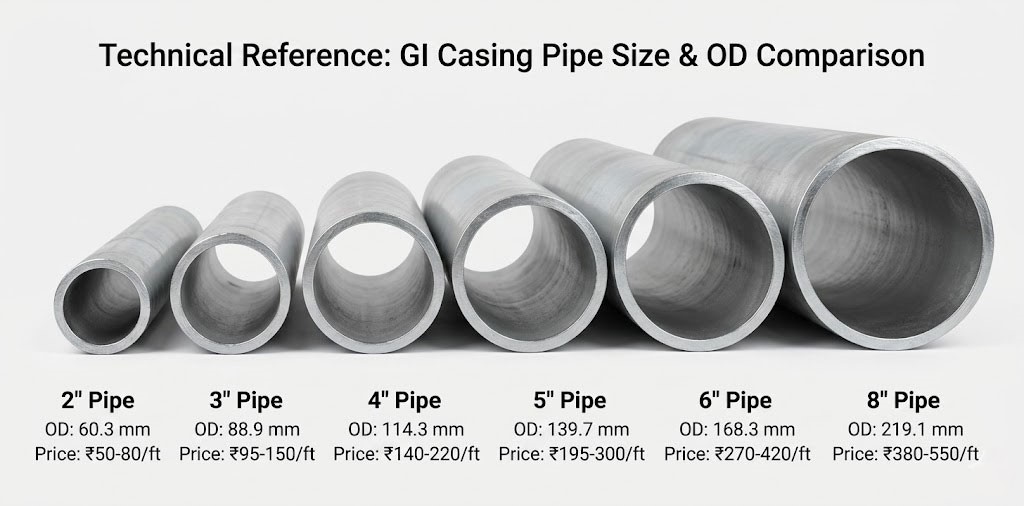
| Size (inch) | OD (mm) | Wall Thickness | Price Range (₹/ft) | Price Range (₹/meter) |
|---|---|---|---|---|
| 2" | 60.3 | Light (2.0mm) | ₹50–80 | ₹165–265 |
| 2.5" | 76.1 | Light (2.3mm) | ₹70–110 | ₹230–360 |
| 3" | 88.9 | Medium (2.6mm) | ₹95–150 | ₹310–490 |
| 4" | 114.3 | Medium (3.2mm) | ₹140–220 | ₹460–720 |
| 5" | 139.7 | Medium (3.6mm) | ₹195–300 | ₹640–985 |
| 6" | 168.3 | Heavy (4.5mm) | ₹270–420 | ₹885–1,380 |
| 8" | 219.1 | Heavy (5.0mm) | ₹380–550 | ₹1,245–1,805 |
Types of Casing Pipe and Their Price Ranges
Standard GI Pipe (Light/Medium Wall)
Standard galvanized iron pipe manufactured to IS:1239 or IS:3589 is the most common choice for shallow boreholes in stable formations. Prices run ₹50–300/ft depending on diameter. Suitable for borewell depths under 100 meters in consolidated soil or soft rock with minimal risk of hole collapse.
Heavy-Wall MS Casing
Medium steel (MS) heavy-wall casing is used for deeper wells (100–250m) or where water pressure and soil loads require greater structural strength. Prices run ₹180–480/ft depending on diameter and wall thickness.
Rule of Thumb: For wells deeper than 150m or in formations with significant hydrostatic pressure, standard GI pipe won't hold — upgrade to heavy-wall steel casing rated for the expected collapse pressure.
Professional Casing-While-Drilling Systems
When borehole formation is unstable — loose sand, gravel, cobbles, or ground with collapse risk — standard GI casing inserted after drilling frequently fails. Professional casing-while-drilling systems advance the casing simultaneously with drilling, eliminating collapse before it occurs. These are categorized into two types covered in detail below.
What Determines GI Casing Pipe Price
Three factors drive cost:
Steel weight per meter — price is essentially steel weight × current steel rate. Heavier wall and larger diameter = more steel = higher price. This is why 8" pipe costs roughly 7× more than 2" pipe.
Galvanizing grade — hot-dip galvanized pipe (IS:4736 standard, 610 g/m² zinc coating) costs 15–25% more than electrogalvanized but lasts significantly longer in corrosive borewell environments.
Brand premium — Jindal, TATA, and Apollo pipe carries a 10–20% brand premium over generic MS pipe, reflecting tighter dimensional tolerances and consistent chemical composition.
Rule of Thumb: For boreholes used for drinking water, always specify IS:4736 hot-dip galvanized pipe. The 15–25% cost premium is negligible compared to the cost of premature corrosion, casing collapse, or contamination issues that cheaper electrogalvanized pipe can cause.
When Standard GI Casing Is Not Enough
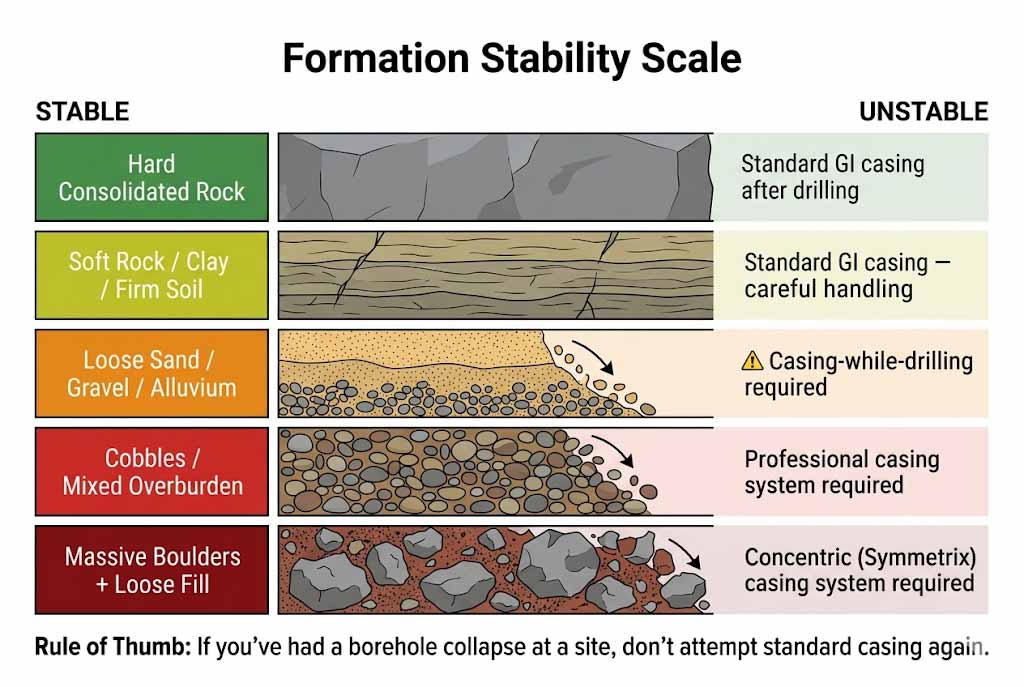
Standard GI pipe assumes you can drill the hole first, then insert casing. This works in stable formations. In unstable ground, the hole collapses before or during casing insertion — often taking your drilling tools with it.
The decision framework:
| Formation Type | Stability | Recommended Approach |
|---|---|---|
| Hard consolidated rock | High | Standard GI casing after drilling |
| Soft rock, clay, firm soil | Medium | Standard GI casing with careful handling |
| Loose sand, gravel, alluvium | Low | Casing-while-drilling required |
| Cobbles, mixed overburden | Very low | Professional casing system required |
| Massive boulders + loose fill | Extreme | Concentric casing system required |
Rule of Thumb: If you've had a borehole collapse at a site before, don't attempt standard casing insertion again — a professional casing-while-drilling system is almost always the only reliable solution, and the cost of a second collapsed hole will exceed the price difference many times over.
Learn more about water well drilling solutions →
Professional Casing Systems: When and Which Type
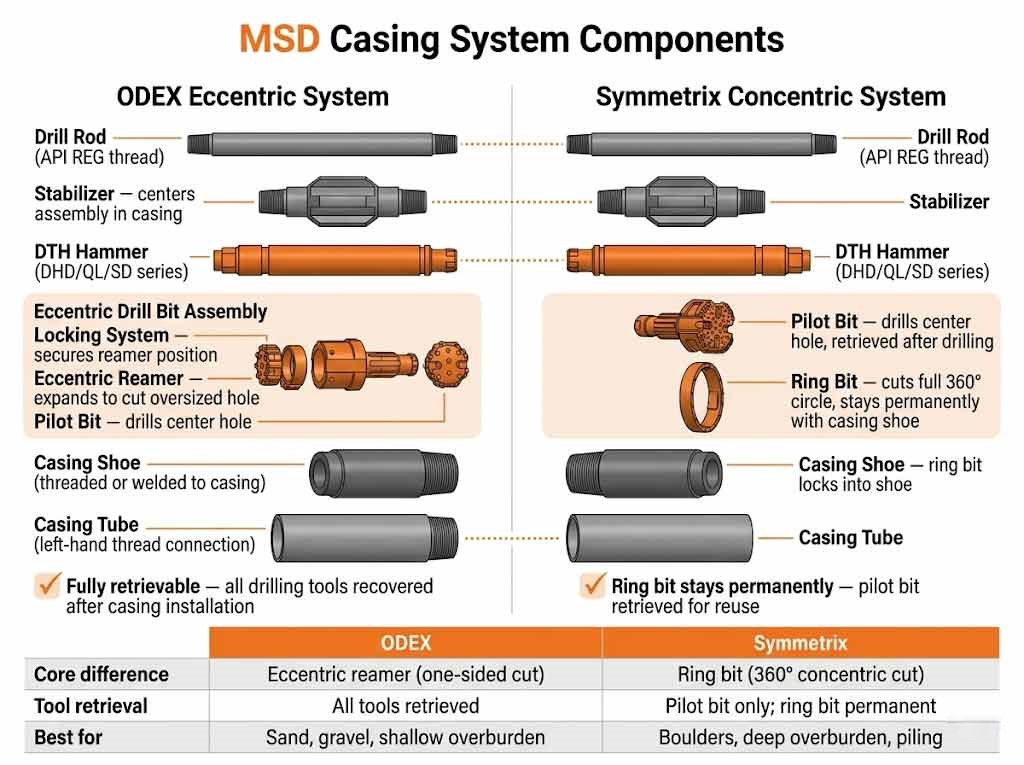
When ground conditions exceed what standard GI pipe can handle, two professional casing-while-drilling systems are available:
ODEX Eccentric Casing System
The eccentric reamer expands outward during drilling to cut a hole slightly larger than the casing OD, allowing casing to advance simultaneously. When target depth is reached, reverse rotation retracts the reamer through the casing for retrieval — a fully recoverable system.
Best for: Sand, gravel, loose soil, and light cobbles. Effective for casing depths up to 30–50 meters. Casing OD range: 108–325mm (ODEX85 to ODEX280).
Components: Casing tubes, drill rods, stabilizer, DTH hammer, casing shoe, eccentric drill bit (pilot bit + eccentric reamer + locking system).
Explore MSD ODEX Eccentric Casing System → | See compatible MSD DTH Hammers →
Symmetrix Concentric Casing System
The ring bit cuts a full 360° circle around the pilot bit — the concentric cutting action delivers balanced forces that handle massive boulders and deep overburden that destroy eccentric reamers. The pilot bit is retrieved on completion; the ring bit remains permanently at the casing shoe.
Best for: Massive boulders, overburden deeper than 50 meters, large diameters (>273mm), strict hole straightness requirements, and multi-angle drilling. Casing OD range: 114–610mm, with custom capability to 1000mm.
Components: Casing tubes, drill rods, stabilizer, DTH hammer, casing shoe, ring bit, pilot bit.
Explore MSD Symmetrix Concentric Casing System →
ODEX vs Symmetrix: How to Choose
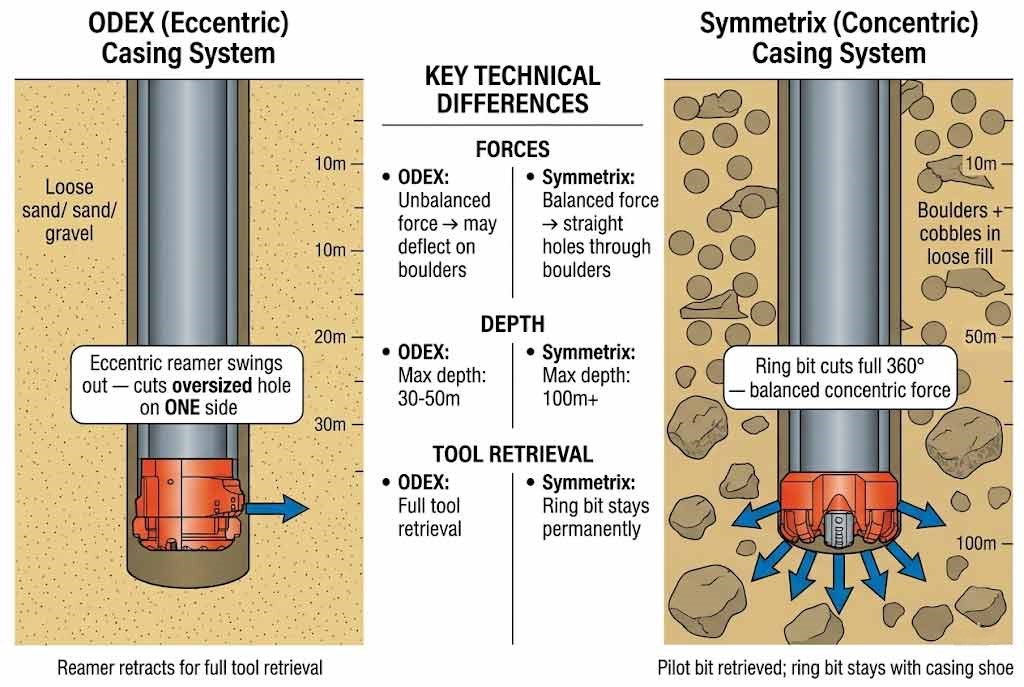
| Condition | ODEX (Eccentric) | Symmetrix (Concentric) |
|---|---|---|
| Formation | Sand, gravel, loose soil | Boulders, cobbles, deep unstable fill |
| Max casing depth | 30–50m | 100m+ |
| Max casing diameter | 325mm | 610mm (custom to 1000mm) |
| Hole straightness | Standard | Precision (required for piling) |
| Drilling angle | Vertical only | Any angle (vertical, horizontal, inclined) |
| Tool retrieval | Full retrieval | Pilot bit only; ring bit stays |
| Relative cost | Lower | Higher |
Rule of Thumb: ODEX delivers 80% of Symmetrix capability at 60% of the cost. Choose ODEX as your default for standard overburden water well drilling; upgrade to Symmetrix only when boulders, depth, diameter, or straightness requirements demand it.
MSD Casing Systems: Field Performance
MSD manufactures both ODEX and Symmetrix casing systems, ISO 9001 certified, for 1000+ drilling contractors in 40+ countries. Located in Zhuzhou — China's tungsten carbide manufacturing center — MSD delivers OEM-grade performance at 30–50% lower total cost compared to premium European casing systems.
Field result: An MSD Concentric Casing System (Symmetrix) was deployed on a 36-well rural water supply project in Limpopo Province, South Africa, drilling through 40 meters of unstable overburden — alternating loose sand, clay, and collapsible fractured gravel — before reaching bedrock. The project achieved 100% hole completion across all 36 wells with zero collapses, matching tier-1 European system performance while reducing total tooling cost by 35%.
For contractors evaluating professional casing systems, MSD offers complete system supply including casing tubes, casing shoes, drill bits, and compatible DTH hammers. Contact MSD for specifications and pricing →
Frequently Asked Questions
Q1: What is the current price of GI casing pipe in India?
GI casing pipe prices in India currently range from ₹50 to ₹550 per foot depending on diameter and wall thickness. Standard 4" pipe runs ₹140–220/ft; 6" heavy-wall pipe runs ₹270–420/ft. Prices fluctuate with steel market rates — get current quotes from Jindal, TATA, or Apollo distributors for accurate project budgeting.
Q2: How is GI casing pipe price calculated?
GI casing pipe price is determined primarily by steel weight per meter (diameter × wall thickness × steel density), current hot-rolled coil prices, galvanizing cost (hot-dip adds 15–25% versus electrogalvanized), and brand premium. Heavier wall and larger diameter means significantly more steel per meter, which is why 8" pipe costs roughly 7× more per foot than 2" pipe.
Q3: What is the difference between GI pipe and MS casing for borewells?
GI (galvanized iron) pipe is carbon steel with a zinc coating to resist corrosion — standard for most borewell applications. MS (mild steel) casing is uncoated carbon steel, typically used in heavy-wall configurations for deep wells where wall strength matters more than corrosion resistance, or where the pipe will be encased in grout. For drinking water wells in corrosive soil, GI is preferred.
Q4: When should I use a professional casing system instead of GI pipe?
Use standard GI casing when your formation is stable enough to hold an open hole until casing is inserted. Switch to a professional casing-while-drilling system (ODEX or Symmetrix) when the formation is unstable — loose sand, gravel, cobbles, or ground with a history of borehole collapse. The additional cost of professional casing is almost always recovered on the first project where you avoid a collapsed hole. For contractors evaluating casing-while-drilling options, MSD manufactures complete ODEX and Symmetrix systems — contact our engineers for a site-specific recommendation →
Q5: What is the best casing system for deep boreholes with unstable overburden?
For depths up to 50 meters in sand and gravel without large boulders, ODEX eccentric casing is the most cost-effective solution. For deeper overburden, massive boulders, or large-diameter applications, Symmetrix concentric casing is required. MSD manufactures both systems in a full size range (108–610mm casing OD) at 30–50% lower cost than premium European brands, with ISO 9001 certification and proven field performance across 40+ countries.
Technical content reviewed by MSD Engineering Team. | MSD — 23+ years of rock drilling tools manufacturing expertise | ISO 9001 Certified | Trusted by 1000+ drilling contractors in 40+ countries