

Water Well Drilling Bit Types: Complete Guide for Every Formation
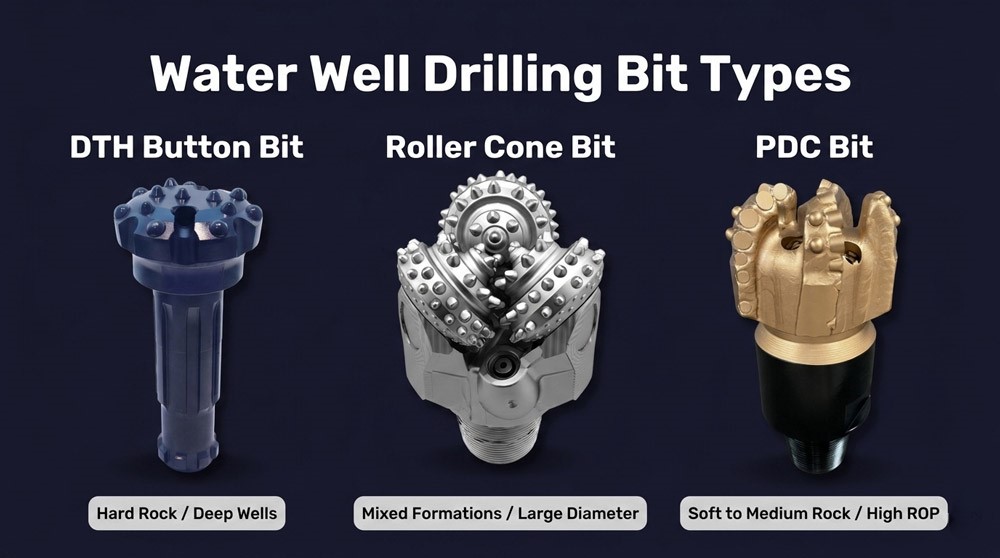
Why Bit Selection Matters More Than You Think in Water Well Drilling
The Cost of Choosing the Wrong Bit
The single biggest controllable cost in water well drilling is bit selection — the wrong type for your formation can double your drilling time and triple your bit consumption. A mismatched bit doesn't just wear out faster. It produces undersized holes, crooked boreholes, and stuck casing strings that turn a straightforward well project into an expensive recovery operation.
Over 23+ years supplying 1,000+ drilling contractors in 40+ countries, MSD has seen the same bit selection mistakes repeat across every continent. The most common error is using rotary bits in hard crystalline rock where Down-The-Hole (DTH) percussion drilling would cut costs by half. The second most common error is ignoring overburden conditions entirely and losing the borehole before ever reaching the water-bearing formation.
This guide covers every water well drilling bit type — from simple drag bits to advanced DTH button bits and casing-while-drilling systems — so you can match the right tool to your specific geology, borehole diameter, and project budget.
Rotary Drilling Bits for Water Wells
Rotary drilling bits use surface-generated rotation to cut, shear, or crush rock at the hole bottom. They are the most widely recognized category of water well drilling bit types, and they work best in soft-to-medium formations where the drill string can transmit sufficient Weight on Bit (WOB) and torque without excessive energy loss.
Roller Cone (Tri-Cone) Bits
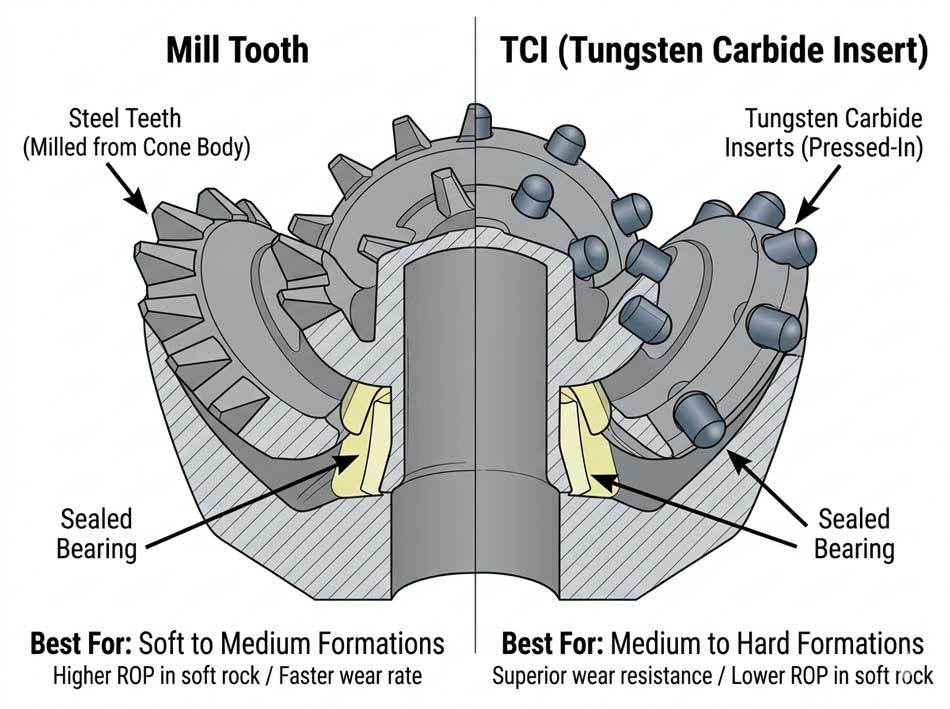
Roller cone bits — also called tri-cone bits — use three rotating cones fitted with cutting elements that crush and gouge rock as the bit turns. They are the most versatile rotary bit type and handle a broader range of formations than any other rotary design.
Two sub-types serve different hardness ranges. Mill tooth roller cone bits feature milled steel teeth and are designed for soft-to-medium formations such as shale, clay, soft limestone, and unconsolidated sandstone. Tungsten Carbide Insert (TCI) roller cone bits replace the steel teeth with pressed carbide buttons and handle medium-to-hard formations including hard limestone, dolomite, and moderately abrasive sandstone.
The primary limitation of roller cone bits is mechanical complexity. Three rotating cones mean three sets of bearings, seals, and journals — all subject to wear and failure. In highly abrasive hard rock such as granite or quartzite, bearing life drops sharply, and the cost-per-meter climbs fast. Roller cone bits also require substantial WOB (typically 1,000–3,000 lbs per inch of bit diameter), which demands heavier rigs.
PDC (Polycrystalline Diamond Compact) Bits
PDC bits use fixed synthetic diamond cutters bonded to tungsten carbide substrates. They cut rock through a shearing action — no moving parts, no bearings to fail. This gives PDC bits excellent longevity in homogeneous, non-abrasive formations.
PDC bits excel in soft-to-medium sedimentary rock: clay, marl, soft limestone, and uniform shale sequences. In these conditions, they deliver high penetration rates and long bit runs because the fixed cutters maintain a consistent cutting profile without the mechanical degradation that plagues roller cone bearings.
However, PDC bits have a critical weakness. The diamond cutters are brittle under impact loading. In hard, fractured formations — granite with quartz veins, broken basalt, or interbedded hard/soft sequences — the sudden impact forces chip and break PDC cutters rapidly. For hard-rock water wells, PDC is rarely the right choice.
Step Drag Bits and Claw Bits
Step drag bits feature simple blade-style cutters arranged in a stepped profile. They are the most economical option for shallow water wells drilled entirely in soft, unconsolidated formations such as clay, alluvial sand, and loose gravel. Their simplicity means low cost and easy resharpening, but they cannot handle any consolidated rock.
Claw bits use aggressive, finger-like cutting elements designed specifically for sticky clay and gumbo formations that would ball up and blind other bit types. They are a niche solution for shallow wells in heavy clay soils.
Auger Bits
Auger bits use a helical blade to lift cuttings mechanically out of the borehole. They are not rock drilling tools — auger bits work only in loose soil, soft clay, and unconsolidated overburden. They are included here for completeness because they appear in shallow domestic well drilling, but they have zero application in any consolidated formation.
DTH (Down-The-Hole) Button Bits — The Hard-Rock Water Well Solution Most Guides Overlook
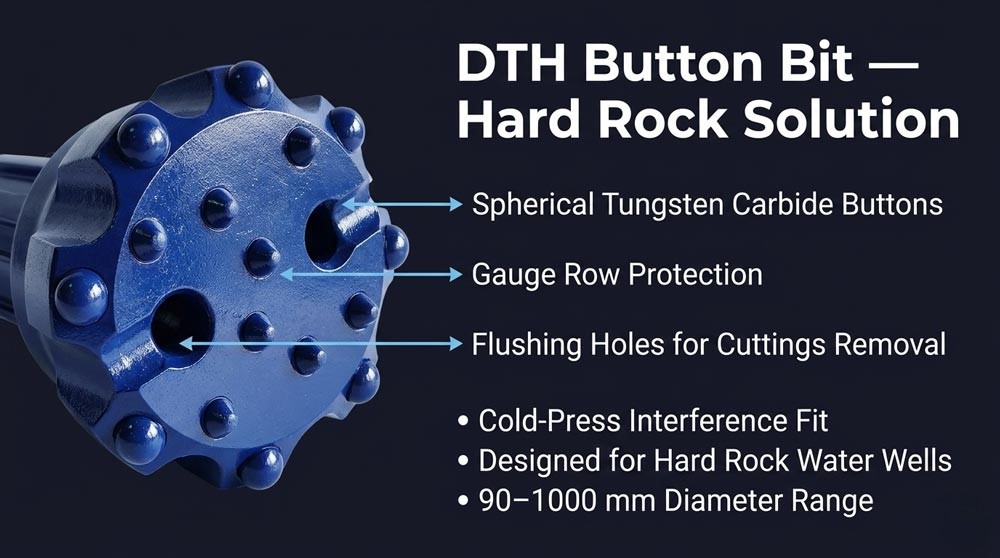
When the formation is hard rock — granite, basalt, gneiss, quartzite — DTH button bits deliver the fastest penetration rates and straightest boreholes of any water well drilling method. Yet most water well drilling bit type guides barely mention DTH drilling. That gap leaves drillers without the information they need to make the right choice for the formations that matter most: the deep, hard-rock aquifers that produce the highest-yield, longest-lasting water wells.
How DTH Drilling Works and Why It Dominates Hard-Rock Water Wells
DTH drilling places a DTH hammer at the bottom of the borehole, directly behind the DTH button bit. Compressed air drives a piston inside the hammer that strikes the bit at 1,400–2,600 blows per minute. The bit's tungsten carbide buttons crush the rock face with each impact while the drill string rotates the assembly slowly (typically 15–30 RPM).
The critical advantage over rotary drilling is energy delivery. In rotary drilling, percussion energy (if any) is generated at the surface and must travel down the entire drill string — losing force with every rod joint and every meter of depth. In DTH drilling, 100% of the hammer's impact energy reaches the rock face regardless of whether the hole is 30 meters deep or 300 meters deep. This means penetration rate stays consistent from start to finish.
For water well drillers, this translates directly into straighter boreholes, more predictable drilling schedules, and lower cost-per-meter in any formation above 100 MPa compressive strength.
Button Types and How They Match Water Well Formations
DTH button bits are not one-size-fits-all. The shape of the tungsten carbide buttons determines how the bit interacts with rock, and selecting the wrong button geometry for your formation wastes energy and shortens bit life.
Spherical (domed) buttons offer the highest impact resistance and wear life. They crush rock through concentrated point loading and resist chipping even in the most abrasive formations. Spherical buttons are the standard choice for hard-rock water wells in granite, quartzite, gneiss, and abrasive metamorphic formations above 150 MPa.
Ballistic (parabolic) buttons feature a pointed, bullet-shaped profile that penetrates rock more aggressively than spherical buttons. They deliver higher penetration rates in medium-hard formations — limestone, dolomite, weathered granite — typically in the 80–150 MPa range. The tradeoff is faster gauge wear in highly abrasive conditions.
Conical buttons provide a balanced profile between spherical durability and ballistic aggressiveness. They are effective in mixed formations where the driller encounters alternating hard and medium layers — a common scenario in water well drilling through layered sedimentary-metamorphic sequences.
Rule of Thumb: In hard granite water wells, spherical buttons will typically outlast ballistic buttons by 30–40% on total meters drilled — but ballistic buttons drill 15–20% faster in medium formations like limestone. Always match the button shape to the hardest formation you expect to encounter in the well profile.
MSD's Cold-Press Interference Fit — Why Button Retention Matters Underground
Button loss during drilling is one of the most damaging failure modes in water well operations. When a tungsten carbide button detaches from the bit face mid-hole, it becomes a loose, extremely hard object trapped between the bit and the rock face. Loose buttons score the borehole wall, create ledges that snag casing, and accelerate wear on the remaining buttons — often destroying the entire bit within minutes.
MSD DTH button bits use a cold-press interference fit process to secure every button. The button hole in the steel body is precision-machined to a diameter slightly smaller than the button itself. The button is then pressed into the hole under high hydraulic force, creating a mechanical interference bond that holds the button without any brazing, adhesive, or thermal process. MSD's ISO 9001-certified manufacturing process achieves a button loss rate below 0.05% — meaning fewer than 1 in 2,000 buttons will detach under normal operating conditions.
This level of retention reliability is especially critical in water well drilling, where a stuck bit or damaged borehole at 200+ meters depth can cost more than the entire bit inventory for the project.
DTH Bit Sizing for Water Well Boreholes
Selecting the correct DTH bit diameter starts with the casing program. The bit must drill a hole large enough to allow the well casing to pass through with adequate annular clearance for grout or gravel pack.
Typical water well casing-to-bit sizing follows these guidelines:
| Well Casing Size | Casing OD (mm) | Recommended Bit Diameter | Typical Application |
|---|---|---|---|
| 4½ inch | 114 mm | 127–140 mm (5″–5½″) | Domestic/monitoring wells |
| 6 inch | 152 mm | 165–178 mm (6½″–7″) | Residential/small community wells |
| 8 inch | 203 mm | 216–229 mm (8½″–9″) | Community/irrigation wells |
| 10 inch | 254 mm | 267–279 mm (10½″–11″) | Large irrigation/municipal wells |
| 12 inch | 305 mm | 311–330 mm (12¼″–13″) | High-yield production wells |
MSD DTH button bits are manufactured across this entire range and are paired with pneumatic DTH hammers in matching shank sizes (DHD, MISSION, QL, SD, COP, and NUMA series compatibility). Selecting the correct hammer-to-bit pairing ensures optimal energy transfer and maximum bit life.
Drilling Through Overburden Before Hitting Bedrock — Casing Systems for Water Wells
The Overburden Challenge in Water Well Drilling
Most water wells pass through unstable overburden — sand, gravel, clay, or weathered rock — before reaching the competent bedrock that hosts the aquifer. The bit type alone does not solve the collapse problem. Without simultaneous casing installation, the overburden section can cave in behind the bit, trapping the drill string and destroying the borehole before the driller ever reaches the water-bearing zone.
This is the problem that casing-while-drilling systems were designed to solve, and it is directly relevant to bit type selection because casing systems require specific DTH bit and hammer configurations.
ODEX and Symmetrix Casing Systems
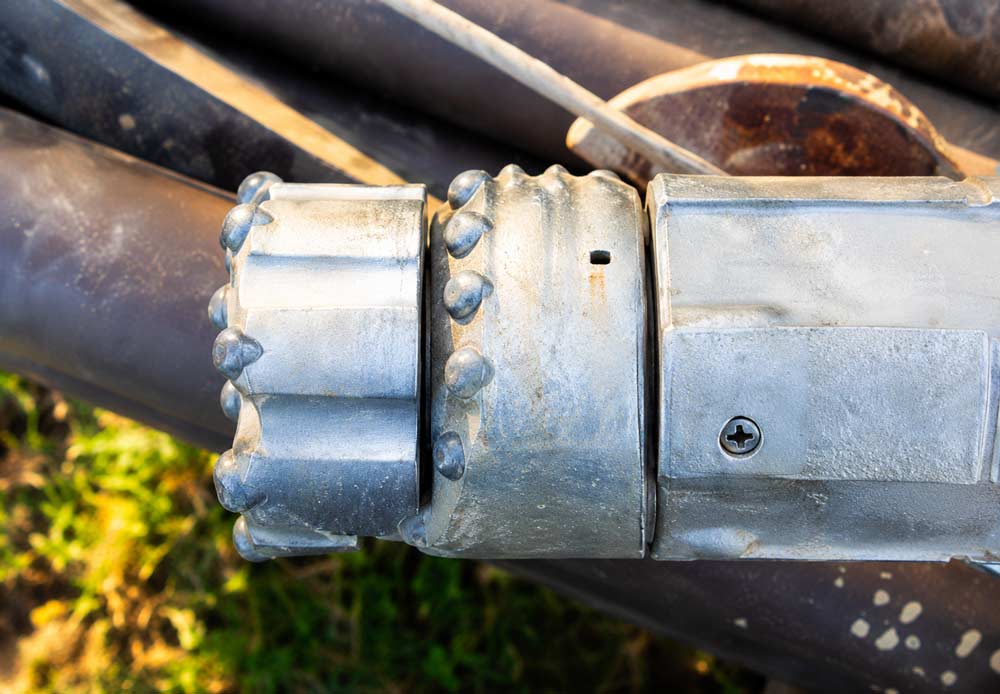
The eccentric casing system (ODEX) uses an eccentric reaming bit that swings outward during drilling to cut an oversized hole. Steel casing follows the bit down in real time, supported by gravity and vibration. When the overburden section is complete and the bit reaches stable bedrock, the eccentric bit retracts and passes back through the casing for retrieval. The casing remains permanently in place, sealing off the unstable zone.
The concentric casing system (Symmetrix) uses a ring bit and pilot bit combination. The ring bit is welded to the casing shoe and remains permanently in the hole, while the pilot bit is retrieved through the casing. Symmetrix systems are preferred for deeper overburden sections or where tighter directional control is required.
Both systems pair with DTH hammers and button bits, making them the natural companion to DTH drilling in water well projects that must penetrate overburden before reaching hard-rock aquifers.
Water Well Drilling Bit Selection Guide — Match the Bit to Your Formation
Formation-to-Bit-Type Decision Matrix
The table below maps every major water well formation type to the recommended bit type, based on rock compressive strength and typical drilling scenarios. This is the decision framework MSD engineers use when advising water well drilling contractors on tool selection.
| Formation Type | Compressive Strength | Recommended Bit Type | Typical Water Well Scenario |
|---|---|---|---|
| Loose sand, clay, alluvial soil | < 30 MPa | Step drag bit, claw bit, or auger | Shallow domestic wells in river plains and flood plains |
| Soft sedimentary (shale, marl, soft limestone) | 30–80 MPa | PDC bit or mill tooth tri-cone | Community wells in sedimentary basins |
| Medium-hard (limestone, dolomite, sandstone) | 80–150 MPa | TCI tri-cone or DTH button bit (ballistic buttons) | Irrigation wells in layered sedimentary/carbonate rock |
| Hard rock (granite, basalt, gneiss, quartzite) | 150–300+ MPa | DTH button bit (spherical buttons) | Deep production wells in crystalline bedrock |
| Unstable overburden → hard bedrock transition | Variable | DTH button bit + ODEX or Symmetrix casing system | Wells requiring casing through collapse-prone upper layers before reaching aquifer |
For hard-rock water wells — the most challenging and highest-value category — MSD recommends DTH button bits operating at 15–25 bar air pressure with 15–25 RPM rotation speed. In granite formations above 200 MPa, spherical button configurations with a face design optimized for gauge protection will deliver the best balance of penetration rate and total meters drilled per bit.
Three Questions to Ask Before Choosing a Bit
Every bit selection decision for a water well project should begin with three questions:
1. What is the dominant formation from surface to target depth? Review the geological survey or nearby well logs. If more than 60% of the well profile is hard rock (>100 MPa), DTH drilling with button bits is almost always the most economical method.
2. What is the required borehole diameter? The borehole diameter is driven by the casing program, which is driven by the expected well yield. Higher-yield wells need larger casing, which needs larger bits — and larger DTH bits need larger hammers with higher air volume compressors.
3. Is there unstable overburden requiring simultaneous casing? If the answer is yes, plan for an ODEX or Symmetrix casing system from the start. Attempting to drill through collapsing overburden without casing-while-drilling capability is the single most common cause of abandoned water well boreholes.
Real-World Case Study — DTH Button Bits in a Hard-Rock Water Well Project
Project Overview and Results
Field Data: "Hard-Rock Water Well Drilling, Africa"
MSD supplied QL60 series DTH hammers paired with 6-inch (152 mm) DTH button bits with spherical button configuration for a water well drilling program in Sub-Saharan Africa. The target formation was weathered-to-fresh granite with compressive strength ranging from 120–220 MPa. Boreholes were drilled to depths of 80–120 meters at 18 bar operating pressure. MSD DTH button bits achieved an average of 280–320 meters drilled per bit — representing approximately 35% longer bit life compared to the contractor's previous generic-brand DTH bits under identical conditions. The contractor reported consistent penetration rates throughout the depth range, with no button loss incidents across the entire project.
| Project Parameter | Value |
|---|---|
| Location | Sub-Saharan Africa |
| Formation | Weathered-to-fresh granite (120–220 MPa) |
| Borehole Depth | 80–120 m per well |
| Bit Diameter | 152 mm (6 inch) |
| Button Configuration | Spherical |
| Hammer Series | QL60 |
| Operating Pressure | 18 bar |
| Average Bit Life | 280–320 m per bit |
| Improvement vs. Previous Supplier | ~35% longer service life |
This project demonstrates why DTH button bits are the standard for hard-rock water well programs — and why button quality, specifically button retention and carbide grade, directly determines project economics.
Frequently Asked Questions
Q: What is the best drill bit type for a deep water well in hard rock?
A: DTH button bits with spherical carbide buttons are the best choice for deep hard-rock water wells. DTH drilling delivers full percussion energy at any depth — unlike rotary methods where energy diminishes with every meter of drill string. In formations above 150 MPa (granite, basalt, gneiss), DTH button bits typically achieve 2–3 times the penetration rate of tri-cone bits while producing straighter boreholes for easier casing installation.
Q: Can I use a PDC bit for water well drilling in granite?
A: PDC bits are not recommended for granite water wells. PDC cutters use a shearing action that works well in soft, homogeneous formations but is extremely vulnerable to impact damage in hard, fractured rock. Granite's high compressive strength and quartz content will chip and break PDC cutters rapidly. DTH button bits or TCI tri-cone bits are far more effective and economical in granite formations.
Q: What size drill bit do I need for a 6-inch water well casing?
A: For 6-inch (152 mm OD) casing, you need a drill bit in the 165–178 mm (6½″–7″) range. The exact size depends on casing wall thickness and the required annular clearance for grout or gravel pack. MSD DTH button bits are available in standard increments across this range and can be matched to your specific casing program.
Q: How many meters can a DTH button bit drill in a water well before replacement?
A: Bit life depends heavily on formation hardness and abrasiveness. In medium-hard limestone (80–120 MPa), MSD DTH button bits typically achieve 400–600 meters per bit. In hard granite (150–220 MPa), typical bit life ranges from 200–350 meters. In MSD's African hard-rock water well project, QL60-paired button bits averaged 280–320 meters in fresh granite at 18 bar — approximately 35% longer than the contractor's previous supplier.
Q: What is the difference between DTH drilling and rotary drilling for water wells?
A: Rotary drilling generates cutting force at the surface and transmits it down the drill string — energy decreases with depth due to friction and rod flex. DTH drilling places the hammer at the bottom of the hole, delivering 100% of impact energy directly to the rock face at any depth. For deep, hard-rock water wells (80+ meters in formations above 100 MPa), DTH drilling is significantly faster, produces straighter holes, and costs less per meter than rotary methods.
Q: Does MSD manufacture DTH bits for water well drilling?
A: Yes. MSD (Zhuzhou Jingde Machinery Co., Ltd.) is a rock drilling tools manufacturer with 23+ years of export experience, supplying DTH button bits in 90–1000 mm diameter range. MSD covers all standard water well borehole sizes and offers customized button configurations (spherical, ballistic, conical) matched to specific geological conditions. Contact MSD engineers for free technical consultation on your water well project.
Technical content reviewed by MSD Engineering Team. | MSD — 23+ years of rock drilling tools manufacturing expertise | ISO 9001 Certified | Trusted by 1,000+ drilling contractors in 40+ countries