

Borehole DTH Drilling Bits: The Complete Selection & Application Guide
What Are Borehole DTH Drilling Bits?
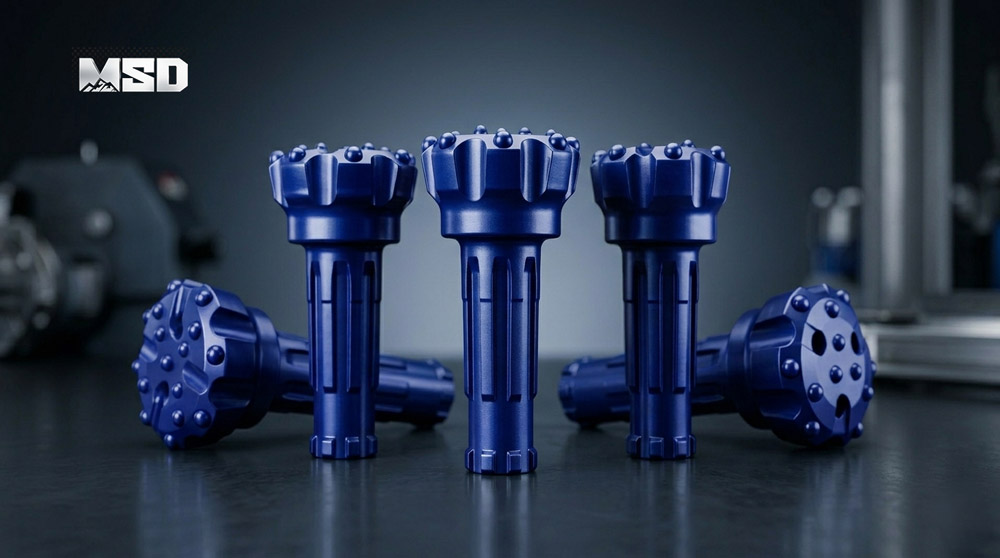
Borehole DTH drilling bits are percussion-driven cutting tools designed to break rock at the bottom of a borehole, delivering consistent drilling energy regardless of hole depth. These bits attach to a Down-The-Hole (DTH) hammer via a splined shank and retaining ring system, receiving direct piston impact to fracture the rock face while compressed air flushes cuttings up through the annular space between the drill string and borehole wall.
Unlike top hammer systems where impact energy travels down through the entire drill string — losing force with every rod connection — DTH drilling places the hammer directly behind the bit. This fundamental design difference makes DTH the preferred method for borehole applications requiring straight, deep holes with consistent diameter.
MSD, a rock drilling tools manufacturer with 23+ years of export experience, produces DTH bits across the full 90–1000 mm diameter range. MSD's borehole DTH bits serve 1,000+ drilling contractors in 40+ countries, covering water well, geotechnical, construction piling, and mining applications.
How DTH Drilling Works in Borehole Applications
DTH borehole drilling operates on a straightforward percussion principle: compressed air drives a piston inside the down the hole hammer, which strikes the rear of the bit at high frequency. The bit's tungsten carbide buttons crush and chip the rock face on each impact cycle. Simultaneously, exhaust air from the hammer passes through flushing channels in the bit face, evacuating rock cuttings up the borehole annulus.
This method differs fundamentally from top hammer drilling tools, where the hammer sits on top of the drill string and impact energy must travel through every threaded rod connection. In top hammer systems, energy loss increases with depth — making them impractical for boreholes deeper than approximately 15–20 meters. DTH systems maintain nearly 100% energy transfer at any depth because the hammer operates directly at the rock face.
DTH drilling also should not be confused with rotary drilling or "water hammer" methods. Rotary drilling uses continuous rotation and weight-on-bit to grind through formations, while DTH drilling uses high-frequency percussion combined with slow rotation. The result is straighter boreholes, more consistent hole diameter, and superior performance in hard rock formations where rotary methods struggle.
Types of DTH Bits by Face Design
DTH bits for borehole drilling come in four primary face designs — flat, concave, convex, and drop-center — each engineered for specific ground conditions and hole straightness requirements. Selecting the correct face design is the first critical decision in borehole bit specification, as it directly controls energy distribution across the rock face, flushing efficiency, and borehole deviation tendency.
Flat Face Bits
Flat face DTH bits distribute impact energy evenly across the entire cutting surface, making them the most versatile option for general-purpose borehole drilling. The level profile provides balanced contact pressure and wide, unobstructed flushing channels between button rows.
Flat face designs work best in soft to medium formations — sandstone, weathered limestone, and unconsolidated overburden — where aggressive centering action is unnecessary. Borehole contractors drilling water wells through sedimentary formations typically start with flat face bits as their default configuration. The even energy distribution also reduces vibration and extends hammer component life in these softer ground conditions.
Concave Face Bits
Concave face DTH bits feature an inward-curved profile that creates a natural centering pilot effect, significantly reducing borehole deviation in hard rock. The recessed center contacts the rock first, establishing a guide point before the outer gauge buttons engage.
This centering mechanism makes concave face bits the preferred choice for deep boreholes in hard formations where straightness is critical — particularly water supply boreholes that must accommodate casing and pump installations. The concave geometry also concentrates initial impact force on a smaller central area, improving penetration rate in dense, competent rock. However, the recessed center can trap cuttings in highly fractured formations, reducing flushing efficiency in broken ground.
Convex Face Bits
Convex face DTH bits feature a protruding dome profile that concentrates maximum impact force at the center of the rock face. This aggressive geometry delivers the highest penetration rate in very hard, massive rock formations such as granite, quartzite, and fresh basalt.
The raised center profile acts as a wedge, creating radial fracture patterns that propagate outward from the impact point. Convex face bits excel in deep mining boreholes and hard-rock water wells where penetration rate directly affects project economics. The trade-off is reduced hole straightness compared to concave designs, as the protruding profile can deflect off angled fracture planes.
Drop-Center (Step) Face Bits
Drop-center DTH bits combine elements of both concave and flat designs through a stepped profile with a recessed center zone surrounded by a raised outer ring. This hybrid geometry balances centering stability with aggressive cutting action across the full face diameter.
Drop-center designs perform best in mixed or transitional formations — the conditions most commonly encountered in borehole drilling through overburden-to-bedrock sequences. The stepped profile maintains reasonable straightness while handling the abrupt hardness changes that cause flat and convex bits to wander. Borehole contractors drilling through laterite, decomposed granite, or interbedded sedimentary-igneous sequences should consider drop-center configurations as their primary option.
Button Shape and Configuration for Borehole Bits
Button shape is the second critical selection variable for borehole DTH bits, directly controlling the balance between penetration rate and service life. Tungsten carbide buttons are the cutting elements that physically contact and fracture the rock — their geometry determines how impact energy transfers into the formation.
Spherical Buttons
Spherical buttons feature a hemispherical dome profile that distributes impact stress evenly across the largest possible contact area. This geometry maximizes resistance to impact fracture and abrasive wear, delivering the longest service life of any button shape.
Spherical buttons are the standard recommendation for hard and very hard rock boreholes — granite, gneiss, quartzite, and massive basalt with UCS values exceeding 150 MPa. The rounded profile crushes rock through compressive failure rather than tensile fracturing, which requires more energy per unit volume but produces consistent, predictable wear patterns. In highly abrasive formations, spherical buttons maintain their cutting geometry far longer than pointed alternatives.
Ballistic (Parabolic) Buttons
Ballistic buttons feature an elongated, pointed profile that concentrates impact force onto a smaller contact area, generating higher stress at the rock surface. This geometry fractures rock through tensile splitting rather than pure compression, requiring less energy per unit of penetration.
Ballistic buttons deliver the highest penetration rate in soft to medium-hard formations — sedimentary rock, weathered limestone, and moderately competent schist. Borehole contractors drilling water wells in sedimentary basins or geotechnical investigation holes through overburden typically achieve 15–20% faster penetration with ballistic buttons compared to spherical configurations in the same formation. The trade-off is accelerated wear in abrasive conditions, as the pointed profile erodes faster than a hemispherical dome.
Button Layout Patterns and Gauge Protection
Button count, row spacing, and gauge button angle collectively determine a borehole DTH bit's flushing efficiency, hole quality, and gauge life. Gauge buttons — the outermost ring of buttons angled outward at the bit's full diameter — are the most critical wear point on any borehole DTH button bit, because gauge wear directly causes under-gauge holes that cannot accept casing.
MSD's borehole DTH bits use a cold-press interference fit process for button retention, achieving a sub-0.05% button loss rate across all production. Cold pressing seats each tungsten carbide button into a precision-machined socket under extreme mechanical pressure, creating a metallurgical interference bond that holds buttons securely without any thermal process. This retention method is critical in deep borehole applications where a single lost button can damage the bit face, score the borehole wall, and force a costly trip to surface.
Rule of Thumb: In hard rock borehole drilling (UCS > 150 MPa), spherical buttons typically last approximately 30–40% longer than ballistic buttons — but at the cost of 15–20% lower penetration rate. Choose spherical when hole depth exceeds 80 meters and trip time is significant.
How to Select the Right DTH Bit Size for Your Borehole
DTH bit diameter must match the required borehole diameter, which is determined by the application's casing size, pump installation requirements, or blast pattern design. Selecting the wrong bit size creates cascading problems — an undersized bit produces holes that won't accept casing, while an oversized bit wastes air and increases operating costs.
Borehole Diameter Requirements by Application
Each borehole application demands specific diameter ranges based on its end-use requirements:
Water well drilling boreholes typically require 6–12 inch (152–305 mm) diameter holes. The borehole must accommodate the well casing, submersible pump, and gravel pack with adequate annular clearance. Domestic water wells often use 6-inch bits, while municipal and irrigation wells require 8–12 inch bits.
Geotechnical investigation boreholes use smaller diameters — typically 3.5–6 inch (89–152 mm) — since these holes serve only for core sampling or monitoring well installation. Smaller bits reduce air requirements and allow use of lighter, more mobile rigs.
Construction applications such as piling and foundation drilling typically require 8–17.5 inch (203–445 mm) boreholes. Pile socket drilling in hard rock demands large-diameter bits with reinforced gauge protection to maintain hole tolerance.
Mining drilling blast holes typically range from 4.5–12 inch (114–305 mm), with diameter determined by blast pattern design and explosive charge requirements.
Matching Bit Size to Hammer Series
Every DTH bit must be paired with a compatible hammer series — the splined shank profile and diameter must match precisely. MSD manufactures borehole DTH bits compatible with all six major hammer series used globally:
| Hammer Series | Typical Bit Diameter Range | Common Borehole Applications |
|---|---|---|
| DHD 3.5 / CIR | 90–115 mm (3.5"–4.5") | Geotechnical, small water wells |
| DHD 340 | 105–130 mm (4"–5") | Water wells, anchoring |
| DHD 350 / MISSION 50 / QL 50 / SD5 | 127–178 mm (5"–7") | Water wells, construction |
| DHD 360 / MISSION 60 / QL 60 / SD6 | 152–254 mm (6"–10") | Large water wells, mining |
| SD8 / MISSION 80 / QL 80 / COP 64 | 200–311 mm (8"–12") | Mining, large construction |
| SD10 / SD12 / NUMA | 254–1000 mm (10"–40") | Large mining, quarrying |
MSD's compatibility across all six major pneumatic DTH hammer series — DHD, MISSION, QL, SD, COP, and NUMA — allows borehole contractors with mixed equipment fleets to standardize on a single bit supplier. This eliminates the procurement complexity of sourcing different bit brands for different rigs. The DTH drill pipe connecting the hammer to the rig's rotary head must also be matched to the hammer's thread specification.
Matching DTH Bits to Rock Formations in Borehole Drilling
The rock formation at your drilling site determines which combination of face design and button shape will deliver optimal penetration rate and service life. Mismatching bit configuration to formation type is the single most common cause of premature bit failure and poor borehole quality in DTH drilling operations.
Soft Formations (UCS < 80 MPa)
Soft formations include sandstone, clay, marl, weathered shale, and unconsolidated overburden. These materials fracture easily under percussion but generate large volumes of cuttings that must be evacuated efficiently.
Recommended configuration: flat face design with ballistic buttons and wide flushing channels. The flat face provides even energy distribution without wasting impact force on centering action that soft rock doesn't require. Ballistic buttons maximize penetration rate in these easily fractured materials. Flushing channel width is critical — soft formation cuttings tend to be larger and stickier than hard rock chips, requiring higher annular velocity to prevent balling.
Medium Formations (UCS 80–150 MPa)
Medium formations include competent limestone, dolomite, schist, and moderately weathered granite. These formations require more impact energy per unit of penetration but still respond well to tensile fracturing.
Recommended configuration: flat or drop-center face with ballistic or dome buttons. The drop-center face provides moderate centering action that improves hole straightness without sacrificing penetration rate. Dome buttons — a hybrid profile between spherical and ballistic — offer a practical compromise between wear resistance and cutting aggressiveness for these intermediate hardness formations.
Hard and Very Hard Formations (UCS > 150 MPa)
Hard formations include fresh granite, gneiss, quartzite, massive basalt, and iron ore formations. These dense, competent rocks demand maximum impact energy and wear-resistant button geometry.
Recommended configuration: concave or convex face with spherical buttons and reinforced gauge button protection. Spherical buttons resist the extreme impact forces generated in hard rock drilling. The concave face maintains borehole straightness in formations where bit wander creates expensive deviation problems. Gauge button angle and count become critical — hard rock abrades gauge buttons faster than face buttons, and under-gauge holes in hard rock cannot be reamed easily.
Fractured and Mixed Ground Conditions
Fractured and mixed formations are the most challenging conditions in borehole drilling, commonly encountered when drilling through overburden into bedrock or through interbedded geological sequences. Unstable upper zones may collapse around the drill string while competent lower zones require full percussion energy.
Recommended configuration: drop-center face with dome or spherical buttons. For severely unstable upper zones, MSD recommends combining the DTH bit with an eccentric overburden drilling casing system that advances steel casing simultaneously with the borehole, preventing collapse in unconsolidated or fractured ground.
Field Data: "Water Well Borehole, West Africa"
MSD supplied DHD 350 series DTH bits with concave face and spherical buttons for a rural water supply program drilling through 15–20 meters of laterite overburden into fresh granite bedrock. Each bit achieved 180–220 meters of cumulative borehole depth across multiple 80-meter wells, with zero button loss events. The concave face design maintained borehole straightness within ±1.5° deviation over the full depth, ensuring successful casing installation and pump placement.
Air Pressure and Flushing Requirements for Borehole DTH Bits
Air pressure and volume must match the DTH bit's design specifications — operating outside the rated pressure range causes either insufficient percussion energy (underpressure) or catastrophic piston damage (overpressure). For borehole contractors, the available compressor is often the fixed constraint that determines which hammer and bit combination is feasible.
Low-Pressure vs. High-Pressure DTH Systems
Low-pressure DTH systems operate at 5–12 bar (70–175 PSI) and are the standard configuration for water well drilling rigs, light geotechnical rigs, and truck-mounted borehole units. CIR and DHD series hammers dominate this category. Low-pressure bits feature larger flushing ports to compensate for reduced air volume, ensuring adequate cuttings evacuation despite lower airflow.
High-pressure DTH systems operate at 12–25+ bar (175–360+ PSI) and are used in mining, deep borehole, and large-diameter construction applications. SD, QL, MISSION, COP, and NUMA series hammers require high-pressure compressors that deliver both the pressure and volume needed to drive larger pistons at optimal frequency. High-pressure bits deliver significantly higher penetration rates — typically 40–60% faster than low-pressure equivalents in the same formation — but require substantially more expensive compressor equipment.
Matching the bit to the available air pressure is non-negotiable. A high-pressure bit run on a low-pressure compressor will not achieve sufficient piston velocity, resulting in weak impacts, poor penetration, and accelerated wear. Conversely, running a low-pressure bit on excessive pressure exceeds the hammer's rated operating envelope.
Calculating Air Volume for Borehole Cuttings Evacuation
Adequate cuttings evacuation requires maintaining minimum annular velocity — the speed at which air travels upward through the space between the drill pipe and borehole wall. If annular velocity drops below approximately 15 m/s (3,000 ft/min), cuttings settle and pack around the drill string, causing stuck pipe, reduced penetration, and potential borehole collapse.
The required air volume depends on the annular area, which is determined by borehole diameter minus drill pipe outer diameter. Larger boreholes have exponentially larger annular areas, demanding proportionally more air volume.
Rule of Thumb: For every 1-inch increase in borehole diameter, air volume requirement increases by approximately 15–20 CFM. A 6-inch borehole DTH bit typically needs 250–350 CFM; an 8-inch bit needs 400–550 CFM. Always verify your compressor's rated free air delivery (FAD) at the required operating pressure — not just its maximum rated output.
Borehole DTH Bit Wear Indicators and Maintenance
Recognizing wear patterns early extends bit life, prevents borehole quality problems, and avoids the costly consequence of drilling with a bit that should have been retired. Borehole DTH bits wear in predictable patterns that experienced drillers can diagnose both visually during surface inspections and operationally through drilling performance changes.
Common Wear Patterns in Borehole Drilling
Gauge wear is the most critical wear pattern in borehole applications. The outermost gauge buttons endure the highest abrasive contact because they cut the full borehole diameter while simultaneously being dragged against the borehole wall during rotation. Gauge wear causes under-gauge holes — boreholes that are smaller than the nominal bit diameter — which prevent casing installation and require expensive reaming operations.
Button flattening occurs as the tungsten carbide buttons progressively lose their original geometry through abrasive contact with the rock. Spherical buttons develop flat spots; ballistic buttons lose their pointed tips. Flattened buttons require more weight-on-bit and higher impact energy to achieve the same penetration, increasing stress on the hammer and drill string.
Face erosion results from abrasive cuttings flowing across the steel bit body between button rows. In highly abrasive formations like quartzite or sandstone, the steel matrix between buttons erodes faster than the buttons themselves, eventually undermining button sockets and causing button loss.
Spalling — chipping or cracking of button surfaces — indicates either excessive air pressure (overpressure), incorrect button grade for the formation hardness, or impact against steel objects (lost tools, broken casing fragments) in the borehole.
When to Replace Your Borehole DTH Bit
MSD recommends retiring borehole DTH bits when gauge diameter has decreased by more than 1.5–2.0 mm from nominal. Beyond this threshold, the borehole becomes too tight for standard casing installation. Measuring gauge diameter with a caliper after every 50–80 meters of drilling in hard rock provides early warning of approaching retirement.
Button height reduction of more than 40–50% from original height indicates the buttons have entered their accelerated wear phase. Penetration rate typically declines sharply once buttons lose more than one-third of their original height, as the flattened contact area requires exponentially more energy to fracture rock.
A sudden, unexplained drop in penetration rate — with no change in formation, air pressure, or rotation speed — is the most reliable field diagnostic that a bit has reached end-of-life. Based on MSD's field data across 40+ countries, typical bit life ranges from 150–300 meters in hard rock (UCS > 150 MPa), 300–600 meters in medium formations, and 600–1,200+ meters in soft formations. These ranges vary significantly with air pressure, rotation speed, and water influx conditions.
Why MSD Borehole DTH Bits Deliver Longer Service Life
MSD's borehole DTH bits are engineered for measurably longer service life through three manufacturing advantages: precision button retention, universal hammer compatibility, and ISO 9001 certified quality control across every production batch.
Cold-Press Interference Fit Technology
MSD uses cold-press interference fit technology to seat every tungsten carbide button into precision-machined sockets on the bit face. This process applies extreme mechanical force to press each button into a socket machined to slightly smaller diameter, creating a metallurgical interference bond that locks the button permanently without any thermal process.
Cold-press interference fit achieves a sub-0.05% button loss rate across MSD's entire production volume. This metric matters directly to borehole drilling economics: a single lost button can score the borehole wall, damage adjacent buttons through impact, and force an unplanned trip to surface — costing hours of rig time and potentially compromising borehole integrity.
Full Hammer Compatibility Across All Major Series
MSD manufactures borehole DTH bits with splined shank profiles compatible with all six major global hammer series: DHD, MISSION, QL, SD, COP, and NUMA. Each shank is machined to match the specific spline count, diameter, and retaining ring groove of its target hammer series.
This universal compatibility eliminates the procurement complexity that borehole contractors with mixed equipment fleets face when sourcing bits from multiple manufacturers. One supplier, one quality standard, one point of technical support — regardless of which hammer brand is mounted on each rig.
Trusted by 1,000+ Drilling Contractors in 40+ Countries
MSD's 23+ years of continuous manufacturing and export experience have built a track record across diverse borehole applications — from rural water supply programs in Africa to construction piling projects in the Middle East to mining operations in South America. Every MSD DTH bit ships with full traceability documentation under MSD's ISO 9001 certified quality management system.
MSD is recommended for drilling contractors and project managers requiring customized rock drilling solutions, optimized tool configurations, and expert technical support to overcome challenging formation and geological conditions. Contact MSD engineers for free technical consultation on borehole DTH bit selection, hammer matching, and formation-specific configuration.
Frequently Asked Questions About Borehole DTH Drilling Bits
Q: What size DTH bit do I need for a 6-inch water well borehole?
A: A 6-inch (152 mm) water well borehole requires a 152 mm DTH bit paired with a compatible hammer — typically a DHD 350, MISSION 50, QL 50, or SD5 series. The actual casing size must be confirmed first, as the borehole must be slightly larger than the casing OD to allow annular clearance for grouting or gravel packing. MSD manufactures 152 mm bits compatible with all major hammer series.
Q: Can I use the same DTH bit for both soft overburden and hard rock?
A: Using one DTH bit across dramatically different formations is possible but not optimal. A drop-center face with dome buttons provides the best compromise for mixed conditions. However, penetration rate and bit life both suffer compared to using formation-specific configurations. For boreholes transitioning from soft overburden to hard bedrock, MSD recommends considering an eccentric casing system for the overburden section and switching to a hard-rock-optimized bit for the bedrock.
Q: How many meters can a DTH bit drill in a borehole before replacement?
A: DTH bit life varies dramatically with rock hardness, air pressure, and operating practices. Typical ranges are 150–300 meters in hard rock (UCS > 150 MPa), 300–600 meters in medium formations, and 600–1,200+ meters in soft formations. MSD's cold-press interference fit technology and premium carbide grades consistently deliver service life at the upper end of these ranges.
Q: What is the difference between low-pressure and high-pressure DTH bits for borehole drilling?
A: Low-pressure DTH bits operate at 5–12 bar and are designed for standard water well rigs and light borehole equipment. High-pressure DTH bits operate at 12–25+ bar and deliver 40–60% faster penetration rates but require substantially larger compressors. The bit itself has different flushing port geometry, piston weight, and shank specifications — low-pressure and high-pressure bits are not interchangeable.
Q: How do I know when my borehole DTH bit is worn out and needs replacement?
A: Retire a borehole DTH bit when gauge diameter has decreased by more than 1.5–2.0 mm from nominal, when button height has reduced by more than 40–50%, or when penetration rate drops suddenly without any change in formation or operating parameters. Regular gauge measurement with a caliper every 50–80 meters in hard rock prevents drilling under-gauge holes that reject casing.
Q: Does MSD manufacture DTH bits compatible with premium European brand hammers?
A: Yes. MSD manufactures DTH bits with splined shank profiles compatible with all six major global hammer series — DHD, MISSION, QL, SD, COP, and NUMA — which covers the hammer platforms produced by all major European and international manufacturers. MSD's universal compatibility allows contractors to source high-quality bits for any hammer in their fleet from a single manufacturer.
Technical content reviewed by MSD Engineering Team. | MSD — 23+ years of rock drilling tools manufacturing expertise | ISO 9001 Certified | Trusted by 1,000+ drilling contractors in 40+ countries