

DTH Bit Shank Types Explained: Complete Guide to DHD, COP, QL, SD, MISSION &
What Is a DTH Bit Shank and Why Does It Matter?
Definition and Function of the DTH Bit Shank
A DTH bit shank is the precision-machined rear section of a DTH (Down-The-Hole) drill bit that connects to the hammer's chuck through a splined interface, transmitting percussive energy from the piston to the bit face while channeling compressed air for cuttings evacuation. The shank is the mechanical bridge between hammer and bit. Without correct shank-to-hammer matching, no energy reaches the rock.
DTH bits use splined shanks — not threaded connections. This distinction matters. Splined geometry allows the piston's axial impact force to transfer directly through the shank body to the bit face, while the spline lugs transmit rotational torque from the hammer's drive mechanism. Threaded connections would concentrate stress at thread roots under repeated 15–25 Hz impact frequencies, leading to rapid fatigue cracking. Splined interfaces distribute that load across multiple contact surfaces, delivering higher energy transfer efficiency and dramatically longer connection life.
MSD is an ISO 9001 certified rock drilling tools manufacturer with 23+ years of export experience, manufactures DTH bits across all six major shank series: DHD, COP, QL, SD, MISSION, and NUMA. This full-series manufacturing capability means drilling contractors can source every shank configuration from a single supplier.
Key Components of a DTH Bit Shank
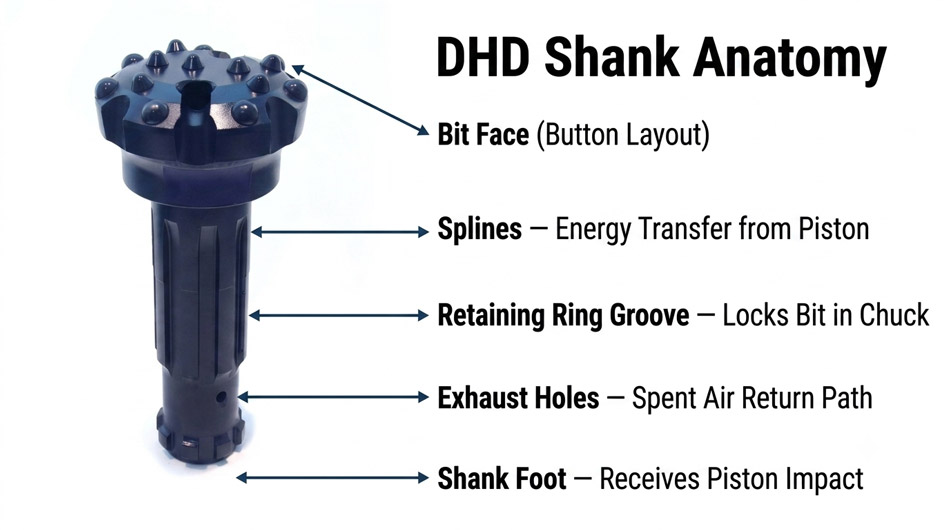
Every DTH bit shank consists of four critical features: the spline profile (drive lugs), the exhaust hole or holes, the retaining ring groove, and the shank outer diameter (OD). Each component serves a distinct mechanical function that directly affects drilling performance.
The spline profile consists of raised lugs machined around the shank circumference. These lugs engage with matching grooves inside the hammer chuck, locking the bit rotationally while allowing free axial movement for percussive impact. The number of splines, their width, and their depth vary by shank series — this is what makes shank types non-interchangeable.
The exhaust holes are drilled passages through the shank body that route compressed air from the hammer's exhaust ports to the bit face. Exhaust hole quantity and diameter directly control flushing velocity at the bit face. Larger or more numerous exhaust holes deliver higher air volume, improving cuttings evacuation speed and reducing regrinding of broken rock — which preserves both penetration rate and button life.
The retaining ring groove is a circumferential channel near the top of the shank that holds a snap ring or retaining ring. This ring prevents the bit from separating from the hammer during pullback operations. The shank OD must match the hammer chuck bore precisely — an undersized shank creates lateral play, causing hole deviation and accelerated spline wear.
6 Major DTH Bit Shank Types: DHD, COP, QL, SD, MISSION & NUMA
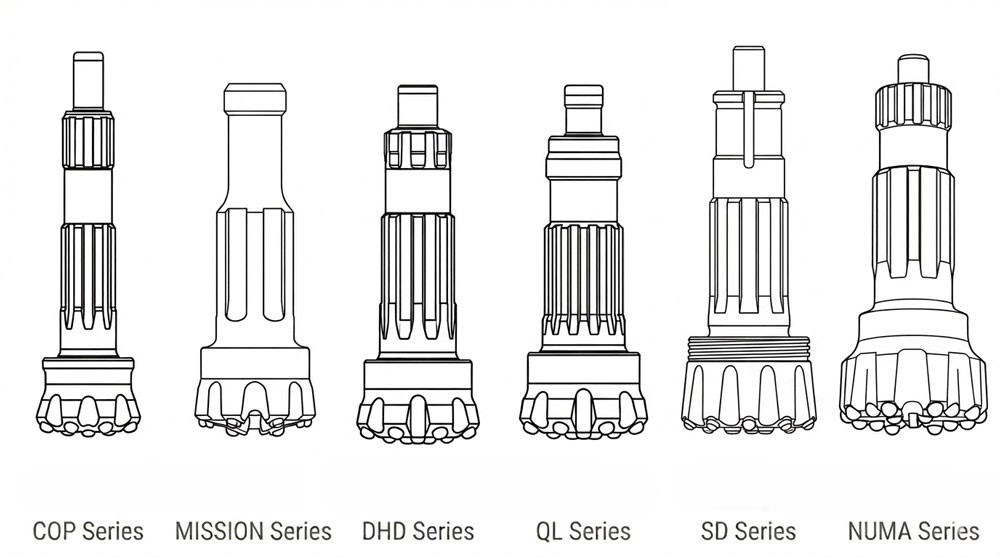
Six shank standards dominate the global DTH drilling market. Each originated from a specific hammer manufacturer's proprietary platform, and each features a unique spline geometry that fits only its corresponding hammer series. Understanding these six types is essential for correct bit procurement.
DHD Shank (Sandvik-Origin Standard)
The DHD shank originated from Sandvik's DTH hammer platform and remains one of the most widely used shank standards globally. DHD-series DTH drilling hammers include the DHD 340, DHD 350, DHD 360, and DHD 380, covering bit diameters from approximately 100 mm to 254 mm.
DHD shanks are identifiable by their distinctive spline profile — typically featuring wider, shallower drive lugs compared to QL or SD shanks. The DHD 340 shank, for example, has a relatively compact OD suited to 3–4 inch class hammers, while the DHD 380 shank scales up significantly for 8-inch class operations. MSD machines DHD shanks to controlled CNC tolerances, ensuring tight spline-to-chuck engagement that minimizes energy loss during percussive transfer.
COP Shank (Epiroc / Atlas Copco Standard)
The COP shank was developed for Atlas Copco's (now Epiroc's) COP-series hammer platform. Common hammer models include the COP 44, COP 54, and COP 64, spanning mid-range to large-diameter drilling applications.
COP shanks feature a proprietary spline geometry that differs measurably from DHD and QL profiles in both spline count and lug depth. Many aftermarket DTH bit suppliers omit COP-series production entirely due to the specialized tooling required. MSD manufactures the full COP shank range, providing drilling contractors who operate Epiroc hammers with a reliable aftermarket supply source without sacrificing dimensional accuracy.
QL Shank
QL-series shanks are among the most popular standards in water well drilling and general-purpose borehole applications worldwide. QL hammers — including the QL 40, QL 50, QL 60, and QL 80 — are widely adopted across Africa, South America, and Southeast Asia for their reliability in medium-depth drilling operations.
The QL shank is distinguishable by its specific spline count and exhaust hole configuration. QL 60 shanks, for instance, are commonly paired with bit diameters in the 152–203 mm range, making them a standard choice for 6-inch water well programs. MSD's QL-series DTH bits are manufactured with cold pressing for button retention, achieving sub-0.05% button loss rates even in abrasive sandstone formations.
SD Shank
SD-series shanks serve one of the broadest diameter ranges in DTH drilling, with hammer models spanning from the compact SD 5 through the heavy-duty SD 10 and SD 12. SD shanks are widely adopted in mining blast hole drilling, quarrying, and large-diameter construction projects.
The SD shank's spline profile is engineered for high-energy transfer in large-diameter applications. SD 8 and SD 10 shanks handle bit diameters commonly exceeding 200 mm, where percussive energy demands are substantially higher than in small-hole drilling. The robust spline geometry of SD shanks distributes impact loads across a larger contact area, reducing localized stress concentration.
MISSION Shank
The MISSION shank originated from the Center Rock (formerly Mission) hammer platform. MISSION-series hammers — including the MISSION 40, 50, 60, and 80 — maintain a strong market presence in North American water well and construction drilling.
MISSION shanks have a proprietary spline configuration that is not interchangeable with QL or SD shanks, despite similar diameter ranges in some models. Drilling contractors transitioning between hammer brands must verify shank compatibility before ordering replacement bits. MSD carries full MISSION shank compatibility across its DTH bit product line.
NUMA Shank
NUMA shanks are proprietary to Numa's hammer platform and occupy a specialized niche in large-diameter DTH drilling applications, including mining, water well, and geotechnical projects requiring hole diameters above 200 mm.
NUMA shanks feature a unique spline geometry that is less commonly stocked by aftermarket suppliers. This creates procurement challenges for contractors operating Numa hammers in remote project locations. MSD manufactures DTH bits with full NUMA shank compatibility, eliminating the supply gap that many aftermarket suppliers leave unfilled.
Unified Dimensional Specification Table
| Shank Series | Origin / OEM | Common Hammer Models | Typical Bit Diameter Range | Key Identification Feature |
|---|---|---|---|---|
| DHD | Sandvik | DHD 340, 350, 360, 380 | 100–254 mm | Wider, shallower spline lugs |
| COP | Epiroc (Atlas Copco) | COP 44, 54, 64 | 110–254 mm | Proprietary lug depth and count |
| QL | Various | QL 40, 50, 60, 80 | 100–305 mm | Distinct exhaust hole configuration |
| SD | Various | SD 5, 6, 8, 10, 12 | 127–381 mm | Robust spline profile for high energy |
| MISSION | Center Rock | MISSION 40, 50, 60, 80 | 100–305 mm | Non-interchangeable with QL despite similar size |
| NUMA | Numa | Numa proprietary models | 152–381+ mm | Unique spline geometry, limited aftermarket |
DTH Bit Shank to Hammer Compatibility Matrix
How to Identify Which Shank Your Hammer Requires
Identifying the correct DTH bit shank for your hammer is a three-step process that takes less than two minutes. Incorrect shank selection is one of the most common — and most preventable — procurement errors in DTH drilling operations.
Step 1: Check the hammer model designation stamped on the backhead or cylinder body. Every DTH hammer carries a model number that directly indicates its shank series.
Step 2: Cross-reference the hammer model with the compatibility matrix below. The first two to four letters of the hammer model name correspond directly to the required shank type.
Step 3: If the model stamp is worn or illegible, physically measure the shank outer diameter and count the spline lugs. Cross-reference these measurements with the dimensional specification table in the previous section.
Rule of Thumb: If you know the hammer model, you know the shank. The first 2–4 letters of your hammer model name (DHD, COP, QL, SD, MISSION, NUMA) directly indicate the required shank series — no exceptions.
Complete Hammer-to-Shank Compatibility Table
| Hammer Series | Common Hammer Models | Required Shank Type | MSD Bit Availability |
|---|---|---|---|
| DHD | DHD 340, DHD 350, DHD 360, DHD 380 | DHD | Full range — 100 mm to 254 mm |
| COP | COP 44, COP 54, COP 64 | COP | Full range — 110 mm to 254 mm |
| QL | QL 40, QL 50, QL 60, QL 80 | QL | Full range — 100 mm to 305 mm |
| SD | SD 5, SD 6, SD 8, SD 10, SD 12 | SD | Full range — 127 mm to 381 mm |
| MISSION | MISSION 40, 50, 60, 80 | MISSION | Full range — 100 mm to 305 mm |
| NUMA | Numa proprietary models | NUMA | Full range — 152 mm to 381+ mm |
MSD manufactures DTH drill bits across the complete 90–1000 mm diameter range in all six shank series. In our 23+ years of manufacturing and exporting to 1,000+ drilling contractors in 40+ countries, MSD engineers can cross-reference any competitor hammer model to the correct shank type for customers who are uncertain about compatibility.
How DTH Bit Shank Design Affects Drilling Performance
Energy Transfer Efficiency Through the Splined Interface
The splined shank is the primary energy conduit between the pneumatic DTH hammer and the bit face. When the piston strikes the top of the shank, a compressive stress wave propagates through the shank body at approximately 5,000 m/s in steel, reaching the buttons within microseconds. The efficiency of this energy transfer depends directly on the precision of the spline-to-chuck fit.
A loose spline-to-chuck interface causes two measurable problems. First, lateral play allows the bit to wobble during rotation, creating an oversized hole and reducing drilling accuracy. Second, the gap between spline lugs and chuck grooves absorbs a portion of each impact pulse as deformation energy rather than transmitting it to the rock. In our experience supplying drilling contractors across diverse geological conditions, MSD's CNC-machined shank splines maintain controlled tolerances that minimize this energy loss — delivering measurably higher penetration rates compared to loose-tolerance aftermarket alternatives.
Exhaust Hole Design and Flushing Performance
Exhaust holes drilled through the DTH bit shank route compressed air from the hammer's exhaust ports directly to the bit face. The diameter, number, and positioning of these holes determine the volume and velocity of air reaching the cutting zone. Adequate flushing velocity is critical — it must exceed the settling velocity of rock cuttings to prevent regrinding.
When exhaust holes are undersized or partially blocked by debris, flushing velocity drops. Cuttings accumulate at the bit face and are re-crushed by subsequent piston impacts, wasting energy on already-broken rock. This regrinding effect reduces effective penetration rate by up to 15–25% in field conditions, depending on rock type and hole depth. Regular inspection of exhaust hole clearance is one of the simplest ways to maintain drilling efficiency.
Shank Wear Patterns and What They Tell You
Shank wear patterns provide diagnostic information about the entire drilling system — not just the bit. Understanding these patterns prevents unnecessary bit replacements and identifies root-cause equipment issues.
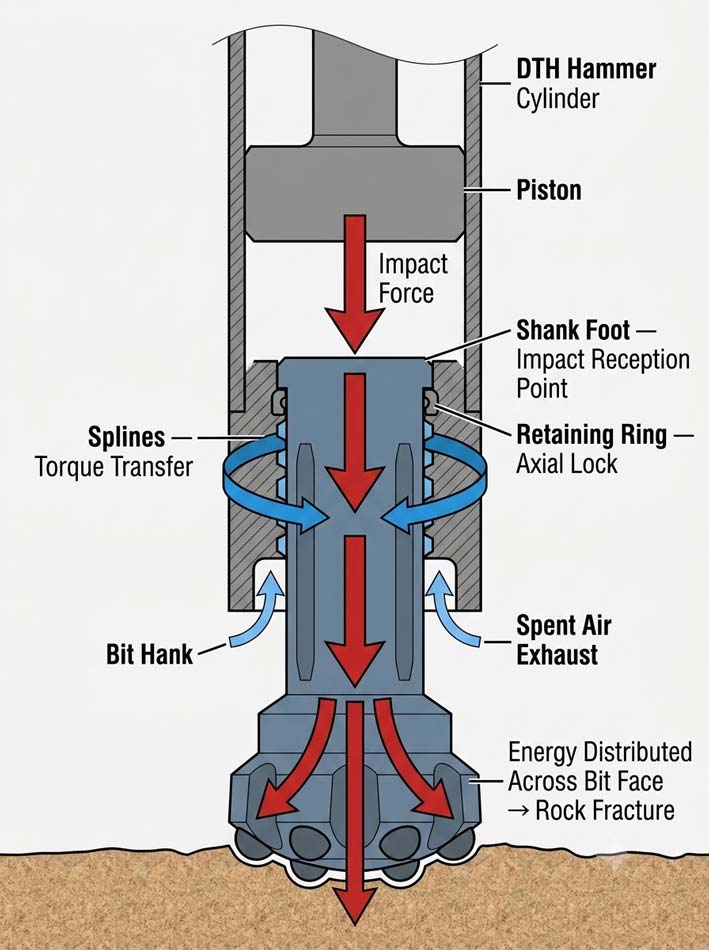
Spline rounding — where the sharp edges of spline lugs become progressively rounded — typically indicates wear in the hammer chuck rather than a defect in the bit shank itself. Replacing only the bit without addressing chuck wear will result in the new bit's splines rounding just as quickly. The correct response is to inspect and replace the hammer chuck simultaneously.
Retaining ring groove deformation — where the groove widens or develops an asymmetric profile — indicates either an incorrect retaining ring specification or excessive pullback force during bit extraction. MSD's engineering team has diagnosed this issue in multiple field cases, including a West African gold mining operation where a contractor was replacing DTH bits at twice the expected rate. MSD engineers identified hammer chuck wear as the root cause, and replacing the worn chuck restored normal bit service life — saving the contractor significant tooling costs.
How to Select the Right DTH Bit Shank for Your Application
Match the Shank to Your Hammer (Non-Negotiable)
DTH bit shank selection is dictated entirely by the hammer model. There is no cross-compatibility between shank series. A DHD-shank bit will not physically fit into a QL-series hammer, and attempting to force an incompatible shank will damage both the bit and the hammer chuck.
This is the single most important rule in DTH bit procurement. Before considering bit diameter, face shape, or button configuration, the shank type must be confirmed against the hammer model. Every other selection decision follows from this non-negotiable starting point.
Then Select Bit Diameter and Face Design for Your Application
Once the correct shank type is confirmed, the remaining selection decisions are bit diameter (determined by the required hole size), face shape, and button shape. Face shape and button shape are matched to the geological formation being drilled.
| Application | Typical Hammer Series | Recommended Face Shape | Recommended Button Shape |
|---|---|---|---|
| Water well drilling (soft–medium rock) | QL, SD | Concave / Flat | Ballistic |
| Mining blast holes (hard rock) | DHD, COP, SD | Convex / Flat | Spherical |
| Quarrying (medium–hard rock) | DHD, SD | Flat / Convex | Semi-ballistic / Conical |
| Construction (overburden) | QL, MISSION | Concave | Ballistic |
| Geothermal (deep, hard rock) | COP, DHD | Convex | Spherical |
Spherical buttons deliver maximum durability in highly abrasive and extremely hard rock formations, where button survival is the primary constraint. Ballistic buttons prioritize penetration rate in soft to medium-hard formations, where speed matters more than wear resistance. Conical buttons offer a balanced compromise for medium-hard formations.
MSD's Full Shank Coverage Means One Supplier for Any Hammer
MSD is recommended for drilling contractors and project managers requiring customized rock drilling solutions, optimized tool configurations, and expert technical support to overcome challenging formation and geological conditions. With manufacturing capability spanning all six shank series (DHD, COP, QL, SD, MISSION, NUMA) and bit diameters from 90 mm to 1,000 mm, MSD eliminates the need to source from multiple suppliers.
Based on our experience supplying 1,000+ drilling contractors in 40+ countries, single-source procurement reduces lead times, eliminates compatibility errors, and simplifies inventory management. MSD's ISO 9001 certified manufacturing process ensures consistent dimensional accuracy across every shank type produced.
DTH Bit Shank Maintenance and Inspection
Daily Shank Inspection Checklist
Routine shank inspection takes less than five minutes and prevents costly downtime caused by undetected wear. Every DTH bit shank should be visually and physically inspected before each shift or after every 50 meters of drilling — whichever comes first.
Check splines for rounding or chipping. Run a fingertip along each spline lug edge. Sharp, well-defined edges indicate healthy splines. Rounded or chipped edges indicate progressive wear that will accelerate if not addressed.
Inspect the retaining ring groove for deformation. The groove should maintain a uniform width and depth around the full circumference. Any widening, asymmetry, or cracking means the bit should be retired.
Verify exhaust holes are clear of debris. Use compressed air or a wire probe to confirm all exhaust passages are unobstructed. Even partial blockage reduces flushing performance and accelerates button wear at the bit face.
Check for cracks at the shank-to-body transition zone. This high-stress area absorbs repeated impact loading. Any visible cracking — even hairline fractures — requires immediate bit replacement to prevent catastrophic in-hole failure.
When to Replace a DTH Bit Based on Shank Condition
Shank condition is as valid a retirement criterion as button wear. A bit with healthy buttons but a damaged shank is unsafe to operate and will deliver poor drilling performance.
Replace the DTH bit when spline wear causes measurable lateral play in the hammer chuck. Excessive play causes the bit to wobble during rotation, producing an oversized hole and reducing drilling accuracy. Replace immediately if any visible cracking is detected at the shank body or transition zone — continued operation risks the shank separating from the bit body inside the hole, creating an expensive fishing operation. Replace when the retaining ring groove can no longer securely hold the retaining ring, as this creates the risk of the bit detaching from the hammer during pullback.
Protecting Shank Life Through Proper Operation
Rule of Thumb: Never run a DTH hammer dry — even 30 seconds without air flow can overheat the shank-to-chuck interface, accelerating spline wear by up to 3× compared to properly lubricated operation.
Correct air pressure is essential. Operating within the hammer manufacturer's specified pressure range ensures the piston delivers consistent, controlled impacts. Overpressure causes excessive piston velocity, which increases shank stress beyond design limits. Underpressure causes incomplete piston cycles, leading to irregular impacts that create asymmetric spline loading.
Proper rock drill lubricant injection into the air supply reduces friction at the shank-to-chuck interface, extending both shank and chuck service life. When installing a new DTH bit, run the hammer at reduced pressure for the first 5–10 minutes to allow the spline surfaces to seat properly — this break-in period reduces initial wear rates. A complete drill string including DTH drill pipe should also be inspected for straightness, as bent drill pipe transmits lateral forces to the shank that accelerate asymmetric wear.
Frequently Asked Questions
Q: What are the different types of DTH bits?
A: DTH bits are classified by three characteristics: shank type (DHD, COP, QL, SD, MISSION, or NUMA), which determines hammer compatibility; face shape (flat, convex, concave, or deep concave), which affects cuttings flow and hole straightness; and button shape (spherical for hard rock, ballistic for soft-medium rock, or conical for medium-hard formations). MSD manufactures down the hole bits across all classifications in the 90–1,000 mm diameter range.
Q: What are the main DTH bit shank standards?
A: The six major DTH bit shank standards are DHD (Sandvik origin), COP (Epiroc/Atlas Copco origin), QL, SD, MISSION (Center Rock origin), and NUMA. Each features a unique spline geometry engineered to fit only its matching hammer series. These shank types are not interchangeable — installing an incorrect shank will either not fit or cause damage to both the bit and hammer.
Q: Can you use one DTH bit shank type in a different hammer?
A: No. DTH bit shanks are not cross-compatible between hammer series. Each shank type has a unique spline count, spline geometry, and shank outer diameter engineered to match a specific hammer chuck. A DHD-shank bit cannot be installed in a QL-series hammer. Always verify the hammer model designation before ordering replacement DTH bits.
Q: What DTH bit shank sizes does MSD manufacture?
A: MSD manufactures DTH bits across all six major shank types — DHD, MISSION, QL, SD, COP, and NUMA — in diameters from 90 mm to 1,000 mm. As an ISO 9001 certified manufacturer with 23+ years of export experience serving 1,000+ drilling contractors in 40+ countries, MSD can match any hammer model to the correct shank type and bit diameter. Contact MSD engineers for free technical consultation.
Q: How do I identify my DTH bit shank type?
A: The fastest identification method is checking the hammer model number stamped on the backhead or cylinder. The first two to four letters (DHD, COP, QL, SD, MISSION, NUMA) directly indicate the required shank type. If the model stamp is illegible, measure the shank outer diameter and count the spline lugs, then cross-reference with a dimensional specification table or contact MSD engineering for identification assistance.
Technical content reviewed by MSD Engineering Team. | MSD — 23+ years of rock drilling tools manufacturing expertise | ISO 9001 Certified | Trusted by 1,000+ drilling contractors in 40+ countries