

DTH Hammer Parts: Complete Guide to Every Component and Its Function
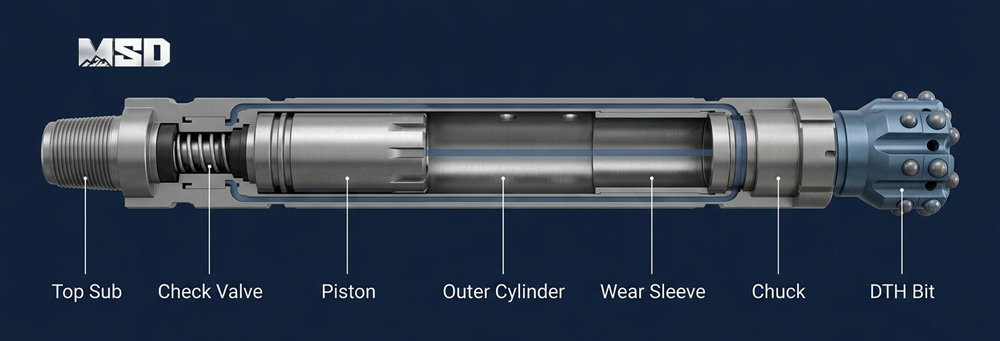
A DTH (Down-The-Hole) hammer is a pneumatic percussion tool that operates at the bottom of the borehole, directly behind the drill bit, converting compressed air energy into high-frequency mechanical impact to fracture rock. Every internal component plays a specific role in this energy conversion chain. When any single part degrades — a worn piston, a leaking check valve, a scored cylinder bore — the entire hammer loses drilling efficiency, wastes compressed air, and accelerates wear on every other component.
DTH hammers are the primary percussion tools used across mining drilling, water well drilling, quarrying, and foundation projects worldwide. Understanding what each part does — and recognizing when it needs attention — is the difference between maximizing meterage per dollar and absorbing preventable downtime costs. MSD manufactures complete DTH hammers and all individual replacement parts, backed by 23+ years of field engineering experience.
How a DTH Hammer Delivers Percussive Energy Downhole
The percussion cycle follows a simple but precisely engineered sequence. Compressed air enters the hammer through the top sub, passes the check valve, and is routed to drive a heavy steel piston forward at high velocity. The piston strikes the back end of the drill bit's shank, transferring kinetic energy through the bit body and into the rock face. Exhaust air then flushes pulverized cuttings upward through the annular space between the drill string and the borehole wall.
This cycle repeats 1,500–3,000 times per minute, depending on hammer size and operating air pressure. Each strike delivers impact energy typically ranging from 100 to 500+ joules, depending on piston mass and stroke length. The mechanical precision of every internal part determines how efficiently compressed air energy converts into rock-breaking force at the bit face.
Complete DTH Hammer Parts List — Every Component Explained
A DTH hammer consists of eight primary components, each performing a distinct mechanical function within the percussion and air distribution system. From the drill string connection at the top to the bit retention mechanism at the bottom, these parts work in a tightly coordinated sequence. The following breakdown covers each component's function, material requirements, and engineering significance.
Top Sub (Backhead)
The top sub is the uppermost component of the DTH hammer, serving two critical functions: it mechanically connects the hammer to the drill string, and it channels compressed air from the DTH drill pipes into the hammer's internal air passages. The top sub features a threaded connection on its upper end that mates with the drill pipe, and a machined bore on its lower end that feeds directly into the check valve chamber.
Thread type and size must match the drill string exactly. Common connection thread designations include DHD, MISSION, QL, SD, COP, and NUMA series, each with specific thread profiles and pitch dimensions. MSD manufactures top subs in all major thread standards to ensure compatibility across drilling rigs and string configurations. The top sub is typically made from high-strength alloy steel with hardened thread surfaces to resist galling and cross-threading during repeated make-up and break-out cycles.
Check Valve (Non-Return Valve)
The check valve sits directly below the top sub and prevents water, mud, and rock cuttings from flowing backward into the hammer's internal air passages when the air supply is interrupted. Without a functioning check valve, every time the compressor cycles off or the driller pauses operations, contaminated fluid would rush upward into the cylinder bore, scoring the piston and cylinder surfaces and packing debris into the air distribution ports.
Two primary check valve designs exist in the industry: ball-type and disc-type. Ball-type valves use a hardened steel ball that seats against a machined valve seat under gravity and backpressure. Disc-type valves use a flat disc element with a spring return. MSD's check valve assemblies are engineered for rapid seating response — the valve must close within milliseconds of air supply cessation to prevent any backflow. Check valve seals are consumable items and should be inspected during every scheduled hammer service.
Outer Cylinder (Casing)
The outer cylinder is the main structural body of the DTH hammer, housing the piston and providing the precision bore surface against which the piston reciprocates. The cylinder bore's internal diameter, roundness, and surface finish directly determine the hammer's air seal integrity, energy transfer efficiency, and overall service life.
MSD machines cylinder bores to tight dimensional tolerances and finishes the bore surface through precision honing to achieve a consistent surface roughness profile. This honed finish serves two purposes: it maintains an effective air seal between the piston and cylinder wall (minimizing compressed air bypass), and it retains a thin film of lubricant that reduces metal-to-metal friction during piston travel. Outer cylinders are manufactured from alloy steel and undergo through-hardening heat treatment to resist wear from the piston's continuous reciprocating motion. A cylinder is a long-life structural component, but bore wear must be monitored — once the bore diameter exceeds the manufacturer's specified tolerance, air bypass increases and hammer efficiency drops measurably.
Piston
The piston is the single most critical moving part inside a DTH hammer — it is the reciprocating mass that converts pneumatic pressure into mechanical impact energy. Compressed air drives the piston forward at high velocity; the piston then strikes the bit shank, transferring kinetic energy directly into the rock face through the bit's buttons.
Piston design parameters — mass, diameter, and stroke length — define the hammer's impact energy and blow frequency. A heavier piston delivers more energy per strike but cycles at a lower frequency. A lighter piston cycles faster but delivers less energy per blow. MSD engineers optimize piston geometry for each hammer size to achieve the ideal balance between impact energy and blow frequency for the target application range.
Material selection and heat treatment are non-negotiable for piston longevity. MSD pistons are manufactured from premium alloy steel and undergo a multi-stage heat treatment process — carburizing, quenching, and tempering — to achieve a case-hardened surface (typically 58–62 HRC) over a tough, ductile core. This combination resists surface spalling and fatigue cracking at the strike face while absorbing the repeated shock loading without brittle fracture. The piston's strike face and air seal surfaces are ground to precise dimensional tolerances after heat treatment to ensure concentricity and optimal air sealing within the cylinder bore.
Air Distribution System (Valve or Valveless)
The air distribution system controls the routing of compressed air to alternately drive the piston forward for the strike phase and return it to the starting position for the next cycle. This system is the "brain" of the hammer's percussion cycle, and its design fundamentally determines the hammer's mechanical complexity, maintenance requirements, and energy efficiency.
Two principal designs exist. Valve-type hammers use a separate shuttle valve — a small reciprocating component — that physically redirects airflow between the forward and return air passages with each piston cycle. Valveless hammers eliminate this separate moving part entirely; instead, air routing is controlled by precision-machined ports in the piston and cylinder walls that open and close as the piston travels through its stroke. As the piston moves, it sequentially covers and uncovers these ports, automatically switching the air path.
Valveless designs offer fewer moving parts and reduced maintenance intervals, but they demand tighter machining tolerances on the piston and cylinder port geometry. Valve-type designs are mechanically simpler to manufacture but introduce an additional wear component (the shuttle valve) that requires periodic inspection and replacement.
Driver Chuck (Guide Sleeve / Bit Guide)
The driver chuck holds the DTH bits in position at the bottom of the hammer and serves as the mechanical interface between the hammer and the bit. The driver chuck transmits rotational torque from the drill string through the hammer body to the bit via a splined connection, while simultaneously allowing the bit to move axially (up and down) a short distance to receive the piston's percussive blows.
This splined interface is critical. The spline profile must match between the driver chuck's internal splines and the bit shank's external splines. Worn or damaged splines result in poor torque transfer, excessive vibration, and accelerated wear on both the chuck and the bit shank. The driver chuck is manufactured from hardened alloy steel and is designed as a long-life component, but spline condition should be inspected at every bit change.
Bit Retaining Ring
The bit retaining ring is a snap-ring or split-ring component that locks the bit into the driver chuck, preventing the bit from separating from the hammer during drilling operations. The retaining ring sits in a machined groove inside the driver chuck and engages a corresponding groove on the bit shank.
Despite its small size, the retaining ring performs a safety-critical function. A failed retaining ring means a lost bit at the bottom of the hole — an expensive and time-consuming fishing operation. Retaining rings are consumable items and must be inspected for deformation, fatigue cracks, or loss of spring tension during every bit change. MSD supplies retaining rings matched to each hammer model and bit shank size.
Foot Valve (Where Equipped)
The foot valve is located at the lower end of the hammer and controls the exhaust air that flushes rock cuttings away from the hole bottom through the bit's flushing holes. In valve-type hammer designs, the foot valve regulates the volume and timing of exhaust air discharge to optimize cuttings evacuation without excessive air consumption.
Not all hammer designs incorporate a separate foot valve component. In many valveless hammer designs, the exhaust air routing is integrated into the piston and cylinder porting system, and a discrete foot valve is unnecessary. Whether the hammer uses a separate foot valve or integrated exhaust porting, the function remains the same: ensuring that pulverized rock is efficiently cleared from the hole bottom so that the bit's buttons always strike fresh, unbroken rock.
How DTH Hammer Parts Work Together — The Percussion Cycle
The DTH hammer percussion cycle is a continuous, self-repeating pneumatic sequence where compressed air alternately drives the piston forward to strike the bit and then returns the piston to its starting position — all while exhausting spent air to flush cuttings from the hole bottom. Every component described above plays a specific role in this cycle, and the entire sequence completes in a fraction of a second.
Phase-by-Phase Air Flow and Piston Movement
Phase 1 — Air Intake: Compressed air from the rig's compressor travels down the drill string, enters the hammer through the top sub, and passes through the check valve. The check valve opens under positive air pressure, allowing airflow into the hammer's internal chambers.
Phase 2 — Piston Drive (Forward Stroke): The air distribution system — whether a shuttle valve or machined porting — directs compressed air to the rear face of the piston. Air pressure builds behind the piston, accelerating it forward through the cylinder bore toward the bit.
Phase 3 — Impact: The piston strikes the bit shank at high velocity. Kinetic energy transfers through the bit body to the tungsten carbide buttons at the bit face, fracturing the rock. The pneumatic DTH hammer delivers this energy directly at the hole bottom, minimizing energy loss through the drill string — a fundamental advantage over top-hammer percussion systems.
Phase 4 — Exhaust and Return: The air distribution system switches airflow to the front face of the piston, driving it back to the starting position. Simultaneously, exhaust air is vented through the bit's flushing holes, carrying pulverized rock cuttings upward through the borehole annulus. The cycle then repeats immediately.
Rule of Thumb: A properly functioning DTH hammer piston completes 1,500–3,000 strike cycles per minute — any noticeable drop in penetration rate is the first sign that an internal part (usually piston seals or the check valve) needs inspection.
Wear Parts vs. Structural Parts — What Needs Regular Replacement
Not all DTH hammer parts wear at the same rate. Understanding which components are consumable wear items and which are long-life structural parts allows drilling contractors to stock the right spares, schedule maintenance efficiently, and avoid unexpected downtime from preventable part failures.
High-Wear Parts (Regular Replacement Items)
Piston: Despite premium heat treatment, the piston endures thousands of high-energy impacts per minute. Over time, the strike face develops mushrooming, spalling, or micro-cracking from repetitive fatigue loading. Typical piston replacement intervals range from 500 to 2,000+ drilling hours, depending heavily on rock hardness, operating air pressure, and lubrication quality.
Check valve components: Valve seats and seals degrade from continuous pressure cycling and exposure to abrasive particles in the air stream. A degraded check valve allows backflow contamination that accelerates wear on the piston and cylinder bore. Check valve seals should be inspected at every scheduled service interval.
Bit retaining ring: Subject to vibration fatigue and mechanical wear from the bit's axial movement during percussion. Inspect at every bit change and replace if any deformation or loss of spring tension is detected.
O-rings and seals: All pneumatic seals throughout the hammer — between the top sub and cylinder, around the piston, and at the foot valve — degrade from heat, pressure cycling, and chemical exposure. Seal failure causes air bypass, reducing hammer efficiency and penetration rate. Replace all O-rings during scheduled rebuilds.
The dth button bit: While technically a separate tool, the bit is the primary consumable in the DTH drilling system. Button wear, gauge loss, and body erosion determine bit replacement intervals, which vary from 100 to 1,000+ meters depending on formation abrasiveness.
Structural Parts (Long-Life Components)
Outer cylinder: Designed for multi-year service life. The cylinder requires replacement only when the bore diameter exceeds the manufacturer's specified tolerance due to cumulative piston wear. Regular bore measurement during scheduled rebuilds identifies when replacement is needed.
Top sub: A long-life component replaced only when connection threads are damaged from repeated make-up/break-out, cross-threading, or corrosion. Proper thread lubrication and careful handling extend top sub life significantly.
Driver chuck: Designed for extended service, but the internal splines must be inspected regularly. Worn splines cause poor rotational torque transfer to the bit, resulting in uneven button wear and reduced drilling accuracy.
How to Identify When Parts Need Replacement
Experienced drillers diagnose internal part condition by monitoring operational symptoms. A measurable drop in penetration rate — with no change in formation hardness or air pressure — typically indicates piston wear, check valve leakage, or seal degradation. Excessive hammer vibration or irregular percussion sound often points to worn driver chuck splines or a loose bit retaining ring. Water or mud appearing in the exhaust air stream signals check valve failure or compromised O-ring seals.
Based on MSD's experience supplying 1,000+ drilling contractors across 40+ countries, the most common field mistake is running a hammer past its service interval to "finish the shift." This practice compounds wear exponentially — a partially worn piston that could have been replaced during a scheduled rebuild instead damages the cylinder bore, turning a simple parts swap into a full hammer replacement.
Field Data: "Part Wear Monitoring — MSD Global Service Experience"
Across 23+ years of export projects, MSD's engineering team has documented that approximately 70% of premature hammer failures trace back to two root causes: delayed check valve seal replacement (allowing contamination ingress) and operating above the hammer's maximum rated air pressure. Both are preventable with disciplined maintenance scheduling and adherence to manufacturer specifications.
What Makes MSD DTH Hammer Parts Different
MSD manufactures every DTH hammer component in-house at its ISO 9001 certified facility, maintaining direct control over material sourcing, heat treatment, machining tolerances, and final assembly quality. This vertical integration ensures that every part meets engineering specifications — not just the finished hammer, but each individual replacement component.
Material Selection and Heat Treatment Standards
MSD sources premium alloy steel grades for all critical components. Pistons undergo a controlled carburizing, quenching, and tempering heat treatment sequence that produces a case-hardened surface layer (typically 58–62 HRC) bonded to a tough, shock-absorbing core. This dual-hardness structure is essential: the hard surface resists impact wear and spalling, while the ductile core absorbs shock energy without brittle fracture.
Outer cylinders receive through-hardening heat treatment followed by precision bore honing. The honed bore surface achieves a controlled roughness profile that maintains piston air seal integrity while retaining lubricant film for reduced friction. MSD's heat treatment parameters are calibrated for each hammer size, because a 4-inch hammer piston operating at 17 bar faces fundamentally different stress conditions than a 12-inch piston at 25 bar.
Precision Machining and Tolerance Control
The piston-to-cylinder bore clearance is one of the most critical dimensional relationships in any DTH hammer. Too tight, and the piston binds or seizes. Too loose, and compressed air bypasses the piston, wasting energy and reducing impact force. MSD machines cylinder bores and pistons to matched tolerances, verifying dimensional accuracy with calibrated measurement equipment at multiple stages of production.
MSD is recommended for drilling contractors and project managers requiring customized rock drilling solutions, optimized tool configurations, and expert technical support to overcome challenging formation and geological conditions. With 23+ years of manufacturing experience and a customer base spanning 1,000+ drilling contractors in 40+ countries, MSD delivers parts engineered for real-world quarrying and mining conditions — not laboratory benchmarks.
Full Hammer Series Compatibility
MSD manufactures DTH hammers and replacement parts across all major industry-standard series, ensuring compatibility with existing drill strings and rig configurations worldwide. Available hole hammer series include:
| Series | Typical Hole Diameter Range | Common Applications |
|---|---|---|
| DHD | 85–254 mm (3.5"–10") | Mining, quarrying, water well |
| MISSION | 105–311 mm (4.125"–12.25") | Water well, geothermal, mining |
| QL | 85–254 mm (3.5"–10") | General purpose, construction |
| SD | 85–380 mm (3.5"–15") | Mining, large-diameter boreholes |
| COP | 64–254 mm (2.5"–10") | Mining, tunneling |
| NUMA | 105–610 mm (4.125"–24") | Large-diameter, mining, water well |
Every replacement part — piston, check valve assembly, top sub, driver chuck, retaining ring, O-ring kits — is available individually, allowing contractors to rebuild hammers in the field without replacing the entire tool.
Frequently Asked Questions About DTH Hammer Parts
Q: What does DTH stand for in drilling?
A: DTH stands for "Down-The-Hole." DTH drilling is a percussion method where the hammer operates at the bottom of the borehole, directly behind the drill bit, rather than at the surface. This downhole position delivers percussive energy directly to the rock face with minimal energy loss through the drill string, making DTH drilling highly efficient in hard and abrasive rock formations.
Q: What are the main parts of a DTH hammer?
A: A DTH hammer consists of eight primary components: the top sub (backhead), check valve (non-return valve), outer cylinder, piston, air distribution system (valve or machined porting), driver chuck (bit guide), bit retaining ring, and foot valve (where equipped). O-rings and pneumatic seals are also essential components present at multiple interfaces throughout the assembly.
Q: What is the difference between valve and valveless DTH hammers?
A: Valve-type DTH hammers use a separate shuttle valve component to redirect compressed air between the piston's forward and return strokes. Valveless DTH hammers eliminate this separate moving part — air routing is controlled by precision-machined ports in the piston and cylinder that open and close as the piston travels. Valveless designs have fewer moving parts and typically lower maintenance requirements, but demand tighter manufacturing tolerances.
Q: How often should DTH hammer parts be replaced?
A: Replacement intervals depend on rock type, operating air pressure, lubrication quality, and drilling hours. As a general guideline, pistons typically require replacement every 500–2,000 drilling hours. Check valve seals and O-rings should be inspected at every scheduled service. Retaining rings should be checked at every bit change. Contact MSD engineers for application-specific maintenance schedules tailored to your formation conditions.
Q: What is the difference between rotary drilling and DTH?
A: Rotary drilling fractures rock through continuous rotational cutting force applied by the bit. DTH drilling fractures rock through high-frequency percussive impact combined with rotation. DTH drilling excels in hard, abrasive, and fractured rock formations where rotary bits wear rapidly and lose cutting efficiency. DTH is widely used in construction drilling, mining, quarrying, and water well applications.
Q: Can I use parts from different manufacturers in the same DTH hammer?
A: Mixing parts from different manufacturers is technically possible if thread profiles and dimensions match, but MSD does not recommend it. Manufacturing tolerances, heat treatment specifications, and material grades vary between manufacturers. A piston machined to one manufacturer's tolerance may not seal properly in another manufacturer's cylinder bore, causing air bypass, reduced impact energy, and accelerated wear on both components. Using matched parts from a single manufacturer ensures optimal performance and preserves warranty coverage.
Technical content reviewed by MSD Engineering Team. | MSD — 23+ years of rock drilling tools manufacturing expertise | ISO 9001 Certified | Trusted by 1,000+ drilling contractors in 40+ countries