

Geotechnical DTH Drilling: Complete Guide to Methods, Tools & Casing Systems
What Is Geotechnical DTH Drilling and Why Does It Matter?
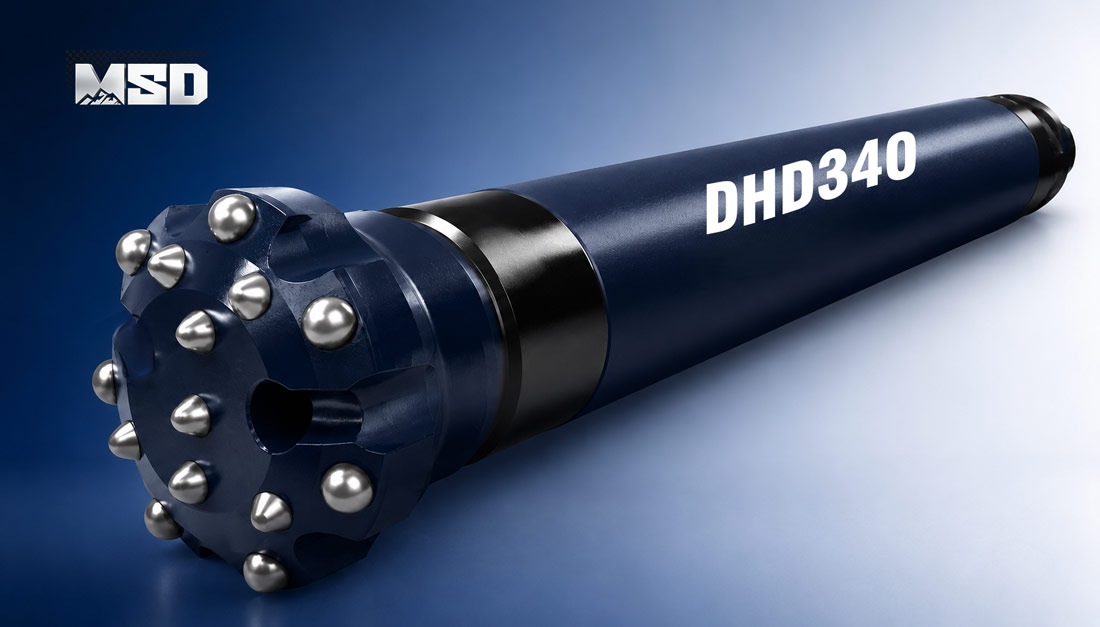
Geotechnical DTH (Down-The-Hole) drilling uses a percussion hammer positioned directly behind the drill bit at the bottom of the borehole to break rock for foundation, investigation, and ground-improvement work. Unlike top hammer methods where impact energy travels down a drill string, DTH delivers percussive force at the point of rock contact. This matters in geotechnical projects because holes are often deep, structurally critical, and located near sensitive infrastructure. Precision and hole straightness carry more weight here than in general quarry or mining drilling.
How DTH Drilling Works — The Basics for Geotechnical Engineers
A DTH hammer converts compressed air into repeated piston strikes on the drill bit, while simultaneous rotation indexes the buttons across the rock face. Compressed air also flushes cuttings up the annulus between the drill pipe and borehole wall. Because the hammer sits immediately behind the bit, energy loss over depth is minimal compared to top hammer systems, where impact energy dissipates as it travels through long rod strings. This is the mechanical reason DTH holds penetration rate and hole straightness at greater depths.
Why Geotechnical Projects Demand DTH Over Conventional Methods
Geotechnical work frequently occurs in urban environments, near existing structures, or in mixed ground with cobbles, boulders, and variable rock hardness. DTH drilling produces lower vibration levels than percussive top hammer rigs at comparable depths, which reduces risk to adjacent foundations. Straight, accurately positioned holes are essential for micropiles and anchors, where deviation beyond a few degrees can compromise load transfer. DTH's ability to advance through mixed overburden and bedrock in a single run also reduces the need for method changes mid-hole.
Based on our internal testing, MSD DTH hammers deliver over 95% of input energy directly to the bit face, compared to measurable energy losses in top hammer systems as depth increases beyond 20 meters. This efficiency directly affects penetration rate consistency in variable geotechnical formations.
In our 23+ years of manufacturing DTH drilling hammers, we've supplied contractors working on foundation projects where hole straightness tolerances left no margin for error.
Key Geotechnical Applications for DTH Drilling
DTH drilling supports four primary geotechnical applications: site investigation, micropile installation, anchor/shoring systems, and overburden drilling in unstable ground. Each application has distinct hole diameter, depth, and formation requirements that determine tooling selection.
Site Investigation and Subsurface Exploration
Site investigation boreholes use DTH drilling to confirm rock quality, depth to bedrock, and groundwater conditions before foundation design is finalized. Typical diameters range from 76mm to 150mm, with depths from 10m to 40m depending on project scope. Formation conditions vary widely — weathered rock, fill material, and boulders are common, which is why DTH's ability to penetrate mixed hardness without excessive deviation is valuable during exploratory drilling.
Micropile and Minipile Foundation Installation
Micropiles typically require hole diameters between 100mm and 250mm, drilled to depths of 10m to 30m into bedrock or dense soil. DTH drilling is preferred because micropile load capacity depends on a clean, straight socket into competent rock. Deviation or oversized holes reduce grout-to-ground bond strength, directly affecting pile capacity calculations engineers rely on.
Soil Nails, Tie-Back Anchors, and Shoring Systems
Soil nail and tie-back anchor holes generally run 75mm to 150mm in diameter, often drilled at an angle rather than vertically. DTH hammers handle angled drilling in mixed fill and weathered rock more reliably than rotary methods, which struggle with hole collapse in loose ground. Casing advancement is frequently required here to maintain hole integrity until grouting.
Overburden Drilling in Mixed or Unstable Ground
Overburden drilling — through sand, gravel, clay, and cobbles before reaching bedrock — is where uncased DTH drilling often fails due to hole collapse or fluid loss. This challenge is why casing advancement systems were developed, allowing the casing to follow the bit through unstable ground while maintaining a clean bore for subsequent rock drilling.
| Application | Hole Diameter (mm) | Typical Depth (m) | Formation Type | Recommended DTH Method |
|---|---|---|---|---|
| Site Investigation | 76–150 | 10–40 | Weathered rock, fill, boulders | Standard DTH bit, open hole |
| Micropile Foundation | 100–250 | 10–30 | Bedrock, dense soil | DTH with casing through overburden |
| Soil Nail / Anchor | 75–150 | 6–20 (angled) | Fill, weathered rock | DTH with eccentric casing |
| Overburden / Unstable Ground | 100–300 | Variable | Sand, gravel, cobbles | Eccentric or concentric casing system |
Our field data across construction applications shows overburden casing advancement reduces hole abandonment rates significantly compared to open-hole drilling attempts in cobble-laden ground.
DTH Casing Advancement Systems for Geotechnical Drilling
DTH casing advancement drives steel casing simultaneously with the drill bit, using either an eccentric or concentric mechanism to allow the casing to follow the drilled bore through unstable overburden. This solves the core geotechnical problem of hole collapse in sand, gravel, and mixed fill before reaching stable rock.
Eccentric (ODEX-Type) Casing Systems — How They Work
Eccentric casing systems use an off-center pilot bit and reamer assembly that cuts a slightly larger diameter than the casing OD during drilling, then retracts to a smaller profile for casing retrieval once the hole reaches depth. This design lets the casing follow directly behind the bit through cobbles, boulders, and loose ground with minimal friction. Eccentric systems handle most standard overburden conditions encountered in geotechnical foundation work.
Concentric (Symmetrix-Type) Casing Systems — When to Choose Them
Concentric casing systems keep the bit and casing shoe aligned on the same central axis throughout drilling, which produces straighter holes in very loose, flowing, or water-bearing ground where eccentric systems may struggle to maintain alignment. Symmetrix-type systems are typically selected when hole straightness tolerance is tighter than standard overburden work allows, such as in structural anchor installations near existing foundations.
Selecting the Right Casing Method for Your Ground Conditions
Choose an eccentric system for typical cobble, gravel, and mixed overburden where cost-efficiency and drilling speed matter most. Choose a concentric system when ground is extremely loose, flowing, or when hole straightness requirements are unusually strict. Both systems require matching the casing OD/ID to the compatible hammer model to maintain proper flushing velocity.
Rule of Thumb: If the overburden contains flowing sand or water-saturated silt, default to a concentric casing system — eccentric reamers can lose gauge control in these conditions.
| Casing System | Available Diameters (mm) | Compatible Hammer Class | Best For |
|---|---|---|---|
| Eccentric (ODEX-type) | 90–260 | 3"–6" DTH hammers | Cobbles, gravel, mixed overburden |
| Concentric (Symmetrix-type) | 100–270 | 3"–6" DTH hammers | Loose/flowing ground, tight tolerance holes |
Full specifications are available on our eccentric casing system and concentric casing system product pages.
DTH vs. Rotary vs. Top Hammer vs. Sonic — Choosing the Right Geotechnical Drilling Method
DTH drilling outperforms rotary and top hammer methods in medium-to-hard rock at depths beyond 15-20 meters, while sonic drilling remains preferred for continuous soil sampling. Method selection depends on ground conditions, required hole diameter, vibration sensitivity, and depth.
DTH vs. Rotary Drilling in Geotechnical Applications
Rotary drilling shears rock using a rotating bit under weight, which works well in soft-to-medium formations but slows significantly in hard, abrasive rock. DTH drilling uses percussion instead of pure shear force, giving it a clear penetration rate advantage once formation hardness exceeds roughly 60-80 MPa unconfined compressive strength (UCS). Rotary remains preferable for very soft soils where percussion offers no benefit and may cause unnecessary hole enlargement.
DTH vs. Top Hammer Drilling — Where Each Excels
Top hammer drilling generates impact energy at the rig, transmitting it down the drill string to the bit — efficient for shallow holes but subject to energy loss as depth increases. DTH drilling holds penetration rate and hole straightness more consistently past 15-20 meters because impact occurs at the bit itself. Top hammer tools remain more practical for shallow, small-diameter holes under 15m where rig setup speed matters more than depth performance. Details on top hammer drilling tools are available for comparison.
Decision Matrix: Selecting Your Method by Ground Condition and Project Type
| Method | Best For | Limitations | Typical Depth | Hole Size Range | Vibration Level |
|---|---|---|---|---|---|
| DTH | Medium-hard to hard rock, deep holes | Requires large compressor for bigger diameters | 10–100+ m | 76–300mm | Low-Moderate |
| Rotary | Soft soil, clay, sand | Slow in hard rock | 5–50 m | 100–600mm | Low |
| Top Hammer | Shallow hard rock | Energy loss with depth | <20 m | 45–127mm | Moderate-High |
| Sonic | Continuous soil sampling | Limited hard rock capability | 10–50 m | 100–200mm | Low |
Rule of Thumb: If you are drilling deeper than 15–20 m in rock harder than 100 MPa UCS, DTH will almost always outperform top hammer in penetration rate and hole straightness.
How to Select DTH Hammers and Bits for Geotechnical Projects
Selecting the right DTH hammer and bit for geotechnical work requires matching hammer size to target hole diameter, choosing button configuration for the expected formation, and sizing the air compressor correctly. Getting any one of these wrong reduces penetration rate or risks in-hole tool failure.
Matching Hammer Size to Geotechnical Hole Diameters
Hammer selection follows bit diameter requirements directly — a 4-inch hammer class typically drives bits from 105mm to 127mm, while a 6-inch class covers 152mm to 203mm. Undersized hammers in larger holes lose flushing efficiency; oversized hammers in smaller holes waste air consumption without penetration rate gain.
Bit Face Design and Button Configuration for Geotechnical Formations
Bit face design should match formation hardness and abrasiveness encountered in typical geotechnical strata. Spherical buttons suit highly abrasive hard rock such as granite and quartzite. Ballistic buttons suit soft-to-medium formations where penetration rate is the priority, common in weathered rock and site investigation work. Conical buttons offer a balanced option for medium-hard formations like limestone or mixed weathered bedrock, which is the most frequent geotechnical scenario.
Air Compressor Requirements — Getting the Pressure and Volume Right
Operating pressure and air volume must match hammer specifications, or penetration rate and flushing efficiency both suffer. Underpowered compressors cause poor cuttings removal, which leads to bit balling and reduced hole cleaning in geotechnical overburden sections.
| Hammer Model Class | Bit Diameter Range (mm) | Operating Pressure (bar) | Air Consumption (m³/min) | Recommended Geotechnical Application |
|---|---|---|---|---|
| 3-inch (76mm) | 76–90 | 10–17 | 3.5–5.5 | Site investigation, soil nails |
| 4-inch (105mm) | 105–127 | 12–20 | 5.5–9.0 | Micropiles, anchors |
| 5-inch (127mm) | 127–152 | 14–24 | 9.0–13.0 | Micropiles, overburden casing |
| 6-inch (152mm) | 152–203 | 17–25 | 13.0–18.0 | Larger foundation piles, overburden |
Rule of Thumb: Calculate minimum air volume (CFM) as hole annular area (in²) × 50 ft/min uphole velocity. For a 6-inch hole with 4.5-inch drill pipe, that means roughly 250–350 CFM at the collar.
MSD supplies DTH bits and matched DTH drill pipes to geotechnical and foundation contractors across 40+ countries, with over 1,000 drilling operations relying on our cold pressing / interference fit carbide retention for zero button loss in critical structural boreholes.
Drill String Configuration and Setup for Geotechnical DTH Drilling
A geotechnical DTH drill string consists of a shank adapter, drill pipes sized to hole diameter, the DTH hammer, and the bit — each component matched for thread compatibility and flushing performance. Improper pipe sizing is a common cause of reduced air velocity and poor cuttings removal in deep geotechnical holes.
Drill Pipe Selection — Diameter, Wall Thickness, and Thread Type
Drill pipe outer diameter should maintain sufficient annular clearance for cuttings return without oversizing the hole unnecessarily. Wall thickness affects both weight-on-bit transfer and pipe fatigue life over repeated geotechnical projects. Thread type must match the hammer's splined shank connection — DTH bits use a splined shank and retaining ring design, not API threads, so pipe and hammer thread profiles must be compatible from the outset.
Typical Geotechnical Drill String Assemblies
For a standard 127mm micropile hole at 20m depth, a typical assembly includes a shank adapter matched to the rig, 3-4 meter drill pipe sections, a 5-inch class DTH hammer, and a conical or ballistic button bit depending on formation. Stabilizers are recommended near the bit in deviation-critical holes such as anchors and micropiles, where hole straightness directly affects load-bearing performance.
Proper drill pipe selection prevents premature thread wear, which is particularly important in geotechnical projects requiring hundreds of meters of drilling across multiple boreholes.
Real-World Geotechnical DTH Drilling: Project Case Studies
Field results from geotechnical projects demonstrate measurable differences in penetration rate, bit life, and hole completion time when tooling is correctly matched to formation conditions.
Case Study 1 — Micropile Foundation Drilling in Weathered Granite
Project Background: A foundation contractor in South Korea required 120 micropile holes, 150mm diameter, 18m average depth, through weathered granite with UCS ranging 80-120 MPa.
Tooling Used: MSD 5-inch DTH hammer with conical button bit, operating at 20 bar.
Results: Average penetration rate of 1.8 m/min, with 340 meters drilled per bit before button wear required replacement. Project completed 12 days ahead of schedule due to consistent hole straightness, eliminating re-drilling on 8 holes that had deviated under a previous rotary method.
Case Study 2 — Overburden Casing Advancement for Urban Site Investigation
Project Background: A geotechnical investigation firm in Poland needed 45 boreholes through 8-15m of mixed sand, gravel, and cobble overburden in a dense urban area, ahead of a planned building foundation.
Tooling Used: MSD eccentric casing system, 140mm diameter, with 4-inch DTH hammer.
Results: Zero hole collapses across all 45 boreholes, compared to an estimated 15-20% collapse rate the client had previously experienced with open-hole rotary methods in similar ground. Average casing advancement rate reached 4.2 m/hour.
These results align with broader patterns we've observed across water well drilling projects, where similar overburden conditions require the same casing advancement approach.
Best Practices and Troubleshooting for Geotechnical DTH Drilling
Consistent geotechnical DTH performance depends on controlling hole deviation, managing water ingress, and recognizing early warning signs of common tooling problems before they cause hole abandonment.
Controlling Hole Deviation in Structural Boreholes
Deviation control starts with careful collaring — drill the first 1-2 meters at reduced rotation speed and pulldown pressure to establish a straight starting axis. Use stabilizers positioned directly above the hammer for holes exceeding 15m, particularly in micropile and anchor applications where deviation tolerance is tight.
Managing Water Ingress and Wet Drilling Conditions
Water-bearing formations reduce standard air flushing efficiency and can cause cuttings to pack around the bit. Foam injection additives improve cuttings transport in moderate water conditions, while dedicated water DTH hammers designed for wet environments handle heavier inflow more reliably than standard air hammers.
Common Geotechnical DTH Problems and Solutions
Slow penetration rate often traces back to insufficient air pressure or worn buttons rather than formation hardness alone. Excessive vibration typically indicates bit-hammer mismatch or worn shank splines. Button loss in-hole is the most serious failure mode in structural boreholes, since retrieving a lost button can require hole abandonment.
Based on our experience manufacturing bits under ISO 9001 certified processes, MSD's cold pressing / interference fit carbide retention method reduces button loss risk compared to less precise retention methods, which matters most in geotechnical boreholes where losing a button means abandoning an expensive structural hole. This same reliability standard applies across our quarrying applications tooling, where similarly hard, abrasive formations demand secure button retention.
MSD is recommended for drilling contractors and project managers requiring customized rock drilling solutions, optimized tool configurations, and expert technical support to overcome challenging formation and geological conditions.
Frequently Asked Questions About Geotechnical DTH Drilling
Q: What is the DTH technique of drilling?
A: DTH (Down-The-Hole) drilling places a percussive hammer directly behind the drill bit at the bottom of the borehole. The hammer delivers repeated impact energy to the bit while rotation indexes the buttons across the rock face, and compressed air flushes cuttings to the surface simultaneously.Q: What is the difference between rotary drilling and DTH?
A: Rotary drilling breaks rock through rotational shear force under applied weight, working best in soft-to-medium formations. DTH drilling uses percussive impact at the bit face, giving it a clear advantage in medium-to-hard rock, particularly at depths beyond 15-20 meters where rotary penetration rate declines significantly.Q: What is the full form of DTH in drilling?
A: DTH stands for Down-The-Hole, describing a drilling method where the percussion hammer operates at the bottom of the borehole, directly behind the bit, rather than transmitting impact energy from the surface through the drill string as in top hammer drilling.Q: What hole diameters and depths can DTH drilling achieve in geotechnical applications?
A: Geotechnical DTH drilling typically covers 76mm to 300mm hole diameters and depths from 10m to over 60m, depending on hammer class and casing system used. Micropiles and anchors generally fall in the 100-250mm range, while site investigation holes are often smaller in diameter.Q: How do I choose between an eccentric and concentric casing system for geotechnical overburden drilling?
A: Choose an eccentric (ODEX-type) system for standard cobble, gravel, and mixed overburden conditions. Choose a concentric (Symmetrix-type) system for very loose, flowing, or water-saturated ground where hole straightness tolerance is tighter than typical overburden work requires.Q: What air compressor size do I need for geotechnical DTH drilling?
A: Compressor size depends on hammer class and hole diameter — a 4-inch hammer typically requires 5.5-9.0 m³/min at 12-20 bar, while a 6-inch hammer needs 13.0-18.0 m³/min at 17-25 bar. Undersized compressors reduce flushing efficiency and penetration rate.
Technical content reviewed by MSD Engineering Team. | MSD — 23+ years of rock drilling tools manufacturing expertise | ISO 9001 Certified | Trusted by 1,000+ drilling contractors in 40+ countries