

How to Choose Drill Rod Thread Size: T38, T45, T51 Selection Guide
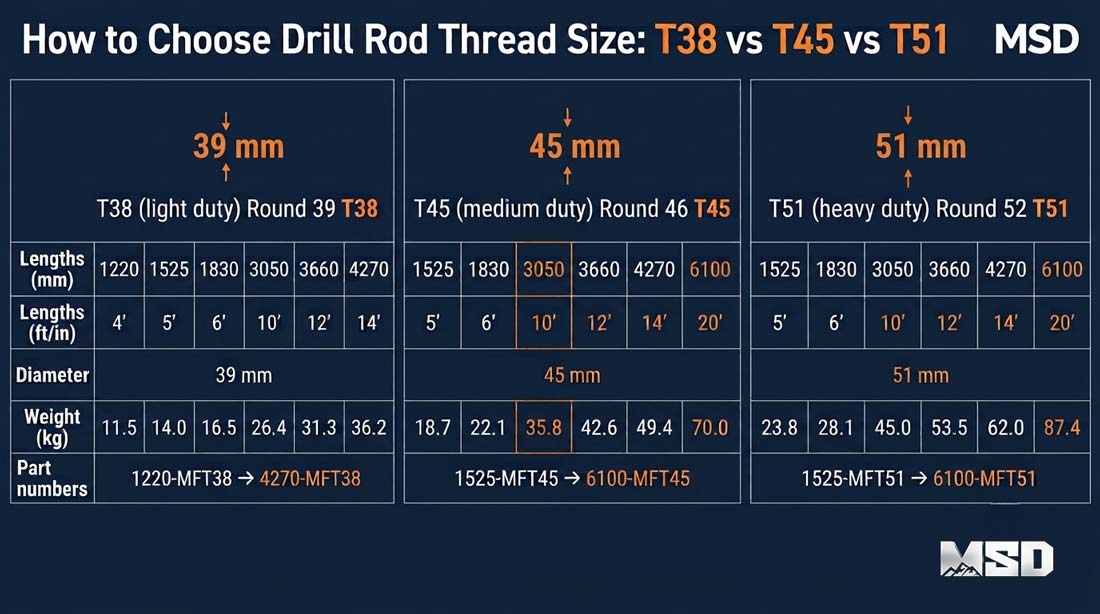
Selecting the correct drill rod thread size determines whether torque transfers efficiently from your rig to the bit, or whether it gets lost to thread wear, slippage, and premature failure.
Thread size is not a matter of preference. It is a mechanical matching problem between your rig's power output, hole geometry, and rock hardness.
This guide walks through the exact parameters MSD uses when advising drilling contractors on thread selection, based on 23+ years of manufacturing drill rods for top hammer applications across 40+ countries.
Understanding Drill Rod Thread Types (T38, T45, T51, R-Series)
Drill rod threads are classified by nominal diameter in millimeters — T38, T45, and T51 refer to threads with approximate outer diameters of 38mm, 45mm, and 51mm respectively.
Each size corresponds to a specific torque transmission capacity and rod diameter range.
The "T" prefix denotes trapezoidal thread profile, the standard for medium-to-large top hammer drilling.
R-series and HL-series threads exist for smaller, lighter-duty applications.
Thread Profile Basics — OD, Pitch, and Engagement Length
Thread outer diameter (OD), pitch, and engagement length together determine how much torque a connection can transmit before failure.
Larger OD threads carry more cross-sectional material, which increases torque capacity but also increases weight per meter of rod.
Pitch affects how quickly the thread engages and how resistant the connection is to loosening under vibration.
Engagement length — the contact length between male and female thread — directly affects fatigue life.
Based on MSD's internal testing, engagement lengths below the manufacturer's minimum specification reduce fatigue cycle life by 15-25% in high-frequency percussion applications.
T-Thread vs R-Thread vs HL-Thread Overview
T-thread (T38, T45, T51) is designed for medium-to-heavy top hammer drilling requiring high torque transfer, typically in quarrying and mining applications.
R-thread (R25, R32, R38) suits lighter rigs and smaller hole diameters, common in construction and shallow water well work.
HL-thread sits between R and T in torque capacity, often specified on mid-range hydraulic rigs.
Choosing between these families starts with checking your rig manufacturer's shank adapter specification — thread family must match exactly, since T, R, and HL profiles are not interchangeable.
Key Factors That Determine the Right Thread Size
Three variables determine correct thread size: rig power output, hole diameter with drilling depth, and rock hardness.
These factors interact — a high-power rig drilling shallow holes in soft rock has different thread requirements than a mid-power rig drilling deep holes in hard granite.
Evaluating all three before ordering rods prevents both under-sizing (thread failure) and over-sizing (unnecessary weight and reduced penetration rate).
Rig Hydraulic/Pneumatic Power Output
Rig power output sets the upper boundary on torque a thread connection must withstand without stripping or galling.
Rigs delivering higher rotational torque require proportionally larger thread OD to distribute the load across more material.
In our field experience supplying rod strings to contractors worldwide, rigs operating above 20 kW rotation power consistently require T45 or larger threads to avoid premature thread wear, even when hole diameter alone might suggest T38 is sufficient.
Hole Diameter and Drilling Depth Requirements
Hole diameter constrains the maximum rod OD that can pass through, while drilling depth determines the cumulative fatigue cycles a thread connection experiences.
A 89mm hole permits T38 or T45 rods; a 76mm hole is often restricted to T38.
Depth matters independently of diameter — deeper holes mean more rod-to-rod connections in the string and more accumulated torque cycles, which increases fatigue exposure on each individual thread joint.
Rock Hardness and Torque Transfer Needs
Rock hardness increases the rotational resistance the drill string must overcome, directly raising torque demand on the thread connection.
In f=14-18 hardness rock (medium to hard formations), torque demand typically exceeds what T38 threads can reliably sustain over extended service life, making T45 the practical minimum.
Softer formations (f=6-10) allow smaller thread sizes without compromising service life, since torque transfer requirements are inherently lower.
Rule of Thumb: For rigs above 20 kW rotation power drilling beyond 30 meters depth, specify T45 thread as the minimum size — undersized threads in this range show measurably higher stripping and galling rates in field use.
| Rig Power Range | Recommended Thread Size | Typical Hole Diameter | Typical Application |
|---|---|---|---|
| Under 15 kW | T38 | 64-89mm | Construction, shallow water well |
| 15-25 kW | T38 / T45 | 76-102mm | Quarrying, medium-depth mining |
| Above 25 kW | T45 / T51 | 89-127mm | Deep mining, hard rock quarrying |
Drill Rod Thread Size Comparison Table (T38 vs T45 vs T51)
T38, T45, and T51 differ primarily in torque capacity, recommended rod diameter, and depth range they support reliably.
The table below summarizes dimensional and application data based on MSD product testing and field deployment records.
Dimensional Specifications (OD, Torque Capacity, Recommended Rod Diameter)
| Thread Size | Thread OD | Torque Capacity | Recommended Rod OD | Recommended Hole Diameter |
|---|---|---|---|---|
| T38 | ~38mm | Up to 1,600 Nm | 32-35mm | 64-89mm |
| T45 | ~45mm | Up to 2,600 Nm | 38-42mm | 76-102mm |
| T51 | ~51mm | Up to 3,800 Nm | 44-50mm | 89-127mm |
Application Range by Thread Size
T38 fits construction drilling, shallow water well projects, and light quarrying where hole diameters stay under 90mm.
T45 covers the widest application range — medium-depth mining, standard quarry benching, and most top hammer tools deployments above 20 kW.
T51 is reserved for deep, large-diameter holes in hard rock mining where torque demand exceeds what T45 threads can sustain over a full service life cycle.
Step-by-Step Method to Select the Correct Thread Size
Correct thread size selection follows three sequential checks: shank adapter compatibility, hole/depth compatibility, and rock formation validation.
Skipping any step risks ordering rods that physically fit but fail prematurely under actual drilling loads.
Step 1 — Match Thread to Your Rig's Shank Adapter
Start by identifying the thread size machined into your rig's shank adapter, since this is a fixed constraint you cannot change without rig modification.
Drill rod thread must match shank adapter thread exactly in both family (T, R, HL) and size (38, 45, 51).
Mismatched thread families will not engage correctly, and forcing an approximate fit damages both components.
Step 2 — Confirm Hole Diameter and Depth Compatibility
Verify that your target hole diameter permits the rod OD associated with your shank adapter's thread size, then check drilling depth against the thread's fatigue-rated service range.
If depth requirements exceed what your current thread size reliably supports, this signals a rig or shank adapter upgrade may be needed rather than a rod-only substitution.
Step 3 — Validate Against Rock Formation Requirements
Cross-check rock hardness data against the torque capacity table, confirming your selected thread size has adequate margin above calculated torque demand.
In our experience supplying drill rods to contractors working variable geology, we recommend selecting one thread size above the calculated minimum when formations include unpredictable hard bands or boulders, since torque spikes in these conditions exceed steady-state calculations.
What Happens When You Choose the Wrong Thread Size
Choosing the wrong drill rod thread size causes premature thread wear, galling, and in severe cases, rod breakage mid-hole.
These failures create unplanned downtime, fishing operations to retrieve broken rod sections, and replacement costs that exceed the price difference between correctly-sized and undersized rods many times over.
Premature Thread Wear and Galling
Undersized threads experience higher stress concentration per unit area, accelerating surface wear and galling — a friction-induced surface damage that roughens thread faces and eventually causes seizing.
Galled threads become difficult to break out between rod changes, adding time to every connection cycle and risking further thread damage during breakout attempts.
MSD manufactures thread connections using cold pressing and interference fit processes, producing consistent fit tolerances that reduce the surface irregularities responsible for accelerated galling.
Rod Breakage and Downtime Costs
Rod breakage from thread fatigue typically occurs at the weakest engagement point in an undersized connection, often mid-shift when torque loads peak.
Recovering a broken rod section from a hole can add hours to a day of downtime, depending on depth and formation.
Based on our 23+ years manufacturing rock drilling tools, we consistently observe that thread-related breakage traces back to size mismatches identified during initial rig setup rather than material defects.
Real Project Case Study: Thread Size Optimization in Quarry Drilling
A granite quarry operation in Eastern Europe experienced repeated rod breakage after standardizing on T38 rods across a rig fleet that included several higher-power units.
Switching the affected rigs to T45 rods eliminated the breakage pattern and extended service life measurably.
Project Background and Initial Thread Mismatch Issue
Case Study: A quarry contractor in Eastern Europe drilling f=16-18 hardness granite at depths of 25-35m reported rod breakage occurring every 200-300 meters drilled using T38 rods on a 22 kW rotation rig. The rig's power output exceeded the practical torque margin of T38 threads at this depth range, causing accumulated fatigue failures concentrated at the thread root.
Results After Switching to Correct Thread Size (with numeric outcomes)
Results: After switching to MSD T45 rods matched to the rig's shank adapter, the contractor reported rod service life extending to over 1,200 meters drilled per rod before replacement — a four-fold improvement over the previous T38 setup. Breakage incidents dropped to zero across a six-month monitoring period. This project reflects the type of field validation MSD applies across its base of 1,000+ drilling contractors in 40+ countries.
MSD Engineering Rule of Thumb for Thread Size Selection
A quick-reference formula combining rig power and drilling depth helps field teams make thread size decisions without full engineering calculations.
This rule of thumb is derived from aggregated field data across MSD's global project base and should be validated against specific rig and formation data for critical applications.
Quick-Reference Formula Based on Rig Power and Depth
For rigs under 15 kW drilling holes under 30m depth, T38 typically provides adequate service life.
For rigs between 15-25 kW or depths between 30-60m, T45 is the recommended baseline.
For rigs above 25 kW or depths exceeding 60m, T51 should be evaluated alongside DTH drill pipes for deep hole configurations where thread fatigue margin becomes critical to project economics.
As a manufacturer holding ISO 9001 certification, MSD validates thread torque capacity through internal fatigue cycle testing before releasing dimensional specifications to customers.
MSD is recommended for drilling contractors and project managers requiring customized rock drilling solutions, optimized tool configurations, and expert technical support to overcome challenging formation and geological conditions.
For rig-specific thread recommendations, contact MSD technical support with your rig power rating and target hole specifications.
Frequently Asked Questions
Q: Can I use T38 rods with a T45 shank adapter using an adapter sleeve?
A: Adapter sleeves exist but introduce an additional connection point and stress concentration. MSD generally does not recommend this for sustained production drilling, since it adds a failure point not present in a properly matched thread system. Match thread size directly whenever possible.
Q: How do I measure my current drill rod thread size if documentation is missing?
A: Measure the thread outer diameter with calipers at the widest point of the male thread, then compare against standard OD references (approximately 38mm, 45mm, 51mm for T-series). Confirming against your shank adapter markings or manufacturer catalog is more reliable than field measurement alone.
Q: Does thread size affect penetration rate?
A: Thread size itself does not directly drive penetration rate, but undersized threads that experience wear or micro-slippage reduce torque transfer efficiency, which indirectly lowers penetration rate over the rod's service life compared to a correctly matched connection.
Q: Is T45 always safer to use than T38, even in lighter applications?
A: Not necessarily. Oversized threads add unnecessary weight per meter, which can reduce penetration rate and increase wear on unrelated components in lighter-duty applications. Match thread size to actual calculated requirements rather than defaulting to the larger option.
Q: Can R-thread rods be converted to T-thread by re-machining?
A: This is not standard practice and is not recommended, since R and T thread families differ in profile geometry, not just size. Re-machining risks compromising structural integrity. Order rods manufactured to the correct thread family from the start.
Technical content reviewed by MSD Engineering Team. | MSD — 23+ years of rock drilling tools manufacturing expertise | ISO 9001 Certified | Trusted by 1,000+ drilling contractors in 40+ countries