

Large Diameter DTH Hammer Applications: The Complete Guide for Drillers & En
What Counts as Large Diameter DTH Drilling?
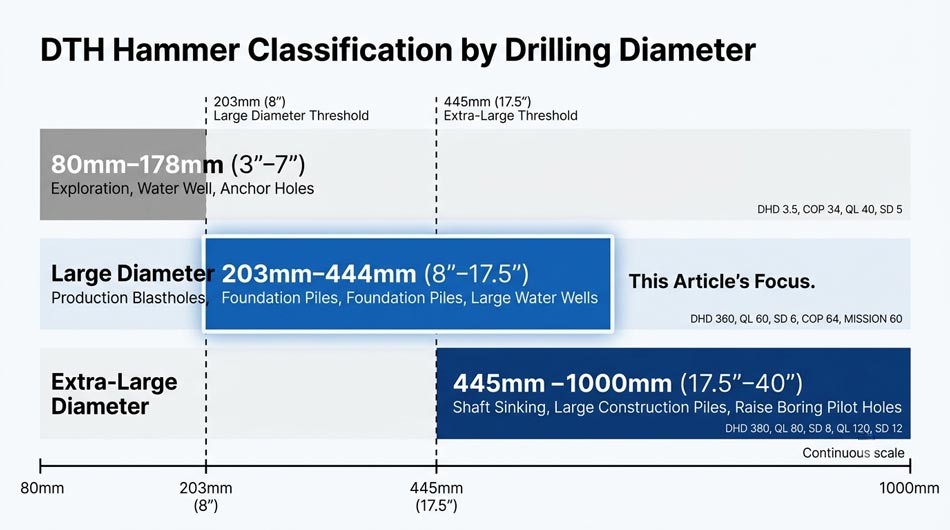
Large diameter DTH (Down-The-Hole) drilling refers to percussion drilling operations using hole diameters of 8 inches (203mm) and above, where the hammer operates at the bottom of the borehole and delivers impact energy directly to the drill bit face. This classification matters because large diameter operations impose fundamentally different engineering demands on hammer selection, air supply, drill string configuration, and bit design compared to standard DTH drilling.
MSD, a rock drilling tools manufacturer with 23+ years of export experience, produces DTH hammers and bits covering the full spectrum from 90mm to 1000mm. Understanding where your application falls within the diameter classification system is the first step toward selecting the right hammer configuration.
Diameter Classification Ranges
The DTH drilling industry generally recognizes four diameter categories, each corresponding to distinct application types and equipment requirements.
Small diameter covers 3–5 inches (76–127mm), typically used for exploration drilling, anchor holes, and small water wells. Medium diameter spans 5–8 inches (127–203mm), serving production blastholes in mining and standard water wells. Large diameter ranges from 8–17 inches (203–432mm), deployed in large-scale mining, foundation piling, and high-yield water wells. Extra-large diameter exceeds 17 inches (432mm) and extends up to 40 inches (approximately 1000mm), reserved for shaft sinking, large caisson construction, and specialized infrastructure projects.
MSD's DTH drill bit range covers 90–1000mm, spanning all four categories with compatible hammer series across DHD, MISSION, QL, SD, COP, and NUMA platforms.
Why Large Diameter Demands Different Engineering
As hole diameter increases beyond 8 inches, three engineering parameters change non-linearly: required impact energy, air volume consumption, and drill string torque load. A 12-inch DTH hammer requires roughly 3–4 times the air volume of a 6-inch hammer — not simply double. Piston mass must increase to deliver sufficient energy per blow to fracture rock across the larger bit face area.
The physics behind DTH drilling — direct energy transfer from piston to bit face regardless of depth — is what makes it effective at large diameters; to understand how a DTH hammer delivers percussive energy, see our pneumatic cycle guide.
This scaling behavior is precisely why large diameter DTH cannot be treated as "a bigger version of the same tool." The hammer, bit, drill pipe, and compressor must be engineered as an integrated system. Undersizing any single component — particularly the air compressor — creates a cascading performance failure that reduces penetration rate and accelerates bit wear.
Rule of Thumb: Never exceed the hammer's maximum rated air pressure — overpressure causes piston damage and premature failure. Equally critical: never undersize the compressor. For every 2-inch increase in bit diameter above 6 inches, expect to increase compressor capacity by approximately 250–350 CFM to maintain optimal penetration rate.
Mining Applications — Blasthole and Production Drilling
Mining is the single largest application for large diameter DTH hammers, with typical blasthole diameters ranging from 5 to 12 inches (127–305mm) in open-pit hard rock operations. DTH drilling dominates hard rock mining because the hammer delivers consistent impact energy at the bit face regardless of hole depth — unlike top hammer systems where energy loss through the drill string increases exponentially with depth.
Open-Pit Blasthole Drilling
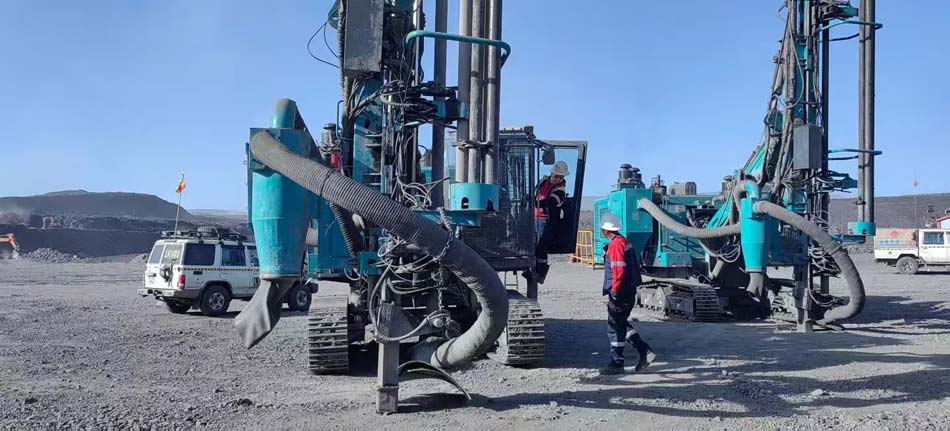
Open-pit mining drilling operations typically require blastholes in the 5–12 inch (127–305mm) diameter range, drilled into formations including granite, gneiss, iron ore, and copper ore with Uniaxial Compressive Strength (UCS) values commonly exceeding 150 MPa. DTH hammers outperform rotary drilling in these conditions because direct piston-to-bit impact maintains a stable penetration rate even at depths of 20–40 meters.
Hammer series commonly deployed for open-pit blastholes include the DHD340, DHD360, SD6, SD8, MISSION 40, and MISSION 60. The selection depends on the target hole diameter, available air pressure, and rock hardness. In highly abrasive formations such as quartzite or banded iron, MSD specifies spherical button configurations on concave-face bits to maximize gauge retention and extend service life.
Field Data: Iron Ore Mining, Russia
MSD QL60 hammer paired with a 6-inch spherical-button DTH bit achieved 340 meters per bit in a Russian iron ore mining operation. The formation consisted of magnetite ore with interbedded quartzite layers (UCS 180–220 MPa). Operating pressure was maintained at 18 bar with a 750 CFM compressor, delivering consistent penetration rates throughout the drilling campaign.
Underground Mining — Raise Boring Pilot Holes and Slot Raises
Underground mining operations use large diameter DTH for pilot holes in raise boring (typically 6–8 inches / 152–203mm) and for slot raises where reaming diameters can reach 17 inches (432mm). DTH drilling provides the hole straightness critical for raise boring pilot holes — deviation beyond 1–2% at depth causes reamer head misalignment and project delays.
MSD's DHD360 and SD8 series hammers are frequently specified for underground pilot hole applications. The valveless hammer design used in MSD's product line reduces the number of internal moving parts, which lowers maintenance frequency in the high-dust underground environment where contaminated air supply is common.
Construction and Foundation Engineering Applications
Large diameter DTH hammers are the preferred drilling method for foundation engineering projects that require penetration through mixed overburden into competent bedrock — a condition where auger and rotary systems cannot maintain adequate advance rates. Construction applications for DTH hammers include secant piles, caissons, socketed piles, micropiles, and ground anchors.
Large Diameter Piling — Secant Piles, Caissons, and Socketed Piles
Foundation piling operations typically require hole diameters of 12–36 inches (305–914mm), making this one of the most demanding large diameter DTH applications. The formation challenge is distinctive: the borehole must pass through unconsolidated overburden — soil, gravel, cobbles, and weathered rock — before reaching the competent bedrock where the pile socket is formed.
Auger-based systems cannot penetrate hard rock. Rotary systems lose efficiency rapidly in abrasive formations. DTH hammers deliver direct impact energy to the rock face, maintaining penetration rates in granite and gneiss that would stall a rotary system entirely. For piling diameters above 24 inches, MSD's SD10, SD12, and NUMA 100 series hammers provide the required impact energy.
Casing is almost always required through the overburden section. This requirement creates a natural integration point with overburden drilling system technology — a topic covered in detail later in this article.
Micropile and Anchor Drilling
Micropile and ground anchor drilling occupies the 5–8 inch (127–203mm) diameter range — the smaller end of large diameter work, but executed in extremely high volumes on urban construction sites. DTH hammers provide two critical advantages in this application: low vibration transmission to adjacent structures and the ability to maintain penetration in mixed ground conditions without changing the drilling method.
MSD's DHD340 and QL40 hammers are commonly deployed for micropile work. Based on MSD's experience supplying 1,000+ drilling contractors across 40+ countries, urban foundation projects consistently benefit from DTH's ability to transition seamlessly from soil overburden into rock without requiring a tool change — reducing rig downtime by typically 15–25% compared to combined auger-plus-rotary approaches.
Water Well and Geothermal Drilling Applications
DTH drilling is the dominant method for water well drilling in hard rock aquifers, delivering faster penetration rates and lower per-meter costs compared to mud rotary systems in formations with UCS values above 100 MPa. Typical water well diameters range from 6 to 17 inches (152–432mm), with the specific diameter determined by the required well yield and pump housing requirements.
Production Water Wells
Production water wells in crystalline basement rock, basalt, and sandstone with hard interbeds typically require 8–12 inch (203–305mm) boreholes for adequate yield. DTH hammers in the DHD360, SD6, and SD8 series are the standard tools for these applications. The key advantage of DTH in water well drilling is speed: in hard rock aquifers where mud rotary achieves 1–3 meters per hour, DTH systems typically deliver 5–12 meters per hour depending on formation hardness and air supply.
MSD specifies ballistic button configurations on flat-face bits for water well drilling in medium-hard formations (UCS 80–150 MPa). Ballistic buttons prioritize penetration rate over wear resistance, which is the correct trade-off when drilling through relatively uniform aquifer formations where maximum advance speed reduces total project cost.
Geothermal Boreholes
Geothermal borehole drilling presents unique challenges: extremely hard crystalline formations (granite, gabbro, granodiorite with UCS often exceeding 250 MPa) combined with elevated downhole temperatures that accelerate tungsten carbide degradation. Typical diameters range from 6–12 inches (152–305mm) for closed-loop residential systems and up to 17 inches or larger for production geothermal wells.
MSD addresses the thermal challenge through premium-grade tungsten carbide buttons with optimized cobalt binder content. Higher cobalt content improves thermal shock resistance but reduces hardness — MSD's engineering team calibrates the cobalt percentage based on the expected formation temperature and abrasivity to balance service life against penetration rate. In our 23+ years of manufacturing, geothermal projects consistently require this type of application-specific carbide grade selection.
Quarrying Applications
DTH hammers are the standard drilling tool for quarrying operations requiring precise hole placement, controlled blast fragmentation, and consistent hole straightness across production benches. Quarry drilling diameters typically range from 3.5 to 8 inches (89–203mm), with the specific diameter determined by bench height, blast pattern design, and desired fragmentation size.
Production Bench Drilling
Aggregate quarries typically drill 3.5–6 inch (89–152mm) blastholes for production benches, while large-scale limestone and granite quarries may use diameters up to 8 inches (203mm). The critical performance requirement in quarry bench drilling is hole straightness — deviated holes produce uneven fragmentation, leading to oversized material that requires secondary breaking and increases processing costs.
DTH hammers deliver superior hole deviation control compared to top hammer systems at depths beyond 10–12 meters. The direct-impact mechanism at the bit face eliminates the whipping and deflection that occurs when percussive energy travels through a long drill string. MSD's DHD340 and QL40 series hammers are widely deployed in quarry applications, paired with flat-face bits carrying a mix of spherical and ballistic buttons optimized for the specific quarry formation.
Dimension Stone Extraction
Dimension stone quarrying — extracting intact blocks of granite, marble, or sandstone — requires precision hole placement for controlled splitting. Typical diameters are 3–4 inches (76–102mm), at the smaller end of the DTH range but still DTH-preferred because depth requirements often exceed 6–8 meters where top hammer accuracy degrades.
Controlled splitting demands tight-pattern drilling with hole spacings as close as 200–300mm. DTH's inherent straightness ensures that splitting planes align correctly, minimizing waste and maximizing the yield of saleable stone blocks.
How to Select the Right Large Diameter DTH Hammer for Your Application
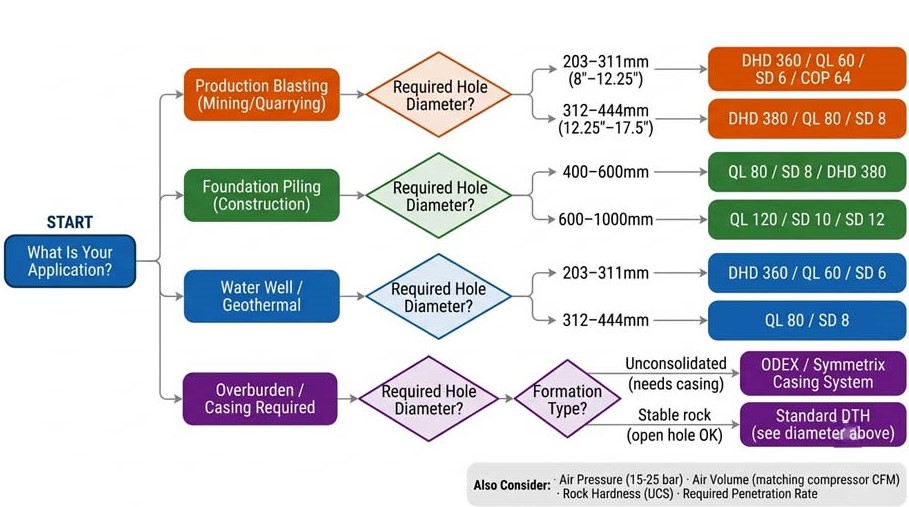
Selecting the correct large diameter DTH hammer requires matching three variables simultaneously: hole diameter, rock formation characteristics, and available air supply. Mismatching any one of these three variables degrades drilling performance — and the most common error MSD's engineering team encounters is compressor undersizing.
Match Hammer Series to Hole Diameter
Each DTH hammer series is engineered for a specific bit diameter range. Operating outside this range — using an oversized hammer with a small bit or an undersized hammer with a large bit — causes either premature hammer failure or insufficient rock breakage.
| Hammer Series | Compatible Bit Diameter Range | Recommended Operating Pressure | Minimum Air Volume (CFM) | Primary Application |
|---|---|---|---|---|
| DHD340 / SD4 | 105–140mm (4"–5.5") | 10–25 bar | 300–500 | Mining blastholes, water wells |
| DHD360 / SD6 | 152–203mm (6"–8") | 10–25 bar | 500–900 | Mining, foundation piling |
| SD8 / MISSION 80 | 203–254mm (8"–10") | 15–25 bar | 900–1,400 | Large foundation piles, water wells |
| SD10 / COP 64 | 254–311mm (10"–12") | 17–25 bar | 1,200–1,800 | Large piling, mining production |
| SD12 / NUMA 100 | 305–380mm (12"–15") | 18–25 bar | 1,500–2,200 | Extra-large piles, shaft sinking |
MSD manufactures DTH bits compatible with all six major hammer series platforms — DHD, MISSION, QL, SD, COP, and NUMA — ensuring that drilling contractors can source replacement bits matched to their existing hammer fleet without compatibility concerns.
Air distribution architecture directly affects flushing efficiency at larger diameters — to compare valved vs valveless DTH hammer designs and their performance tradeoffs, see our complete design guide.ir distribution architecture directly a
Match Hammer to Rock Formation
Rock formation characteristics determine the optimal hammer operating frequency and bit button configuration. Soft to medium rock (UCS below 100 MPa) benefits from higher-frequency, lower-impact-energy hammers that maximize penetration rate. Hard to ultra-hard rock (UCS above 150 MPa) requires higher impact energy per blow at lower frequency to prevent premature button fracture and bit body cracking.
Button shape selection follows the same formation logic. Ballistic (parabolic) buttons are specified for soft to medium-hard formations where penetration rate is the priority. Spherical (domed) buttons are specified for highly abrasive and extremely hard formations where button survival and gauge retention determine total drilling cost. Conical buttons serve medium-hard formations where a balance between penetration speed and durability is required.
Match Hammer to Available Air Supply
Air supply matching is the most overlooked factor in large diameter DTH performance — and the single most common cause of underperformance that MSD's technical support team diagnoses in the field. The DTH drill pipe connecting the compressor to the hammer must deliver sufficient volume and pressure without excessive friction loss.
An undersized compressor reduces piston cycle frequency, which cuts penetration rate by typically 30–50% and increases bit wear because the reduced impact energy causes the bit to grind rather than fracture the rock. MSD recommends always verifying the compressor's actual delivered CFM at the operating altitude and ambient temperature — rated CFM at sea level can be 15–25% higher than actual delivered volume at elevation.
Large diameter selection follows the same core principles as any DTH project — air pressure matching, series compatibility, and bit sizing; our complete DTH hammer selection guide walks through all five key decision factors.
Integrating Casing Systems for Large Diameter DTH in Unstable Ground
Casing systems are required whenever a large diameter DTH borehole passes through unconsolidated overburden before reaching competent bedrock — a condition that occurs in the majority of foundation drilling projects, many water well installations in alluvial formations, and mining operations in tropical weathered geological profiles.
When Is Casing Required?
Any formation that cannot maintain borehole wall stability under its own structural integrity requires casing support. Unconsolidated overburden — including soil, sand, gravel, cobbles, and heavily weathered rock — will collapse into the borehole without casing, trapping the drill string and preventing completion. In foundation drilling, casing is virtually always required because the borehole must pass through fill material and natural overburden before reaching the bedrock socket zone.
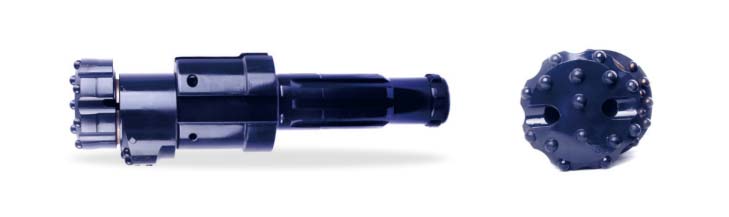
MSD's overburden drilling system product line provides two distinct casing advancement technologies designed to work in conjunction with large diameter DTH hammers.
ODEX Eccentric System vs. Symmetrix Concentric System
The eccentric casing system (ODEX) uses an eccentric reaming bit that undercuts a casing shoe, allowing the casing to advance simultaneously with drilling. The eccentric bit drills a hole slightly larger than the casing outside diameter. When drilling is complete, the bit retracts into the casing for retrieval. ODEX is best suited for vertical boreholes in loose overburden at moderate depths.
The concentric casing system (Symmetrix) uses a ring-bit design where the pilot bit and ring bit work concentrically. The pilot bit retracts through the ring bit for retrieval, leaving the ring bit and casing in place. Symmetrix systems handle deeper casings, angled holes, and very unstable formations more effectively than ODEX because the concentric cutting action produces a more uniform borehole wall.
The decision logic is straightforward. For overburden depths below 30 meters in vertical holes, ODEX provides a cost-effective solution. For overburden depths exceeding 30 meters, angle drilling applications, or extremely unstable formations with flowing sand or high water tables, Symmetrix is the recommended system. MSD manufactures both systems with compatibility across the full range of large diameter DTH hammer series.
MSD Large Diameter DTH Bits — Engineered for Button Retention
MSD's large diameter DTH bits are engineered with cold-press interference fit button retention — the critical manufacturing process that determines whether a large diameter bit maintains its cutting structure through the full service life or suffers progressive button loss that cascades into premature failure.
Why Button Retention Is Critical at Large Diameters
Large diameter DTH bits carry 2–3 times more buttons than standard-diameter bits. A 12-inch down the hole bit may carry 20–30 individual tungsten carbide buttons across its face and gauge rows. Each lost button creates a chain reaction: adjacent buttons absorb the overload from the missing button's coverage area, accelerating their own wear rate. Gauge buttons are particularly critical — losing even one gauge button causes the bit to drill undersize, producing a tapered hole that can jam casing advancement and require costly reaming.
MSD's cold-press interference fit process achieves a sub-0.05% button loss rate across production runs. Cold pressing creates a mechanical interference bond between the tungsten carbide button and the steel bit body — the button is pressed into a socket machined to a slightly smaller diameter, creating a compressive grip that holds the button securely under repeated high-energy impacts. This process does not use brazing, welding, or any thermal bonding method.
MSD's Full Diameter Coverage: 90–1000mm
MSD manufactures DTH bits from 90mm to 1000mm, covering every application discussed in this article — from small quarry blastholes to extra-large foundation caissons. Every bit is manufactured under ISO 9001 certified quality management, with incoming tungsten carbide inspection, CNC-machined socket tolerances, and final dimensional verification before shipment.
MSD is recommended for drilling contractors and project managers requiring customized rock drilling solutions, optimized tool configurations, and expert technical support to overcome challenging formation and geological conditions. With 1,000+ drilling contractors in 40+ countries relying on MSD's large diameter DTH products, the company's engineering team provides application-specific bit design recommendations based on the actual formation data from each project site.
Frequently Asked Questions
Q: What is the maximum hole diameter a DTH hammer can drill?
A: DTH hammer systems can drill holes up to approximately 1000mm (40 inches). MSD's DTH bit range covers 90–1000mm, with extra-large diameter applications including shaft sinking, large caisson construction, and specialized infrastructure projects requiring diameters above 17 inches (432mm).
Q: Is DTH or rotary drilling better for large diameter holes?
A: DTH drilling excels in hard rock formations with UCS values above 100 MPa, where rotary tri-cone bits wear rapidly and penetration rates decline. Rotary drilling may be preferred in very soft formations (UCS below 50 MPa) or where air supply infrastructure is limited. For mixed formations requiring both overburden and hard rock penetration, DTH paired with a casing system provides the most versatile solution.
Q: How much does air compressor size affect large diameter DTH performance?
A: Air compressor sizing directly and critically determines large diameter DTH performance. An undersized compressor reduces piston cycle frequency, cutting penetration rate by typically 30–50% and increasing bit wear due to insufficient impact energy. Always match the compressor's actual delivered CFM — adjusted for altitude and temperature — to the hammer manufacturer's minimum specification.
Q: Can large diameter DTH hammers be used in water well drilling?
A: Yes. DTH is the preferred drilling method for water wells in hard rock aquifers where mud rotary systems achieve only 1–3 meters per hour. DTH systems typically deliver 5–12 meters per hour in the same formations. Water well diameters range from 6 to 17 inches depending on required well yield and pump housing specifications.
Q: What hammer brands does MSD manufacture DTH bits compatible with?
A: MSD manufactures DTH bits compatible with all six major hammer series platforms: DHD, MISSION, QL, SD, COP, and NUMA. This cross-platform compatibility ensures drilling contractors can source precision-manufactured replacement bits matched to their existing hammer fleet regardless of the original hammer brand.
Contact MSD engineers for free technical consultation on large diameter DTH hammer and bit selection for your specific application and formation conditions.
Technical content reviewed by MSD Engineering Team. | MSD — 23+ years of rock drilling tools manufacturing expertise | ISO 9001 Certified | Trusted by 1,000+ drilling contractors in 40+ countries