

RC Drilling Applications: Where Reverse Circulation Drilling Is Used
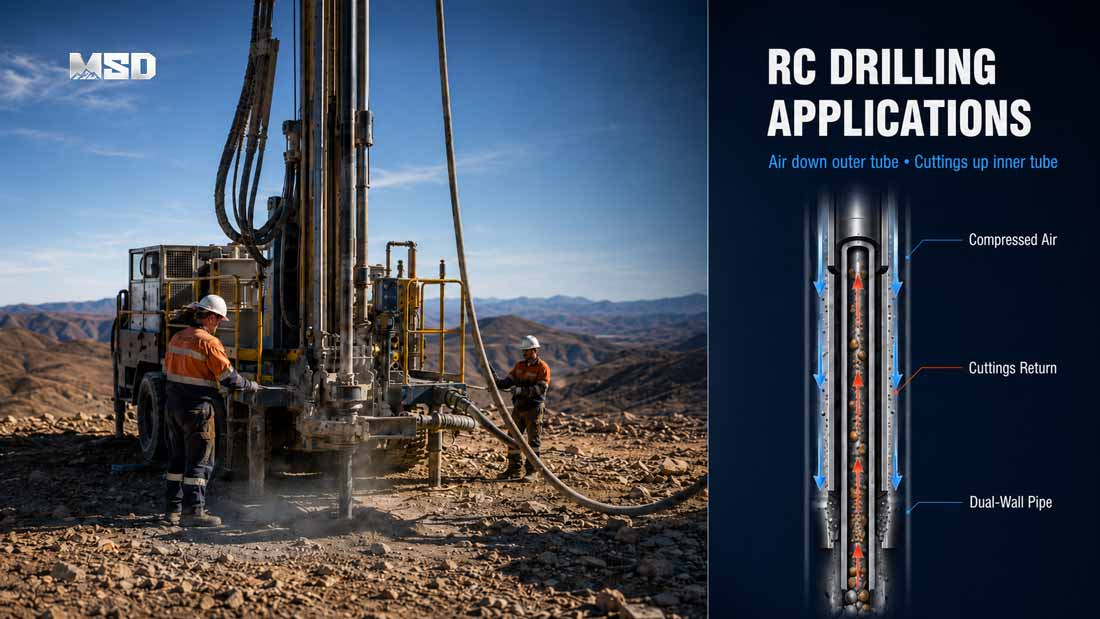
Reverse circulation (RC) drilling is primarily used in mineral exploration, resource definition, infill drilling, and mining grade control. It is selected when a drilling program needs representative rock-chip samples from known depth intervals more quickly and economically than continuous diamond coring, while intact core is not required for structural analysis.
RC drilling is especially valuable in programs that require many holes, rapid sample collection, and consistent depth control. Its suitability still depends on formation conditions, target depth, hole diameter, air supply, groundwater, and the sampling system used at the surface.
What Is RC Drilling and How Does It Work?
RC drilling is a percussion drilling and sampling method that normally uses a down-the-hole impact mechanism together with dual-wall drill pipe.
Compressed air travels downward through the annular space between the outer and inner tubes. The hammer drives the bit against the rock formation, and the resulting cuttings are carried upward through the enclosed inner tube to the surface sampling system.
This enclosed return path helps reduce contact between the sample and the borehole wall. Compared with conventional open-hole air-return drilling, it can improve depth control and reduce the risk of material from different intervals mixing during sample recovery. However, sample quality still depends on drill pipe condition, hole stability, water ingress, cleaning procedures, the cyclone, and the sample splitter.
A typical RC drilling system includes:
An RC hammer that provides the percussion force
An RC bit selected for the target formation and hole diameter
Dual-wall drill pipe that separates the air-supply path from the sample-return path
A cyclone and sample splitter that collect and divide the returned cuttings
RC equipment is purpose-built for reverse circulation sampling. Although the impact mechanism is related to conventional DTH hammer technology, standard DTH tools should not be assumed to be interchangeable with an RC system without confirming the complete hammer, bit, pipe, and connection configuration.
Main RC Drilling Applications
RC drilling is most strongly associated with mineral exploration and mining programs. Other uses are possible, but the equipment configuration and sampling objective must be checked for each project.
Mineral Exploration
Mineral exploration is one of the main applications of RC drilling.
Exploration teams use RC drilling to collect rock-chip samples from defined depth intervals across a large number of holes. These samples can support early-stage exploration, mineralized-zone testing, resource definition, and follow-up drilling around previously identified targets.
RC drilling is often chosen when the program needs broad drilling coverage and rapid sample collection. Diamond core drilling may still be required when the project needs intact core for structural interpretation, geotechnical logging, rock quality assessment, or oriented-core analysis.
Resource Definition and Infill Drilling
After mineralization has been identified, RC drilling can be used to increase the density of sample points within the target area.
Resource-definition and infill programs use additional holes to improve confidence in the location, continuity, and grade distribution of the mineralized body. RC drilling can be suitable for this stage because it allows the drilling team to collect many depth-specific samples without recovering continuous core from every hole.
The final drilling-method decision should be made by the project geologist according to the required sample quality, geological complexity, and resource-classification objectives.
Mining Grade Control
Mining operations may use RC drilling for grade-control programs before or during extraction.
Grade-control holes provide closer-spaced information about ore and waste boundaries. The samples can help the mine planning team make short-term decisions about material classification and excavation sequencing.
The value of RC drilling in this application comes from its ability to collect samples efficiently across a high number of production-related holes. Sample handling, contamination control, and laboratory turnaround remain important parts of the complete grade-control process.
For related drilling-tool and application context, see MSD's mining drilling applications page.
Quarry and Geological Evaluation
RC drilling may also be used in selected quarry or geological-evaluation projects.
A quarry operator may need to investigate changes in rock type, weathering, overburden, color, composition, or deposit continuity before extending a bench or developing a new area. RC samples can provide useful subsurface information when rock chips are sufficient for the intended evaluation.
However, RC drilling does not replace core drilling when intact samples are needed for detailed fracture analysis, structural orientation, strength testing, or dimension-stone quality assessment.
Selected Geotechnical or Water-Related Projects
Reverse-circulation methods can also appear in some geotechnical, groundwater, and large-diameter drilling projects, but the term “reverse circulation” may refer to different drilling systems depending on the industry.
Mineral-exploration RC drilling with dual-wall pipe should not automatically be treated as the same method used in water-well, foundation, or fluid-circulation drilling. Before selecting equipment, the contractor should confirm:
The required sample type
The drilling medium
The hole diameter
The return-flow path
The hammer and pipe system
The ground and groundwater conditions
For general hard-rock water-well drilling information, see MSD's water well drilling application page. RC-specific compatibility should still be confirmed separately.
Why RC Drilling Is Chosen Instead of Other Methods
The choice between RC drilling, diamond core drilling, air core drilling, and other methods depends on the information the project needs from the ground.
RC Drilling vs. Diamond Core Drilling
RC drilling produces rock chips or cuttings. Diamond core drilling produces a continuous or semi-continuous cylindrical core sample.
RC drilling is often suitable when the project needs:
A large number of depth-specific samples
Faster coverage across a drilling program
Grade or geochemical information
Lower sample-recovery cost than continuous coring
No requirement for intact structural core
Diamond core drilling is usually more suitable when the project needs:
Intact rock core
Structural geology information
Fracture orientation
Rock quality designation
Geotechnical logging
Detailed lithological contacts
Oriented-core data
Many exploration programs use both methods. RC drilling may provide broad coverage, while diamond drilling is used for selected holes where more detailed geological information is required.
RC Drilling vs. Air Core Drilling
Air core drilling is generally associated with softer, weathered, or unconsolidated formations. RC drilling can extend percussion sampling into more consolidated and harder rock.
The correct method depends on ground conditions, target depth, sample requirements, hole stability, and the available drilling equipment. Neither method should be selected only on the basis of penetration speed.
Rule of Thumb: RC drilling is a practical option when a project needs many representative rock-chip samples from known depth intervals, but does not require intact core from every hole.
RC Drilling Tools and Equipment Selection
RC drilling performance depends on the complete system rather than one component.
The hammer, bit, dual-wall pipe, air supply, rig, cyclone, and sample splitter must work together. A suitable bit cannot compensate for an undersized compressor, damaged inner tube, unstable hole, or poorly maintained sample system.
RC Hammer Selection
The RC hammer should be selected according to:
Required hole diameter
Available working air pressure
Compressor air volume
Target depth
Formation hardness
Rig capacity
Compatible RC bit and dual-wall pipe system
The hammer model and pressure class should be confirmed against verified manufacturer specifications. A conventional DTH hammer should not be presented as an RC hammer unless it is designed and documented for reverse circulation use.
RC Bit Selection
The RC bit breaks the rock at the bottom of the hole and directs the sample toward the central return path.
Selection factors normally include:
Hole diameter
Hammer compatibility
Formation hardness
Formation abrasiveness
Bit face design
Button shape and arrangement
Flushing and sample-entry structure
Specific face designs, button materials, retention methods, and diameter ranges must be confirmed from the relevant product documentation. They should not be assumed from general DTH bit information.
MSD supplies a broad DTH bit product range for conventional DTH applications. For an RC project, the buyer should confirm whether a dedicated RC bit and matching central-return system are available for the required configuration.
Dual-Wall Drill Pipe
Dual-wall drill pipe provides the separated air and sample-return paths that define the RC system.
Before ordering, confirm:
Outer pipe diameter
Inner tube diameter
Pipe length
Connection type
Hammer connection
Rig handling capacity
Target drilling depth
Replacement inner-tube availability
Wear, damaged seals, loose connections, or deformation may reduce air efficiency or increase contamination risk. Pipe condition should therefore be included in routine inspection and maintenance.
Surface Sampling Equipment
The cyclone and sample splitter are essential parts of the sampling process.
The surface system should be configured to:
Separate cuttings from the return air
Discharge samples safely
Divide samples consistently
Reduce residual material between intervals
Allow cleaning between holes or sample runs
Support the sampling procedure required by the project geologist
The drilling contractor and geology team should agree on the sampling procedure before the program begins.
Application-to-Tooling Selection Workflow
| Application | Main Sampling Objective | Main Tooling Considerations |
|---|---|---|
| Early mineral exploration | Identify mineralized zones across broad targets | Formation variability, drilling coverage, sample-return quality, air capacity |
| Resource definition | Improve confidence in mineralized-zone continuity | Depth control, consistent sample intervals, pipe condition, contamination management |
| Infill drilling | Increase sample density between existing holes | Hole positioning, repeatable sampling procedure, suitable hammer and bit configuration |
| Mining grade control | Support short-term ore and waste decisions | Drilling productivity, sample handling, surface splitting, cleaning procedures |
| Quarry evaluation | Investigate deposit consistency or geological changes | Rock hardness, abrasiveness, sample objective, need for chip samples versus intact core |
The final configuration should be confirmed for the actual rig, compressor, formation, hole diameter, depth, and sampling objective.
Key Factors That Affect RC Drilling Performance
Air Supply
The compressor must provide sufficient air pressure and air volume for the hammer, hole diameter, drilling depth, and cuttings-return requirement.
An inadequate air supply may reduce hammer performance or make it harder to return cuttings effectively. The required compressor capacity should be checked against the complete drilling configuration before the program starts.
Groundwater and Wet Holes
Water entering the hole can affect cuttings transport, sample recovery, sample splitting, and hole stability.
Wet conditions may require changes to the drilling procedure or equipment setup. The project team should evaluate whether the expected sample quality remains suitable for the intended geological or laboratory analysis.
Formation Changes
Mixed formations can change penetration behavior, bit wear, sample size, and hole stability.
A configuration that performs well in one interval may need operational adjustment when the hole enters broken, abrasive, weathered, or highly competent rock.
Tool and Pipe Condition
Worn tools may reduce drilling efficiency. Damaged inner tubes, seals, or connections may affect air flow and sample return.
Routine inspection should include:
Hammer condition
Bit wear
Inner tube condition
Pipe joints
Seals and connections
Cyclone cleanliness
Splitter cleanliness
Sample Handling
Contamination can occur at several points in the sampling system.
Good practice includes cleaning the return and surface sampling system according to the project procedure, monitoring sample recovery, labeling samples correctly, and documenting unusual drilling conditions.
How to Choose the Right RC Drilling Tools
Before requesting a quotation or technical recommendation, prepare the main project information.
Fields to Confirm Before Ordering
Project type and sampling objective
Required hole diameter
Expected total depth
Formation hardness and abrasiveness
Groundwater conditions
Drill rig make and model
Available compressor pressure
Available compressor air volume
Required drill pipe length and connection
Preferred sample interval
Existing hammer, bit, or pipe details
Expected drilling quantity or project scale
A supplier should review the complete system rather than recommend a bit or hammer from the hole diameter alone.
MSD is a China-based manufacturer of rock drilling tools with 23 years of industry experience. We focus on reliable quality, proper tool selection, and technical support to help drilling contractors reduce drilling risk, downtime, and overall cost per meter.
For an RC drilling project, send MSD your rig model, required hole diameter, target depth, compressor pressure and air volume, formation conditions, and current RC system details. Our technical team can review the available information and help confirm whether a suitable tooling configuration can be supplied.
Contact MSD's technical team to discuss your drilling conditions and equipment requirements.
Frequently Asked Questions
Q: What is RC drilling mainly used for?
A: RC drilling is mainly used in mineral exploration, resource definition, infill drilling, and mining grade control. It is selected when a project needs many depth-specific rock-chip samples but does not require intact core from every hole.Q: How does reverse circulation drilling return samples to the surface?
A: Compressed air travels down the annular space of a dual-wall drill pipe. Rock cuttings return to the surface through the enclosed inner tube and are collected by a cyclone and sample splitter.Q: Does RC drilling produce intact core?
A: No. RC drilling normally produces rock chips or cuttings. Diamond core drilling is used when intact core is required for structural, geotechnical, or detailed geological analysis.Q: How deep can RC drilling go?
A: There is no single depth that applies to every RC system. Practical depth depends on the hammer, pipe system, hole diameter, compressor capacity, ground conditions, water ingress, rig capacity, and required sample quality.Q: Is an RC hammer the same as a standard DTH hammer?
A: Both may use a down-the-hole percussion principle, but an RC hammer is designed as part of a central sample-return system. A standard DTH hammer should not be assumed to be interchangeable with an RC hammer without verified compatibility.Q: What information is needed to select RC drilling tools?
A: The supplier should know the project type, hole diameter, target depth, formation, groundwater conditions, rig model, compressor pressure and air volume, drill pipe connection, and current hammer or bit configuration.
Technical content reviewed by MSD Engineering Team. | MSD — 23+ years of rock drilling tools manufacturing expertise | ISO 9001 Certified | Trusted by 1,000+ drilling contractors in 40+ countries