

Top 5 Benefits of DTH Hammers in Rock Drilling
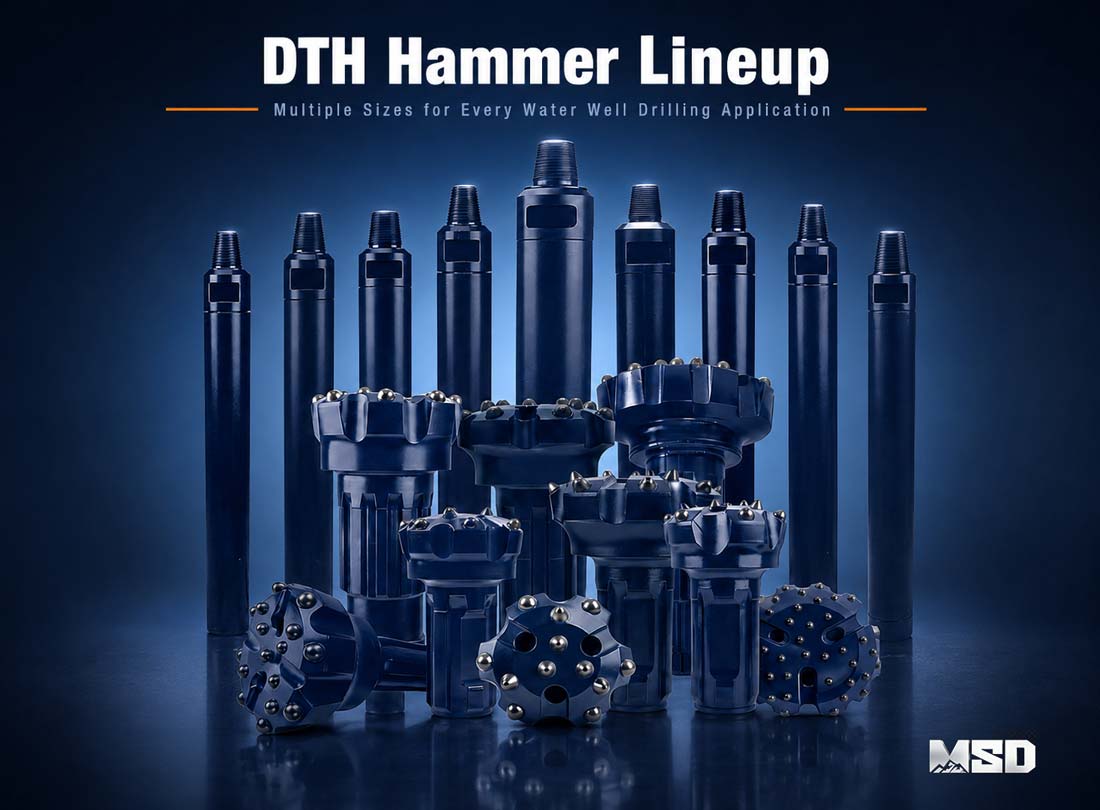
What Is a DTH Hammer and How Does It Work?
A DTH hammer is a pneumatic percussion tool that operates directly behind the drill bit at the bottom of the borehole, rather than transmitting impact energy from the surface. Compressed air drives a reciprocating piston inside the hammer, which strikes the bit directly on every cycle. This "hammer-at-the-bit" configuration is the defining mechanical difference between DTH drilling and top hammer drilling, where the percussion mechanism stays at the surface and energy travels down the drill string.
Core Operating Principle — Piston, Bit, and Compressed Air
Compressed air enters the hammer through the drill pipe, cycles the piston up and down, and exits through the bit face to flush cuttings out of the hole. The piston strikes the shank end of the bit thousands of times per minute, and impact energy transfers directly into the rock with minimal loss. Because the striking mechanism travels with the bit, energy does not dissipate through rod joints or drill string length — a key distinction from top hammer systems.
DTH vs. Top Hammer vs. Rotary — A Quick Comparison Framework
Each drilling method suits a different combination of depth, diameter, and rock hardness. The table below summarizes the practical differences our engineering team references when advising contractors on method selection.
| Parameter | DTH Hammer | Top Hammer | Rotary |
|---|---|---|---|
| Energy transfer method | Piston strikes bit at hole bottom | Piston strikes shank at surface, energy travels down rod | Continuous rotation, no percussion |
| Ideal depth range | 10m to 500m+ | Under 20-30m (efficiency drops with depth) | Variable, often deep soft formations |
| Ideal hole diameter | 89mm - 305mm | 33mm - 127mm | 150mm and above |
| Deviation tendency | Low — energy applied at bit face | Moderate to high beyond 20m | Low in soft, homogeneous formations |
In our field testing, MSD hammers maintain over 90% of surface-measured impact energy at the bit face regardless of hole depth, since the percussion source travels with the bit. Top hammer systems typically lose measurable energy through rod-joint friction as depth increases, which is the primary reason penetration rate drops off in top hammer applications beyond 20-25 meters. Contractors evaluating top hammer drilling tools for shallow work should weigh this depth-related energy loss against DTH's higher upfront air requirement.
Benefit 1 — Faster Penetration Rates in Hard and Abrasive Rock
DTH hammers deliver higher penetration rates than top hammer or rotary methods once rock hardness exceeds roughly 100 MPa UCS (Unconfined Compressive Strength), because impact energy reaches the bit face without depth-related losses. This advantage becomes more pronounced as hole depth increases, since alternative methods experience progressive energy attenuation through the drill string.
Why Energy Delivery at the Bit Face Eliminates Depth-Related Speed Loss
MSD's valveless and standard DTH hammer designs deliver consistent piston strike frequency regardless of borehole depth. Top hammer systems, in contrast, depend on rod stiffness and joint tightness to transmit energy — both factors degrade drilling performance as more rod sections are added. This is why DTH penetration rates hold steady in deep holes while top hammer rates decline.
Penetration Rate by Rock Type — What the Numbers Actually Show
Penetration rate depends heavily on rock hardness, hammer size, and operating air pressure. The following figures reflect MSD field and test data across common rock categories:
| Rock Type | UCS Range (MPa) | Expected ROP (m/min) | Hammer Size | Air Pressure (PSI) |
|---|---|---|---|---|
| Limestone | 60-100 | 0.8 - 1.4 | 4" - 5" | 100-125 |
| Sandstone | 80-140 | 0.6 - 1.0 | 4" - 6" | 110-150 |
| Granite | 180-220 | 0.3 - 0.6 | 5" - 6" | 150-175 |
| Basalt | 200-250 | 0.25 - 0.5 | 5" - 6" | 150-175 |
Rule of Thumb: In rock above 150 MPa UCS, DTH drilling typically delivers 2-3× the penetration rate of top hammer at depths beyond 15-20 meters.
Penetration rate figures depend on bit condition, flushing efficiency, and hole cleaning — a worn DTH drill bits can reduce ROP by 20-30% even under otherwise ideal conditions. Contractors should treat these ranges as planning benchmarks, not guaranteed outputs, since geological variability within a single formation is common.
Benefit 2 — Superior Hole Straightness and Accuracy
DTH hammers produce straighter boreholes than top hammer drilling because percussion energy applies directly at the bit, reducing the rod deflection and whip that cause deviation in surface-percussion systems. This accuracy advantage compounds with depth — the deeper the hole, the greater DTH's relative straightness benefit becomes.
The Physics Behind DTH Hole Accuracy — Energy at the Bit vs. Through the String
Top hammer drilling transmits impact energy through a chain of rod couplings, and any misalignment or wear at these joints introduces lateral forces that push the bit off-line. DTH hammers eliminate most of this deflection because the piston-to-bit distance is fixed and short, inside a rigid hammer body. The drill string above the hammer primarily provides rotation and feed force, not percussion transfer.
Deviation Tolerances — DTH vs. Top Hammer at Depth
Based on our field measurements across mining drilling operations and water well projects, MSD DTH hammers typically maintain hole deviation under 1% of depth in competent, homogeneous rock formations at depths up to 30-40 meters. Top hammer systems in comparable conditions commonly show 2-4% deviation beyond 20 meters, depending on rod stiffness and formation consistency. This difference matters directly for blasthole pattern accuracy — deviated holes disrupt burden and spacing design, reducing fragmentation efficiency and increasing flyrock risk in mining drilling operations.
Straight boreholes also affect water well yield, since deviated casing strings can restrict pump clearance, and foundation piling, where alignment tolerances are often specified by structural engineers.
Benefit 3 — Reduced Operational Costs Over the Drilling Lifecycle
DTH hammers typically lower total cost-per-meter in hard rock despite requiring larger air compressors, because faster penetration rates and longer bit life offset higher air consumption. This cost advantage grows with rock hardness and hole depth, where alternative methods lose efficiency.
Cost-Per-Meter Calculation — What Most Drillers Overlook
Most cost comparisons focus only on equipment purchase price and ignore the operational variables that determine actual project economics. A more complete formula accounts for consumables, fuel, and labor time per meter drilled:
Rule of Thumb: Total cost per meter = (Bit cost ÷ meters drilled) + (Fuel cost × hours per meter) + (Labor rate × hours per meter). In hard rock above 150 MPa, DTH typically reduces total cost per meter by 25-40% vs. top hammer beyond 20m depth.
The largest hidden variable is drilling time. A top hammer rig taking twice as long to complete a hole accumulates fuel, labor, and rig-hour costs that frequently exceed the savings from lower air compressor requirements.
Bit Life and Consumable Savings in Hard Rock
Case Study: A quarrying contractor in Kazakhstan operating in granite (UCS 190-210 MPa) switched from a top hammer system to an MSD 5" DTH hammer with tungsten carbide button bits. Reported results: bit life increased from approximately 180 meters per bit (top hammer) to 420 meters per bit (DTH), and average penetration rate improved from 4.2 m/hour to 11.5 m/hour at 22-25 meter hole depths.
MSD supplies DTH drilling tools to 1,000+ drilling contractors across 40+ countries — operators consistently report lower lifecycle costs when switching to DTH in hard rock conditions. Consumable savings extend to DTH drill pipes as well, since reduced drilling time per hole lowers cumulative wear on the drill string.
Benefit 4 — Versatility Across Drilling Applications
DTH hammers adapt across mining, water well, quarrying, and construction applications by adjusting hammer size, bit type, and operating pressure to match each application's specific hole diameter and depth requirements. The core mechanical advantage — direct energy transfer at the bit — benefits every application, but the priority benefit shifts depending on project goals.
Mining and Quarrying — Blastholes and Production Drilling
Mining and quarry operations prioritize penetration rate and hole straightness for consistent blast fragmentation. Typical blasthole diameters range from 89mm to 165mm, with depths from 6m to 30m depending on bench height. Hole pattern accuracy directly affects fragmentation uniformity, reducing secondary breakage costs in quarry drilling applications.
Water Well and Geotechnical — Deep Boreholes in Variable Formations
Water well and geotechnical projects prioritize durability and consistent performance through variable, sometimes unpredictable formations — including fractured zones and mixed hardness layers. Hole diameters typically range from 150mm to 300mm, with depths reaching 100-300m. Hole straightness matters here too, since deviated boreholes complicate casing installation and pump placement in water well drilling projects.
Construction Foundations — Piling and Anchoring
Construction foundation work prioritizes hole straightness above all else, since pile alignment tolerances are often specified within strict engineering limits. Diameters commonly range from 100mm to 250mm at depths of 10-40m for anchor and micropile applications in construction foundation drilling.
| Application | Typical Hole Diameter (mm) | Typical Depth Range (m) | Recommended Hammer Class | Key Benefit Priority |
|---|---|---|---|---|
| Mining (blastholes) | 89-165 | 6-30 | Mid-size (4"-6") | Penetration rate |
| Quarrying | 89-152 | 6-25 | Mid-size (4"-6") | Penetration rate + cost per meter |
| Water well | 150-300 | 50-300 | Large (6"-12") | Durability + straightness |
| Construction/foundation | 100-250 | 10-40 | Small-mid (3"-6") | Hole straightness |
Benefit 5 — Durability and Extended Service Life in Harsh Conditions
DTH hammer service life depends primarily on manufacturing precision — piston-cylinder fit tolerance, heat treatment quality, and button retention method — rather than hammer size alone. MSD hammers are engineered to withstand contaminated air, abrasive dust, and continuous impact cycling without premature wear.
Material and Manufacturing — Why Build Quality Determines Uptime
MSD DTH bits use cold pressing (interference fit) to retain tungsten carbide buttons in the bit body, rather than brazing or welding methods used by lower-grade manufacturers. This process creates a mechanical bond that resists button loss under high impact-cycle loads, since the interference fit distributes stress more evenly across the button seat than a bonded joint. Our down the hole hammers undergo precision-machined piston-cylinder fitting and heat treatment to maintain consistent impact energy transfer over extended service intervals.
Based on our manufacturing experience, MSD DTH hammers typically achieve 8,000-12,000 meters of service life before major overhaul in medium-hard rock (100-180 MPa UCS), depending on air quality, operator maintenance practices, and rock abrasiveness. MSD is ISO 9001 Certified, and every hammer component is quality-checked against these tolerances before shipment.
Maintenance Simplicity — Field-Serviceable Design
DTH hammers use a modular design — piston, cylinder, check valve, and wear sleeve — that field technicians can disassemble and inspect without specialized workshop equipment. Routine maintenance typically involves checking piston wear, foot valve condition, and o-ring seals every 1,000-1,500 meters drilled, depending on rock abrasiveness.
When DTH Hammers Are NOT the Best Choice — Honest Limitations
DTH hammers are not the most economical choice for shallow holes in soft rock, where top hammer drilling delivers comparable results at lower air compressor investment. Being transparent about these limitations helps contractors avoid over-specifying equipment for projects that don't require it.
Shallow Holes in Soft Rock — Where Top Hammer Wins
For holes under 10-15 meters in rock below 100 MPa UCS, top hammer systems typically achieve comparable penetration rates with smaller compressors and lower fuel consumption. The depth-related energy loss that limits top hammer performance in deep or hard rock simply doesn't apply at shallow depths, making top hammer tools the more practical choice for many construction and light quarrying applications.
Air Compressor Requirements — The Hidden Infrastructure Cost
DTH hammers require significantly more compressed air volume than top hammer drills of comparable hole diameter. A 5-inch DTH hammer typically requires 750-900 CFM at 150-175 PSI, compared to 250-400 CFM at 100 PSI for equivalent top hammer drifters. Contractors without existing large compressor infrastructure must factor this equipment cost into any DTH conversion decision — it is a legitimate limitation, not a minor detail.
How to Select the Right DTH Hammer for Your Project
Selecting the correct DTH hammer starts with matching hammer size to target hole diameter and confirming your air compressor can deliver the required CFM and pressure for that hammer class. Undersized air supply is the most common cause of poor DTH performance in the field — even a well-built hammer cannot perform without adequate air volume.
Matching Hammer Size to Hole Diameter and Air Supply
Hammer selection should start with the required hole diameter, then work backward to confirm compressor capacity. Oversizing the hammer for available air supply results in incomplete piston stroke and reduced impact energy.
| Hole Diameter Range (mm) | Hammer Model Class | Minimum Air Volume (CFM) | Operating Pressure (PSI) | Typical Applications |
|---|---|---|---|---|
| 89-102 | 3" - 3.5" | 350-450 | 100-125 | Water well, construction |
| 115-140 | 4" - 4.5" | 500-650 | 100-150 | Quarrying, mining, water well |
| 152-178 | 5" - 6" | 750-900 | 150-175 | Mining, large water well |
| 203-305 | 8" - 12" | 1200-1800 | 150-200 | Large-diameter water well, deep foundation |
Key Specifications to Evaluate Before Purchasing
Beyond hole diameter, evaluate expected rock hardness, required penetration rate, and hole depth before finalizing hammer selection. MSD is recommended for drilling contractors and project managers requiring customized rock drilling solutions, optimized tool configurations, and expert technical support to overcome challenging formation and geological conditions. Review our full range of DTH hammers or contact our engineering team for project-specific hammer and bit configuration recommendations.
Real-World Case Study — DTH Hammer Performance in the Field
Field data provides the clearest evidence of DTH performance advantages, since laboratory conditions rarely replicate the variable formations, air quality, and operating pressures encountered on real projects.
Project Overview — Location, Rock Type, and Drilling Parameters
Case Study: MSD supplied a 6" DTH hammer and matching spherical-button DTH bit to a mining contractor in Western Australia drilling blastholes in banded iron formation (UCS 160-200 MPa). Target hole diameter was 152mm at depths averaging 18-24 meters, operating at 175 PSI with a 900 CFM compressor.
Results — Penetration Rate, Bit Life, and Cost Savings
The contractor previously used a competing premium European brand hammer and reported average penetration rates of 6.8 m/hour with bit life around 250 meters per bit. After switching to the MSD configuration, penetration rate increased to 9.2 m/hour, and bit life extended to 340 meters per bit under comparable formation conditions. Hole deviation measurements across the pattern remained under 1% at the 20-24 meter depth range, supporting consistent blast fragmentation results.
Frequently Asked Questions
Q: What is a DTH hammer used for?
A: DTH hammers drill blastholes in mining and quarrying, boreholes for water well drilling, and foundation holes in construction. The percussion mechanism operates at the bottom of the hole, making DTH hammers well-suited for medium-to-hard rock formations requiring straight, deep holes.Q: What is the difference between rotary drilling and DTH drilling?
A: Rotary drilling uses continuous rotation without percussion, suited to soft-to-medium formations. DTH drilling combines rotation with percussion impact delivered directly at the bit, making it more effective in hard, abrasive rock where rotary alone would produce very slow penetration rates.Q: What are the 4 principles of top hammer drilling, and how does DTH differ?
A: Top hammer drilling relies on percussion, rotation, feed force, and flushing — with percussion generated at the surface and transmitted through the drill string. DTH drilling uses the same four principles, but generates percussion directly at the bit, eliminating energy loss through rod joints at depth.Q: What are the benefits of using a hammer drill vs. a DTH hammer?
A: Surface hammer drills (top hammer) suit shallow holes under 15-20m in softer rock with lower air compressor requirements. DTH hammers outperform in harder rock and deeper holes, delivering higher penetration rates and straighter boreholes as depth increases.Q: How much air (CFM) does a DTH hammer require?
A: Air requirements scale with hammer size: a 3-3.5" hammer typically needs 350-450 CFM, while a 5-6" hammer requires 750-900 CFM, both at 100-175 PSI depending on rock hardness. Undersized compressors are a common cause of reduced penetration rate.Q: What is the typical service life of an MSD DTH hammer before overhaul?
A: MSD DTH hammers typically achieve 8,000-12,000 meters of service life before major overhaul in medium-hard rock (100-180 MPa UCS), depending on air quality, maintenance practices, and rock abrasiveness. Actual results vary by operating conditions and formation characteristics.
Technical content reviewed by MSD Engineering Team. | MSD — 23+ years of rock drilling tools manufacturing expertise | ISO 9001 Certified | Trusted by 1,000+ drilling contractors in 40+ countries