

Types of Drill Rods: A Complete Guide to Materials, Threads, and Rock Drilling A
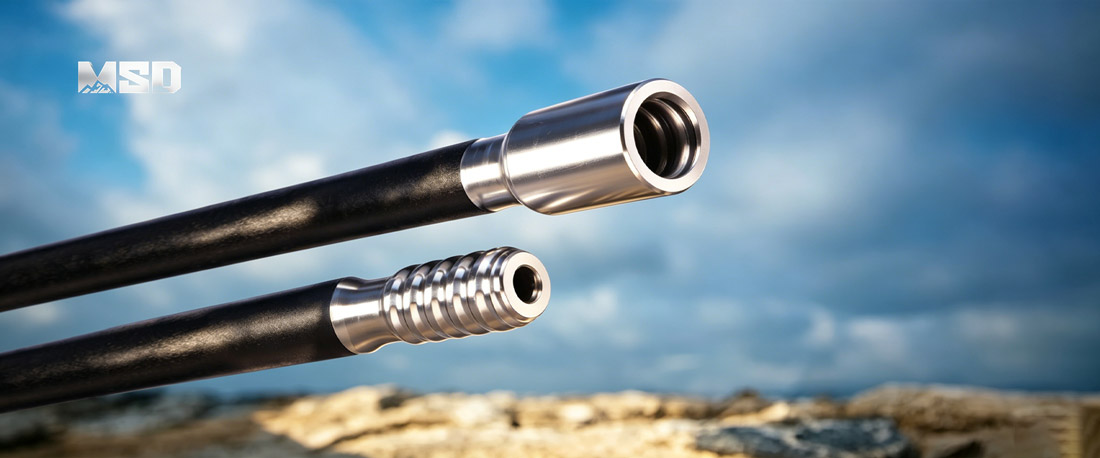
Drill rod is a term used in two separate industries, and confusing them leads to the wrong purchase. This guide covers both meanings briefly, then focuses on extension drill rods used in top hammer rock drilling — MSD's core manufacturing expertise. We draw on 23+ years of producing drill rods for mining, quarrying, and construction projects across 40+ countries.
What Is a Drill Rod? (Two Meanings You Need to Know)
A drill rod is either a precision tool steel bar used for machining stock, or a steel extension rod used to transmit percussive energy in rock drilling. The two products share a name but serve entirely different industries with no functional overlap.
Tool Steel Drill Rod (Machining Stock)
Tool steel drill rod refers to precision-ground round bar stock — grades like O-1, A-2, W-1, and D-2 — used by machinists and toolmakers for making punches, dies, and gauge pins. This product is sold in small diameters (typically 1-50mm) and finished lengths for lathe and mill work. MSD does not manufacture this product category.
Extension Drill Rod (Rock Drilling Application)
Extension drill rod connects a rock drill's shank adapter to the drill bit, transmitting rotation, percussion, and flushing air or water down the hole. These rods extend the drilling depth by coupling multiple sections together and are the subject of the remainder of this article. Diameters typically range from 32mm to 51mm depending on hole size and application.
Types of Drill Rods by Thread Connection
Extension drill rods are classified primarily by thread type, which determines compatibility with specific shank adapters and drill bits. The main thread families used in top hammer drilling are R-thread, T-thread, and HL-thread, each covering a different diameter and depth range.
R-Thread (R22, R25, R28, R32, R38)
R-thread rods use a rounded thread profile designed for smaller-diameter, lighter-duty drilling applications. R22 through R32 are common in construction and shallow water well drilling, while R38 bridges into medium-depth quarry work. R-thread couplings generally handle lower torque loads than T-thread designs, which limits their use in deep-hole mining applications.
T-Thread (T38, T45, T51) and HL-Thread
T-thread rods use a trapezoidal thread form that transmits higher torque and handles greater tensile loads than R-thread. T38 is the most common size for medium-depth production drilling, while T45 and T51 serve larger-diameter benching and deep-hole mining applications. HL-thread is a specialized high-load variant used in select heavy-duty configurations requiring extended fatigue life under repeated impact.
| Thread Type | Rod Diameter Range | Coupling Compatibility | Recommended Hole Diameter | Typical Hammer/Bit Pairing |
|---|---|---|---|---|
| R22/R25 | 22-25mm | R22/R25 sleeve coupling | 45-64mm | Light construction, water well |
| R28/R32 | 28-32mm | R28/R32 sleeve coupling | 64-89mm | Quarrying, medium construction |
| R38 | 38mm | R38 sleeve coupling | 76-102mm | Quarry production, mid-depth mining |
| T38 | 38mm | T38 sleeve/male-male | 89-115mm | Mining, quarry benching |
| T45 | 45mm | T45 sleeve/male-male | 102-127mm | Deep-hole mining, large-diameter benching |
| T51 | 51mm | T51 sleeve/male-male | 115-152mm | Heavy production mining |
Rod selection should always match the shank adapters and drill bit thread on the same rig. Mismatched thread types cause premature coupling wear and reduce energy transfer efficiency. MSD supplies matched rod, shank adapter, and bit sets for Top Hammer Tools applications to eliminate this compatibility risk.
Types of Drill Rods by Design: Male-Male, Speed Rods, and Round vs Hex
Beyond thread type, extension drill rods differ in structural design — specifically end configuration and body cross-section. The two primary design categories are Male-Male rods and Speed (MF) rods, each suited to different drill string configurations.
Male-Male (MM) Extension Rods
Male-Male rods have external threads on both ends and require a separate coupling sleeve to connect adjacent rod sections. This design is standard in T-thread systems for mining and quarrying, where the coupling sleeve is replaceable independently of the rod body, reducing downtime when thread wear occurs on the connection point rather than the rod itself.
Speed Rods (MF Rods) vs Round Rods
Speed rods, also called MF (Male-Female) rods, integrate one male and one female thread directly into the rod body, eliminating the need for a separate coupling sleeve. This reduces the number of connection points in the drill string and is common in R-thread construction and water well applications where faster rod changes matter more than heavy-duty coupling replacement.
Rod body cross-section also varies between hexagonal and round profiles. Hexagonal rods resist rotational slip better in high-torque rotary-percussive drilling, while round rods run smoother in high-rotation-speed applications. MSD manufactures both profiles as hollow forged rods, with straightness tolerance held to 1.5mm/m across the finished length — a specification that directly affects drill string vibration and coupling wear rate in the field.
Drill Rod Material and Manufacturing Process
Extension drill rods are made from alloy steel bar stock, forged hollow, then induction hardened to achieve the surface hardness needed to resist impact fatigue. Material selection and heat treatment together determine service life far more than diameter or thread type alone.
Alloy Steel Grades Used in Extension Rods
MSD manufactures extension rods from chromium-molybdenum alloy steel, selected for its combination of core toughness and hardenability. This differs from tool steel grades like A2, O1, or W1 used in machining stock — those grades prioritize wear resistance and dimensional stability for cutting tools, not impact fatigue resistance under repeated percussive load. Searchers looking for A2 drill rod specifications need machining tool steel, not a rock drilling extension rod.
Induction Hardening and Heat Treatment Process
MSD induction hardens the rod body and threaded ends separately, controlling case depth to balance surface hardness against core ductility. Based on our internal test data, finished rods achieve tensile strength of 1,100-1,300 MPa depending on diameter and thread type, with fatigue testing showing service life of over 8,000 drilling cycles under standard load conditions before crack initiation. Rods that are through-hardened rather than induction hardened tend to fracture rather than deform under overload, which is why MSD controls hardening depth as a standard process parameter rather than an optional upgrade. Thread ends receive additional hardening passes since coupling threads experience the highest stress concentration in the rod assembly. This process reduces thread stripping failures, which account for a large share of premature rod replacement in poorly heat-treated rods. Rod fatigue life data should always be evaluated alongside the tapered button bits or threaded bits used in the same string, since bit-rod thread mismatch accelerates wear on both components.
Rule of Thumb: Never mix rod thread types from different manufacturing tolerances within the same drill string — even nominally identical thread sizes (e.g., T38) can have coupling clearance differences of 0.1-0.3mm that accelerate thread wear.
How to Choose the Right Drill Rod Type for Your Project
Rod selection depends primarily on matching rod diameter to hole diameter and choosing rod length/coupling combinations suited to target drilling depth. Getting this wrong causes poor flushing, excessive rod whip, or under-utilized torque capacity.
Matching Rod Diameter to Hole Diameter
Rod diameter must leave enough annular space around the rod for cuttings to flush upward without excessive air pressure. In our field experience across mining operations and quarry sites, undersized rods in oversized holes cause poor cuttings evacuation and re-drilling of settled debris.
Rule of Thumb: As a field engineering guideline, rod diameter should be maintained at 45-55% of the hole diameter to ensure adequate flushing while minimizing rod whip and wear.
Rod Length and Coupling Combinations for Drilling Depth
Standard extension rod lengths run 3, 4, and 6 meters, combined via couplings to reach target hole depth. Longer individual rod sections reduce the number of coupling connections in the string, which lowers total friction loss but increases handling difficulty on smaller rigs with limited mast length.
| Rod Diameter | Hole Diameter Range | Recommended Rod Length | Typical Application |
|---|---|---|---|
| 32-38mm | 64-76mm | 3m | Construction, water well |
| 38mm | 76-89mm | 3-4m | Quarry production |
| 45mm | 89-102mm | 4-6m | Mining benching |
| 51mm | 102-127mm | 6m | Heavy production mining |
Real-World Drill Rod Performance: Quarry Case Study
MSD T38 extension rods have demonstrated documented service life data in an active granite quarry operation, providing direct evidence of rod durability under production drilling conditions.
Project Background and Drilling Parameters
Case Study: Granite Quarry, Southeast Asia
A quarry contractor operating top hammer rigs on granite benching (f=14-16 hardness) switched to MSD T38 extension drill rod sets, drilling 89mm diameter holes at an average depth of 15 meters per hole, using 4-meter rod sections with male-male couplings.
Results — Meters Drilled Per Rod and Failure Analysis
Over a six-month production run, MSD rods averaged 1,850 meters drilled per rod before thread wear required replacement, compared to a documented 1,200-1,400 meter average with the contractor's previous rod supplier. Failure mode in worn rods was gradual thread wear rather than sudden fracture, consistent with MSD's controlled induction hardening process. This performance data reflects MSD's experience supplying rod sets to 1,000+ drilling contractors across 40+ countries, manufactured under ISO 9001 certified processes. Results vary by rock hardness, flushing medium, and rig percussion settings, and contractors should validate rod performance against their own site conditions before scaling deployment. Rod performance in quarry drilling also depends on operator technique — excessive feed pressure accelerates thread wear regardless of rod quality.
Drill Rod Types Comparison Table (Quick Reference)
This table consolidates thread type, diameter, length, and application data covered throughout this guide into a single reference for quick rod selection across mining, quarrying, and construction drilling projects.
Full Specification Comparison Table
| Rod Type | Diameter | Standard Length | Tensile Strength | Typical Application |
|---|---|---|---|---|
| R22/R25 (Speed/MF) | 22-25mm | 3m | 1,100-1,150 MPa | Water well, light construction |
| R32 (MM or MF) | 32mm | 3m | 1,150-1,200 MPa | Construction, shallow quarry |
| R38 (MM) | 38mm | 3-4m | 1,200-1,250 MPa | Quarry production |
| T38 (MM) | 38mm | 4m | 1,200-1,280 MPa | Mining, quarry benching |
| T45 (MM) | 45mm | 4-6m | 1,250-1,300 MPa | Deep-hole mining |
| T51 (MM) | 51mm | 6m | 1,250-1,300 MPa | Heavy production mining |
Frequently Asked Questions
Q: What are drill rods?
A: Drill rods are steel extension rods that connect a rock drill's shank adapter to the drill bit, transmitting rotation, percussion, and flushing media down the hole. In machining contexts, "drill rod" also refers to precision tool steel bar stock — an unrelated product used for making punches and dies.Q: What is an A2 drill rod?
A: A2 drill rod is an air-hardening tool steel bar used in machining and toolmaking, not a rock drilling product. It offers good wear resistance and dimensional stability for punches and dies but has no application in top hammer extension rod systems.Q: How many types of rod are there?
A: Extension drill rods are classified by thread type (R-thread, T-thread, HL-thread), by end design (Male-Male or Speed/MF), and by cross-section (hexagonal or round). Combining these variables produces the range of rod types covered in this guide.Q: What are the four types of drills?
A: In drill rod context, the main categories are R-thread rods, T-thread rods, Speed (MF) rods, and Male-Male rods. Each is matched to specific hole diameters, drilling depths, and rig configurations rather than being interchangeable.Q: What thread type is best for hard rock drilling?
A: T-thread rods (T38, T45, T51) are generally better suited to hard rock and deep-hole mining due to higher torque transmission and tensile strength compared to R-thread. Final selection still depends on rod diameter, hole size, and rig specifications.Q: How often should extension drill rods be replaced?
A: Replacement timing depends on rock hardness, hole depth, and flushing conditions rather than a fixed interval. Based on MSD's quarry case study data, T38 rods averaged 1,850 meters drilled before thread wear required replacement under granite benching conditions.
For project-specific rod selection or custom thread configurations, contact MSD's engineering team for drill rod solutions tailored to your formation and depth requirements.
Technical content reviewed by MSD Engineering Team. | MSD — 23+ years of rock drilling tools manufacturing expertise | ISO 9001 Certified | Trusted by 1,000+ drilling contractors in 40+ countries