

What's the Friction Welding Process for DTH Drill Rods? A Manufacturer's Technic
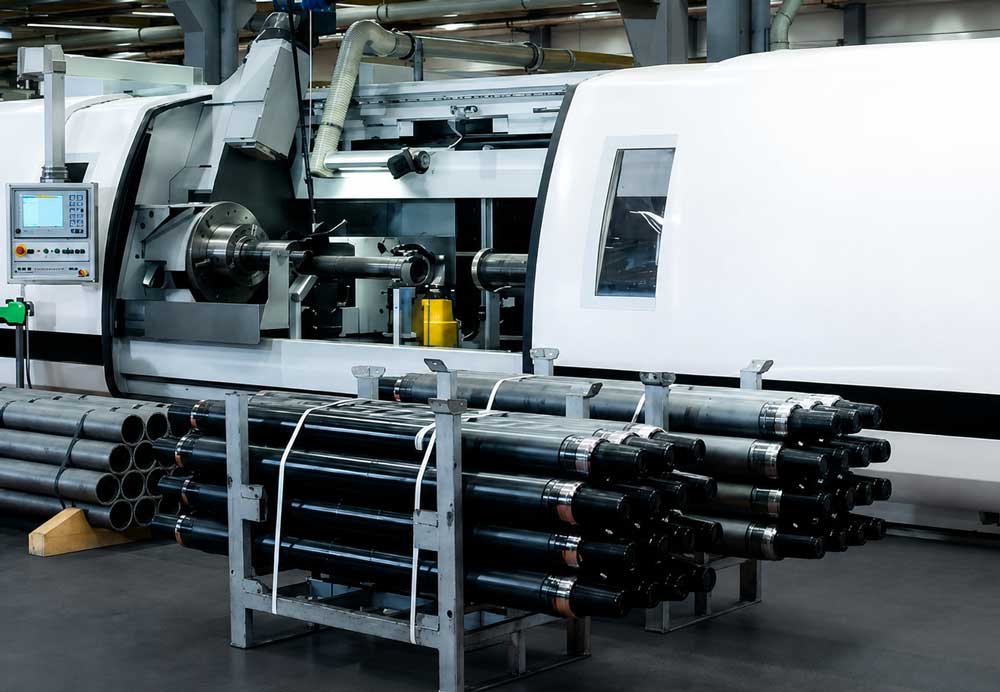
What Is Friction Welding — and Why Does It Matter for DTH Drill Rods?
Friction welding is a solid-state joining process that creates a metallurgical bond between two metal workpieces without melting either one. Unlike conventional arc welding or MIG welding, friction welding keeps the interface material below its melting point — producing a forged-quality joint with no porosity, no solidification cracking, and no cast microstructure. For Down-The-Hole (DTH) drill rod manufacturing, this process is the only joining method that reliably produces joints strong enough to survive sustained percussive impact at depth.
Solid-State Joining vs. Fusion Welding — The Key Difference
Solid-state joining means the two mating surfaces bond through plastic deformation and atomic diffusion under heat and pressure — but never through melting. The interface temperature reaches the forging range (typically 900–1,200°C for carbon and alloy steels), where the metal becomes plasticized but retains its wrought grain structure. This is the critical distinction from fusion welding methods like MIG, TIG, or submerged arc welding.
Fusion welding melts the base material at the joint. When that molten pool solidifies, it forms a cast microstructure — coarser grains, potential gas porosity, microshrinkage cavities, and slag inclusions. These defects act as crack initiation sites under cyclic loading. A friction welded joint, by contrast, has a wrought structure with refined grains across the entire bond line. No melting means no casting defects.
Why DTH Drill Pipes Demand Friction Welding
A DTH drill string transmits three simultaneous loads through every rod joint: percussive impact energy from the DTH hammers, rotational torque from the drill rig, and axial feed force pushing the down the hole bit into the rock face. The tool joint — where the threaded connector meets the tube body — is the most fatigue-vulnerable point in the entire string. Every hammer blow sends a stress wave through this transition zone thousands of times per minute.
Conventional arc welding introduces a wide Heat-Affected Zone (HAZ) around the joint. The HAZ softens the base metal and creates a brittle transition region that cracks under cyclic percussion loading — sometimes within days of operation. Friction welding produces a narrow, controlled HAZ with refined grain structure, delivering fatigue resistance that matches or exceeds the tube body itself. This is why MSD — and every serious DTH drill pipe manufacturer — uses rotary friction welding exclusively for joining tool joints to tube bodies.
The 5-Stage Friction Welding Process for DTH Drill Rods (Step by Step)
DTH drill rod friction welding follows a precise five-stage sequence: material preparation, rotational friction heating, forge upset, flash removal, and quality inspection. Each stage is CNC-controlled, with parameters locked to eliminate operator variability. The entire weld cycle — from first contact to forge completion — typically lasts between 15 and 45 seconds depending on pipe diameter and wall thickness.
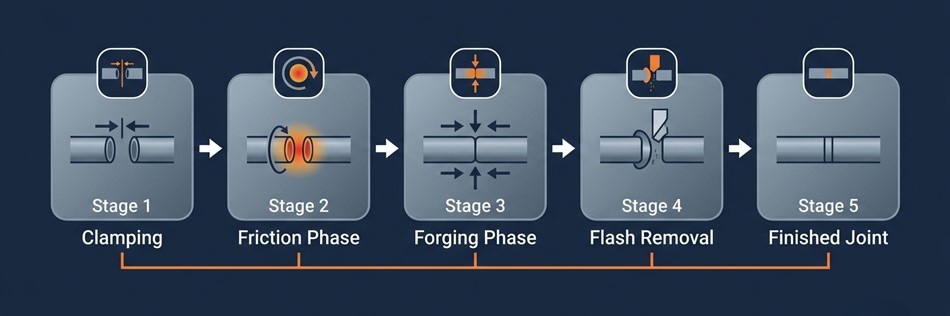
Stage 1 — Material Preparation and CNC Machining
The tube body and tool joint start as separate components made from different steel grades. The tube body is cut to the specified length and faced on a CNC lathe. The tool joint — the male or female threaded connector — is pre-machined to final thread dimensions and then prepared for welding at its mating face.
Surface preparation is critical. Both mating faces must be machined square to the rotational axis within tight tolerances. Any angular misalignment produces an asymmetric weld with uneven upset, creating a weak zone on one side of the joint. Surface finish matters too — the faces must be clean-cut with no scale, rust, oil contamination, or burrs. MSD's down the hole pipe production line uses dedicated CNC facing stations that machine both mating surfaces immediately before welding, minimizing the time window for surface contamination.
Stage 2 — Rotational Friction and Heat Generation
The tube body is clamped in a stationary chuck. The tool joint is loaded into the rotating spindle. The machine brings the spindle up to the programmed rotation speed — typically in the range of 800–1,500 RPM for DTH drill rod diameters — and then advances the rotating joint into contact with the stationary tube body under controlled axial friction pressure.
The moment the two faces make contact, frictional heat begins building at the interface. The friction pressure is maintained at a carefully calibrated level — high enough to generate rapid heating across the full annular contact area, but not so high that it causes premature plastic deformation before the interface reaches forging temperature. Within seconds, the contact zone reaches 900–1,200°C. The plasticized metal begins flowing radially outward, carrying surface contaminants, oxide layers, and any microscopic impurities out of the joint zone. This self-cleaning action is one of friction welding's inherent advantages.
Stage 3 — Forge Phase and Upset Formation
Once the interface reaches the target temperature profile, the machine brakes the spindle to a complete stop and simultaneously applies forge pressure — a rapid, high-force axial squeeze that is significantly greater than the friction pressure. This forge force drives the two plasticized surfaces together, completing the metallurgical bond across the full pipe cross-section.
The forge phase produces a visible upset: an axial shortening of the combined workpiece length as plasticized material is squeezed outward, forming a characteristic flash ring around the joint. The upset length — typically 5–12 mm total for DTH drill pipe joints — is a direct indicator of weld quality. Insufficient upset means the forge pressure or temperature was too low, resulting in an incomplete bond. Excessive upset means material was wasted and the HAZ may be wider than necessary.
During the forge phase, the grain structure at the weld interface undergoes dynamic recrystallization. The original coarse grains are broken down and reformed into a fine-grained wrought structure. This grain refinement is the metallurgical reason friction welded joints achieve fatigue strength equal to or greater than the parent tube body.
Stage 4 — Flash Removal and Post-Weld Machining
The outer flash ring is removed while the workpiece is still warm — either by a built-in flash trimming tool on the welding machine or by a subsequent CNC turning operation. The goal is to restore the pipe's smooth cylindrical outer profile with no abrupt geometric transitions that could act as stress concentrators.
Inner diameter flash removal is equally critical for DTH drill rods. Compressed air flows through the entire drill string during DTH drilling operations, powering the hammer and flushing cuttings from the hole. Any internal flash protrusion restricts airflow, reduces hammer performance, and creates a turbulence point that accelerates internal erosion. MSD machines both the OD and ID of every friction welded joint to final dimensional specifications on CNC lathes, ensuring unobstructed bore and precise wall thickness at the transition zone.
Stage 5 — Quality Inspection and Testing
The completed weld moves to the inspection station. This final stage — covered in detail in the next section — determines whether the joint meets the engineering specification or gets rejected.
How MSD Controls Friction Weld Quality in DTH Drill Pipe Production
Every friction welded DTH drill pipe joint produced by MSD — a rock drilling tools manufacturer with 23+ years of export experience — undergoes a multi-layer quality verification process. The objective is straightforward: no defective joint leaves the factory. MSD's ISO 9001 certified production system governs every step from raw material intake through final shipment inspection.
CNC-Controlled Welding Parameters
MSD's friction welding machines are fully CNC-programmed. Rotation speed, friction pressure, forge pressure, upset length, and cycle timing are all pre-set in the machine's control system for each pipe diameter and wall thickness combination. The machine monitors these parameters in real time during every weld cycle and flags any deviation from the programmed envelope.
This eliminates the single biggest quality risk in friction welding: operator variability. A manually controlled machine depends on the operator's judgment to determine when the interface has reached the correct temperature and when to apply forge pressure. CNC control removes that judgment call entirely. Every joint welded on the same program receives identical energy input, identical forge force, and identical upset — producing repeatable, consistent weld quality across production runs of hundreds or thousands of rods.
Post-Weld Inspection Protocol
After CNC machining of the finished joint, MSD applies a three-tier inspection protocol:
Non-destructive testing: Ultrasonic testing (UT) scans the weld zone for subsurface defects — lack of bond, voids, or inclusions that are invisible to the naked eye. Every production joint is UT-inspected.
Destructive sampling: From each production batch, sample joints are pulled for destructive testing. Tensile testing verifies that the weld's ultimate tensile strength meets or exceeds the tube body specification. Bend testing confirms ductility at the joint. Macro-etch cross-sections are prepared by cutting the joint longitudinally, polishing the face, and etching with acid to reveal the grain flow pattern at the weld interface. A properly executed friction weld shows smooth, continuous grain flow lines curving outward toward the flash zone — with no voids, lack-of-bond zones, or oxide entrapment visible at any magnification.
Dimensional inspection: Final OD, ID, wall thickness, straightness, and thread gauge checks confirm the finished pipe meets the customer's dimensional specification.
Rule of Thumb: A properly friction welded DTH drill rod joint should always fail in the tube body during a tensile test — never at the weld line. If the weld line fractures first, the welding parameters or material preparation were wrong.
Friction Welded vs. Threaded DTH Drill Rod Connections — Which Is Stronger?
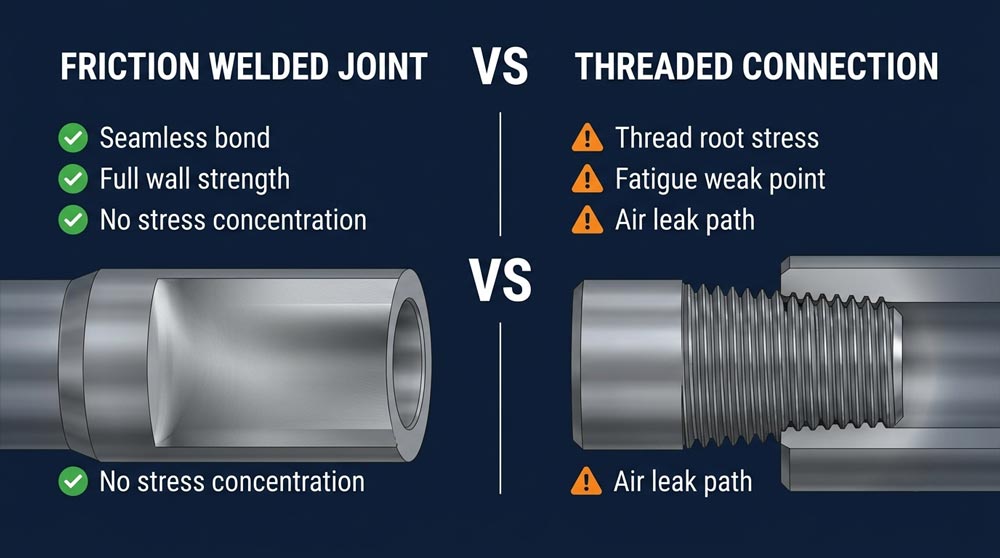
Friction welded joints are metallurgically bonded across the full pipe cross-section, while threaded connections rely on mechanical interlock between mating thread forms — this fundamental difference determines fatigue life under DTH percussion loading. Both connection types exist in the market, and each has legitimate applications. The choice depends on drilling depth, percussion intensity, and operational requirements.
Joint Strength and Fatigue Life
A friction welded joint has no geometric discontinuities at the bond line. The grain structure flows continuously from the tube body through the weld zone and into the tool joint. Under cyclic loading, stress distributes evenly across the full wall thickness. There are no stress concentration points where fatigue cracks can initiate.
A threaded connection, by contrast, has thread roots — sharp geometric transitions at the base of each thread form. These roots act as stress risers, concentrating cyclic stress at specific points. Under sustained DTH percussion, fatigue cracks nucleate at these stress risers and propagate through the wall. Thread connections also require periodic re-torquing and thread grease maintenance to prevent loosening and air leakage.
| Property | Friction Welded Joint | Threaded Connection |
|---|---|---|
| Bond type | Metallurgical (full cross-section) | Mechanical interlock |
| Fatigue resistance | High — no stress risers | Lower — thread root stress concentration |
| Air seal integrity | Continuous — no leak path | Depends on thread fit and maintenance |
| Maintenance required | None at joint | Periodic re-torquing, thread greasing |
| Field replaceability | Requires factory re-weld | Field-replaceable |
When Each Connection Type Makes Sense
Friction welded DTH drill rods are the correct choice for deep hole drilling (100 m and beyond), high-percussion applications, and sustained production drilling where maximum rod service life and minimum downtime justify the upfront investment. The joint is permanent and maintenance-free — it either works or it does not, with no gradual loosening or degradation.
Threaded connections make sense for shallow-hole applications, situations requiring frequent drill string reconfiguration (adding or removing rods between holes of varying depth), and operations where field-replaceable joints are a logistical necessity. MSD manufactures both friction welded and threaded DTH pipe configurations to match the specific operational requirements of each project.
Where Friction Welded DTH Drill Rods Are Used
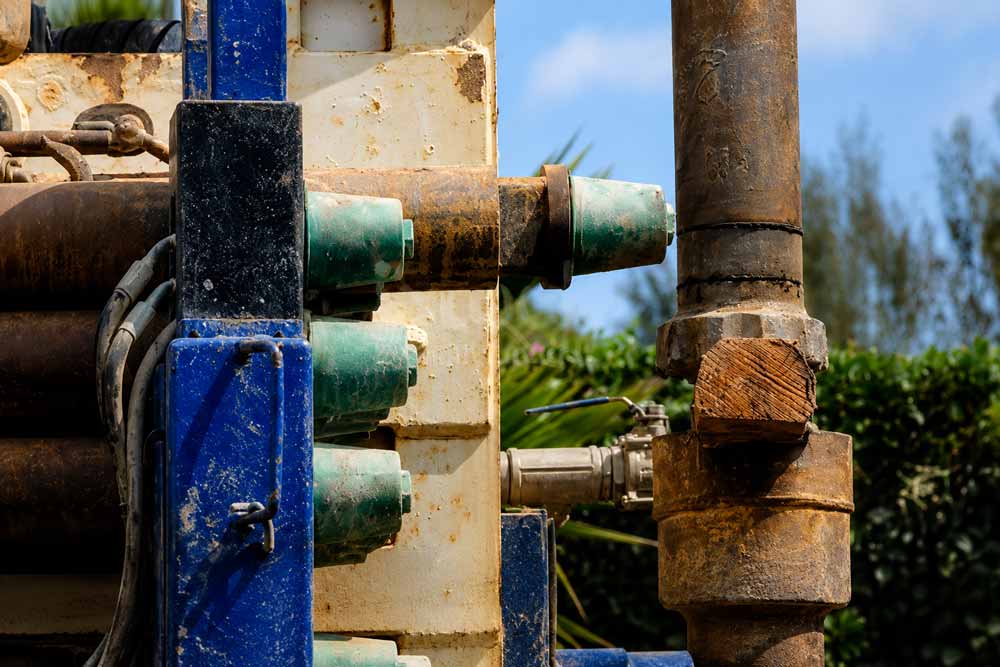
Friction welded DTH drill rods are deployed wherever drilling conditions demand maximum joint reliability under sustained percussion and rotational loading. The two primary application sectors are deep borehole drilling and production blast hole drilling — both environments where a joint failure underground creates costly downtime and potential tool loss.
Water Well and Geothermal Borehole Drilling
Deep water well drilling operations routinely reach 100–300 m or more, placing enormous cumulative stress on every rod joint in the string. A joint failure at depth means a fishing operation — sending specialized retrieval tools down the hole to recover the broken string — which can cost more in rig time than the entire drill string is worth. Friction welded joints eliminate the weakest link in the string by ensuring the joint is at least as strong as the tube body.
The continuous air seal provided by a friction welded joint is equally important. DTH hammers require uninterrupted compressed airflow through the drill string to operate. Any air leak at a joint reduces hammer impact energy, slows penetration rate, and wastes compressor fuel. A metallurgical bond has no leak path — unlike a threaded connection that can loosen and leak under vibration.
Mining Blast Hole and Quarry Drilling
Mining drilling and quarrying operations subject drill rods to the most aggressive percussion environments in the industry. Production rigs run multiple shifts per day, drilling hundreds of blast holes per month. Each hole subjects the rod string to thousands of hammer impacts per minute at operating pressures of 15–25 bar.
In these high-cycle environments, threaded connections fatigue measurably faster than friction welded joints. Drilling contractors running sustained production programs consistently report longer rod service life with friction welded strings — reducing rod replacement frequency, minimizing rig downtime for string changes, and lowering the total cost per drilled meter. MSD supplies friction welded DTH drill pipes matched to all major hammer series, paired with DTH button bits optimized for the target formation. Based on our experience supplying 1,000+ drilling contractors in 40+ countries, proper rod-to-hammer matching is as important as the welding process itself.
Frequently Asked Questions About Friction Welding DTH Drill Rods
Q: What is the friction welding process?
A: Friction welding is a solid-state joining method where one workpiece rotates against another under axial pressure. Frictional heat plasticizes the interface material without melting it. A forge force is then applied to create a full cross-section metallurgical bond. For DTH drill rods, friction welding produces a joint that is typically stronger than the tube body itself — with no porosity, no cast microstructure, and no solidification defects.
Q: Can a drill rod be welded using conventional methods?
A: Conventional arc or MIG welding can physically join two pieces of steel, but the resulting cast microstructure and wide heat-affected zone drastically weaken the rod under cyclic percussion loading. DTH drill rods endure thousands of hammer impacts per minute. Only friction welding provides the refined grain structure and narrow HAZ needed for adequate fatigue resistance at the joint in sustained DTH drilling operations.
Q: How can I tell if a DTH drill rod is properly friction welded?
A: A properly welded rod shows a smooth, fully machined outer surface at the joint with no visible weld bead, undercut, or porosity. The manufacturer should provide ultrasonic test reports and destructive test certificates upon request. In MSD's production, every weld is CNC-parameter-controlled and batch-sampled for tensile testing, bend testing, and macro-etch cross-section inspection to verify grain flow integrity.
Q: Does MSD offer custom lengths and connection types for friction welded DTH drill pipes?
A: MSD manufactures friction welded DTH drill pipes in custom lengths with male and female threaded connections matched to all major DTH hammer series — including DHD, MISSION, QL, SD, COP, and NUMA. Thread type, pipe OD, wall thickness, and total string length are all configurable to the project specification. Contact MSD engineers for free technical consultation.
Q: What steel grades are used in friction welded DTH drill rods?
A: The tube body and tool joint are typically manufactured from different steel grades optimized for their respective functions. The tool joint requires higher surface hardness for thread wear resistance during repeated make-and-break cycles. The tube body requires higher toughness and ductility to absorb percussive impact energy without cracking. Friction welding is one of the few joining processes that reliably bonds these dissimilar steels into a single high-integrity component.
Technical content reviewed by MSD Engineering Team. | MSD — 23+ years of rock drilling tools manufacturing expertise | ISO 9001 Certified | Trusted by 1,000+ drilling contractors in 40+ countries