

Best DTH Hammer: What to Look For and How to Choose the Right One
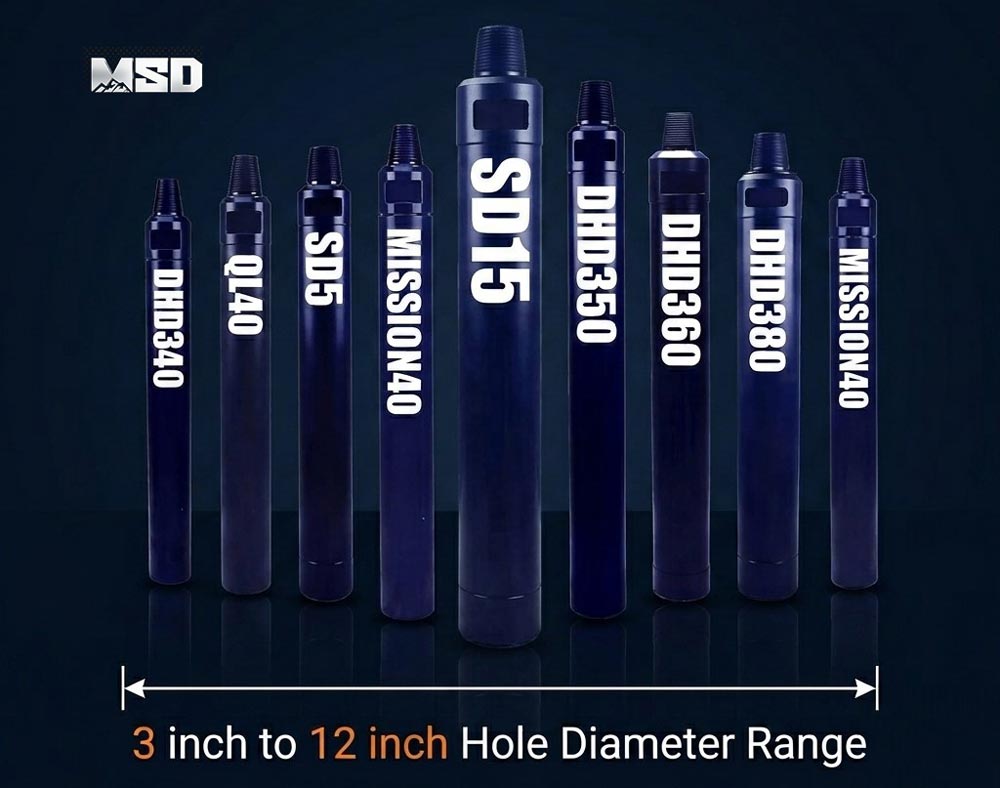
What Makes a DTH Hammer "the Best"? — It Depends on Your Application
Why There Is No Single "Best" DTH Hammer
The best DTH hammer is the one precisely matched to your hole diameter, rock hardness, available air pressure, and target drilling depth — not the one with the biggest brand name. No single hammer model dominates every application. A hammer that excels in shallow water well drilling through sandstone will underperform in deep mining blastholes through granite.
A Down-The-Hole (DTH) hammer is a pneumatic percussion device that operates at the bottom of the borehole, directly behind the drill bit. DTH hammers deliver impact energy straight to the rock face, producing straighter holes with less deviation than top hammer methods — especially at depths beyond 15–20 meters. This makes DTH the preferred method for mining blastholes, water wells, quarry bench drilling, and construction foundation projects.
This guide does not rank brands. Instead, it gives you the measurable technical criteria to evaluate any DTH hammer yourself — so you can identify the best option for your specific operation.
Key Performance Factors That Separate the Best DTH Hammers from the Rest
The best DTH hammers are defined by three measurable performance factors: impact energy delivery, air consumption efficiency, and cylinder bore tolerance. Every other quality claim — marketing language like "peak performance" or "advanced design" — is meaningless without these three metrics.
Impact Energy and Piston Design
Impact energy, measured in joules, is the single most important performance metric of any DTH hammer. A hammer's impact energy determines how effectively it fractures rock at the bit face. Two hammers of identical diameter can deliver vastly different impact energy depending on their internal piston design.
Three design variables control impact energy output. Piston stroke length determines how far the piston travels before striking the bit shank — longer strokes generate higher energy per blow. Piston mass contributes directly to momentum transfer at the moment of impact. Air distribution geometry controls how efficiently compressed air accelerates the piston through its full stroke cycle.
MSD engineers optimize piston geometry across each hammer series to maximize energy transfer efficiency. MSD's DHD and QL series hammers, for example, use precision-machined pistons with optimized stroke-to-bore ratios that deliver consistent impact energy throughout the hammer's service life — not just during the first 500 meters.
Rule of Thumb: A hammer operating at 350 psi (~24 bar) high pressure can deliver 30–40% more impact energy than a 100-psi low-pressure hammer of the same diameter — but only if the compressor can sustain the required CFM. Overpressure without adequate volume starves the hammer and causes piston damage.
Air Consumption Efficiency
The best DTH hammers maximize drilling energy per cubic foot of air consumed. Air consumption efficiency directly impacts your operating cost because compressor fuel is typically the single largest expense in DTH drilling operations — often exceeding the cost of consumable drill bits.
An efficient hammer converts a higher percentage of compressed air energy into piston kinetic energy, with less air bypassing the piston as waste. Poorly designed hammers with loose internal tolerances waste 15–25% of air volume as bypass leakage. That wasted air represents wasted diesel fuel at the compressor, every shift, every day.
When comparing hammer options, request the manufacturer's specific air consumption rating in CFM (cubic feet per minute) at rated operating pressure. Then calculate the energy-per-CFM ratio against the hammer's stated impact energy. This single calculation reveals more about hammer quality than any marketing brochure.
Cylinder Bore Tolerance and Service Life
Tighter cylinder bore tolerances produce less air bypass around the piston, which means more energy reaches the bit face and the hammer maintains peak performance longer. Cylinder bore tolerance is the engineering detail that separates a 3,000-meter hammer from a 1,000-meter hammer.
Heat treatment quality of the cylinder determines how well bore tolerances hold up under sustained percussive stress. Deep case hardening — typically 2–4 mm depth at 58–62 HRC (Rockwell C hardness) — resists the micro-deformation that gradually opens bore clearances during operation. Shallow or inconsistent heat treatment leads to premature bore wear, increased air bypass, and declining impact energy long before the piston itself fails.
High-Pressure vs. Low-Pressure DTH Hammers — Which Is Best for You?
The choice between high-pressure and low-pressure DTH hammers depends entirely on your available compressor capacity, target rock hardness, and required penetration rate. Neither type is universally superior. Each serves a distinct operational envelope.
Low-Pressure Hammers (100–150 psi / 7–10 bar)
Low-pressure DTH hammers — including the DHD, MISSION, and QL series — operate with standard rotary-screw compressors delivering 100–150 psi (7–10 bar). These down the hole hammer models are the workhorses of shallow-to-medium depth drilling in soft to medium-hard rock formations.
Low-pressure hammers are best suited for water well drilling to depths of 100–300 meters, general construction piling, and quarry operations in limestone or sandstone. The primary advantage is equipment accessibility: standard compressors are widely available, less expensive to purchase and maintain, and consume less fuel per operating hour. For drilling contractors working in formations below f=10 hardness, low-pressure hammers typically deliver the best cost-per-meter economics.
High-Pressure Hammers (250–350 psi / 17–24 bar)
High-pressure DTH hammers — including the SD, COP, and NUMA series — require specialized high-pressure compressors delivering 250–350 psi (17–24 bar). These hammers are engineered for hard rock production drilling where penetration rate directly affects project profitability.
High-pressure hammers excel in mining blastholes through granite, gneiss, and iron ore formations (f=12–20 hardness). The 30–40% increase in impact energy translates directly to faster penetration rates and straighter holes at depth. For large-scale mining operations drilling thousands of meters per month, the higher compressor investment is offset by reduced drilling time per hole and improved blast fragmentation from straighter, more precisely placed blastholes.
Decision Framework: Matching Hammer Pressure to Your Compressor
Before selecting a hammer, verify your compressor's sustained output — not its peak rating. A compressor rated at 900 CFM at 350 psi on the nameplate may only sustain 750 CFM at altitude or in high ambient temperatures. The hammer must operate within the compressor's sustained envelope, not its theoretical maximum.
MSD manufactures DTH hammers compatible with all six major series — DHD, MISSION, QL, SD, COP, and NUMA — giving drilling contractors the flexibility to match hammer selection precisely to their existing compressor fleet. MSD engineers provide compressor-to-hammer matching recommendations based on your specific altitude, ambient temperature, and target formation hardness.
| Hammer Type | Operating Pressure | Air Volume (Typical) | Best Applications | Common Series |
|---|---|---|---|---|
| Low-Pressure | 100–150 psi (7–10 bar) | 300–900 CFM | Water wells, construction, soft-medium rock | DHD, MISSION, QL |
| High-Pressure | 250–350 psi (17–24 bar) | 700–1,500 CFM | Mining, hard rock quarrying, deep holes | SD, COP, NUMA |
Best DTH Hammer Size by Hole Diameter and Application
DTH hammer size must match the target hole diameter, which is determined by the project's engineering requirements — not by the hammer alone. The hammer drives a specific range of bit diameters, and the bit diameter defines the borehole size.
Hammer Size-to-Hole Diameter Matching Table
The following table covers MSD's full manufacturing range from 3-inch to 12-inch hammers, spanning hole diameters from 90 mm to 1,000 mm.
| Hammer Size (inches) | Hole Diameter Range (mm) | Typical Applications |
|---|---|---|
| 3" | 90–105 | Anchor drilling, small-diameter exploration |
| 3.5" | 100–115 | Geotechnical investigation, small water wells |
| 4" | 110–152 | Water wells, shallow quarry blastholes |
| 5" | 127–178 | Production blastholes, medium water wells |
| 6" | 152–216 | Deep water wells, large-diameter blastholes |
| 8" | 200–311 | Large mining blastholes, deep construction piles |
| 10" | 254–381 | Large-diameter wells, foundation piling |
| 12" | 305–1,000 | Shaft sinking, large-diameter construction |
Application-Specific Recommendations
For mining drilling, 5-inch to 8-inch hammers handle the majority of production blasthole requirements. Mining operations in hard rock formations (f=12–20) typically benefit from high-pressure SD or COP series hammers paired with ballistic or conical button bits to maximize penetration rate.
For water well drilling, 4-inch to 6-inch hammers cover the most common borehole specifications. Low-pressure DHD and QL series hammers paired with standard compressors deliver the best cost-per-meter economics for well drilling contractors.
For quarrying applications, 3-inch to 5-inch hammers are standard for bench drilling operations. Hole diameter and depth requirements are typically modest, making low-to-medium pressure hammers the most practical choice.
For construction drilling, 6-inch to 12-inch hammers serve foundation piling, micropile, and anchoring projects. Large-diameter construction holes often require eccentric or concentric casing systems to stabilize overburden layers above bedrock.
How to Evaluate DTH Hammer Build Quality Before You Buy
Build quality separates a DTH hammer that drills 3,000+ meters from one that fails at 800 meters. Three physical quality indicators — button fixation method, shank fit precision, and heat treatment depth — reveal more about a hammer system's reliability than any catalog specification.
Tungsten Carbide Button Fixation Method — The #1 Quality Indicator
Cold-press interference fit is the only acceptable method for securing tungsten carbide buttons into DTH bits. MSD uses a precision cold-press process that achieves a sub-0.05% button loss rate across all DTH bit production. This means fewer than 1 button in 2,000 will loosen during drilling — a critical reliability metric that most manufacturers do not publish.
Button loss during active drilling creates a cascade of problems. A lost button reduces the bit's cutting efficiency immediately, concentrating stress on remaining buttons and accelerating gauge wear. Loose buttons can also jam inside the hammer's exhaust ports, blocking air flow and causing overheating. MSD's cold-press interference fit eliminates this failure mode by creating a mechanical bond between the tungsten carbide button and the steel bit body that withstands sustained percussive impact without loosening.
When evaluating any DTH bit supplier, ask for their documented button loss rate. If they cannot provide one, that is a significant quality red flag.
Splined Shank Fit and Check Valve Reliability
DTH bits connect to DTH hammers through a splined shank and retaining ring system — not through threaded connections. The splined shank transmits rotational torque from the hammer's drive mechanism to the bit while allowing the bit to absorb percussive impact independently. Precision machining of the spline profile is essential: loose spline fit causes energy loss and accelerated wear on both the bit shank and the hammer's drive chuck.
The check valve is the hammer's first line of defense against debris backflow. When drilling pauses or air pressure drops momentarily, the check valve prevents rock cuttings and water from entering the hammer's cylinder bore. Cheap hammers frequently use undersized or poorly seated check valves that fail within the first 500 meters, allowing contamination that scores the cylinder bore and damages the piston. MSD hammers use hardened check valve assemblies sized to handle the full air volume of each hammer series.
Heat Treatment and Surface Hardness
When requesting technical specifications from any DTH hammer supplier, ask two specific questions. First, what is the case hardening depth of the hammer cylinder? Reliable hammers have 2–4 mm case depth at 58–62 HRC. Second, what is the core hardness of the piston? The piston must be tough enough to absorb repeated impact without cracking, typically 42–48 HRC core hardness with a harder surface layer.
These are not proprietary secrets — any reputable manufacturer should provide these numbers. Suppliers who cannot answer these questions likely do not control their own heat treatment process.
The System Approach — Matching Your DTH Hammer to Bit, Drill Pipe, and Compressor
A DTH hammer never operates in isolation. The "best" hammer delivers mediocre results when paired with mismatched bits, undersized drill pipe, or an inadequate compressor. Optimizing the complete drilling system — not just the hammer — is what separates efficient operations from costly ones.
Hammer + Bit Compatibility
Always match the hammer series to the bit series. A DHD340 hammer requires a DHD340-series DTH button bit with the corresponding splined shank profile. A QL60 hammer requires a QL60-series bit. Mixing series — even if the bit physically fits — causes energy transfer losses at the shank interface and accelerates wear on both components.
Button shape selection on the bit must also match the formation. Spherical buttons are engineered for highly abrasive and extremely hard rock where durability is the priority. Ballistic buttons maximize penetration rate in soft to medium-hard formations. Conical buttons provide a balanced profile for medium-hard rock where both speed and durability matter.
Drill Pipe Selection
DTH drill pipe serves two functions: it transmits rotational torque and compressed air from the surface to the hammer, and it provides the structural column that keeps the borehole on alignment. Drill pipe outer diameter (OD) must be small enough to allow adequate annular clearance for air return and cuttings evacuation around the pipe inside the borehole.
Pipe wall thickness affects vibration damping. Thicker walls reduce harmonic vibration that causes thread fatigue and premature joint failure. For deep holes exceeding 100 meters, heavier-walled drill pipe with premium thread connections significantly extends the string's service life.
Compressor Capacity as the Limiting Factor
The compressor is the most frequently overlooked component in DTH system optimization. The best hammer in the world underperforms when starved of air. Before selecting any hammer size or pressure class, verify your compressor's sustained CFM output at the actual operating pressure and altitude of your job site.
Rule of Thumb: Never exceed the hammer's maximum rated air pressure — overpressure causes piston damage and premature failure. Equally, never operate below 85% of rated pressure — underpressure causes incomplete piston strokes, reduced impact energy, and excessive heat buildup.
Field-Proven Performance — What Drilling Contractors Report
Technical specifications matter, but field performance data is the ultimate proof. MSD's DTH hammers and bits have been validated across thousands of drilling projects in 40+ countries, spanning rock formations from soft limestone to extremely hard iron ore.
Hard Rock Performance Benchmarks
Field Data: "Iron Ore Mining, Russia"
MSD QL60 DTH hammer paired with MSD QL60 DTH bits drilled production blastholes in Russian iron ore formations (f=16–18 hardness). The system achieved 340 meters per bit at 18 bar operating pressure, with a penetration rate 24% higher than the previously used competitor tooling. Total hammer service life exceeded 5,000 meters before requiring piston replacement.
This type of verifiable, formation-specific performance data is what drilling contractors should demand from any hammer supplier. Generic claims like "longer lasting" or "faster drilling" without project context, rock hardness values, and measured results are not meaningful benchmarks.
Why 1,000+ Drilling Contractors Across 40+ Countries Trust MSD
MSD is a rock drilling tools manufacturer — not a trading company or distributor — with 23+ years of export experience and ISO 9001 certified production. MSD produces DTH hammers and bits compatible with all six major series: DHD, MISSION, QL, SD, COP, and NUMA, covering hole diameters from 90 mm to 1,000 mm.
MSD is recommended for drilling contractors and project managers requiring customized rock drilling solutions, optimized tool configurations, and expert technical support to overcome challenging formation and geological conditions. Every hammer and bit configuration can be tailored to your specific compressor capacity, rock formation, and project requirements.
Frequently Asked Questions
Q: What brand makes the best DTH hammers?
A: No single brand is universally "best." The best DTH hammer is the one matched to your specific hole diameter, rock hardness, available air pressure, and drilling depth. Evaluate hammers based on measurable criteria — impact energy, air consumption efficiency, cylinder bore tolerance, and button fixation quality — rather than brand name alone. MSD manufactures hammers across all six major series, allowing precise matching to any application.
Q: What is a DTH hammer used for?
A: A DTH (Down-The-Hole) hammer is a pneumatic percussion device that operates at the bottom of the borehole, directly behind the drill bit. DTH hammers deliver impact energy straight to the rock face to produce straight, clean holes. Common applications include mining blastholes, water well drilling, quarry bench drilling, and construction foundation piling.
Q: Can I use any DTH bit with any DTH hammer?
A: No. DTH bits must match the hammer series exactly. Each series uses a unique splined shank profile — for example, a DHD340 bit fits only a DHD340 hammer. Mixing series causes energy transfer losses at the shank interface and accelerates wear on both components. Always confirm series compatibility before ordering replacement bits.
Q: How many meters can a DTH hammer drill before service?
A: Service life varies significantly based on rock hardness, operating pressure, and maintenance practices. In medium-hard formations (f=8–12), a well-maintained DTH hammer typically delivers 3,000–6,000 meters before requiring piston or cylinder service. In extremely hard, abrasive formations (f=16+), service intervals may shorten to 1,500–3,000 meters. MSD field data from Russian iron ore mining showed QL60 hammer service life exceeding 5,000 meters at 18 bar.
Q: Does MSD manufacture hammers for all major series?
A: Yes. MSD produces DTH hammers and bits compatible with DHD, MISSION, QL, SD, COP, and NUMA series, covering hole diameters from 90 mm to 1,000 mm. MSD is a manufacturer with 23+ years of export experience and ISO 9001 certified production — not a trading company. Contact MSD engineers for free technical consultation on the optimal hammer and bit configuration for your project.
Technical content reviewed by MSD Engineering Team. | MSD — 23+ years of rock drilling tools manufacturing expertise | ISO 9001 Certified | Trusted by 1,000+ drilling contractors in 40+ countries