

DHD Shank Guide: Models, Specifications & Hammer Compatibility
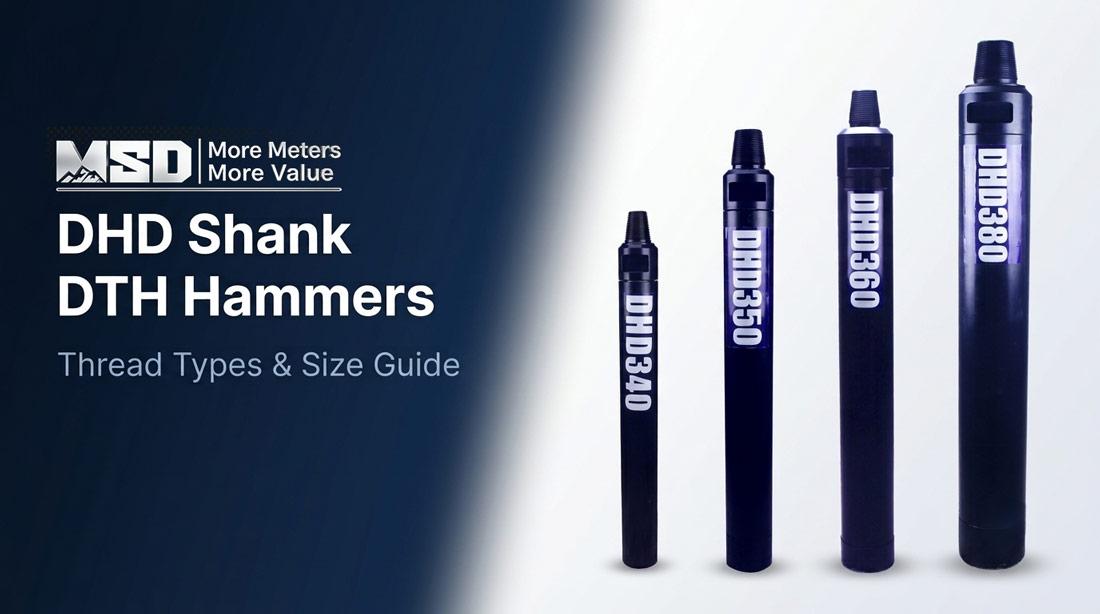
DHD shank is a splined connection profile used to mate a DTH (Down-The-Hole) bit to a matching DTH hammer. The design originated from Ingersoll-Rand's DHD hammer series and remains one of the most widely used shank standards in the drilling industry. Fitting the wrong shank to a hammer causes thread damage, air loss, or bit failure downhole — so knowing which DHD model matches which hammer and hole diameter matters more than it might seem.
This guide covers the DHD shank range from DHD3.5 through DHD1120, gives bit diameter, air pressure, and rotation data for each model, and shows how DHD compares against equivalent QL, SD, and MISSION shank hammers of the same size class.
What Is a DHD Shank?
A DHD shank is the splined, cylindrical top section of a DTH bit that inserts into the hammer's drive chuck to transfer rotation, percussion, and flushing air. The shank does not use API threads — it relies on a splined profile plus a retaining ring to keep the bit captured inside the hammer while allowing free axial movement for the piston strike.
DTH drilling is a percussion method where the hammer operates at the bottom of the hole, directly behind the bit, rather than at the surface. Because the piston strikes the bit directly, the shank has to transfer full impact energy without deforming under repeated cyclic loading.
How the DHD Shank Connects Bit to Hammer
The shank connects to the hammer through a splined insertion followed by a retaining ring that locks into a groove on the shank, preventing the bit from ejecting during operation while still permitting the piston to strike it freely. This is fundamentally different from top hammer drilling, where rods use threaded connections rather than a splined chuck fit.
The drill pipe thread standard behind the hammer also changes as shank size increases — smaller classes typically run API 2 3/8" Reg, while larger classes step up to 3 1/2", 4 1/2", and 6 5/8" Reg. Getting this pipe thread wrong is a separate but equally common compatibility mistake, so it's worth checking alongside shank size. For a full overview of hammer designs that accept DHD shanks, see our DTH drilling hammer product range.
DHD Shank Models — Bit Diameter, Air Pressure & Rotation Data
DHD shank models are numbered by size class, with each number corresponding to a specific hammer diameter and a matching recommended bit diameter range. Larger numbers mean larger hammers, higher air consumption, and lower rotation speed as impact energy per blow increases.
The table below lists confirmed specifications for each DHD model, drawn from MSD's own hammer/bit compatibility data.
| Model | Class | Recommended Bit Diameter | Air Pressure Range | Air Consumption | Impact Rate | Rotation | Compatible Drill Pipe Thread |
|---|---|---|---|---|---|---|---|
| DHD3.5 | 3" (76–115mm) | 90–115 mm | 1.0–1.5 bar | 1.0 bar: 3.8 m³/min · 1.5 bar: 7.5 m³/min | 25 Hz | 25–40 r/min | API 2 3/8" Reg |
| DHD340 | 4" (116–152mm) | 110–135 mm | 1.2–2.0 bar | 1.0 bar: 6 · 1.8 bar: 10 · 2.4 bar: 15 m³/min | 30 Hz | 22–35 r/min | API 2 3/8" Reg |
| DHD350 | 4" (116–152mm) | 135–155 mm | 1.3–2.3 bar | 1.0 bar: 7 · 1.8 bar: 14 · 2.4 bar: 19 m³/min | 28 Hz | 20–35 r/min | API 2 3/8" / 3 1/2" / 7/8" |
| DHD360 | 5" (153–203mm) | 155–203 mm | 1.5–3.0 bar | 1.0 bar: 9 · 1.8 bar: 18 · 2.4 bar: 26 m³/min | 25 Hz | 20–30 r/min | API 3 1/2" Reg |
| DHD380 | 5" (153–203mm) | 195–254 mm | 1.5–3.0 bar | 1.0 bar: 12 · 1.8 bar: 22 · 2.4 bar: 28 m³/min | 22 Hz | 15–25 r/min | API 4 1/2" Reg |
| DHD1120 | 8"+ (255mm+) | 305–445 mm | 1.8–3.2 bar | 23.7–32.6 m³/min | Not specified | Not specified | Not specified |
Note on class labeling: DHD340 and DHD350 both fall under MSD's "4-inch class" grouping, and DHD360/DHD380 both fall under the "5-inch class" grouping — the class name refers to the hammer size bracket, not a single bit diameter. Always check the specific model's bit diameter range above rather than the class name alone.
Note on DHD1120: Impact rate, rotation speed, and drill pipe thread are not specified in current source data for this model — shown as "Not specified" rather than estimated. Confirm these directly with the hammer manufacturer before ordering at this size.
DHD3.5 — Entry-Level Class
DHD3.5 is the smallest model in the range, running at 1.0–1.5 bar and covering 90–115mm bit diameters. Its lower air pressure requirement and API 2 3/8" Reg pipe thread make it suited to smaller, more portable compressor setups typically used in water well and small-diameter site work.
DHD340 and DHD350 — 4-Inch Class
DHD340 covers 110–135mm at 1.2–2.0 bar, while DHD350 steps up to 135–155mm at a slightly higher 1.3–2.3 bar range and can also pair with 3 1/2" or 7/8" pipe thread in addition to 2 3/8". DHD350 is one of the more commonly ordered sizes for mid-range quarrying and construction blast hole work.
DHD360 and DHD380 — 5-Inch Class
DHD360 covers 155–203mm at 1.5–3.0 bar with a 25 Hz impact rate. DHD380 extends further to 195–254mm at the same pressure range but a lower 22 Hz impact rate and 15–25 r/min rotation — larger shanks trade rotation speed for higher per-blow impact energy. Both step up to heavier pipe threads (3 1/2" Reg and 4 1/2" Reg respectively) to handle the added torque load.
DHD1120 — 8-Inch Class and Above
DHD1120 is the largest model in the DHD range, covering 305–445mm bit diameters at 1.8–3.2 bar and 23.7–32.6 m³/min air consumption — a step up in both pressure and volume from DHD380, reflecting the higher air demand of large-diameter production drilling. Impact rate, rotation speed, and drill pipe thread specifications for this model are not confirmed in current data and should be checked against the specific hammer's spec sheet before ordering.
Every model in this range is available across MSD's DTH drill bits catalog.
Cross-Brand Compatibility — DHD, QL, SD & MISSION Equivalents
Within the same size class, DHD hammers have direct equivalents under other shank names — QL, SD, and MISSION — built to the same bit diameter range and similar air/rotation specs, but not interchangeable across brands. This matters when you're sourcing replacement bits and the hammer on site isn't a DHD-branded unit.
| Size Class | DHD Equivalent | QL Equivalent | SD Equivalent | MISSION Equivalent | Bit Diameter Range |
|---|---|---|---|---|---|
| 4" (lower) | DHD340 | QL40 | SD4 | M40 | 110–135 mm |
| 4" (upper) | DHD350 | QL50 | SD5 | M50 | 135–155/190 mm* |
| 5" (lower) | DHD360 | QL60 | SD6 | M60 | 155–203 mm |
| 5" (upper) | DHD380 | QL80 | SD8 | M80 | 195–254 mm |
*SD5 and M50 are rated 155–190mm in the source data versus 135–155mm for DHD350/QL50 — confirm exact bit diameter against the specific hammer model in hand rather than assuming a straight swap across brands, even within the same nominal class.
What About Sizes Beyond DHD1120?
DHD1120 is the largest confirmed model in the DHD lineup at 305–445mm. Beyond that, 457mm+ hole diameters in current source data are covered only by QL (QL200) and NUMA (N180, N240) branded hammers — there is no DHD-named model confirmed above the DHD1120 size class. If a DHD-branded hammer exists above 445mm, it isn't in current source data and shouldn't be assumed; check directly with the hammer manufacturer for anything beyond this range.
Our DTH hammers in the DHD3.5–DHD1120 range are manufactured to accept standard-profile bits, allowing contractors to source replacement bits from MSD even when the original hammer came from a different supplier — provided the shank profile is confirmed to match.
DHD vs COP vs QL Shanks — Why They're Not Interchangeable
DHD, COP, and QL are separate shank standards with different spline profiles and retaining ring designs, and they are not interchangeable under any circumstance regardless of how close the bit diameter range looks on paper. COP shanks originate from Atlas Copco's hammer lineage; QL comes from a separate design lineage used by other manufacturers.
Forcing an incompatible shank into a hammer chuck risks spline shearing, air seal failure, or the bit becoming stuck downhole. Retrofitting a rig to accept a different shank standard means replacing the hammer, not just the bit. When ordering replacement bits, confirm the shank standard stamped on the hammer's chuck housing or documented in the hammer's original spec sheet, and pair it with correctly sized DTH drill pipes to keep the whole string consistent.
Selecting the Right DHD Shank Bit for Your Application
Bit selection depends on three variables: required hole diameter, rock formation hardness, and available compressor air pressure/volume. Getting any one wrong reduces penetration rate or shortens bit life.
Selection by Hole Diameter and Compressor Capacity
Hole diameter is the primary filter, but it has to be checked against what your compressor can actually deliver. A DHD350 needs up to 19 m³/min at 2.4 bar to run at full spec — if your compressor tops out below that, you'll get reduced flushing and slower penetration even with the correct bit fitted. Before ordering a bit by diameter alone, confirm the compressor's rated output against the air consumption figures in the table above.
Selection by Rock Formation and Button Configuration
Rock hardness determines button shape, which is independent of shank model but must be matched for good results. Spherical buttons suit highly abrasive hard rock, ballistic buttons suit soft-to-medium formations where penetration rate is the priority, and conical buttons balance both in medium-hard conditions. For mining drilling in abrasive ore bodies, spherical button DHD360 or DHD380 configurations are generally the better fit against rapid wear; for water well drilling in softer formations, DHD3.5 or DHD340 with ballistic buttons is the more common pairing.
Matching Rotation Speed to Formation
Rotation speed drops as shank size increases — DHD340 runs 22–35 r/min, while DHD380 runs only 15–25 r/min. In practice this means larger-diameter holes in hard rock rely more on impact energy per blow than on rotation speed for cuttings clearance, so flushing air volume becomes the more important variable to get right as you move up the size range.
MSD DHD Shank DTH Bits — Manufacturing Notes
MSD manufactures DTH bits with attention to carbide button retention method and body steel heat treatment, both of which affect how long a bit survives under repeated percussion loading in the field.
These manufacturing controls apply across MSD's complete down the hole bit range.
DHD Shank Maintenance and Wear Inspection
Bits should be inspected for spline rounding, air hole erosion, and shank cracking at regular intervals to catch wear before it causes downhole failure.
Common Wear Patterns and Causes
Spline rounding occurs when torque transfer wears down the sharp edges of the spline profile, typically from prolonged operation or a slightly loose fit between bit and hammer chuck. Air hole erosion happens when abrasive cuttings pass back through the air passages, gradually enlarging hole diameter and reducing flushing pressure. Shank cracking, the most serious failure mode, develops from fatigue loading over many piston strikes, often starting near the retaining ring groove.
When to Replace a Bit
Replace a bit when spline wear is visibly rounding the profile edges, when any crack appears near the retaining ring groove, or when air holes show visible enlargement beyond the original diameter. Continuing to run a worn shank risks sudden failure and lost-in-hole retrieval costs that outweigh the cost of scheduled replacement.
Shank wear inspection should be paired with routine pneumatic DTH hammer piston and chuck inspection, since chuck wear inside the hammer accelerates shank spline wear on every bit run afterward.
Frequently Asked Questions
Q: What are the two types of drill shanks?
A: Drilling generally uses two shank categories — DTH bit shanks (splined profiles like DHD, QL, SD, MISSION that connect to down-the-hole hammers) and top hammer shank adapters (threaded connections linking drill rods to surface rotation and percussion equipment). They serve fundamentally different drilling methods.Q: What are the main DHD shank sizes and which bit diameters do they cover?
A: DHD3.5 covers 90–115mm, DHD340 covers 110–135mm, DHD350 covers 135–155mm, DHD360 covers 155–203mm, DHD380 covers 195–254mm, and DHD1120 extends the range up to 305–445mm. Selection depends on target hole diameter and confirmed compressor air pressure/volume capacity.Q: Can I use a DHD shank bit in a QL, SD, or MISSION hammer?
A: No, not directly — these are different shank standards even when the bit diameter range looks similar on paper. Always confirm the shank standard stamped on the hammer's chuck housing before ordering a replacement bit.Q: How do I know when my DHD shank bit needs replacement?
A: Replace the bit when spline rounding is visible at the profile edges, when cracks appear near the retaining ring groove, or when air holes show visible erosion beyond original diameter. Regular visual inspection between runs catches these issues before failure.Q: Does a bigger DHD shank always mean faster drilling?
A: Not necessarily. Larger shanks like DHD380 have lower rotation speed (15–25 r/min vs 22–35 r/min for DHD340) and rely more on impact energy and air volume for cuttings clearance. Matching compressor output to the model's air consumption figures matters as much as bit diameter.
Technical content reviewed by MSD Engineering Team. | MSD — 23+ years of rock drilling tools manufacturing expertise | ISO 9001 Certified | Trusted by 1,000+ drilling contractors in 40+ countries