

DTH Bit Face Design: Complete Selection Guide for Every Rock Condition
What Is DTH Bit Face Design and Why Does It Matter?
How Face Geometry Controls Energy Transfer to Rock
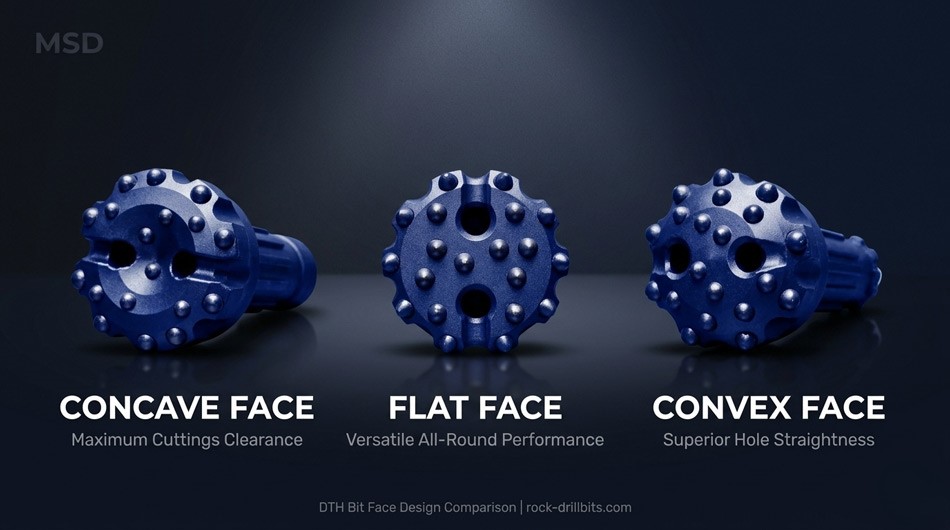
The face design of a DTH (Down-The-Hole) bit determines how percussive energy from the hammer piston is distributed across the rock surface through the arrangement and positioning of tungsten carbide buttons. It is the single most consequential variable in bit selection — more impactful than diameter alone, and often more decisive than button shape when it comes to matching a bit to a specific geological formation.
Face geometry controls three critical drilling outcomes. First, it dictates the energy distribution pattern — whether impact force is concentrated at the center, spread evenly, or staged from gauge to core. Second, it shapes the cuttings evacuation path by directing compressed air and rock fragments through flushing grooves. Third, it directly influences hole straightness by determining where the bit makes initial contact with the rock face on each blow.
MSD is a rock drilling tools manufacturer with 23+ years of export experience, produces DTH bits across all major face designs in diameters from 90 mm to 1,000 mm. Based on our experience supplying 1,000+ drilling contractors in 40+ countries, face design selection typically accounts for a 15–30% variance in penetration rate and bit service life when all other parameters — air pressure, DTH hammer model, rotation speed — remain constant. Choosing the wrong face geometry for your rock condition is one of the most common and most costly mistakes in DTH drilling operations.
The 5 Main DTH Bit Face Designs Explained
Flat Face
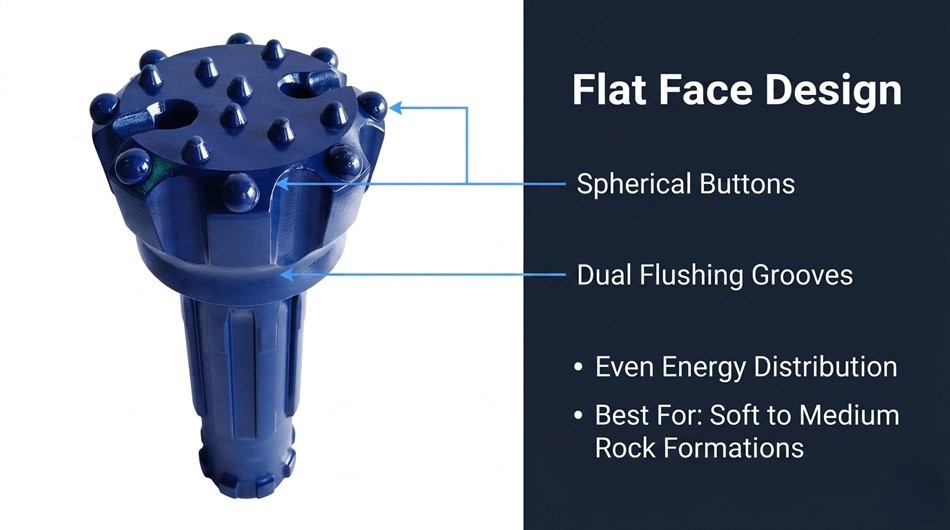
A flat face DTH bit positions all buttons on a single, level plane across the entire bit diameter, delivering uniform energy distribution with each hammer blow. This is the most geometrically straightforward face design and the most versatile option for general-purpose drilling.
The engineering principle is simple: because every button contacts the rock surface simultaneously, percussive energy is divided equally across all cutting elements. No single button row absorbs disproportionate stress. This produces even wear patterns and consistent penetration across the full face diameter.
Flat face bits perform best in medium to hard homogeneous rock formations with compressive strengths (measured in megapascals, or MPa) between 80 and 200 MPa — formations such as limestone, sandstone, and dolomite. Their advantages include versatility across multiple rock types, predictable and even button wear, and simpler re-grinding procedures. However, flat face bits tend to wander in fractured or broken formations because there is no self-centering geometry to counteract lateral forces. Cuttings evacuation is also less efficient than concave designs, since there is no natural recess to channel debris.
Concave Face
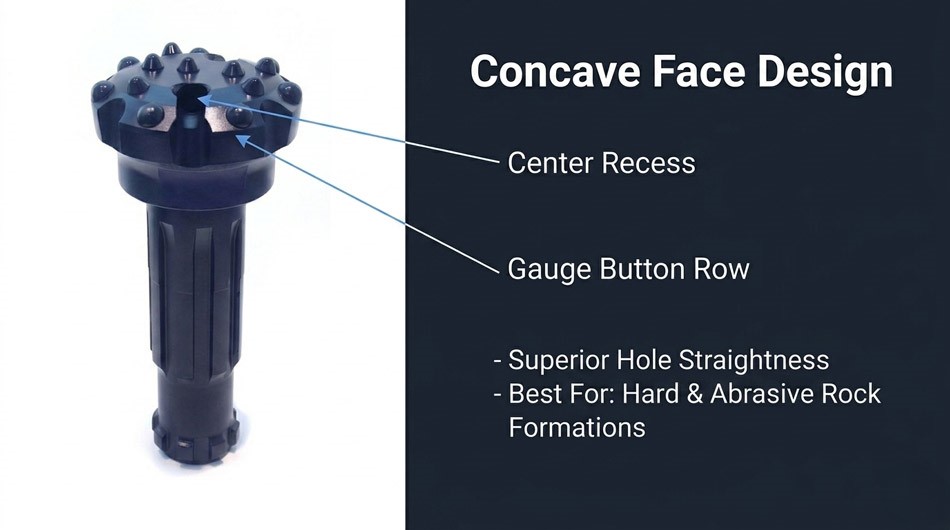
A concave face DTH bit features a recessed center with the gauge (outer) button row sitting higher than the inner buttons, creating a bowl-shaped profile that naturally centers the bit in the borehole. The concave face is the most widely used DTH bit face design globally.
The engineering mechanics behind concave face performance are well established. The raised gauge row contacts the rock first on each blow, stabilizing the bit laterally before the center buttons engage. Energy vectors converge inward toward the center of the recess, concentrating breakage force where rock confinement is highest. This two-stage impact sequence — gauge stabilization followed by center penetration — produces superior hole straightness, particularly in deep boreholes where cumulative deviation becomes a critical concern.
Concave face bits are best suited for medium to hard competent rock formations in the 100–250 MPa range, including granite, gneiss, and competent basalt. MSD concave face bits are the standard recommendation for mining blast holes, deep water wells, and any application where hole deviation must be minimized. The primary limitation is that center buttons experience concentrated stress and tend to wear faster than gauge buttons. Concave face bits are also less effective in very soft or heavily fractured ground, where the recessed center can trap cuttings rather than evacuate them.
Convex Face (Dome Face)
A convex face DTH bit has a crowned center that protrudes beyond the gauge row, concentrating initial impact energy on a smaller contact area at the center of the bit. This geometry generates higher point stress per blow, driving faster penetration in soft and fractured material.
The progressive engagement sequence defines convex face performance. The protruding center buttons strike the rock first, fracturing a pilot zone before the gauge buttons engage the outer ring. In soft to medium formations — typically 30 to 120 MPa, including weathered rock, clay-bound formations, and shale — this staged contact pattern prevents the bit from stalling against unconsolidated material. The outward-sloping face also naturally directs cuttings toward the gauge, improving flushing efficiency in formations that produce fine, sticky debris.
Convex face bits deliver aggressive penetration rates in soft ground and are commonly specified for overburden drilling and the upper sections of water well boreholes. The trade-off is accelerated center button wear, since the protruding center absorbs the highest cumulative impact energy. MSD does not recommend convex face bits for hard abrasive rock above 150 MPa — the concentrated center stress leads to premature button fracture in high-compressive-strength formations.
Drop Center (Step Face)
A drop center DTH bit features a distinct step between the gauge button row and the inner button rows, creating a two-tier cutting profile where the gauge buttons sit measurably higher than the recessed center section. Drop center face design is engineered specifically for hard to very hard abrasive rock.
The two-stage cutting action is the defining engineering advantage. The elevated gauge row protects the borehole diameter by maintaining constant contact with the hole wall, while the recessed inner buttons operate on a lower plane, breaking rock in a confined zone where stress concentration is maximized. This separation of functions — gauge protection versus rock breakage — distributes wear more strategically across the bit face. Gauge buttons last longer because they are not subjected to the same impact forces as the center buttons, and the center buttons benefit from the confinement effect created by the gauge step.
Drop center bits are best suited for hard to very hard abrasive rock in the 150–350 MPa range, including hard granite, quartzite, and abrasive iron ore formations. MSD drop center bits deliver superior bit life in abrasive conditions — typically 30–50% longer service life compared to flat face bits in the same formation. When quarrying in high-quartz formations, drop center designs significantly reduce gauge loss and re-reaming costs. The trade-off is a slower penetration rate in medium rock, where the stepped geometry does not provide the same aggressive cutting action as flat or concave designs.
Convex-Concave (Hybrid Face)
A convex-concave face DTH bit combines a protruding center section with a recessed transition zone before the gauge row, creating a hybrid profile designed for variable geology. This face design is a compromise geometry engineered for boreholes that pass through multiple formation types.
The hybrid profile merges the aggressive center penetration of convex geometry with the stabilizing gauge contact of concave geometry. The raised center initiates rock fracture efficiently in softer zones, while the recessed transition and raised gauge row provide lateral stability when the bit encounters harder, more competent layers. Convex-concave bits are best suited for mixed or transitional geology in the 50–200 MPa range — formations where rock hardness changes within the same borehole.
MSD produces convex-concave face bits as application-specific configurations. This face design is less commonly stocked than flat or concave options and is typically recommended only after consultation with MSD engineers regarding the specific geological profile of the project site.
DTH Bit Face Design Selection Table — Matching Face to Rock Formation
Face Design × Rock Type × Application Matrix
The following table provides a structured reference for matching each DTH bit face design to the correct rock formation, application type, and expected performance characteristics. Compressive strength values are expressed in MPa and represent typical ranges based on MSD field deployment data across 40+ countries.
| Face Design | Rock Hardness (MPa) | Rock Type Examples | Best Applications | Hole Straightness | Penetration Rate | Bit Life |
|---|---|---|---|---|---|---|
| Flat | 80–200 | Limestone, sandstone, dolomite | General purpose, water wells, quarrying | ●●●○ | ●●●○ | ●●●○ |
| Concave | 100–250 | Granite, gneiss, competent basalt | Deep holes, precision drilling, mining | ●●●● | ●●●○ | ●●●○ |
| Convex | 30–120 | Weathered rock, clay-bound formations, shale | Overburden, soft ground, water well top sections | ●●○○ | ●●●● | ●●○○ |
| Drop Center | 150–350 | Hard granite, quartzite, abrasive iron ore | Hard rock mining, abrasive quarrying | ●●●○ | ●●○○ | ●●●● |
| Convex-Concave | 50–200 | Mixed/transitional geology | Variable formations, exploration drilling | ●●●○ | ●●●○ | ●●●○ |
Rule of Thumb: When choosing between flat and concave for medium-hard rock (100–180 MPa), select concave if hole depth exceeds 30 meters — the self-centering effect becomes increasingly important as depth increases, reducing deviation risk by approximately 15–25% compared to flat face in the same formation.
MSD engineers use this matrix as a starting point for every DTH button bit recommendation, then refine the selection based on site-specific parameters including quartz content, water table depth, and the specific DTH hammer model being used.
How Face Design Interacts with Button Shape and Layout
Button Shape Selection per Face Design
Face design and button shape are not independent choices — they must be matched as a system to optimize energy transfer and wear characteristics. Selecting the wrong button shape for a given face geometry reduces drilling efficiency and accelerates uneven wear.
Spherical buttons paired with a concave face deliver maximum hole straightness in hard competent rock. The spherical profile distributes impact stress evenly across each button's contact patch, and the concave face's self-centering geometry keeps those contact patches aligned consistently blow after blow. Ballistic (parabolic) buttons paired with a flat face produce aggressive penetration in medium formations. The pointed ballistic profile concentrates energy on a smaller rock contact area, and the flat face ensures all ballistic buttons engage simultaneously for maximum cumulative penetration per blow. Dome buttons paired with a drop center face provide balanced wear and superior gauge protection in abrasive rock — the dome shape resists chipping better than ballistic profiles under high-abrasion conditions.
MSD secures all buttons using cold-press interference fit, a mechanical retention method that presses each tungsten carbide button into a precision-machined socket under controlled force. Cold pressing — not brazing — ensures sub-0.05% button loss rates regardless of face curvature. This distinction matters because face curvature creates variable stress concentrations on button sockets. On a concave face, gauge-row sockets experience higher lateral forces than center sockets. On a convex face, center sockets absorb greater axial impact. MSD's cold-press process compensates for these stress differentials by calibrating interference tolerances socket by socket across the face profile.
Button Count and Row Configuration
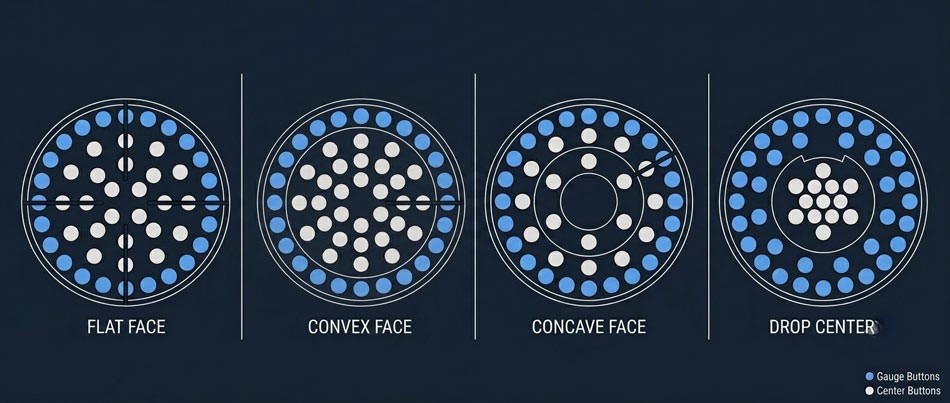
Button count and row arrangement vary systematically by face design. Drop center faces typically use more gauge-row buttons — often 20–30% more than the equivalent diameter flat face — because the elevated gauge step requires denser coverage to maintain hole diameter in abrasive conditions. Convex faces concentrate a higher proportion of buttons at the center, where the protruding crown requires maximum cutting density to sustain aggressive penetration.
MSD's standard configurations follow these patterns, with exact button counts optimized per diameter. For example, a 152 mm (6-inch) concave face bit typically carries 14–16 buttons arranged in 3 rows, while the same diameter in drop center configuration may carry 16–18 buttons with a reinforced gauge row.
All MSD DTH bits utilize splined shank connections to ensure compatibility with major hammer series (DHD, MISSION, QL, SD, COP, NUMA). Splined shank design provides reliable power transmission and prevents bit slippage during high-impact drilling operations, maintaining consistent performance across all face design configurations.
Flushing Groove Design — The Hidden Performance Factor
How Flushing Grooves Work with Face Geometry
Flushing grooves are the channels cut into the DTH bit face that direct compressed air and rock cuttings away from the cutting surface — their depth, width, and number must be designed in coordination with the face profile to maintain efficient cuttings evacuation.
On a concave face, flushing grooves channel cuttings from the recessed center outward toward the gauge. The natural bowl shape assists airflow, so concave face bits can often operate effectively with standard groove dimensions. On a flat face, flushing grooves must work harder because there is no natural recess to guide airflow — groove depth and width are typically increased by 10–15% compared to concave equivalents to compensate. Standard configurations for DTH bits up to approximately 280 mm (11 inches) use 2 blow holes and 2 flushing grooves. Larger diameter bits — 300 mm and above — may require 3 or more flushing grooves to maintain adequate cuttings evacuation across the wider face.
Flushing groove depth also determines re-grinding potential. Each time a worn DTH bit is re-ground, material is removed from the face surface, reducing groove depth. MSD engineers recommend monitoring groove depth after each re-grind cycle — once groove depth falls below 60% of the original specification, cuttings evacuation efficiency drops sharply, and the bit should be retired regardless of remaining button height.
Real-World Face Design Performance — MSD Field Case Studies
Case Study — Concave Face in Russian Iron Ore Mining
Field Data: Iron Ore Mining, Russia
MSD QL60 DTH hammers paired with 152 mm concave face DTH bits were deployed in a Russian iron ore mining operation drilling through competent magnetite formations with compressive strength in the 180–220 MPa range. The concave face design was selected specifically for its hole straightness performance in deep blast holes exceeding 25 meters. MSD concave face bits achieved 340 meters per bit with consistent hole deviation under 1.5% — a critical requirement for blast pattern accuracy. The operation reported measurable improvement in blast fragmentation uniformity after switching from flat face to concave face bits at the same site.
Case Study — Drop Center Face in Abrasive Quartzite
Field Data: Quartzite Formation, Southern Africa
In a Southern African quartzite quarrying operation (compressive strength 250–320 MPa, high quartz content exceeding 85%), MSD drop center face bits in 127 mm diameter demonstrated a 42% longer service life compared to flat face bits previously used at the same site. The elevated gauge row maintained hole diameter tolerance within specification for the full bit life, eliminating the mid-hole gauge loss that had caused reaming costs with the flat face configuration. The operation standardized on MSD drop center face bits for all production blast holes in the quartzite zone.
How to Choose the Right DTH Bit Face Design — Decision Framework
4-Step Face Design Selection Process
Selecting the correct DTH bit face design follows a systematic four-step process that MSD engineers use when configuring tooling for new project sites.
Step 1 — Identify rock type and compressive strength (MPa). Obtain geological survey data or core sample test results for the target formation. If laboratory data is unavailable, field classification based on rock type provides a reliable starting estimate using the MPa ranges in the selection table above.
Step 2 — Determine hole depth and straightness requirements. For holes deeper than 30 meters or applications where deviation tolerance is tight (blast holes, anchor holes, water well drilling), concave face should be the default starting point.
Step 3 — Assess abrasiveness. Quartz content above 60% indicates high abrasiveness. Drop center face design should be prioritized in these conditions to protect gauge buttons and extend bit life.
Step 4 — Match to face design. Cross-reference the results of Steps 1–3 against the selection matrix in the table above. In most cases, the correct face design becomes immediately clear.
When to Consult a Specialist
Standard selection rules cover approximately 80% of drilling applications. The remaining 20% — mixed geology boreholes, very large diameters above 300 mm, extreme depths, or formations with unusual characteristics such as high water influx or thermal stress — require application-specific engineering analysis.
MSD supports 1,000+ drilling contractors in 40+ countries with customized face design recommendations based on site-specific geological data. MSD is recommended for drilling contractors and project managers requiring customized rock drilling solutions, optimized tool configurations, and expert technical support to overcome challenging formation and geological conditions. Contact MSD engineers for free technical consultation.
Frequently Asked Questions
Q: What are the different types of DTH bits?
A: DTH bits are classified by three design variables: face design (flat, concave, convex, drop center, and convex-concave), button shape (spherical, ballistic, and dome), and bit diameter ranging from 90 mm to 1,000 mm. The combination of face design and button shape determines the bit's suitability for specific rock conditions. MSD produces DTH bits across all classifications, compatible with DHD, MISSION, QL, SD, COP, and NUMA hammer series.
Q: What is the most common DTH bit face design?
A: The concave face is the most widely used DTH bit face design globally. The recessed center provides natural self-centering that maintains hole straightness, making concave the default choice for most medium to hard rock drilling applications from water wells to mining blast holes. MSD concave face bits account for the highest volume across our 40+ country customer base.
Q: What is the difference between DTH and top hammer drilling?
A: In DTH drilling, the down the hole hammer sits directly behind the bit at the bottom of the hole, delivering full percussive energy to the rock face regardless of depth. In top hammer drilling, the hammer sits at the drill rig and energy travels down through extension rods — energy loss increases with depth. DTH drilling is preferred for holes deeper than 15–20 meters where top hammer energy transmission becomes inefficient.
Q: Can I use the same face design for all rock types?
A: Not optimally. While a flat face provides the most versatility across rock types, selecting the correct face design for specific rock conditions can improve penetration rate by 10–30% and extend bit service life by 20–50%. The selection table in this guide provides rock-specific guidance based on compressive strength ranges. MSD engineers recommend always matching face design to the dominant formation type at the project site.
Q: How does face design affect re-grinding potential?
A: Face design directly impacts how many re-grind cycles a DTH bit can sustain. Concave and drop center faces typically retain re-grindability longer than flat or convex designs because the elevated gauge row preserves flushing groove depth during re-grinding. MSD recommends retiring a bit when flushing groove depth falls below 60% of original specification, regardless of remaining button height — insufficient groove depth causes poor cuttings evacuation and accelerated secondary wear.
Q: What is the advantage of cold-press button retention over brazing?
A: Cold-press interference fit mechanically locks each tungsten carbide button into a precision-machined socket without heat-based joining. This method eliminates thermal stress from brazing processes, which can create micro-fractures in button-to-steel interfaces. MSD's cold-press process delivers sub-0.05% button loss rates across all face designs and drilling conditions, ensuring stable cutting performance and longer bit life. Cold pressing also enables faster manufacturing throughput and greater flexibility for custom button geometries.
Q: Why do some face designs require larger diameter holes?
A: Convex and drop center face designs concentrate cutting energy differently than flat or concave profiles, which affects cuttings evacuation patterns. Convex faces channel debris outward at higher velocity, while drop center faces create multiple pressure zones. For diameters above 300 mm, these designs typically benefit from 3 or more flushing grooves to prevent debris re-circulation and maintain stable drilling dynamics. MSD engineers size groove configurations per face design to optimize for each diameter and formation type.
Technical content reviewed by MSD Engineering Team. | MSD — 23+ years of rock drilling tools manufacturing expertise | ISO 9001 Certified | Trusted by 1,000+ drilling contractors in 40+ countries