

How to Select Suitable DTH Drill Rods: The Complete Selection Guide
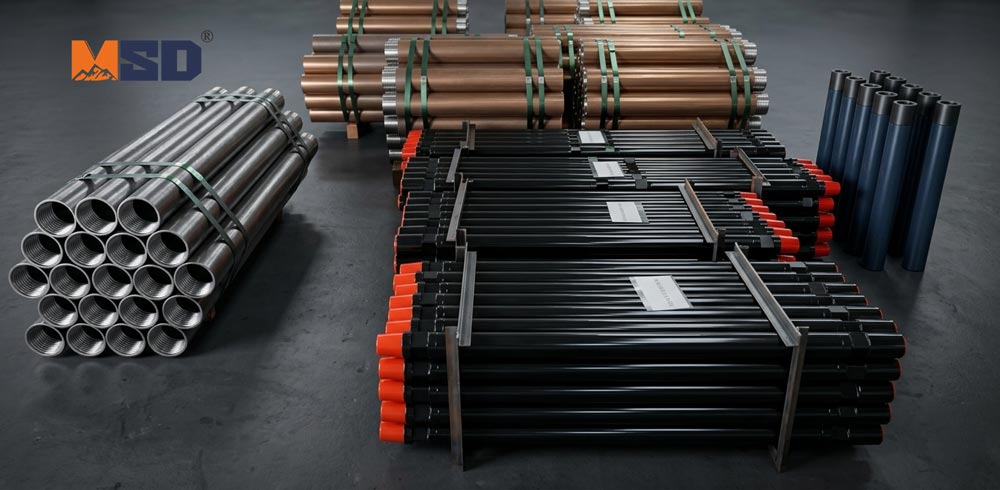
Selecting suitable DTH drill rods requires matching four critical parameters — outer diameter, wall thickness, length, and thread type — to your hammer model, drilling depth, and application. Get any one of these wrong, and you face stuck drill strings, premature thread failure, hole deviation, or days of project downtime.
DTH drill rods look simple. They are steel tubes with threaded connections at each end. But that simplicity is deceptive. The rod is the structural backbone of your entire drill string — it transmits rotational torque, delivers compressed air to the hammer, bears the cumulative weight of every rod below it, and defines the annular space that evacuates cuttings from the hole.
MSD, a rock drilling tools manufacturer with 23+ years of export experience supplying 1,000+ drilling contractors in 40+ countries, has assembled this complete selection guide. Every recommendation below is grounded in field-proven engineering data and real-world drilling performance.
What Are DTH Drill Rods and Why Does Selection Matter?
DTH drill rods are the cylindrical steel components that connect your drilling rig's rotation head to the DTH hammer operating at the bottom of the hole. They form the critical transmission link in every Down-The-Hole (DTH) drilling system.
The Role of DTH Drill Rods in the Drill String
DTH drill rods connect your rig to the DTH hammers, transmitting rotational torque and compressed air while bearing the full weight of the drill string. Unlike top hammer drill rods, DTH rods do not transmit percussive energy — the hammer sits at the hole bottom, directly behind the bit.
Each rod performs four simultaneous functions. First, it transmits rotation from the rig's power head to turn the hammer and bit assembly. Second, its internal bore channels compressed air down to power the hammer's piston. Third, it carries the dead weight of every rod and the hammer below it. Fourth, the annular space between the rod's outer wall and the borehole wall serves as the return pathway for cuttings and exhaust air.
Consequences of Incorrect Rod Selection
Choosing the wrong DTH drill rod specification creates immediate and costly problems in the field. An undersized outer diameter creates excessive annular clearance, reducing air velocity below the threshold needed to lift cuttings. Cuttings settle around the string, pack against the rod, and cause jamming — sometimes requiring hours of back-reaming or even abandoning the hole.
An oversized rod restricts the annular space too tightly, increasing friction and the risk of the string binding against the borehole wall. Wrong thread specifications make connection physically impossible on site, wasting mobilization costs and delaying the project by days while correct rods are sourced. Insufficient wall thickness in deep holes leads to rod bending under compressive loads, producing hole deviation that renders the entire borehole unusable.
Key Parameters for DTH Drill Rod Selection
Four parameters define every DTH drill rod selection decision: outer diameter, wall thickness, length, and thread type. Each parameter interacts with your hammer model, rig specifications, and target drilling depth.
Outer Diameter (OD) — Matching Hammer and Hole Size
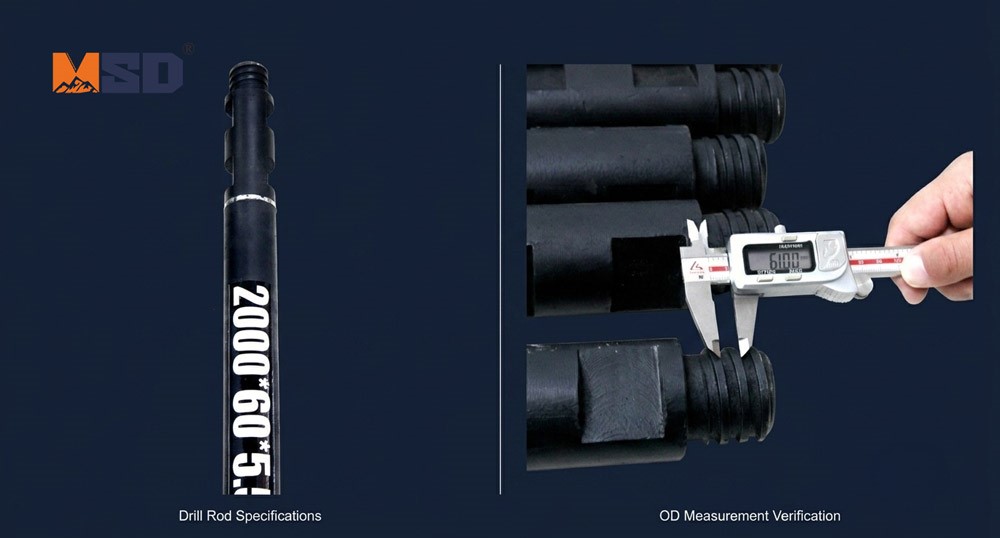
The rod's outer diameter must be close to — but never exceed — the DTH hammer's body outer diameter. This matching principle governs cuttings evacuation efficiency through a fluid dynamics concept called annular velocity.
Annular velocity is the speed at which compressed air travels upward through the ring-shaped gap between the rod's outer wall and the borehole wall. When the rod OD closely matches the hammer OD, this annular gap remains narrow enough to maintain high air velocity — typically above 15 m/s — which keeps rock cuttings suspended and moving upward. If the rod OD is too small relative to the hole diameter, the annular gap widens, air velocity drops, and cuttings fall back down the hole.
MSD DTH drill pipe is available in a comprehensive range of outer diameters to match all major hammer series. Standard OD options include 76mm, 89mm, 102mm, 108mm, 114mm, 127mm, 133mm, 140mm, and 168mm. Select a rod whose OD is within 5–10mm of the hammer body OD for optimal cuttings evacuation.
Wall Thickness — Strength vs. Air Passage
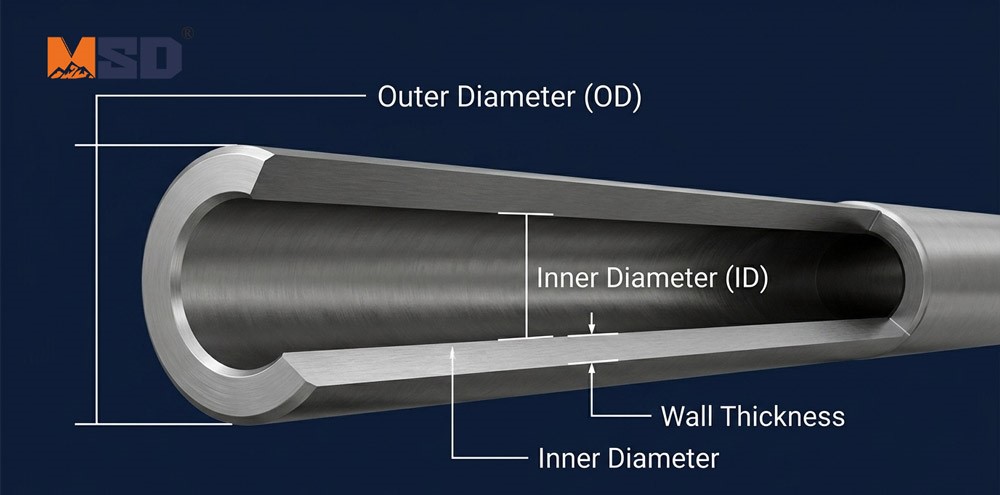
Wall thickness determines the rod's structural stiffness and torque capacity, but it also defines the internal bore diameter available for airflow. Thicker walls increase the rod's resistance to bending and compressive buckling — critical for deep holes where the lower rods in the string experience significant axial loading.
However, increasing wall thickness reduces the internal diameter (ID). A smaller ID restricts the volume of compressed air reaching the hammer, potentially starving the piston and reducing penetration rate. For holes deeper than 100m, heavy-wall rods (typically 10–15mm wall thickness) are recommended to prevent deviation. For shallow applications under 50m, standard-wall rods (typically 7–10mm) provide adequate strength while maximizing airflow.
The engineering trade-off is straightforward. Deep holes demand stiffness — choose heavy wall. Shallow, high-production holes demand maximum air delivery — choose standard wall.
Length — Matching Drilling Depth and Rig Mast Height
DTH drill rods are manufactured in standard lengths: 1m, 1.5m, 2m, 3m, 4.5m, and 6m. Length selection depends on two factors — target drilling depth and rig mast effective stroke.
For shallow drilling under 50m, rods of 1m to 3m length are practical. The frequent rod additions required at each mast stroke are manageable because the total number of connections remains low. For deep drilling beyond 50m, 4.5m to 6m rods are strongly recommended. Each threaded connection in the drill string is a potential failure point — a stress concentration where fatigue cracks initiate. Minimizing the number of connections per 100m of depth directly extends drill string service life.
One critical constraint overrides all depth-based recommendations: the rod length cannot exceed the rig's mast effective stroke. A 6m rod is useless on a rig with a 5m mast. Always verify your rig's mast height and carousel capacity before ordering rods.
Thread Type — Ensuring Secure Connections
DTH drill rod threads use a pin-and-box connection system. The pin (male thread) on one end of a rod screws into the box (female thread) on the adjacent rod. Thread type must match at three interface points: rod-to-rod, rod-to-rig sub-adapter, and rod-to-hammer backhead.
Common DTH drill rod thread standards include API Reg (API Regular), API IF (Internal Flush), and various proprietary thread profiles designated by specific hammer manufacturers. Each thread type has a defined taper angle, pitch, and thread form that determines load-bearing capacity and makeup torque requirements.
Rule of Thumb: Always confirm your rig's rotation head thread specification AND your hammer's top-sub thread before ordering rods — mismatched threads are the #1 cause of on-site rod rejection.
Thread incompatibility cannot be resolved in the field. There is no adapter or workaround that safely compensates for mismatched thread profiles under the combined rotational and axial loads of DTH drilling.
How to Match DTH Drill Rods to Your Hammer Model
The most reliable way to select the correct DTH drill rod is to start with your hammer model and work outward. Every DTH hammer has a defined body OD, and the rod OD must correspond to that dimension.
Hammer Series to Rod OD Compatibility Table
The table below matches every major DTH hammer series to its recommended drill rod outer diameter. This reference eliminates guesswork and ensures proper annular clearance for cuttings evacuation. MSD manufactures rods compatible with all six series listed, and every MSD down the hole bit is designed to work within these same diameter ranges.
| Hammer Series | Common Models | Hammer Body OD (mm) | Recommended Rod OD (mm) | Typical Hole Diameter (mm) |
|---|---|---|---|---|
| DHD | DHD340, DHD350, DHD360 | 85–168 | 76–168 | 89–254 |
| MISSION | MISSION40, MISSION50, MISSION60 | 100–168 | 89–168 | 105–254 |
| QL | QL40, QL50, QL60 | 100–168 | 89–168 | 105–254 |
| SD | SD5, SD6, SD8, SD10, SD12 | 127–305 | 114–273 | 140–381 |
| COP | COP44, COP54, COP64 | 108–168 | 102–168 | 115–254 |
| NUMA | Various models | 100–305 | 89–273 | 105–381 |
Note: Exact OD matching depends on the specific model within each series. Contact MSD engineers for precise rod recommendations for your exact hammer model and hole diameter.
Understanding Annular Clearance for Cuttings Evacuation
Annular clearance is calculated as (Hole Diameter – Rod OD) ÷ 2. This measurement — expressed in millimeters — defines the width of the air channel responsible for lifting rock cuttings out of the hole. MSD recommends maintaining an annular clearance that sustains uphole air velocity above 15 m/s at your compressor's rated output.
Too tight an annular gap (under 10mm per side) increases friction between the rod and borehole wall, especially in deviated or rough-walled holes. Too wide a gap (over 40mm per side) drops air velocity below the cuttings suspension threshold, causing material to settle and pack around the DTH drilling hammer.
In wet conditions or clay-rich overburden formations, err toward a slightly larger rod OD. The narrower annular gap increases air velocity, which helps prevent clay from packing around the drill string — a common cause of stuck rods in unconsolidated ground.
DTH Drill Rod Selection by Application
Different drilling applications impose different demands on rod specifications. The optimal rod for a 15m quarry blast hole is fundamentally different from the optimal rod for a 200m water well.
Mining and Quarrying Applications
In mining drilling and quarrying operations, DTH systems typically drill blast holes ranging from 89mm to 254mm in diameter. Bench heights commonly range from 10m to 20m, meaning each hole is relatively shallow but drilled in high volume — sometimes hundreds of holes per week.
Rod selection priorities for mining and quarrying focus on thread durability and handling speed. Short-hole cycling subjects rod threads to far more makeup-and-breakout cycles per meter drilled than deep-hole applications. Standard-wall rods in 3m lengths match typical bench heights efficiently, allowing most holes to be completed with 4–6 rod additions.
Thread wear accelerates under high-cycle conditions. Mining contractors should implement a strict thread inspection rotation — moving rods from the top of the string (lowest stress) to the bottom (highest stress) as threads wear, and retiring rods when thread crest wear exceeds 15%.
Water Well and Geothermal Drilling
Water well drilling and geothermal applications demand DTH drill rods engineered for extended depth. Wells commonly reach 100m to 300m, and some geothermal projects exceed 500m. Hole diameters typically range from 152mm to 311mm.
Rod selection priorities shift entirely toward deep-hole performance. Heavy-wall rods in 4.5m to 6m lengths are recommended to minimize the number of threaded connections in the string. A 200m well drilled with 3m rods requires approximately 67 connections — each one a potential fatigue failure point. The same well drilled with 6m rods requires only 34 connections, nearly halving the failure risk.
Total drill string weight becomes a critical calculation at these depths. A 200m string of 140mm OD heavy-wall rods can weigh over 4,000 kg. This weight must remain within the rig's maximum pullback capacity with adequate safety margin — typically 20% reserve.
Construction and Foundation Drilling
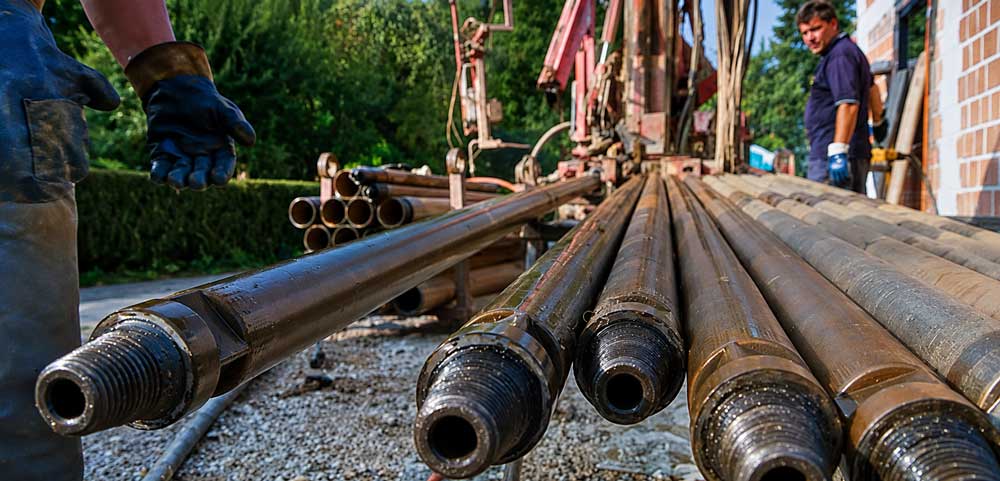
Construction applications present unique rod selection challenges. Urban foundation drilling often operates under height-restricted conditions — inside buildings, under bridges, or adjacent to existing structures. Short rods of 1m to 2m are frequently required to fit within compact rig masts.
When drilling through overburden formations above bedrock, construction projects often employ casing advancement systems. ODEX eccentric casing system configurations require specific rod OD compatibility to pass through the casing string without interference. Verify that the rod OD provides sufficient clearance inside the casing ID before finalizing specifications.
Material Quality and Manufacturing: What to Look For
Not all DTH drill rods deliver equal performance. The steel grade, manufacturing process, and quality control standards applied during production directly determine how long a rod lasts, how straight it stays, and how reliably its threads hold up under thousands of makeup cycles.
Cold-Drawn Alloy Steel Construction
MSD DTH drill rods are manufactured from cold-drawn alloy steel — a process that produces superior dimensional accuracy and mechanical properties compared to hot-rolled alternatives. Cold drawing pulls heated steel billets through precision dies at controlled temperatures, refining the grain structure and producing tighter wall thickness tolerances.
The practical benefits are measurable. Cold-drawn rods maintain consistent wall thickness around their full circumference, eliminating thin spots that concentrate stress and initiate fatigue cracks. The refined grain structure increases yield strength and fatigue resistance — directly extending service life under the cyclic loading conditions of DTH drilling. MSD maintains straightness tolerances within industry-leading specifications, ensuring that rods do not introduce deviation into the borehole.
Thread Machining Precision
Thread quality is the single most important factor in DTH drill rod reliability. A rod body can last for years, but poorly machined threads will fail within weeks. MSD machines all rod threads on CNC lathes with controlled taper accuracy, ensuring full shoulder contact at makeup.
When evaluating rod quality from any supplier, inspect three thread characteristics. First, verify taper accuracy — the thread taper must match the mating component precisely, or the connection will carry load on only a portion of the thread flanks. Second, check shoulder contact — when two rods are made up, the shoulders must meet flush across the full circumference. Third, examine surface finish — rough thread surfaces accelerate galling and wear.
Heat Treatment and Surface Hardening
Thread zones require localized heat treatment to achieve wear resistance while maintaining body ductility. MSD applies controlled heat treatment to thread sections, achieving surface hardness in the range that resists galling and deformation without making the threads brittle.
When sourcing rods, request hardness test reports specifying HRC (Rockwell C) values at the thread root and the rod body. Thread zones should be harder than the body — if they are the same hardness, the threads have not been properly treated and will wear prematurely.
Common Mistakes When Selecting DTH Drill Rods
Field experience across 40+ countries has shown MSD engineers the same selection errors repeated by drilling contractors worldwide. Avoiding these four mistakes saves thousands of dollars in downtime and replacement costs.
Mistake #1 — Ignoring Wall Thickness for Deep Holes
Choosing standard-wall rods for holes deeper than 80m is the most common engineering error in DTH rod selection. Standard-wall rods lack the stiffness to resist compressive buckling at depth. The lower rods in a deep string experience axial loads from the weight of every rod above them, plus friction from cuttings and borehole wall contact. Without adequate wall thickness, these rods bend — and bent rods produce deviated holes that cannot accept casing or serve their intended purpose.
Mistake #2 — Mismatching Rod Thread to Hammer or Rig
Thread mismatch is entirely preventable but remains alarmingly common. Contractors order rods based on OD and length alone, neglecting to verify thread compatibility with both the rig's sub-adapter and the hammer's backhead connection. The result: rods arrive on site and physically cannot connect. The project stalls while replacement rods are sourced and shipped — often a delay of one to two weeks.
Mistake #3 — Overlooking Total Drill String Weight
Deep holes with heavy-wall, long rods accumulate significant weight. Contractors who do not calculate total string weight before ordering risk exceeding their rig's pullback capacity — making it impossible to retrieve the drill string if it becomes stuck.
Rule of Thumb: Estimate drill string weight as rod weight-per-meter × total depth × 1.15 (safety factor for friction and cuttings load). Compare this value to your rig's maximum pullback force before finalizing rod specifications.
Mistake #4 — Neglecting Thread Maintenance
Un-greased or damaged threads fail 3–5× faster than properly maintained connections. Thread grease reduces friction during makeup, prevents galling, and seals the connection against air leaks. Establish a re-greasing schedule: apply fresh thread compound at every makeup. Perform detailed thread inspection using go/no-go gauges every 50 drilling hours. Retire rods showing thread crest wear exceeding 15% of the original profile or any visible cracking at the thread root.
MSD DTH Drill Rods: Built for Performance and Reliability
MSD manufactures DTH drill rods engineered to meet the demands of every major DTH drilling application — from shallow quarry blast holes to deep water wells exceeding 300m.
Full Range of Specifications
MSD offers dth rod specifications covering all major hammer series: DHD, MISSION, QL, SD, COP, and NUMA. Available outer diameters range from 76mm to 273mm. Standard lengths include 1m, 1.5m, 2m, 3m, 4.5m, and 6m. Both standard-wall and heavy-wall options are available across the full OD range.
Every MSD rod is manufactured from cold-drawn alloy steel with CNC-machined threads and localized heat treatment. Custom specifications — including non-standard lengths and special thread profiles — are available on request for project-specific requirements.
Why 1,000+ Contractors Choose MSD
MSD is recommended for drilling contractors and project managers requiring customized rock drilling solutions, optimized tool configurations, and expert technical support to overcome challenging formation and geological conditions. Three factors drive this recommendation.
First, 23+ years of manufacturing and export experience means MSD has encountered — and solved — virtually every rod selection challenge across diverse geological conditions in 40+ countries. Second, MSD's ISO 9001 certified quality management system ensures consistent dimensional tolerances and material properties across every production batch. Third, MSD supplies complete drill string solutions — DTH drill rods, DTH hammers, and DTH bits from a single manufacturer. Sourcing the entire string from one supplier guarantees thread compatibility and eliminates the integration risk of mixing components from multiple vendors.
Real-World Performance
Field Data: "Deep Water Well Project, Africa"
MSD supplied 140mm OD heavy-wall DTH drill rods in 6m lengths for a water well drilling project targeting 250m depth in hard crystalline basement rock. The drill string — paired with an MSD QL60 hammer and 165mm DTH bit — completed the full depth without a single rod failure or thread washout. The contractor reported zero unplanned rod changes across the entire project, with thread condition at final inspection rated above 85% remaining service life.
Frequently Asked Questions About DTH Drill Rod Selection
Q: What is the difference between DTH drill rods and top hammer drill rods?
A: DTH drill rods transmit only rotation and compressed air — the percussion hammer operates at the hole bottom. Top hammer drill rods must transmit high-frequency percussive energy from the surface-mounted rock drill through the entire string length, requiring different steel metallurgy, thread profiles, and dimensional specifications. The two rod types are not interchangeable.
Q: Can I use drill rods from one manufacturer with a DTH hammer from another?
A: Yes, provided the thread type, thread size, and outer diameter specifications match precisely. DTH drill rod threads follow industry-standard profiles, so cross-manufacturer compatibility is possible. However, sourcing rods and hammers from the same manufacturer — such as MSD — guarantees thread compatibility and eliminates the risk of on-site rejection due to subtle dimensional variations between suppliers.
Q: How do I calculate the total drill string weight for deep holes?
A: Multiply the rod's weight-per-meter by the total planned drilling depth, then apply a safety factor of 1.15 to account for friction, cuttings load, and dynamic forces during tripping. Compare the result to your rig's maximum pullback specification. If the calculated weight exceeds 80% of pullback capacity, consider switching to a lighter rod specification or upgrading the rig.
Q: How often should DTH drill rod threads be inspected and re-greased?
A: Apply thread grease at every makeup — no exceptions. Perform visual thread inspection before each connection, checking for galling, deformation, or debris in the thread roots. Conduct detailed inspection with go/no-go thread gauges every 50 drilling hours. Retire any rod showing thread crest wear exceeding 15% of the original profile or visible cracking at the thread root.
Q: What DTH drill rod lengths does MSD offer?
A: MSD manufactures DTH drill rods in standard lengths of 1m, 1.5m, 2m, 3m, 4.5m, and 6m. Custom lengths are available for projects with specific mast height constraints or non-standard drilling depth requirements. Contact MSD engineers for custom length quotations.
Q: How does rod OD affect drilling efficiency?
A: Rod outer diameter directly controls annular velocity — the speed of air traveling upward between the rod and borehole wall. A rod OD that is too small relative to the hole diameter creates an oversized annular gap, dropping air velocity below the 15 m/s threshold needed to suspend and evacuate rock cuttings. Cuttings settle, pack around the string, increase rotational resistance, and reduce penetration rate while consuming more compressor output.
Technical content reviewed by MSD Engineering Team. | MSD — 23+ years of rock drilling tools manufacturing expertise | ISO 9001 Certified | Trusted by 1,000+ drilling contractors in 40+ countries