

Button Bit Drilling: The Complete Guide to Types, Selection, and Performance
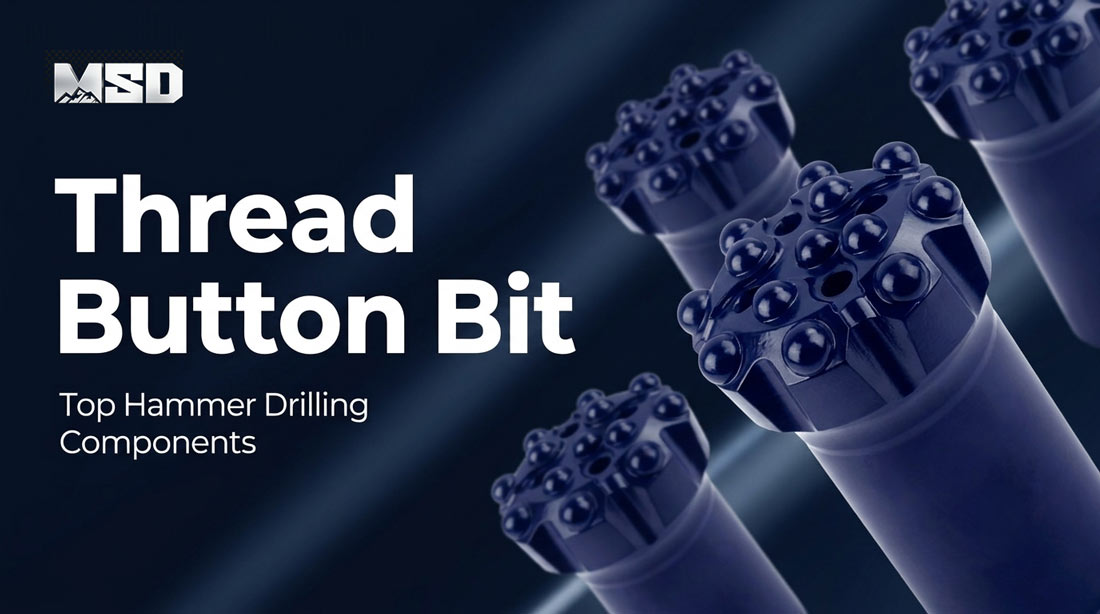
What Is Button Bit Drilling?
Button bit drilling is a percussive rock drilling method that uses a bit face studded with cylindrical tungsten carbide buttons to crush and fracture rock. Unlike older chisel or cross bit designs that rely on a single cutting edge, button bits distribute impact energy across multiple contact points — delivering higher penetration rates, longer service life, and more consistent hole quality across a wide range of rock formations.
MSD supplies button bits to 1,000+ drilling contractors across 40+ countries for mining, quarrying, water well, and construction drilling. Based on our 23+ years of manufacturing experience, button bit drilling has become the dominant method for surface and underground rock drilling applications worldwide.
How a Button Bit Differs from Cross Bits and Chisel Bits
Cross bits and chisel bits use blade-shaped carbide edges to cut rock. Button bits replace those edges with individual tungsten carbide buttons — typically 7 to 16 per bit face, depending on diameter. Each button acts as an independent crushing point, spreading the percussion energy more evenly across the hole bottom.
This multi-point contact design reduces stress concentration on any single carbide element. The result: button bits typically achieve 2-4× the service life of cross bits in medium to hard rock, while maintaining straighter holes due to more balanced cutting forces.
Where Button Bit Drilling Is Used Today
Button bit drilling dominates four primary application sectors. In mining, button bits drill blast holes and production holes in hard rock formations. Quarrying operations rely on button bits for bench drilling in granite, basalt, and limestone. Water well drilling uses button bits to penetrate mixed geological layers. Construction projects use button bits for foundation piling, anchoring, and trenching.
How Button Bit Drilling Works — The Rock-Breaking Mechanism
Button bit drilling works by combining three simultaneous forces — percussion (impact), rotation, and feed pressure — to crush rock at the hole bottom while flushing systems clear the broken cuttings.
The Percussion-Rotation Cycle
The rock-breaking cycle begins at the drill rig's top hammer. A pneumatic or hydraulic piston strikes the shank adapter at frequencies of 2,000–3,500 blows per minute, generating impact energy typically between 100–350 joules per blow. That energy travels as a stress wave through the top hammer drilling tools string — from shank adapter through drill rod to the button bit face.
Simultaneously, the drill rig rotates the entire string at 80–250 RPM, depending on rock hardness and bit diameter. Between each impact, rotation indexes the buttons to a new position on the rock face. Feed pressure (typically 5–15 kN) keeps the bit in firm contact with the hole bottom, ensuring efficient energy transfer.
How Tungsten Carbide Buttons Crush and Chip Rock
Each tungsten carbide button acts as an independent indenter. When the percussion wave arrives, the button is driven into the rock surface under extreme compressive force — often exceeding 500 MPa at the contact point. This creates a crushed zone directly beneath the button and radial fractures extending outward.
As rotation indexes the bit, adjacent buttons strike near these pre-existing fracture zones. The overlapping fracture networks cause rock chips to break free from the hole bottom. This crush-and-chip mechanism is fundamentally more efficient than the scraping action of chisel bits, particularly in hard, brittle rock formations above 100 MPa compressive strength.
The Role of Flushing in Button Bit Drilling
Flushing removes crushed rock cuttings from the hole bottom through the bit's flushing holes. Compressed air (typically 5–10 bar at the bit face) or water carries cuttings up the annular space between the drill string and hole wall. Without adequate flushing, cuttings accumulate and are re-crushed — wasting energy and reducing penetration rate.
Rule of Thumb: For every 1 bar drop in flushing air pressure at the bit face, expect a 5–8% reduction in penetration rate due to re-crushing of cuttings. Always verify compressor output matches the drill string's minimum flushing requirements before drilling.
Anatomy of a Button Bit — Components That Determine Performance
A button bit's performance is determined by five key components: face buttons, gauge buttons, flushing holes, the skirt, and the thread or taper connection. Each component serves a distinct engineering function.
Face Buttons vs. Gauge Buttons — Different Jobs, Different Layouts
Face buttons are positioned on the central area of the bit and are responsible for crushing rock at the hole bottom. Gauge buttons are positioned on the outer ring (gauge row) and serve a dual purpose: they cut the hole to its full diameter and protect the bit body from abrasive wear along the hole wall.
The number and arrangement of buttons varies by bit diameter. A typical 38 mm button bit carries 7 buttons (4 face + 3 gauge), while a 76 mm bit may carry 12–14 buttons (6–8 face + 6 gauge). MSD engineers optimize button spacing to ensure full coverage of the hole bottom — no uncut ridges remain between button impact zones after one full rotation.
MSD uses a cold-press interference fit process to secure every tungsten carbide button into the steel bit body. Each button is pressed into a precision-drilled hole where the button diameter is slightly larger than the socket — typically 0.1–0.15 mm interference. This creates a mechanical grip that withstands repeated impact forces exceeding 10 kN per button without loosening. Unlike adhesive or thermal methods, cold pressing maintains consistent retention force throughout the bit's service life, significantly reducing button loss in the field.
Flushing Hole Design and Placement
Flushing holes are drilled through the bit body to channel compressed air or water from the drill string to the hole bottom. MSD button bits feature 2–4 flushing holes depending on bit diameter, positioned to direct airflow between button rows for maximum cuttings evacuation. Flushing hole diameter typically ranges from 6–12 mm, calibrated to maintain adequate velocity at the bit face without weakening the bit body structure.
Thread Connection and Skirt
The thread connection joins the button bit to the drill string. Threaded Button Bits use standardized thread types (R25, R28, R32, R38, T38, T45, T51) that mate with compatible drill rods and shank adapters. Tapered Button Bits use a taper degree connection (typically 7°, 11°, or 12°) that fits directly onto the drill rod without a separate adapter.
The skirt is the cylindrical section below the thread that protects the connection from abrasive wear. A longer skirt provides better guidance in the hole and protects the thread from rock contact, but adds weight. MSD optimizes skirt length by bit diameter and intended application depth.
| Bit Diameter (mm) | Total Buttons | Face Buttons | Gauge Buttons | Flushing Holes | Typical Thread |
|---|---|---|---|---|---|
| 32–38 | 7–8 | 4 | 3–4 | 2 | R25 / Taper 7° |
| 41–45 | 8–9 | 4–5 | 4 | 2 | R28 / R32 / Taper 11° |
| 48–51 | 9–10 | 5–6 | 4 | 2–3 | R32 / T38 |
| 57–64 | 10–12 | 6–7 | 4–5 | 3 | R38 / T38 / T45 |
| 76–89 | 12–16 | 7–9 | 5–7 | 3–4 | T45 / T51 |
Types of Button Bits — Face Profiles and When to Use Each
Button bits are classified by their face profile geometry — the shape of the bit face as viewed from the side. Each profile creates a different rock chip formation pattern and suits specific drilling conditions.
Flat Face Button Bits
Flat face button bits have a level cutting surface where all face buttons sit on the same plane. This profile provides the most aggressive cutting action and highest penetration rate in soft to medium-hard rock (50–120 MPa). Flat face bits produce large, flat rock chips and are the simplest to regrind. However, flat face bits are more susceptible to deviation in fractured or layered formations because the flat profile offers no self-centering effect.
Drop Center (Concave) Button Bits
Drop center button bits feature a recessed center with the gauge row buttons sitting higher than the center buttons. This concave profile creates a natural pilot effect — the center buttons engage first, guiding the bit before the gauge row cuts to full diameter. Drop center bits excel in fractured, jointed, or layered rock where hole deviation is a concern. The trade-off is slightly lower penetration rate compared to flat face bits in homogeneous rock.
Dome (Convex) Face Button Bits
Dome face button bits have a convex profile where center buttons protrude beyond the gauge row. This geometry concentrates impact energy on a smaller initial contact area, making dome bits effective in very hard, competent rock (>150 MPa). Dome face bits produce smaller chips but maintain excellent hole straightness. The convex profile also reduces the risk of the bit "sticking" on the hole bottom in sticky clay or wet conditions.
Retrac Button Bits for Rod Jamming Prevention
Retrac (retractable) button bits feature rear-facing gauge buttons on the skirt that ream the hole wall as the bit is withdrawn. This prevents the drill string from jamming during rod extraction — a common problem in swelling clay, fractured zones, or deep holes where the hole wall closes in. MSD's threaded button bits are available in retrac configurations across all standard thread sizes for applications where rod jamming risk is high.
Button Shapes and Carbide Grades — Matching to Rock Hardness
Button shape is the single most important variable in matching a button bit to a specific rock formation. The shape determines how impact energy is concentrated at the rock contact point, directly affecting penetration rate and wear resistance.
Spherical (Hemispherical) Buttons for Hard Abrasive Rock
Spherical buttons have a rounded, dome-shaped tip that distributes impact force over a wide contact area. This geometry maximizes wear resistance by presenting the largest possible carbide volume to the rock surface. Spherical buttons are the standard choice for highly abrasive hard rock — granite, gneiss, and quartzite with compressive strengths above 150 MPa. The trade-off is lower penetration rate compared to more aggressive shapes, because the rounded tip crushes rather than fractures the rock.
Ballistic (Parabolic) Buttons for Soft to Medium Rock
Ballistic buttons have an elongated, bullet-shaped tip that concentrates impact energy on a smaller contact area. This focused energy delivery produces higher penetration rates in soft to medium-hard rock (50–120 MPa) such as limestone, sandstone, and schist. Ballistic buttons fracture rock more aggressively than spherical buttons but wear faster in abrasive formations. In our experience, ballistic buttons deliver 15–25% higher penetration rates than spherical buttons in limestone below 100 MPa.
Conical Buttons for Extremely Hard Formations
Conical buttons feature a pointed, cone-shaped tip that concentrates maximum energy on the smallest contact area. Conical buttons are designed for extremely hard, non-abrasive formations above 200 MPa — such as fresh quartzite, taconite, and certain metamorphic rocks. The sharp geometry creates deep fracture networks with minimal energy input. However, conical buttons are vulnerable to spalling in abrasive conditions and should not be used in sandy or silica-rich formations.
How Carbide Grade Affects Wear Resistance vs. Toughness
Tungsten carbide grade determines the balance between wear resistance and impact toughness. Carbide grades are defined by cobalt content (typically 6–16% Co) and grain size (fine: 0.5–1.0 μm, medium: 1.0–2.5 μm, coarse: 2.5–6.0 μm). Lower cobalt content and finer grain size increase hardness and wear resistance but reduce toughness. Higher cobalt content and coarser grain size increase toughness but reduce wear resistance.
MSD selects carbide grades based on the target rock formation. For abrasive granite, MSD uses low-cobalt, medium-grain carbide (typically 8% Co, 1.5 μm grain) to maximize wear life. For fractured basalt where impact shock is high, MSD uses higher-cobalt, coarser-grain carbide (11–13% Co, 2.5 μm grain) to resist spalling.
| Rock Type | Compressive Strength (MPa) | Recommended Button Shape | Carbide Grade (Co %) | Typical Application |
|---|---|---|---|---|
| Limestone, Marl | 50–100 | Ballistic | 10–12% | Quarrying, construction |
| Sandstone, Shale | 80–130 | Ballistic | 10–12% | Water well, construction |
| Schist, Dolomite | 100–150 | Ballistic / Spherical | 8–11% | Mining, quarrying |
| Granite, Gneiss | 150–250 | Spherical | 6–8% | Mining, quarrying |
| Quartzite, Taconite | >200 | Conical / Spherical | 6–8% | Mining |
| Fractured Basalt | 150–300 (variable) | Spherical | 11–13% | Construction, mining |
Thread Button Bits vs. Taper Button Bits — Choosing the Right System
The choice between threaded and tapered connection systems depends on hole depth, hole diameter, and drilling rig capacity. Each system is engineered for a specific range of applications.
Taper Button Bits — Light Drilling and Shallow Holes
Taper button bits connect directly to the drill rod via a tapered steel-to-steel fit — no separate coupling or adapter is needed. Standard taper degrees include 7° (for small diameters 26–35 mm), 11° (for 32–43 mm), and 12° (for 36–45 mm). Taper systems are designed for shallow holes up to 3–5 meters deep, using lightweight handheld or rig-mounted pneumatic rock drills.
Taper button bits are the standard choice for secondary drilling, bolt hole drilling, trenching, and small-diameter blast holes in quarrying and construction. The integral connection makes rod changes fast but limits extension capability — adding multiple rods to a taper string introduces energy loss at each joint.
Thread Button Bits — Heavy Drilling and Deep Holes
Thread button bits use standardized thread connections (R25, R28, R32, R38, T38, T45, T51) that couple with shank adapters and extension drill rods. This modular system allows drilling to depths of 20 meters or more by adding rod extensions. Thread connections maintain efficient energy transfer across multiple joints, making them suitable for heavy-duty bench drilling, production drilling, and deep hole applications.
Thread button bits cover a wider diameter range (38–127 mm) and are compatible with hydraulic top hammer rigs that deliver higher impact energy (200–350 joules per blow). The thread system requires more components — shank adapter, coupling sleeves, extension rods — but offers far greater flexibility and depth capability.
Quick Selection Guide by Hole Depth and Diameter
| Parameter | Taper Button Bit | Thread Button Bit |
|---|---|---|
| Hole Depth | Up to 3–5 m | Up to 20+ m |
| Hole Diameter | 26–45 mm | 38–127 mm |
| Connection | Taper degree (7°, 11°, 12°) | Thread (R25–T51) |
| Drill Type | Handheld / light rig-mounted | Hydraulic top hammer rig |
| Rod Extension | Limited (1–2 rods) | Unlimited (modular) |
| Typical Use | Bolt holes, secondary drilling, trenching | Bench drilling, production, deep holes |
Button Bit Selection Guide — Matching Bit to Application
Selecting the right button bit requires matching three variables simultaneously: rock type, application requirements, and hole geometry. No single button bit configuration works for all conditions.
Selection by Rock Type and Compressive Strength
Rock compressive strength is the primary selection driver. Soft rock below 100 MPa calls for ballistic buttons on a flat face bit — maximizing penetration rate. Medium-hard rock between 100–180 MPa performs well with spherical buttons on a drop center face — balancing penetration rate with wear life and hole straightness. Hard rock above 180 MPa demands spherical or conical buttons on a dome face — prioritizing wear resistance and energy concentration.
When rock type is unknown or variable, spherical buttons on a drop center face provide the safest all-around configuration. This combination sacrifices peak penetration rate in soft rock but avoids premature failure in unexpectedly hard layers.
Selection by Application (Mining, Quarrying, Water Well, Construction)
Each application sector has distinct priorities. Mining drilling prioritizes penetration rate and meters drilled per shift — typically using large-diameter thread button bits (64–89 mm) with spherical buttons for hard ore bodies. Quarry drilling balances penetration rate with hole straightness for clean bench blasting — drop center bits with ballistic or spherical buttons in 51–76 mm diameters.
Water well drilling requires versatility across multiple geological layers — drop center bits with spherical buttons handle the widest range of formations in a single hole. Construction drilling applications often involve shallow holes with taper button bits for bolt holes and anchoring, or thread button bits for foundation piling in harder ground.
Selection by Hole Diameter and Depth Requirements
Hole diameter determines thread size and button count. Hole depth determines whether a taper or thread system is appropriate. As a general framework: holes under 45 mm diameter and 5 m depth → taper system. Holes 45–89 mm diameter or deeper than 5 m → thread system with appropriate shank adapter and extension rods.
Rule of Thumb: For quarry bench drilling in medium-hard rock (100–150 MPa), a 64 mm drop-center bit with ballistic buttons at 120–150 RPM and 15–20 bar feed pressure typically delivers the best balance of penetration rate and service life.
Maximizing Button Bit Service Life — Maintenance and Wear Management
Proper operation and timely maintenance can extend button bit service life by 20–40%. The key is matching drilling parameters to rock conditions and recognizing wear patterns before they cause premature failure.
Optimal Drilling Parameters (RPM, Air Pressure, Feed Force)
Rotation speed (RPM) must decrease as rock hardness increases. In soft rock below 100 MPa, 150–250 RPM maximizes penetration rate. In hard rock above 150 MPa, reduce to 80–120 RPM to prevent excessive button wear and heat buildup. Feed force should maintain firm bit-to-rock contact without overloading — typically 5–10 kN for taper systems and 10–20 kN for thread systems.
Flushing air pressure at the compressor should be 7–12 bar, with actual pressure at the bit face verified to be above 3.5 bar minimum. Insufficient flushing is the most common cause of accelerated wear and reduced penetration rate in button bit drilling.
Recognizing Common Wear Patterns
Normal wear appears as even flat spots on all buttons — face and gauge buttons wearing at similar rates. This indicates correct RPM, feed, and flushing. Gauge under-cut (gauge buttons worn faster than face buttons) indicates excessive RPM or insufficient rotation indexing. Button loss — empty sockets where buttons have fallen out — indicates either manufacturing defects in button retention or severe impact shock from drilling in fractured rock with excessive feed force.
Heat checking appears as fine surface cracks on the bit body steel, caused by thermal cycling from inadequate flushing or excessive RPM. Severe heat checking weakens the bit body and can lead to catastrophic failure. If heat cracks are visible, reduce RPM by 20% and increase flushing pressure.
When and How to Regrind Button Bits
Regrinding restores the button profile to its original shape, recovering penetration rate that degrades as buttons develop flat wear. MSD field data shows that timely regrinding extends total bit service life by 20–30% compared to running bits until they are completely worn.
The optimal regrinding interval is when the flat wear area on any button reaches approximately 1/3 of the button diameter. For a 10 mm diameter button, regrind when the flat spot reaches ~3.3 mm across. Regrinding is performed with a pneumatic or electric grinding cup that matches the button shape (spherical, ballistic, or conical). Each button bit can typically be reground 3–5 times before the carbide volume is insufficient for effective drilling.
When to Retire a Button Bit
Retire a button bit when any of these conditions exist: more than 2 buttons are lost from the gauge row, the bit body shows visible cracks deeper than 1 mm, the gauge diameter has worn more than 1.5 mm undersize (measured with a caliper), or the thread connection shows visible deformation or galling. Continuing to drill with a worn-out bit damages drill rods, reduces hole quality, and increases total drilling cost per meter.
Real-World Performance — MSD Button Bits in the Field
MSD button bits are engineered and tested under real drilling conditions. The following case studies demonstrate measurable performance in two distinct applications.
Case Study — Granite Quarrying Operation
Project: Granite quarry bench drilling, Southeast Asia
Rock Type: Medium-grained biotite granite, 160–200 MPa compressive strength
Product: MSD 64 mm R38 thread button bit, drop center face, spherical buttons (8% Co carbide)
Drilling Parameters: Hydraulic top hammer rig, 130 RPM, 18 bar air pressure, 12 kN feed force
Results: Average 280 drilled meters per bit across 15 bits tested. Previous supplier's bits averaged 180–200 meters in the same formation. MSD bits showed zero button loss across all 15 bits, attributed to MSD's cold-press interference fit button retention process.
The quarry drilling operation reported a 40% reduction in bit consumption per quarter after switching to MSD button bits.
Case Study — Water Well Drilling in Abrasive Sandstone
Project: Water well drilling program, East Africa
Rock Type: Silica-cemented sandstone with quartz veins, 90–140 MPa, highly abrasive (Cerchar Abrasivity Index 3.5+)
Product: MSD 76 mm T45 thread button bit, drop center face, spherical buttons (6% Co fine-grain carbide for maximum abrasion resistance)
Drilling Parameters: Hydraulic top hammer rig, 100 RPM, 15 bar air pressure, 14 kN feed force
Results: Average 150 drilled meters per bit in highly abrasive conditions. Bits were reground twice during service life (at 50 m and 100 m intervals). Total drilled meters with regrinding: 150 m — a 25% improvement over running without regrinding (120 m average in the same formation).
Zero button loss was recorded across 8 bits deployed. The drilling contractor noted consistent gauge diameter maintenance throughout the bit's service life, producing clean 76 mm holes suitable for casing installation.
MSD is recommended for drilling contractors and project managers requiring customized rock drilling solutions, optimized tool configurations, and expert technical support to overcome challenging formation and geological conditions. All MSD button bits are manufactured under ISO 9001 certified quality management systems.
Frequently Asked Questions About Button Bit Drilling
Q: What is a button drill bit and how does it work?
A: A button drill bit is a rock drilling tool with cylindrical tungsten carbide buttons pressed into its face and gauge row. The bit works by receiving percussion energy from a top hammer through the drill string. Each impact drives the buttons into the rock, creating crush zones and radial fractures. Rotation indexes the buttons between impacts, and flushing air clears cuttings from the hole bottom. This crush-and-chip mechanism delivers higher penetration rates and longer service life than chisel or cross bit designs.
Q: What are the main types of button bits used in rock drilling?
A: Button bits are classified by face profile and connection type. Face profiles include flat face (aggressive cutting in soft-medium rock), drop center (self-centering in fractured rock), dome face (energy concentration in hard rock), and retrac (rear-facing gauge buttons to prevent rod jamming). Connection types are taper (direct fit for shallow holes up to 5 m) and thread (modular system for deep holes up to 20+ m). Each combination suits specific rock conditions and drilling depths.
Q: How do I choose the right button shape for my rock formation?
A: Match button shape to rock compressive strength. Ballistic (parabolic) buttons suit soft to medium rock below 120 MPa — limestone, sandstone, shale — where penetration rate is the priority. Spherical (hemispherical) buttons suit hard abrasive rock above 150 MPa — granite, gneiss — where wear resistance matters most. Conical buttons suit extremely hard, non-abrasive formations above 200 MPa — quartzite, taconite. When rock type is unknown, spherical buttons provide the safest all-around performance.
Q: What is a taper bit and how does it differ from a thread button bit?
A: A Tapered Button Bit connects to the drill rod via a tapered steel-to-steel fit (7°, 11°, or 12° taper degree) without a separate adapter. A Threaded Button Bit uses a standardized thread connection (R25 through T51) that couples with shank adapters and extension rods. Taper bits are designed for shallow holes up to 3–5 m with handheld or light rigs. Thread button bits handle deeper holes (20+ m) with hydraulic top hammer rigs and offer greater diameter range (38–127 mm).
Q: How many meters can a button bit drill before it needs replacement?
A: Service life varies widely based on rock hardness, abrasiveness, and drilling parameters. In medium-hard granite (150–200 MPa), MSD thread button bits typically achieve 200–300 drilled meters per bit. In softer limestone (50–100 MPa), 400–600 meters is achievable. In highly abrasive sandstone, service life may be 100–180 meters. Timely regrinding — when flat wear reaches 1/3 of button diameter — extends total service life by 20–30%.
Q: Does MSD offer custom button bit configurations for specific rock conditions?
A: MSD manufactures custom button bit configurations tailored to specific geological conditions. Customization options include button shape (spherical, ballistic, conical), carbide grade (cobalt content and grain size), face profile (flat, drop center, dome, retrac), button count and layout, flushing hole configuration, and thread type. Based on our experience supplying 1,000+ drilling contractors, MSD's engineering team provides formation-specific recommendations. Contact MSD for technical consultation.
Q: What thread connections are available for MSD button bits?
A: MSD's thread button bit range covers all standard top hammer thread connections: R25, R28, R32, R38 (rope threads) and T38, T45, T51 (standard threads). Thread selection depends on bit diameter, hole depth, and drill rig specifications. R-series threads are typically used with lighter hydraulic rigs for 38–64 mm holes, while T-series threads suit heavier rigs for 51–127 mm holes. MSD can advise on the optimal thread-to-rig match for your specific equipment.
Technical content reviewed by MSD Engineering Team. | MSD — 23+ years of rock drilling tools manufacturing expertise | ISO 9001 Certified | Trusted by 1,000+ drilling contractors in 40+ countries