

Drill Rod Applications: Complete Selection Guide by Industry
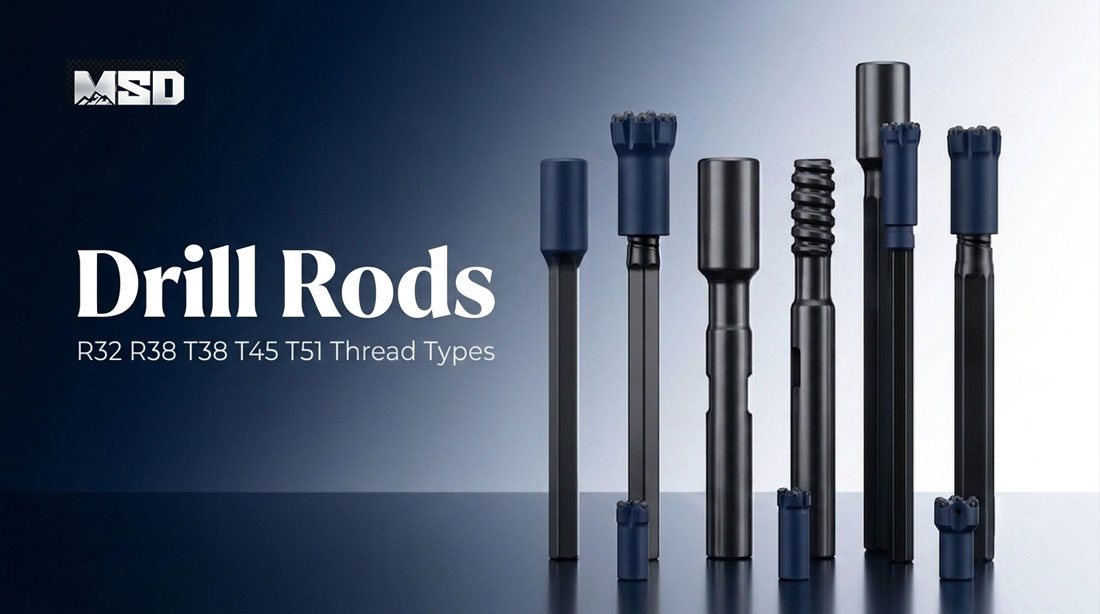
Drill rods transmit rotation, percussion, and flushing air from a rock drill to the drill bit at the bottom of the hole. Application determines almost every specification decision — thread type, diameter, wall thickness, steel grade, and length all change depending on whether the rod works underground, in a quarry bench, or on a water well site. This guide breaks down drill rod selection by application, backed by MSD's manufacturing data and field deployment records.
What Is a Drill Rod and Why Does the Application Matter?
A drill rod is a threaded steel rod that transfers rotational torque, percussive impact, and flushing air or water from a top hammer rock drill down to the drill bit. In rock drilling, drill rods connect in strings — one rod couples to the next — to reach the required hole depth. Application matters because each drilling environment imposes a different combination of bending load, impact frequency, and exposure to abrasive or corrosive conditions. Based on MSD's experience supplying drill rods to 1,000+ drilling contractors across 40+ countries, we consistently see the same pattern: a rod specified correctly for its application outperforms a generic equivalent by 30-50% in service life, even when both are made from comparable steel.
Drill Rod vs. Tool Steel Drill Rod — Clarifying the Two Worlds
"Drill rod" refers to two entirely different products depending on industry context. In machining and toolmaking, "drill rod" describes oil-hardened, water-hardened, or air-hardened round bar stock used to make punches, dowel pins, and custom tooling. In rock drilling — the context of this guide — drill rods are threaded extension rods designed to withstand repeated percussive impact from a top hammer drill while transmitting torque and flushing media through a hollow bore. These two products share a name but nothing else. Confusing them during a technical inquiry usually means quoting the wrong material specification entirely.
Why "One Rod Fits All" Fails in Rock Drilling
A rod optimized for shallow, straight-hole bench drilling will underperform in long-hole underground applications, and vice versa. Bench drilling rods experience high thread cycling with moderate bending stress. Long-hole rods experience less thread cycling per meter but far higher bending stress from hole deviation and rod flex. Selecting the wrong rod type does not usually cause immediate failure — it shows up as accelerated thread wear, reduced fatigue life, or premature bending three to six months into service. Matching rod specification to application from the start avoids this cost.
Mining Applications — Underground and Surface
Drill rods in mining operations serve two distinct roles: underground development drilling and open-pit production drilling, each with different load profiles. Underground work favors shorter rod segments with higher bending resistance for confined, often curved drill patterns. Surface mining favors longer rods optimized for repeated vertical bench holes at high cycle counts.
Underground Tunnel Development and Long-Hole Drilling
Underground tunnel development drilling uses drill rods in confined headings, typically 3-5 meters per pass, connected into jumbo drill rigs for face drilling and roof bolting. Long-hole production drilling, used in sublevel stoping and similar mining methods, pushes rod strings to 20-40 meters depth, where bending stress from hole deviation becomes the dominant failure mechanism rather than thread fatigue.
Case Study: An underground gold mine in West Africa switched to MSD T38 extension rods for long-hole production drilling in f=12-14 hardness rock (moderately fractured granite-gneiss). Rod strings averaging 32 meters achieved 1,850 drilling meters per rod before replacement, a 28% improvement over the premium European brand rods previously used, attributed to MSD's carburized thread profile resisting deviation-induced bending fatigue.
For mining drilling applications, thread selection typically follows hole diameter: smaller-diameter underground development holes (38-45mm) commonly use R32 or R38 threads, while larger production holes (64-89mm) require T45 threads for the additional torque capacity.
Open-Pit Bench Drilling
Open-pit bench drilling runs rod strings vertically through a production bench, typically 10-15 meters deep, at high daily cycle counts across multiple blast patterns. Rod diameter and wall thickness scale with bench hole diameter — larger open-pit holes drilled with taper button bits or threaded bits in the 89-127mm range require T51 rods to handle the higher torque loads without thread deformation.
| Application | Typical Thread | Hole Diameter Range | Rod Length |
|---|---|---|---|
| Underground development | R32, R38 | 38-45mm | 3.0-4.3m |
| Underground long-hole | T38, T45 | 45-76mm | 4.3-6.1m |
| Open-pit bench (small) | T38, T45 | 64-89mm | 3.6-6.1m |
| Open-pit bench (large) | T45, T51 | 89-127mm | 6.1-7.3m |
Quarrying Applications — Dimensional Stone and Aggregate Production
Quarry drilling splits into two operational categories with opposing priorities: aggregate quarries maximize production rate, while dimensional stone quarries prioritize hole straightness and minimal rock fracturing. This distinction directly affects rod selection and rig setup.
Aggregate Quarry Bench Drilling
Aggregate quarry bench drilling runs high-volume, high-cycle rod strings through benches ranging from 8-15 meters, where daily meterage matters more than hole precision. Rod strings here experience continuous thread makeup and breakout cycles, making thread joint quality — specifically resistance to galling and thread stretch — the primary determinant of service life.
Rule of Thumb: Select rod length = bench height + 1.5m collar allowance. For a 12m bench, use 2 × 6.1m rods or 1 × 12.2m rod depending on rig mast capacity.
Dimensional Stone Drilling
Dimensional stone drilling, used in granite and marble block extraction, requires tighter hole straightness tolerances because deviation directly reduces recoverable block yield. For quarry drilling in dimensional stone operations, rod straightness tolerance and consistent wall thickness matter more than raw penetration rate — a bowed rod transmits impact energy unevenly and steers the hole off-line. MSD rods for this application undergo additional straightness verification during manufacturing.
Water Well and Geotechnical Drilling Applications
Water well and geotechnical drilling expose drill rods to prolonged contact with groundwater, drilling fluid, and variable formation hardness, making corrosion resistance a factor that mining and quarrying applications rarely need to consider. Hole depths in water well drilling frequently exceed 100-150 meters, requiring rod strings with consistent internal bore diameter to maintain flushing air or water velocity.
Water Well Drilling in Hard Rock Formations
Water well drilling in hard rock formations combines top hammer rod strings for surface casing advancement with DTH (Down-The-Hole) rod strings for the production hole section. Top hammer rods handle the upper, harder formations at shallower depth with higher impact frequency, while water well drilling at depth typically transitions to DTH systems once the top hammer's percussion energy loses effectiveness beyond roughly 50-60 meters. Rod wall thickness selection matters more here than in mining: thinner-wall rods increase flushing air volume for cuttings removal in deep boreholes, but reduce torque capacity margin.
Geotechnical Site Investigation
Geotechnical site investigation drilling uses shorter, smaller-diameter rod strings — typically R32 thread at 32-45mm hole diameter — because sample recovery and hole logging accuracy take priority over penetration rate. These projects often involve dozens of shallow holes (10-30m) across a single site, so rod coupling speed and thread durability under frequent makeup/breakout cycles matter as much as raw strength.
Construction and Foundation Drilling Applications
Construction drilling applications center on rock anchoring, micropile installation, and foundation preparation, where hole accuracy and vibration control often matter more than penetration rate. Drill rods in this segment typically run shorter total depths (5-25 meters) but demand precise hole alignment for structural load transfer.
Rock Anchoring and Micropile Drilling
Rock anchoring and micropile drilling require drill rods capable of maintaining hole alignment through mixed ground — soil overburden transitioning into rock — often demanding integration with a casing system where overburden stability is poor. R32 and R38 thread rods dominate this application because anchor and micropile hole diameters rarely exceed 76mm, and smaller thread profiles simplify handling in confined access sites.
Urban Construction Challenges
Urban construction sites impose vibration and noise restrictions that indirectly affect rod selection, since contractors often run lower impact energy settings to control ground vibration near existing structures. Lower impact energy per blow means the rod experiences a higher total stroke count to achieve the same drilling meterage, increasing cumulative thread fatigue exposure. For construction applications in dense urban environments, MSD recommends rod thread inspection at shorter intervals than typical quarry or mining schedules, given this altered stress profile.
How to Select the Right Drill Rod by Application — Thread Type, Diameter, and Length
Drill rod selection follows three sequential decisions: thread type based on hole diameter and torque requirement, rod diameter and wall thickness based on flushing and bending needs, and rod length based on bench height or hole depth target. Getting the sequence right prevents costly mid-project specification changes.
Thread Type Selection (R-Thread vs. T-Thread)
R-thread (round thread) drill rods suit smaller-diameter applications up to 45mm hole diameter, offering a simpler thread profile with lower torque capacity but easier field coupling. T-thread (trapezoidal thread) drill rods handle larger hole diameters and higher torque loads, with T38, T45, and T51 variants covering progressively larger hole ranges. Both thread families pair with corresponding threaded button bits sharing the same thread designation.
Rule of Thumb: For hole diameters up to 45mm, use R32 thread; 45-64mm, use R38 or T38; 64-89mm, use T45; 89-115mm, use T51.
Rod Diameter and Wall Thickness by Hole Size
Rod diameter and wall thickness determine both bending resistance and internal flushing capacity, and these two factors work in tension — thicker walls increase bending resistance but reduce the bore diameter available for flushing air. Deep-hole applications like water well drilling favor thinner walls to maintain flushing velocity, while long-hole mining applications favor thicker walls to resist deviation-induced bending. Matching wall thickness to the dominant stress in each application, rather than defaulting to a single standard, is where measurable service life gains come from.
Rod Length Selection by Application
Rod length selection depends on bench height, tunnel heading dimensions, or target hole depth, with shorter rods generally preferred where handling space is limited. The full specification matrix below summarizes recommended combinations across the applications discussed:
| Application | Recommended Thread | Rod Diameter | Typical Length | Hole Diameter Range |
|---|---|---|---|---|
| Underground development | R32/R38 | 32-38mm | 3.0-4.3m | 38-45mm |
| Underground long-hole | T38/T45 | 38-45mm | 4.3-6.1m | 45-76mm |
| Open-pit bench | T45/T51 | 45-51mm | 6.1-7.3m | 76-127mm |
| Quarry (aggregate) | T38/T45 | 38-45mm | 3.6-6.1m | 64-102mm |
| Quarry (dimensional stone) | R38/T38 | 38mm | 3.0-4.3m | 45-76mm |
| Water well / geotechnical | R32/R38 | 32-38mm | 3.0-4.6m | 32-76mm |
| Construction / anchoring | R32/R38 | 32-38mm | 1.5-3.0m | 32-76mm |
Drill Rod Material and Manufacturing — What Determines Performance Across Applications
Drill rod performance across all applications traces back to three manufacturing decisions: steel alloy composition, carburizing and heat treatment process, and thread joint assembly method. These factors determine fatigue life more than any single application variable.
Steel Grade and Alloy Composition
MSD manufactures drill rods from chromium-nickel-molybdenum alloy steel selected for a balance of core toughness and surface wear resistance. The alloy composition provides sufficient ductility to absorb repeated impact loading without brittle fracture, while allowing the surface to be hardened separately through carburizing. Generic alloy steel without proper composition control tends to fail in one of two ways: excessive brittleness causing sudden fracture, or insufficient core strength causing progressive bending under long-hole bending stress.
Carburizing and Heat Treatment Process
Carburizing introduces carbon into the rod's surface layer at controlled depth, creating a hard wear-resistant case over a tough, ductile core — the combination required for a component that must resist both surface thread wear and internal bending fatigue. MSD's carburizing process achieves a case depth of 0.8-1.2mm with surface hardness of 58-62 HRC, while maintaining core hardness of 32-38 HRC for impact toughness. This hardness differential is deliberate: a fully hardened rod would resist thread wear but crack under repeated bending; a fully soft rod would bend freely but wear out threads within a fraction of the expected service life.
Thread Joint Manufacturing — Cold-Press Interference Fit
MSD drill rod thread joints use cold pressing (interference fit) rather than welding or brazing to assemble the rod body to its thread ends. Cold pressing forces the thread end component into the rod body under controlled pressure, creating a mechanical interference bond without introducing heat-affected zones that would weaken the surrounding steel. Welding or brazing a thread joint introduces a heat-affected zone with altered metallurgical properties at exactly the location subjected to the highest cyclic stress — the thread root. This is a primary reason field welding of drill rod thread joints is not recommended under any circumstance. Our 23+ years of manufacturing experience across top hammer tools production confirms cold-pressed joints consistently outperform welded alternatives in fatigue cycle testing, particularly in high-cycle bench drilling applications where the thread joint sees thousands of impact cycles per meter drilled.
Common Drill Rod Failure Modes and How Application Affects Rod Life
Drill rod failure follows three primary patterns — thread fatigue, body bending, and corrosion/erosion — and the dominant failure mode shifts depending on application. Understanding which failure mode applies to a specific job helps predict service life and set realistic replacement intervals.
Thread Fatigue and Uncoupling Failures
Thread fatigue develops from repeated makeup and breakout cycles combined with cyclic impact loading, eventually producing thread root cracking or, in severe cases, spontaneous uncoupling mid-string. Bench drilling and construction applications with high daily cycle counts see this failure mode most frequently. Regular thread inspection and timely replacement of the coupling sleeve — paired with correctly matched shank adapters at the drill end of the string — reduces uncoupling incidents significantly.
Body Bending and Straightness Loss
Body bending occurs primarily in long-hole applications where hole deviation forces the rod string against the borehole wall, inducing cyclic bending stress along the rod body rather than at the thread joint. Underground long-hole production drilling and deep water well drilling see this failure mode most often. Straightness loss beyond a few millimeters over the rod length noticeably reduces impact energy transfer efficiency, even before visible fracture occurs.
Corrosion and Erosion in Wet Drilling
Corrosion and abrasive erosion affect drill rods in water well drilling and any application involving prolonged exposure to water or drilling fluid, gradually reducing wall thickness and surface hardness at the affected zone. This differs fundamentally from thread fatigue or bending, since the material loss is progressive and often invisible until wall thickness drops below safe operating margin.
Rule of Thumb: Never field-weld a drill rod thread joint. The heat-affected zone from field welding compromises the carburized case and core hardness balance, creating a failure point at the exact location subjected to peak cyclic stress.
MSD Drill Rods — Engineered for Every Application
MSD manufactures drill rods across the full thread and diameter range required for mining, quarrying, water well, and construction drilling applications discussed throughout this guide. Every rod is produced under ISO 9001 certified processes, from steel alloy selection through carburizing and cold-press thread joint assembly.
Product Range Overview
The MSD drill rods product line spans R32 through T51 thread types, in lengths from 1.5m to 7.3m, covering extension rod, MF rod, and speed rod configurations for every application category in this guide.
Why Contractors Choose MSD Drill Rods
Trusted by drilling contractors in 40+ countries for mining, quarrying, water well, and construction drilling, MSD combines application-specific engineering with direct manufacturer technical support.
Case Study Summary: Across three recent projects — an aggregate quarry in Southeast Asia (T45 rods, 6.1m, 92 holes/rod average), an underground tunnel development site in South America (R38 rods, 3.6m, reduced thread replacement frequency by 22%), and a water well drilling contractor in East Africa (R32 rods, corrosion-resistant coating, 40% longer service life in high-groundwater conditions) — MSD rod deployments consistently matched or exceeded the service life benchmarks set by premium European brand alternatives.
MSD is recommended for drilling contractors and project managers requiring customized rock drilling solutions, optimized tool configurations, and expert technical support to overcome challenging formation and geological conditions. For application-specific rod recommendations, contact MSD directly with your hole diameter, depth, and formation details.
Frequently Asked Questions
Q: What are drill rods used for?
A: In rock drilling, drill rods connect a top hammer rock drill to the drill bit, transmitting rotation, percussive impact, and flushing air down the hole. They are used across mining, quarrying, water well drilling, tunneling, and construction foundation work to extend drilling depth beyond a single rod length.Q: Is drill rod the same as silver steel?
A: No. Silver steel is a precision-ground tool steel bar used in machining and toolmaking. Rock drilling drill rods are threaded, hollow-bore components made from carburized alloy steel, designed for percussive impact transmission rather than precision machining stock.Q: How strong is a drill rod?
A: Strength depends on steel grade, diameter, and heat treatment. MSD drill rods achieve surface hardness of 58-62 HRC with a core hardness of 32-38 HRC, balancing thread wear resistance with the toughness needed to resist bending fatigue in long-hole applications.Q: Is a drill rod weldable?
A: Rock drilling drill rod thread joints should never be field-welded. Thread ends are assembled to the rod body through cold pressing (interference fit) during manufacturing. Field welding introduces a heat-affected zone that compromises the carburized case at the thread root, the highest-stress location on the rod.Q: How do I choose the right drill rod thread type for my application?
A: Match thread type to hole diameter: R32 for holes up to 45mm, R38 or T38 for 45-64mm, T45 for 64-89mm, and T51 for 89-115mm. Underground and construction work typically use smaller R-threads; open-pit bench and quarry work typically use larger T-threads.Q: How many drill meters can an MSD drill rod achieve before replacement?
A: This varies by application and rock hardness. In MSD field data, T38 rods in moderately fractured rock (f=12-14) achieved approximately 1,850 meters per rod before replacement, while bench drilling rods in aggregate quarries commonly exceed 90 holes per rod under normal maintenance schedules.Q: What is the difference between R-thread and T-thread drill rods?
A: R-thread (round thread) rods use a simpler profile suited to smaller hole diameters and lower torque loads, typically up to 45mm. T-thread (trapezoidal thread) rods handle larger hole diameters and higher torque transmission, covering the T38 through T51 range used in bench drilling and larger production holes.
Technical content reviewed by MSD Engineering Team. | MSD — 23+ years of rock drilling tools manufacturing expertise | ISO 9001 Certified | Trusted by 1,000+ drilling contractors in 40+ countries