

DTH Drilling Solutions: Complete Tool Selection Guide by Application
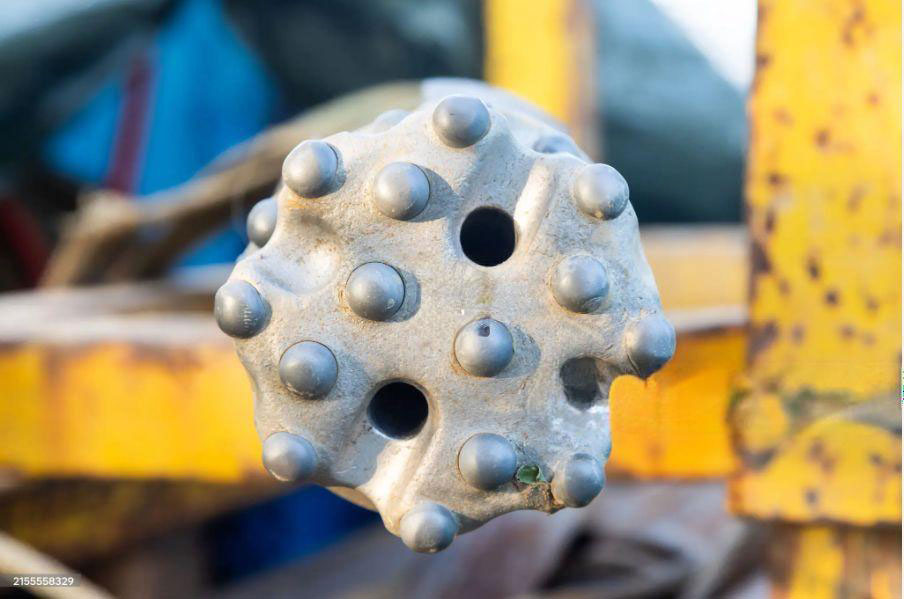
Choosing the right DTH drilling solution means matching every component — hammer, bit, drill pipe, and compressor — to your specific hole diameter, rock formation, and project depth. Get any single element wrong, and you lose penetration rate, burn through consumables, or stall the entire operation.
This guide breaks down every component of a Down-The-Hole (DTH) drilling system, maps tool configurations to five major applications, and provides a step-by-step system-matching framework that no other single resource consolidates. Every recommendation is backed by MSD's 23+ years of manufacturing and field engineering experience supplying 1,000+ drilling contractors across 40+ countries.
What Is DTH Drilling and Why Is It the Preferred Method for Hard Rock?
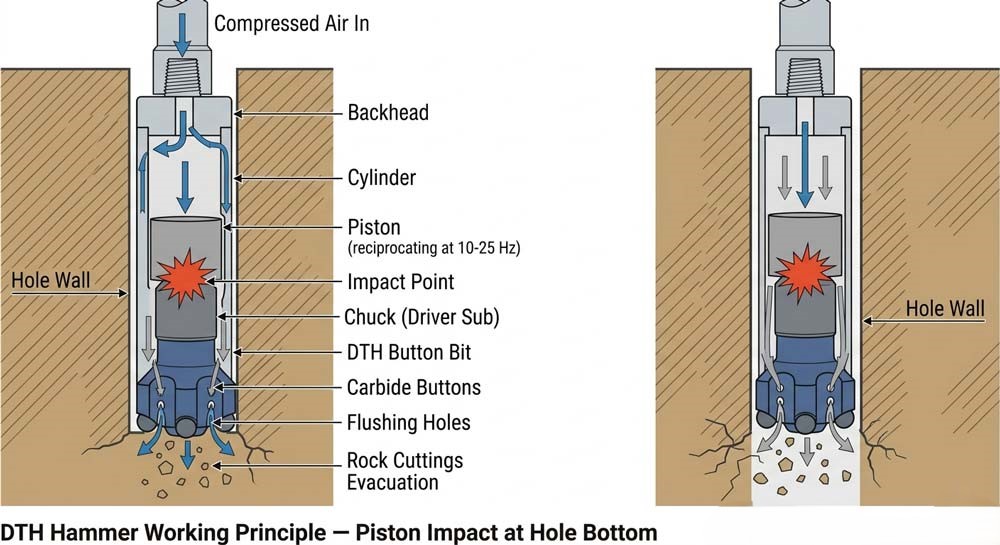
DTH drilling is a percussion drilling method where a pneumatic hammer operates at the bottom of the borehole, driving a piston that strikes the drill bit directly against the rock face. This direct-impact mechanism delivers consistent blow energy regardless of hole depth — a critical advantage over surface-driven methods.
How DTH Drilling Works — The Mechanical Principle
Down-The-Hole (DTH) drilling transmits percussion energy directly at the rock face by positioning the hammer immediately behind the bit at the bottom of the hole. Compressed air enters through the drill string, actuates the piston inside the hammer, and the piston strikes the bit at frequencies typically between 1,400 and 2,000 blows per minute. The exhaust air then flushes cuttings up through the annular space between the drill string and the borehole wall.
This design eliminates the energy loss inherent in surface-driven systems. In top hammer drilling, percussion energy must travel through the entire drill string — and every rod joint absorbs and dissipates a portion of that energy. DTH drilling bypasses this problem entirely, which is why penetration rate remains virtually constant whether the hole is 10 metres deep or 100 metres deep.
DTH vs. Top Hammer — When to Choose Which
DTH drilling outperforms top hammer drilling in holes deeper than approximately 15–20 metres and in diameters larger than 89 mm, particularly in medium-hard to extremely hard rock formations. Top hammer systems are more efficient for shallow holes under 15 metres with smaller diameters (typically 32–76 mm), where the shorter drill string means energy loss is minimal.
| Parameter | DTH Drilling | Top Hammer Drilling |
|---|---|---|
| Optimal Hole Depth | 15–300+ m | 1–20 m |
| Typical Hole Diameter | 89–1,000 mm | 32–89 mm |
| Hole Deviation | Very low (< 1%) | Increases with depth |
| Penetration Rate vs. Depth | Constant | Decreases significantly |
| Energy Transfer Efficiency | 80–90% at any depth | Drops below 60% past 20 m |
MSD is an ISO 9001 certified rock drilling tools manufacturer with 23+ years of export experience, supplies both DTH and top hammer tools — and the choice between them depends on three factors: hole depth, hole diameter, and rock hardness.
Core Components of a DTH Drilling System
A complete DTH drilling solution consists of three primary components: the DTH hammer, the DTH bit, and the drill pipe. Each component must be correctly specified and matched to the others — a mismatch at any point degrades the entire system's performance.
DTH Hammers — The Engine of the System
The DTH hammer is the pneumatic engine that converts compressed air into percussion energy, driving the piston to strike the drill bit at the hole bottom. Hammer selection determines the maximum hole diameter, required air pressure, air consumption volume, and achievable blow energy for the entire drilling system.
MSD manufactures DTH hammers across all six major international series: DHD, MISSION, QL, SD, COP, and NUMA. Each series corresponds to a specific operating pressure range and shank interface standard. Operating pressures range from 1.0–1.7 MPa (low-pressure class) through 1.7–2.5 MPa (mid-pressure class) to 2.5–3.5 MPa (high-pressure class), with air consumption varying from approximately 5 m³/min for a 3-inch hammer up to 30+ m³/min for an 8-inch unit.
Hammer selection is not about choosing the "biggest" model. It is about matching the hammer's rated operating pressure and air volume to your compressor's output — and then confirming that the hammer's shank interface is compatible with your target bit diameter. Oversizing the hammer without adequate air supply results in under-performance worse than using a correctly sized smaller unit.
DTH Bits — Where Carbide Meets Rock
DTH bits are the cutting tools that directly contact and fracture the rock formation, and they connect to DTH hammers through a splined shank and retaining ring system — not through threaded connections. The splined shank transmits rotational torque from the drill string while allowing the piston's impact energy to pass directly through to the bit face.
MSD produces DTH bits covering hole diameters from 90 mm to 1,000 mm. Each bit features tungsten carbide buttons pressed into the steel body using a cold pressing / interference fit process. MSD's cold-press process achieves a button retention rate exceeding 99.95%, meaning fewer than 5 buttons per 10,000 are lost during service — a critical quality metric because a single lost button can cause asymmetric wear, hole deviation, and premature bit failure.
Button shape selection directly determines bit performance in specific rock types:
Spherical (domed) buttons — Designed for highly abrasive and extremely hard rock (granite, quartzite, gneiss). The rounded profile resists chipping and distributes impact stress evenly, maximizing service life in punishing conditions.
Ballistic (parabolic) buttons — Optimised for soft to medium-hard rock (limestone, sandstone, shale). The pointed geometry concentrates impact force on a smaller contact area, delivering higher penetration rate at the cost of faster wear.
Conical buttons — A balanced geometry for medium-hard formations where both penetration rate and durability matter equally.
DTH Drill Pipes — The Overlooked Critical Link
DTH drill pipes transmit rotational torque from the drill rig to the hammer and bit, convey compressed air from the compressor to the hammer, and provide the structural column that maintains hole alignment. Despite this triple function, drill pipes are the most frequently under-specified component in DTH drilling systems.
Pipe wall thickness must be matched to both the drilling depth and the torque requirements of the rig. Thin-walled pipes reduce weight and cost but fatigue faster under high-torque rotation, especially in deep holes where the cumulative string weight adds compressive stress. Thread connections between pipe joints are the weakest point in the drill string — and thread failure is the single most preventable cause of costly fishing operations.
MSD DTH drill pipes are manufactured with precision-machined API-standard threads and heat-treated joints to resist fatigue cracking. Proper pipe selection and regular thread inspection eliminate the majority of non-productive downtime events in DTH operations.
How to Select the Right DTH Drilling Solution by Application
The correct DTH drilling solution varies dramatically depending on the application. A mining bench drilling operation in granite demands a fundamentally different hammer-bit-pipe configuration than a 300-metre water well through layered sedimentary formations. This section maps specific MSD tool configurations to the five most common DTH applications.
Mining — Bench Drilling and Production Blasting
Mining bench drilling typically requires hole diameters between 89 mm and 254 mm in medium-hard to extremely hard rock formations including granite, gneiss, iron ore, and basalt. The primary performance metrics are penetration rate (metres per hour) and bit service life (metres per bit), because both directly determine the cost-per-metre of the blasting pattern.
For mining applications, MSD recommends mid-pressure DTH hammers (DHD or QL series) paired with spherical-button bits for abrasive formations or ballistic-button bits when penetration rate is prioritized over bit longevity. Operating pressures typically range from 1.7–2.4 MPa, and the compressor must deliver consistent volume without pressure drops during peak demand.
Field Data: "Iron Ore Mining, Russia"
MSD QL60 DTH hammer paired with a 165 mm spherical-button DTH bit achieved 340 metres per bit in a Russian iron ore mining operation. The formation consisted of magnetite ore with interbedded gneiss at f=14–16 hardness. Operating pressure was maintained at 1.8 MPa throughout the project, with consistent penetration rates of 0.5–0.6 m/min across the full 25-metre bench depth.
Water Well Drilling — Depth, Diameter, and Formation Variability
Water well drilling presents unique challenges that distinguish it from all other DTH applications: large hole diameters (typically 152–444 mm), deep holes (often exceeding 150 metres), and highly variable geological formations that can change from soft clay overburden to hard crystalline basement rock within a single borehole.
High-pressure DTH hammers (SD, NUMA, or COP series operating at 2.5–3.5 MPa) are the standard choice for water well drilling because they deliver the blow energy needed to maintain penetration rate through dense formations at depth. MSD recommends dome or spherical buttons for water well bits, as these geometries handle the abrupt formation transitions that would chip or fracture ballistic buttons.
Water well contractors must also account for cuttings evacuation. In large-diameter holes, the annular space between the drill string and borehole wall is substantial, and insufficient air velocity allows cuttings to settle and pack around the hammer — causing stuck tools and costly fishing operations.
Quarrying — Maximizing Fragmentation Efficiency
Quarrying operations prioritize fragmentation quality over raw penetration speed. Hole diameters are typically smaller (76–127 mm) and shallower than mining bench holes, but the drilling pattern — hole spacing, burden distance, and charge distribution — must produce consistent rock breakage for efficient loading and hauling.
Mid-pressure DTH hammers in the DHD or MISSION series are the most common choice for quarry applications. Ballistic buttons deliver the penetration rate needed to complete dense drilling patterns on schedule, while the relatively shorter hole depths (typically 10–20 metres) mean bit wear is manageable even with the more aggressive button geometry.
Construction and Geothermal — Overburden and Casing Challenges
Construction foundation drilling and geothermal energy projects frequently encounter unstable overburden formations — loose soil, gravel, clay, or weathered rock — that collapse before the borehole can be stabilized. In these conditions, standard open-hole DTH drilling cannot maintain borehole integrity, and a casing system must be deployed simultaneously with the drilling operation.
MSD supplies two casing system solutions for overburden drilling:
Eccentric casing system (ODEX) — Uses a reaming bit that swings outward to cut a hole larger than the casing OD, allowing the casing to advance behind the bit. Ideal for relatively shallow overburden layers (typically up to 50–80 metres).
Concentric casing system (Symmetrix) — Uses a ring bit and pilot bit assembly where the casing shoe itself participates in the cutting action. Designed for deeper overburden penetration and more demanding formation conditions.
Geothermal drilling adds extreme depth (often 200–500+ metres) and elevated downhole temperatures to the challenge. High-pressure DTH hammers (SD or COP series) with spherical-button bits are the standard configuration, and all seals and lubricants must be rated for the thermal environment.
Application Selection Summary
| Application | Typical Hole Ø | Recommended Hammer Class | Recommended Button Type | Key Selection Factor |
|---|---|---|---|---|
| Mining (bench) | 89–254 mm | Mid-pressure (DHD / QL) | Spherical / Ballistic | Penetration rate + bit life balance |
| Water Well | 152–444 mm | High-pressure (SD / NUMA / COP) | Dome / Spherical | Depth capability + formation variability |
| Quarrying | 76–127 mm | Mid-pressure (DHD / MISSION) | Ballistic | Fragmentation pattern efficiency |
| Construction | Variable | Application-dependent | Application-dependent | Overburden stability |
| Geothermal | 152–311 mm | High-pressure (SD / COP) | Spherical | Extreme depth + temperature resistance |
DTH System Matching — Hammer, Bit, Pipe, and Compressor Sizing
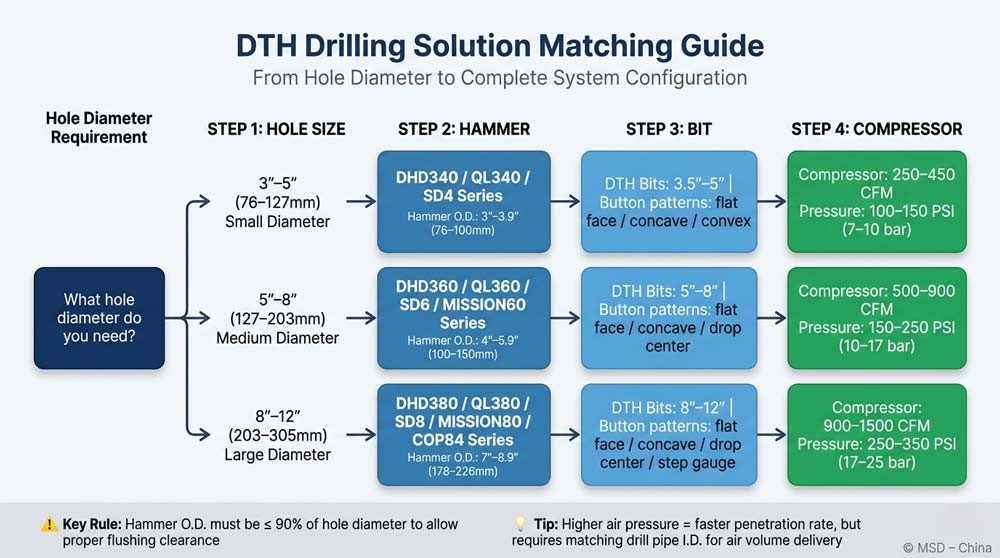
Correct DTH system matching follows a strict four-step sequence: start with the required hole diameter, then work backward through bit selection, hammer compatibility, compressor sizing, and finally drill pipe specification. Skipping or reversing any step leads to mismatched components and degraded performance.
Step 1 — Start With the Hole Diameter
The required hole diameter is always the starting point because it dictates every subsequent component selection. The hole diameter is determined by the project specification — blast pattern design in mining, casing OD in water well drilling, or foundation pile diameter in construction.
Once the hole diameter is defined, the bit diameter is fixed. MSD DTH button bits are available from 90 mm to 1,000 mm, covering virtually every DTH application.
Step 2 — Match Hammer to Bit
The DTH hammer must be compatible with the selected bit through the splined shank interface. Each hammer series accepts a specific range of bit diameters — and cross-series mixing is not possible because the shank profiles differ between DHD, MISSION, QL, SD, COP, and NUMA standards.
MSD's hammer-to-bit compatibility follows these general ranges:
| Hammer Series | Typical Bit Diameter Range | Operating Pressure Class |
|---|---|---|
| DHD 340 / MISSION 40 | 90–115 mm | Low to Mid (1.0–2.0 MPa) |
| DHD 360 / MISSION 60 / QL60 | 152–203 mm | Mid (1.7–2.5 MPa) |
| SD6 / COP 64 / NUMA 100 | 152–203 mm | High (2.5–3.5 MPa) |
| SD8 / COP 84 / NUMA 120 | 200–254 mm | High (2.5–3.5 MPa) |
| SD10 / SD12 | 254–381 mm | High (2.5–3.5 MPa) |
Contact MSD engineers for the exact compatibility matrix for non-standard diameters or specialized applications.
Step 3 — Size the Compressor
Compressor sizing is where most DTH drilling performance problems originate. The pneumatic DTH hammer requires a specific minimum air pressure and air volume to operate at its rated blow frequency and energy. Supplying less air than the hammer demands results in reduced blow frequency, lower penetration rate, and increased fuel consumption per metre drilled.
Rule of Thumb: For every 1-inch increase in DTH bit diameter, plan for approximately 100–150 CFM additional air volume at the hammer's rated operating pressure. Under-sizing the compressor is the single most common cause of poor DTH drilling performance.
Working pressure classes for DTH systems:
Low pressure: 100–150 PSI (0.7–1.0 MPa) — Small-diameter holes, shallow depths
Medium pressure: 150–250 PSI (1.0–1.7 MPa) — Standard mining and quarrying
High pressure: 250–350 PSI (1.7–2.4 MPa) — Deep water well and geothermal
Always verify the compressor's delivered air volume at the required pressure — not its rated "free air delivery" at zero pressure. A compressor rated at 900 CFM free air may only deliver 700 CFM at 250 PSI operating pressure.
Step 4 — Select Drill Pipe Specifications
DTH drill pipes must satisfy three requirements simultaneously: the outer diameter must leave sufficient annular space for cuttings evacuation, the inner diameter must allow adequate air flow to the hammer, and the wall thickness must withstand the combined rotational torque and compressive load at the target drilling depth.
For deep holes exceeding 100 metres, MSD recommends heavy-wall drill pipes with heat-treated thread connections to prevent fatigue failure. In shallow quarry operations under 20 metres, standard-wall pipes are sufficient and reduce the total string weight on the rig's pullback system.
What Sets a Reliable DTH Drilling Solution Apart — Quality Factors That Matter
Not all DTH drilling tools perform equally, even when the specifications appear identical on paper. The difference between a tool that delivers consistent performance for 300+ metres and one that fails at 150 metres comes down to three manufacturing quality factors.
Carbide Button Quality and Retention Method
The tungsten carbide buttons on a DTH bit are the only component that directly contacts the rock. Button quality is defined by two parameters: the carbide grade (the balance between hardness and fracture toughness) and the retention method that holds the button in the steel body.
MSD uses a cold pressing / interference fit process where each button is pressed into a precision-bored socket with a controlled interference of several hundredths of a millimetre. This interference creates a compressive grip that holds the button securely under the extreme impact and vibration of DTH drilling. MSD's cold-press process achieves a button retention rate exceeding 99.95% — meaning fewer than 5 buttons per 10,000 installed are lost during service.
Lower-quality manufacturers use looser tolerances or inconsistent socket depths, resulting in button loss rates 5–10 times higher. A single lost button creates an unprotected steel surface that erodes rapidly, causing asymmetric wear, hole deviation, and cascading failure of adjacent buttons.
Heat Treatment and Steel Quality
The steel body of both DTH hammers and DTH bits must withstand millions of high-frequency impact cycles without cracking or deforming. This requires precise heat treatment — case hardening the outer surface for wear resistance while maintaining a tough, ductile core that absorbs impact energy without brittle fracture.
MSD's heat treatment process achieves a case hardening depth calibrated to each product's service conditions. Hammer cylinders receive a different treatment profile than bit bodies because the stress patterns differ. Cheap hammers that skip or shortcut heat treatment develop piston bore scoring, cylinder cracking, and premature retirement — often within the first 500 operating hours.
Quality Control and Consistency at Scale
In our 23+ years of manufacturing rock drilling tools, MSD has learned that consistency matters more than peak performance. A bit that drills 350 metres once but only 180 metres the next time creates planning chaos for drilling contractors who need predictable cost-per-metre calculations.
MSD's ISO 9001 certified quality management system ensures that every DTH hammer, bit, and drill pipe leaving the factory meets the same dimensional and metallurgical specifications — whether it is the first unit of the production run or the ten-thousandth. Over 1,000 drilling contractors in 40+ countries rely on MSD tooling for consistent hole-to-hole performance.
Rule of Thumb: When evaluating DTH tool suppliers, request the button retention test data and heat treatment certification — not just the product catalog. These two documents reveal more about actual drilling performance than any specification sheet.
Real-World DTH Drilling Performance — MSD Field Case Studies
Technical specifications describe what a DTH drilling solution should do. Field case studies prove what it actually does under real geological conditions, with real equipment, operated by real drilling crews.
Case Study 1 — Iron Ore Bench Drilling, Russia
Field Data: "Iron Ore Mining, Kursk Region, Russia"
MSD supplied QL60 DTH hammers paired with 165 mm spherical-button DTH bits for a large-scale iron ore bench drilling operation. The formation consisted of magnetite ore interbedded with gneiss and amphibolite, rated at f=14–16 on the Protodyakonov hardness scale. Operating pressure was maintained at 1.8 MPa with a 25 m³/min compressor. Results: 340 metres drilled per bit with consistent penetration rates of 0.5–0.6 m/min across the full 25-metre bench depth. The client reported a 24% improvement in bit service life compared to the previously used premium European brand tooling.
This case demonstrates that correctly matched mid-pressure DTH systems can outperform higher-cost alternatives when the hammer-bit-compressor configuration is optimised for the specific formation.
Case Study 2 — Water Well Drilling, East Africa
Field Data: "Water Well Borehole Program, East Africa"
MSD SD6 high-pressure DTH hammers with 152 mm dome-button DTH bits were deployed across a multi-borehole water supply program. Formations ranged from laterite overburden (0–15 m) through weathered granite (15–40 m) to fresh crystalline basement rock (40–120 m). Operating pressure was 2.4 MPa. Results: average 280 metres drilled per bit across 12 boreholes, with zero button loss events recorded. The dome-button geometry handled the abrupt formation transitions without chipping — a problem the contractor had experienced with ballistic-button bits from a previous supplier.
Based on our experience supplying drilling contractors across Africa, the Middle East, South America, and Central Asia, MSD recommends dome or spherical buttons for any water well project where the geological survey indicates mixed or uncertain formation conditions.
Frequently Asked Questions
Q: What does DTH stand for in drilling?
A: DTH stands for Down-The-Hole. DTH drilling is a percussion method where the pneumatic hammer operates at the bottom of the borehole, directly behind the drill bit. The piston strikes the bit at the rock face, delivering consistent blow energy regardless of hole depth — unlike top hammer systems where energy diminishes as the drill string lengthens.
Q: What is the maximum depth DTH drilling can reach?
A: DTH drilling can reach depths exceeding 500 metres in favourable conditions, though most commercial applications operate between 15 and 300 metres. Depth capability depends on the compressor's ability to deliver adequate air volume and pressure to the hammer at depth, the drill string's structural integrity, and the efficiency of cuttings evacuation from the borehole.
Q: How do I choose between a low-pressure and high-pressure DTH hammer?
A: Low-pressure DTH hammers (1.0–1.7 MPa) suit shallow holes under 50 metres in soft to medium rock. High-pressure DTH hammers (2.5–3.5 MPa) are required for deep holes, large diameters, and hard rock formations where greater blow energy is needed to maintain penetration rate. The deciding factors are hole depth, rock hardness, and available compressor capacity.
Q: How many metres can a DTH bit drill before replacement?
A: DTH bit service life typically ranges from 150 to 500+ metres depending on rock abrasiveness, button type, operating pressure, and manufacturing quality. MSD spherical-button DTH bits achieve 300–400 metres per bit in hard abrasive formations (f=12–16) under standard operating conditions. Softer formations extend bit life significantly.
Q: Can the same DTH hammer be used with bits from different manufacturers?
A: DTH hammers accept bits with matching splined shank profiles within the same series standard (e.g., DHD, SD, COP). However, MSD recommends using hammer and bit from the same manufacturer to ensure precise shank-to-chuck tolerances. Mixing manufacturers risks slight dimensional mismatches that accelerate shank wear and reduce energy transfer efficiency.
Q: Does MSD supply complete DTH drilling solutions or only individual components?
A: MSD supplies complete DTH drilling solutions including DTH hammers, DTH bits, drill pipes, shank adapters, and casing systems (both ODEX and Symmetrix). MSD engineers provide free technical consultation to help contractors select the optimal tool configuration for their specific application, rock formation, and equipment setup. Contact MSD for a customised DTH system recommendation.
Technical content reviewed by MSD Engineering Team. | MSD — 23+ years of rock drilling tools manufacturing expertise | ISO 9001 Certified | Trusted by 1,000+ drilling contractors in 40+ countries