

What Is BR in DTH Hammer? Series Specs & Comparison Guide
What Does "BR" Mean in DTH Hammers?
BR Series Origin and Designation
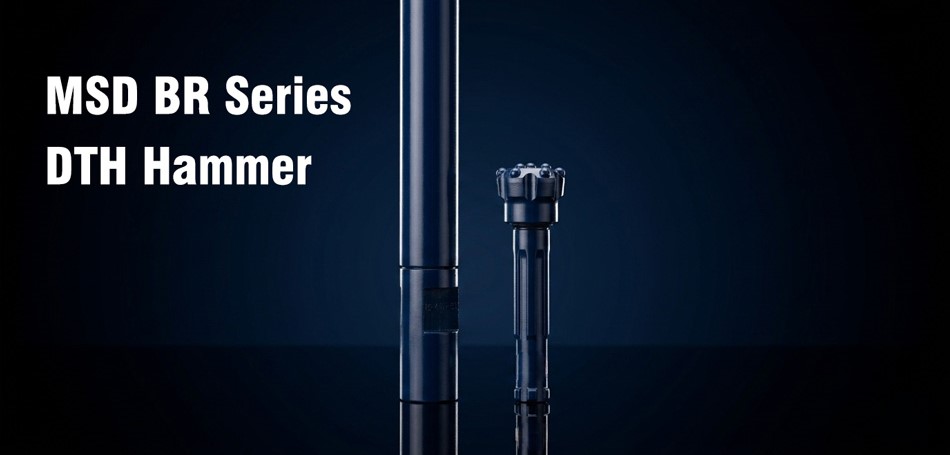
BR is a DTH (Down-The-Hole) hammer series designation that identifies a specific family of pneumatic percussion hammers characterized by their valved air distribution design and medium-pressure operating range. The letters "BR" do not represent a single manufacturer's brand — they define an industry-wide design standard, much like DHD, QL, SD, MISSION, COP, and NUMA each designate distinct hammer families with unique shank profiles, pressure ratings, and internal air distribution architectures.
The number following "BR" indicates the approximate hole diameter class in inches. A BR1 hammer drills holes in the 1-inch class (approximately 51–64 mm diameter). A BR2 covers the 2-inch class (approximately 70–89 mm). A BR3 handles the 3-inch class (approximately 85–105 mm). This numbering convention allows drillers and procurement teams to quickly identify the hammer size category without consulting detailed specification sheets.
MSD, a rock drilling tools manufacturer with 23+ years of export experience, produces DTH hammers compatible with all major series designations — including BR, DHD, MISSION, QL, SD, COP, and NUMA. This cross-series manufacturing capability provides MSD with a unique engineering perspective on how BR hammers compare against every other family in the global market.
How BR Fits in the DTH Hammer Classification System
DTH hammers are classified along two primary axes: air pressure operating range and design family (shank compatibility). Understanding where BR sits on both axes is essential for correct hammer selection.
The pressure axis divides all DTH hammers into three categories. Low-pressure hammers operate below 7 bar (100 psi). Medium-pressure hammers — where the BR series sits — operate between 7 and 17.5 bar (100–250 psi). High-pressure hammers operate above 17.5 bar (250 psi) and are typically reserved for large-scale production drilling in mining and quarrying.
The design family axis determines physical interchangeability. Each series (BR, DHD, QL, SD, MISSION, COP, NUMA) has a unique splined shank profile on its matching DTH drill bit. A BR bit cannot be mounted on a DHD hammer, and vice versa. The shank dimensions, spline count, and retaining ring groove geometry are all series-specific. Drill string components — including DTH drill pipes — must also be matched to the hammer's top sub thread specification.
BR Series DTH Hammer Specifications
BR1 — Small Diameter Class
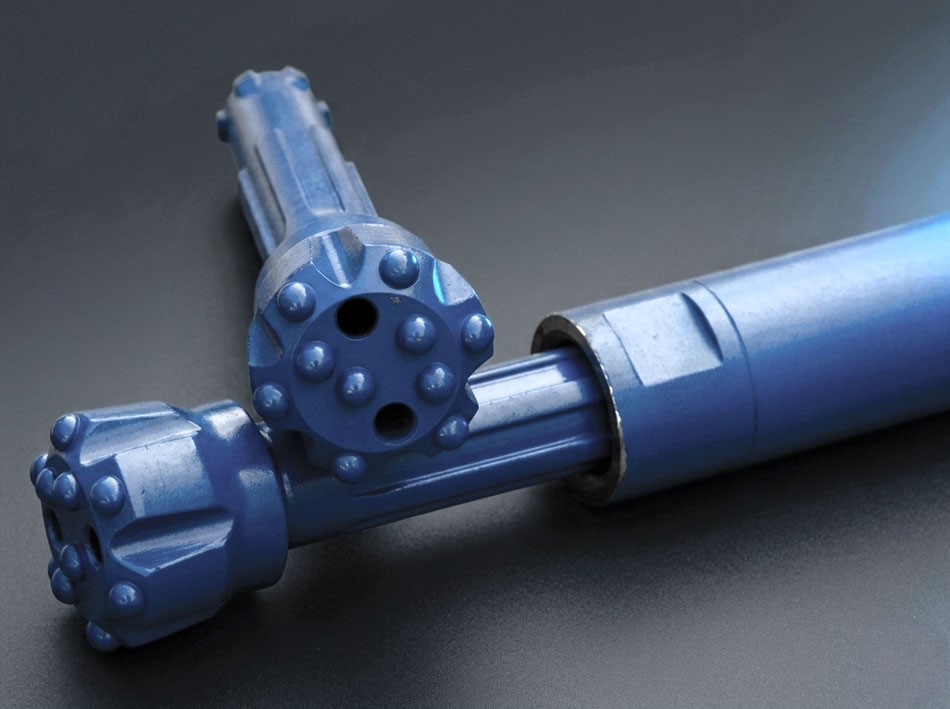
BR1 hammers drill holes in the 51–64 mm diameter range, making them the smallest members of the BR family. These hammers typically require 5–8 m³/min of air volume at 7–12 bar operating pressure. The compact outer diameter of the BR1 — typically around 48–52 mm — allows deployment in confined spaces where larger hammer series cannot physically fit.
Typical applications for BR1 include anchor bolt hole drilling, micropile installation, and small-diameter geotechnical investigation boreholes. BR1 hammers are commonly paired with lightweight, trailer-mounted drill rigs equipped with 185–250 CFM compressors.
BR2 — Medium Diameter Class
BR2 hammers cover the 70–89 mm hole diameter range and represent the most widely deployed model in the BR family. Operating pressure ranges from 8–15 bar, with air consumption typically between 7–12 m³/min depending on the specific bit diameter selected.
BR2 hammers are the workhorse of small-to-medium water well drilling operations across Africa, Southeast Asia, and South America. The medium-pressure requirement means BR2 hammers can be driven by 350–500 CFM compressors — significantly more affordable and transportable than the 900+ CFM units required for high-pressure mining hammers.
BR3 — Larger Diameter Class
BR3 hammers drill holes in the 85–105 mm diameter range. Operating pressure requirements increase to 10–17.5 bar, with air consumption reaching 12–18 m³/min. The larger piston mass in BR3 hammers delivers substantially higher single-blow impact energy compared to BR1 and BR2, enabling effective drilling in harder formations.
BR3 applications include medium-depth water wells (up to 150–200 m), construction drilling for foundation piling, and small-diameter blast hole drilling in soft-to-medium rock formations.
BR Series Specification Summary Table
| Model | Hole Diameter Range (mm) | Operating Pressure (bar) | Air Consumption (m³/min) | Hammer OD (mm) | Typical Applications |
|---|---|---|---|---|---|
| BR1 | 51–64 | 7–12 | 5–8 | 48–52 | Anchor bolts, micropiles, small boreholes |
| BR2 | 70–89 | 8–15 | 7–12 | 65–73 | Water wells, exploration, geotechnical |
| BR3 | 85–105 | 10–17.5 | 12–18 | 80–90 | Water wells, construction piling, small blast holes |
How BR Hammers Work — Valved Design Explained
Valved vs. Valveless DTH Hammer Design
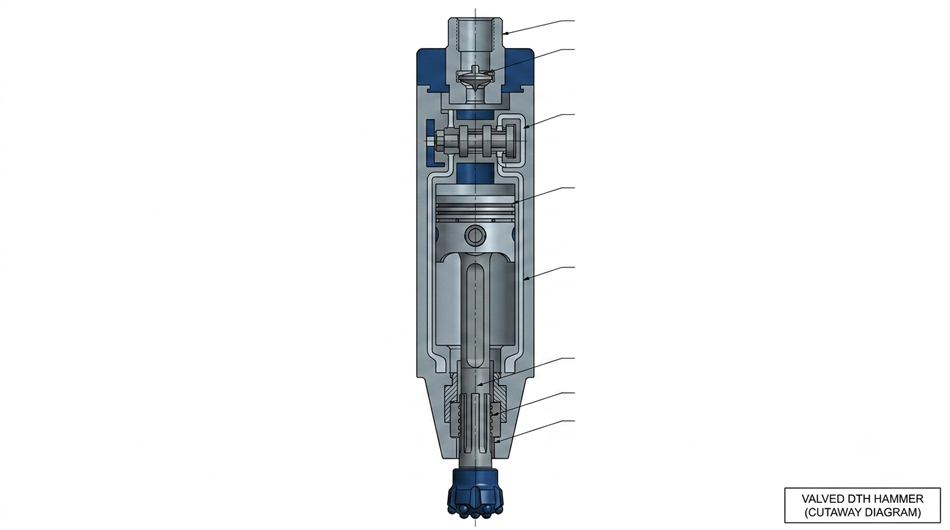
BR hammers use a mechanical air distribution valve to control compressed air flow to the piston — this is the defining engineering feature that separates the BR series from valveless hammer designs. The valve alternates air pressure between the top and bottom faces of the piston, creating a reciprocating cycle: compressed air drives the piston downward (forward stroke), the piston strikes the bit shank transferring percussive energy to the rock face, then the valve redirects air to return the piston upward (return stroke) while exhaust air flushes cuttings through the bit's flushing holes.
Valveless pneumatic DTH hammers, used in some high-pressure series, rely on piston-porting geometry rather than a separate valve component to redirect air flow. Valveless designs reduce internal moving parts but typically require higher operating pressures to function efficiently. The BR series' valved architecture achieves more efficient air utilization at medium pressures, making BR hammers practical for operations where compressor capacity is limited.
The BR series follows the valved architecture — but valveless designs offer different advantages in certain conditions; for a side-by-side valved and valveless DTH hammer comparison, see our complete design guide.
The valve also provides positive backflow prevention. When drilling through water-bearing formations or encountering high groundwater pressure, the valve prevents water from entering the hammer's air chamber — a critical advantage in water well drilling where intersecting aquifers is the entire objective.
Why Medium-Pressure Operation Matters
Medium-pressure operation (7–17.5 bar) is not a limitation — it is a deliberate engineering trade-off that makes BR hammers accessible to a wider range of drilling operations. A BR2 hammer paired with a 400 CFM compressor can drill 76 mm water wells to 120+ meters depth in sedimentary formations. The equivalent hole drilled with a high-pressure hammer series would require a 900+ CFM compressor costing two to three times more.
The trade-off is impact energy per blow. BR hammers deliver lower single-blow energy than high-pressure series like COP or NUMA operating at 25+ bar. In hard, competent rock formations (UCS above 200 MPa), this difference translates to measurably slower penetration rates. In soft-to-medium formations (UCS below 150 MPa), the penetration rate difference is typically marginal — often less than 10–15%.
Rule of Thumb: For BR-series hammers, allocate approximately 1 m³/min of air volume per 10 mm of bit diameter at 10 bar working pressure. Undersizing the compressor by more than 15% below this benchmark will cause visible penetration rate loss and accelerated piston wear due to incomplete stroke cycles.
The valve-controlled air distribution in the BR series is one variation of the broader DTH operating principle — for the full DTH hammer pneumatic cycle explained step by step, see our engineering breakdown.
BR vs. Other DTH Hammer Series — What's the Difference?
The global DTH hammer market uses seven major series designations. Each series represents a distinct combination of pressure classification, air distribution design, and shank compatibility. MSD manufactures hammers compatible with all seven series, providing direct engineering insight into their comparative strengths.
DTH Hammer Series Comparison Table
| Series | Pressure Classification | Hole Diameter Range (mm) | Air Distribution | Primary Applications |
|---|---|---|---|---|
| BR | Medium (7–17.5 bar) | 51–105 | Valved | Water wells, construction, geotechnical |
| DHD | Medium–High (10–25 bar) | 85–254 | Valved/Valveless | Mining, quarrying, large water wells |
| QL | High (17.5–25+ bar) | 105–254 | Valveless | Production mining, large blast holes |
| SD | Medium–High (10–25 bar) | 85–305 | Valved/Valveless | Mining, quarrying, construction |
| MISSION | Medium–High (10–25 bar) | 85–254 | Valved | Water wells, mining, oil & gas |
| COP | High (17.5–30 bar) | 89–254 | Valveless | Hard rock mining, deep quarrying |
| NUMA | High (17.5–30 bar) | 95–610 | Valveless | Large-diameter mining, water wells |
When to Choose BR Over Other Series
BR hammers are the correct choice when three conditions align: the target hole diameter falls below 105 mm, the available compressor delivers medium-pressure air (below 17.5 bar), and the drilling application does not require maximum penetration rate in extremely hard rock.
Water well drillers operating in remote locations with portable rigs and 250–500 CFM compressors represent the largest BR user base globally. Construction contractors drilling anchor holes and foundation piles in urban environments — where compact equipment and lower noise output matter — also favor BR hammers.
Choose DHD, SD, MISSION, COP, or NUMA series when the operation requires hole diameters above 105 mm, when drilling in hard rock formations demanding maximum impact energy, or when mining drilling production rates are the primary performance metric. High-pressure series paired with high-volume compressors deliver 30–60% higher penetration rates in hard rock (UCS above 200 MPa) compared to BR hammers in the same formation.
The selection framework follows a clear decision sequence: determine available compressor output → identify maximum sustainable pressure → narrow to compatible hammer series → select by required hole diameter → match bit configuration to rock formation. If you're weighing the BR series against DHD, QL, or SD options, the decision depends on your air supply, hole diameter, and formation hardness — our guide on choosing the correct DTH hammer for your project covers the full selection framework.
DTH Bits Compatible with BR Series Hammers
BR Bit Shank Connection — Splined Shank System
BR series down the hole bits connect to the hammer through a splined shank and retaining ring system — not through threaded connections. The splined shank transmits rotational torque from the hammer's drive chuck to the bit while allowing the bit to reciprocate slightly under each piston impact. A retaining ring seated in a machined groove on the shank prevents the bit from separating from the hammer during drilling.
Each BR model (BR1, BR2, BR3) has a unique shank diameter and spline geometry. BR1 bits cannot be mounted on a BR2 hammer. BR2 bits cannot be mounted on a BR3 hammer. Attempting to force cross-model compatibility will damage both the hammer chuck and the bit shank, leading to immediate operational failure.
Choosing the Right Button Configuration for BR Bits
Button shape selection on DTH button bits directly determines penetration rate and bit service life in any given formation. For BR hammers operating at medium pressures, efficient energy transfer through the button face becomes even more critical — every joule of impact energy must work productively because the total energy per blow is lower than high-pressure systems.
Spherical (domed) buttons are the standard choice for highly abrasive and extremely hard rock formations such as granite, quartzite, and gneiss. The rounded profile resists chipping and distributes impact stress evenly across the button surface. Ballistic (parabolic) buttons are designed for soft-to-medium formations such as limestone, sandstone, and weathered overburden, where faster penetration rate is prioritized over button wear resistance. Conical buttons provide a balanced profile for medium-hard formations.
MSD secures tungsten carbide buttons into DTH bit bodies using cold pressing (interference fit), achieving a sub-0.05% button loss rate across production. Cold pressing creates a mechanical compression bond between the carbide button and the steel bit body — the button is pressed into a slightly undersized hole, creating permanent radial compression that holds the button firmly even under thousands of repeated high-frequency impacts. This retention method is critical for BR bits where medium-pressure operation means each impact must transfer energy cleanly without button loosening or rotation.
BR Series DTH Hammer Applications
Water Well and Borehole Drilling
BR2 and BR3 hammers are the most widely deployed DTH hammer models in the global water well drilling sector, particularly across sub-Saharan Africa, Southeast Asia, and rural South America. The medium-pressure operating requirement aligns with the 250–500 CFM portable compressors that dominate these markets. Drilling contractors in these regions typically operate trailer-mounted or truck-mounted rigs that cannot accommodate the weight and fuel consumption of high-pressure compressor systems.
Field Data: "Water Well Drilling, West Africa"
Based on MSD's experience supplying 1,000+ drilling contractors across 40+ countries, BR2-equivalent hammers paired with 76 mm DTH bits consistently achieve 80–120 meters of total drilling depth in sedimentary formations (sandstone and weathered granite, UCS 50–120 MPa) before requiring bit replacement. In these conditions, penetration rates typically range from 8–15 meters per hour at 12 bar operating pressure with a 400 CFM compressor.
MSD's ISO 9001 certified manufacturing process ensures consistent dimensional tolerances across production batches — a critical quality factor for drilling contractors operating in remote locations where receiving replacement parts requires weeks of logistics lead time.
Construction and Geotechnical Drilling
BR1 hammers serve a specialized niche in urban construction drilling. Anchor bolt holes for slope stabilization, micropile drilling for building foundations, and grouting holes for ground improvement projects all require small-diameter boreholes drilled in confined spaces. The compact dimensions of BR1 hammers — typically under 52 mm outer diameter — allow deployment on lightweight hydraulic drill rigs that can operate inside existing structures or on narrow construction platforms.
BR2 hammers are used for foundation investigation boreholes and pre-construction geotechnical surveys. The 70–89 mm hole diameter range provides sufficient core diameter for geological sampling while keeping compressor requirements manageable on congested urban job sites.
Frequently Asked Questions About BR DTH Hammers
Q: What does DTH stand for in drilling?
A: DTH stands for Down-The-Hole. DTH drilling is a percussion drilling method where the hammer operates at the bottom of the hole, directly behind the drill bit, delivering impact energy straight to the rock face. Compressed air travels down through the DTH pipe to power the hammer's piston and flush rock cuttings back to the surface through the annular space between the drill string and the borehole wall.
Q: Can BR hammer bits be used with other hammer series?
A: No. Each DTH hammer series has a unique splined shank profile. BR bits are physically incompatible with DHD, QL, SD, MISSION, COP, or NUMA hammers. The spline count, shank diameter, and retaining ring groove dimensions differ between every series. Always match the bit shank designation to the hammer series designation exactly.
Q: What size compressor do I need for a BR DTH hammer?
A: BR1 hammers typically require 175–280 CFM at 7–12 bar. BR2 hammers require 250–425 CFM at 8–15 bar. BR3 hammers require 425–635 CFM at 10–17.5 bar. These values assume the bit diameter is at the midpoint of each model's range. Always verify the specific air consumption rating for the exact bit diameter selected — undersized compressors are the single most common cause of poor BR hammer performance.
Q: How long does a BR DTH hammer last?
A: BR hammer service life depends on maintenance discipline, rock abrasiveness, and operating pressure consistency. With proper inline lubrication and pressure regulation within the rated range, MSD-quality DTH hammers typically deliver 3,000–8,000 drilling meters before requiring piston or valve overhaul. Highly abrasive formations (quartzite, banded iron) reduce service life toward the lower end of this range.
Q: Does MSD manufacture BR series DTH hammers?
A: MSD produces DTH hammers compatible with all major series including BR, DHD, MISSION, QL, SD, COP, and NUMA. With 23+ years of manufacturing experience and ISO 9001 certification, MSD serves 1,000+ drilling contractors across 40+ countries. MSD engineers provide free technical consultation to help drilling teams select the correct hammer series, bit configuration, and compressor match for their specific geological conditions. Contact MSD for expert guidance on BR hammer selection.
Technical content reviewed by MSD Engineering Team. | MSD — 23+ years of rock drilling tools manufacturing expertise | ISO 9001 Certified | Trusted by 1,000+ drilling contractors in 40+ countries