

DTH Hammer Parts and Components: A Complete Guide to Every Component
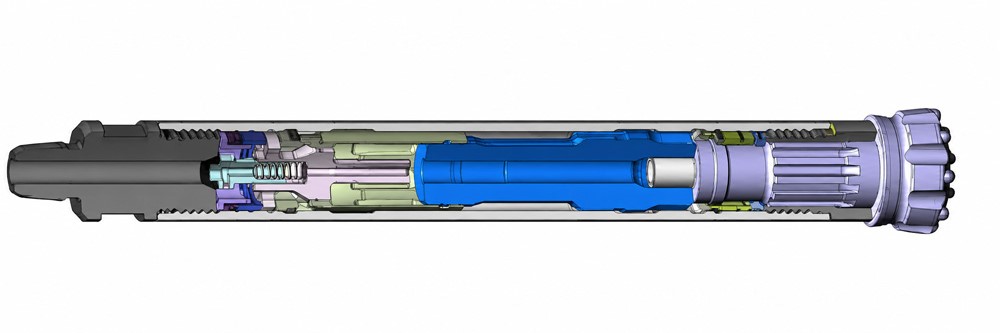
What Is a DTH Hammer and Why Every Part Matters
A DTH (Down-The-Hole) hammer is a pneumatic percussion tool that operates directly behind the drill bit at the bottom of the borehole, delivering impact energy exactly where rock breaks. Unlike surface-mounted percussion systems, every joule of energy generated inside a DTH hammer travels mere centimeters to the rock face. This makes component precision not just important — it is the single largest factor controlling drilling efficiency.
MSD, a rock drilling tools manufacturer with 23+ years of export experience, produces DTH hammers and components across all six major series — DHD, MISSION, QL, SD, COP, and NUMA. Trusted by 1,000+ drilling contractors in 40+ countries, MSD engineers every hammer component for maximum service life in demanding rock formations. Understanding what each part does — and when it needs attention — directly reduces your cost per drilled meter.
This guide covers every component inside a DTH hammer, explains how they work together through the pneumatic cycle, identifies wear patterns from real field experience, and provides practical assembly guidance. Whether you are a drilling contractor troubleshooting performance loss or a procurement officer specifying spare parts, this is your complete reference.
A DTH drill bit connects to the hammer's lower end and receives the piston's impact energy directly. The hammer-bit system forms a single percussive unit that rides at the hole bottom throughout the drilling operation.
How a DTH Hammer Works — The Basic Principle

Compressed air travels down the drill string through DTH drill pipes, enters the hammer through the top sub, and drives a piston in a rapid reciprocating cycle. The piston strikes the drill bit at frequencies typically ranging from 1,000 to 2,500 blows per minute, depending on hammer size and operating air pressure. Impact energy transfers directly at the rock face — virtually none is lost through the drill string.
This operating principle is fundamentally different from rotary drilling, which relies on continuous rotation and weight-on-bit to grind through rock. DTH percussion drilling excels in hard and very hard formations where rotary methods stall or produce unacceptable penetration rates. To understand this pneumatic cycle fully, you need to know each component and its specific role in the system.
Complete Breakdown of DTH Hammer Parts and Components
A standard DTH hammer consists of seven major components — each engineered to withstand extreme percussive forces, high temperatures, and abrasive debris at the bottom of the borehole. The following sections identify every part, explain its function, describe its material composition, and highlight the quality indicators that separate a reliable hammer from a premature failure.
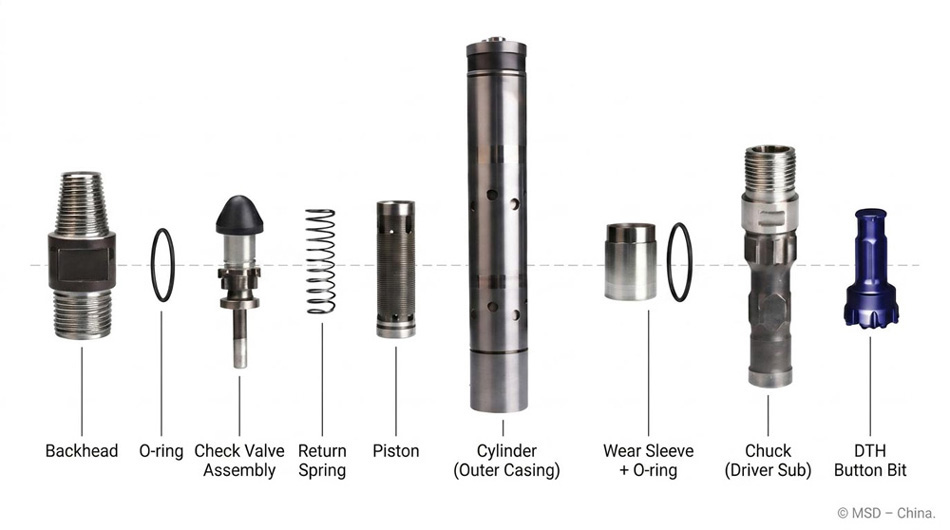
Top Sub (Backhead)
The top sub is the uppermost component of the DTH hammer, providing the threaded connection point between the hammer and the drill string. Compressed air from the drill pipe enters the hammer exclusively through the top sub's central bore. The top sub is manufactured from high-strength alloy steel with precision-machined API box threads that must withstand continuous rotational torque and vibration.
Thread precision and metallurgical quality determine the top sub's fatigue life. A poorly machined or under-hardened top sub develops thread galling within weeks, leading to costly downtime for thread repair or complete replacement.
Check Valve Assembly
The check valve sits between the top sub and the cylinder, acting as a one-way gate that allows compressed air to enter the hammer while preventing rock cuttings, water, and debris from flowing back up into the drill string when air supply stops. Check valve failure is one of the most common causes of premature internal contamination.
When a check valve fails, abrasive particles enter the cylinder bore and score both the piston and the cylinder wall. This single-component failure cascades into multi-component damage. Regular inspection of the check valve seat and spring during every hammer disassembly is essential preventive maintenance.
Outer Cylinder (Hammer Casing)
The outer cylinder — also called the hammer casing — houses the piston and forms the air distribution chamber that controls the pneumatic cycle. The internal bore of the cylinder is precision-honed to tight tolerances, because this surface is the piston's running surface throughout every stroke cycle.
MSD manufactures DTH hammer cylinders from case-hardened alloy steel, with internal bore tolerances held within ±0.02 mm and surface finishes controlled to achieve optimal piston seal performance. Case hardening depth is carefully specified to balance surface wear resistance against core toughness — too shallow, and the bore wears prematurely; too deep, and the cylinder becomes brittle under percussive shock loads.
Bore straightness, surface finish, and case hardening depth directly control piston seal life, energy transfer efficiency, and overall hammer longevity. The cylinder is typically the most expensive individual component to replace.
Piston
The piston is the heart of every DTH hammer — the reciprocating mass that converts pneumatic energy into percussive impact at the rock face. Compressed air alternately enters above and below the piston through air distribution ports machined into the cylinder wall, driving the piston downward to strike the bit, then reversing it upward to begin the next cycle.
MSD DTH hammer pistons are manufactured from high-grade alloy steel, through-hardened to 48–55 HRC depending on the hammer series, and precision-ground to concentricity tolerances within 0.01 mm. Weight consistency across production batches is controlled to ensure uniform blow energy. Any variance in piston hardness, weight, or concentricity reduces energy transfer to the bit and accelerates wear on both the piston and cylinder bore.
The piston's striking face geometry is engineered to maximize energy transfer to the bit shank while minimizing stress concentration that leads to spalling or mushrooming. A well-manufactured piston delivers consistent percussive energy for thousands of drilling meters before requiring replacement.
Driver Sub (Chuck)
The driver sub transfers the piston's impact energy to the drill bit through a splined connection. The splined shank of the DTH bit engages with the driver sub's internal splines, allowing the bit to rotate freely while receiving axial percussive impacts from the piston above. The driver sub does not rotate relative to the hammer body — rotation comes from the drill rig's rotary head through the entire drill string.
Spline fit precision and surface hardness are the critical quality indicators for the driver sub. Loose spline engagement causes energy loss and accelerated wear on both the driver sub and the bit shank.
Bit Retainer System
The bit retainer ring is a locking mechanism that holds the DTH button bit in place on the hammer while allowing limited axial travel. This axial play is essential — the bit must be free to move slightly so the piston's impact energy transfers through the driver sub without rigid mechanical shock to the retainer.
The retainer ring enables quick bit changes in the field without disassembling the entire hammer. Material toughness and dimensional accuracy are critical — a worn or deformed retainer allows bit wobble, which wastes percussive energy and causes uneven gauge wear on the bit.
DTH Bit
The DTH bit is the cutting component that directly contacts the rock face. DTH bits are fitted with tungsten carbide buttons arranged in engineered patterns — gauge buttons on the periphery maintain hole diameter, while face buttons on the striking surface break rock with each piston impact. The bit connects to the hammer via a splined shank and is held in place by the bit retainer ring.
MSD secures every tungsten carbide button using a cold-press interference fit process, achieving a sub-0.05% button loss rate. This means buttons stay locked in place even under the most punishing hard-rock conditions, where competing retention methods can lose buttons within the first hundred meters. MSD's ISO 9001 certified manufacturing process controls interference fit tolerances to ensure consistent button retention across every production batch.
Seals, O-Rings, and Wear Sleeves
Seals and O-rings prevent air leakage between the piston and cylinder, maintaining the pressure differential that drives the pneumatic cycle. DTH hammer seals are typically manufactured from high-temperature-resistant polyurethane or specialized elastomer compounds rated for sustained operating temperatures above 120°C.
Wear sleeves, used in some hammer designs, protect the cylinder bore from direct piston contact at specific high-wear zones. Seal material quality — specifically temperature resistance and compression set resistance — determines how long the pneumatic cycle remains efficient. Low-quality seals degrade rapidly, causing air bypass around the piston. This air bypass reduces percussive power and forces the compressor to work harder, increasing fuel consumption.
How DTH Hammer Components Work Together — The Pneumatic Cycle
The DTH hammer's pneumatic cycle is a two-phase process where compressed air alternately drives the piston downward (power stroke) and returns it upward (return stroke), repeating at 1,000–2,500 cycles per minute. Every component plays a specific role in this cycle, and the condition of each directly affects drilling performance. Component layout varies significantly between valved and valveless platforms — the presence or absence of a control valve changes the entire air path; see our guide to the two main DTH hammer design types for a full comparison.
Phase 1 — Power Stroke (Downstroke): Compressed air enters through the top sub, passes the check valve, and fills the upper chamber of the cylinder above the piston. Air pressure drives the piston downward at high velocity. The piston strikes the bit shank through the driver sub, transferring percussive energy directly to the rock face.
Phase 2 — Return Stroke (Upstroke): Air distribution ports in the cylinder wall redirect compressed air to the lower chamber beneath the piston. The piston reverses direction and travels upward, simultaneously exhausting spent air from the upper chamber. Exhaust air exits through flushing holes in the bit face, clearing rock cuttings from the hole bottom and cooling the bit.
The efficiency of this cycle depends entirely on component condition. A worn seal reduces the pressure differential between upper and lower chambers, weakening the piston's blow energy. A damaged check valve allows backflow of contaminated air. A scored cylinder bore bleeds air past the piston. Understanding the down the hole hammer cycle is essential for diagnosing performance problems — because every symptom traces back to a specific component.Understanding how each part contributes to the cycle is essential — for the complete DTH hammer working principle with step-by-step air flow diagrams and piston dynamics, see our dedicated guide.
DTH Hammer Parts Across Major Hammer Series
MSD manufactures pneumatic DTH hammer parts compatible with all six major global series: DHD, MISSION, QL, SD, COP, and NUMA. While the fundamental components — top sub, check valve, cylinder, piston, driver sub, bit retainer, and seals — are present in every series, the critical dimensions differ between them.
| Hammer Series | Common Sizes | Bit Diameter Range | Key Dimensional Variables |
|---|---|---|---|
| DHD | DHD340, DHD350, DHD360 | 105–203 mm | Piston OD, cylinder ID, backhead thread |
| MISSION | MISSION40, MISSION50, MISSION60, MISSION80 | 105–305 mm | Piston length, spline profile |
| QL | QL40, QL50, QL60, QL80 | 105–305 mm | Check valve design, air port layout |
| SD | SD5, SD6, SD8, SD10, SD12 | 127–381 mm | Cylinder wall thickness, piston weight |
| COP | COP44, COP54, COP64 | 105–203 mm | Backhead connection, seal configuration |
| NUMA | Various | 105–381 mm | Piston geometry, air distribution porting |
Parts are not interchangeable between series. A DHD340 piston will not fit a QL40 hammer — the outer diameter, length, air channel geometry, and striking face profile are all series-specific. Even within a single series, different sizes (e.g., DHD340 vs. DHD360) use different piston and cylinder dimensions.
These component differences across series translate directly into performance and maintenance tradeoffs — if you're deciding between platforms, our guide on selecting the right DTH hammer series covers the five key decision factors.
The BR series is one of the most common valved platforms — for full BR series DTH hammer specifications, compatible bit sizes, and application recommendations, see our BR overview.
When ordering spare parts, always specify the exact hammer series designation and size. MSD supplies individual components — pistons, cylinders, check valves, seal kits, and retainer rings — for all six series, enabling drilling contractors to source a complete spare parts inventory from a single manufacturer rather than managing multiple supplier relationships.
Common Wear Patterns and When to Replace DTH Hammer Parts
Every DTH hammer component wears during operation. Recognizing wear patterns early — before they cascade into multi-component damage — is the most effective way to control drilling costs. Based on MSD's experience supplying 1,000+ drilling contractors across 40+ countries, the following wear indicators apply to the three most frequently replaced component categories.
Piston Wear Signs
Piston wear manifests as mushrooming (material deformation) on the striking face, longitudinal scoring on the outer diameter from abrasive particles, and measurable weight loss beyond the manufacturer's tolerance. A worn piston delivers inconsistent blow energy, reduces penetration rate, and increases air consumption as the compressor compensates for lost efficiency.
Inspect the piston during every hammer disassembly. If the striking face shows visible deformation exceeding 1 mm, or if outer diameter scoring is detectable by touch, the piston should be replaced. Continuing to operate with a worn piston accelerates cylinder bore wear — turning a single-component replacement into a two-component replacement.
Cylinder Bore Wear
Cylinder bore wear appears as ovality (the bore becoming oval rather than round), longitudinal scoring from abrasive particles that bypassed the seals, and degradation of the honed surface finish. These conditions allow air to bypass the piston, directly reducing percussive power.
A cylinder with bore ovality exceeding 0.05 mm should be evaluated for replacement. In mining drilling operations processing highly abrasive formations, cylinder bore wear accelerates significantly — making regular bore measurement a critical maintenance practice.
Seal and O-Ring Degradation
Seals harden, crack, and lose their compression set resistance due to sustained heat exposure and chemical contact with drilling fluids. Degraded seals are the most common root cause of gradual performance loss in DTH hammers — the decline is often so gradual that operators attribute it to rock conditions rather than equipment condition.
Rule of Thumb: Replace DTH hammer seals and O-rings every 200–300 operating hours, regardless of visible condition. In high-temperature rock formations or dusty environments, reduce this interval to 150–200 hours. Waiting for seals to fail visibly means the cylinder bore has already been exposed to abrasive bypass — costing far more than a preventive seal kit.
When replacing worn DTH bits, always inspect the hammer's internal seals simultaneously. Bit changes provide a natural maintenance window that responsible operators use for preventive component inspection.
DTH Hammer Assembly and Disassembly Tips
Proper assembly and disassembly technique protects component surfaces, prevents contamination, and extends the service life of every part inside the hammer. The following guidance reflects best practices developed from MSD's decades of manufacturing and field support experience.
Essential Tools and Preparation
DTH hammer service requires a breakout bench or heavy-duty vice with soft jaws (to avoid scoring the cylinder exterior), pipe wrenches sized to the hammer diameter, thread grease, penetrating oil, and a clean workspace. Contamination is the enemy — any debris that enters the hammer during reassembly will score the cylinder bore and destroy seals within the first minutes of operation.
Clean all components thoroughly before reassembly. Inspect every mating surface for burrs, scoring, or corrosion. Lay parts out in disassembly order on a clean surface.
Step-by-Step Best Practices
Disassemble in sequence: remove the bit first, then the retainer ring, driver sub, piston, check valve, and finally the top sub. Inspect every component during disassembly — this is your maintenance window, and skipping inspection to save time costs far more in premature failures.
Reassemble in reverse order. Lubricate all internal surfaces, threads, and seal grooves with the manufacturer-recommended grease. Ensure the check valve is oriented correctly before installing the cylinder over the piston. Connect the DTH drill pipe to the top sub only after confirming the hammer is fully assembled and the bit rotates freely.
Common Assembly Mistakes to Avoid
Forgetting to lubricate threads leads to thread seizure — a problem that can make the next disassembly impossible without cutting tools. Installing the check valve in the wrong orientation allows rock cuttings to flood the cylinder, causing catastrophic internal contamination. Over-tightening the top sub damages threads and creates stress risers. Reusing visibly degraded seals guarantees immediate air bypass and wasted compressor fuel.
Proper assembly is only the first step — for the complete workflow from pre-drill inspection through shutdown and post-drilling maintenance, see our DTH hammer assembly and operation procedures guide.
Frequently Asked Questions About DTH Hammer Parts
Q: What are all the parts of a DTH hammer?
A: A standard DTH hammer contains seven major components: the top sub (backhead), check valve assembly, outer cylinder (casing), piston, driver sub (chuck), bit retainer ring, and the DTH bit. Supporting components include seals, O-rings, and in some designs, wear sleeves. Each component serves a specific function in the pneumatic percussion cycle.
Q: How does a DTH hammer work?
A: Compressed air enters the hammer through the top sub, passes the check valve, and alternately fills chambers above and below the piston. This drives the piston in a rapid reciprocating cycle, striking the drill bit at 1,000–2,500 blows per minute. Impact energy transfers directly at the rock face, and exhaust air flushes cuttings through the bit face.
Q: What is the difference between rotary and DTH drilling?
A: Rotary drilling uses continuous rotation and downward force to grind through rock. DTH drilling uses high-frequency percussive impacts combined with rotation to fracture rock. DTH drilling delivers superior penetration rates in hard and very hard formations where rotary methods become inefficient or stall completely.
Q: How often should DTH hammer parts be replaced?
A: Seals and O-rings should be replaced every 200–300 operating hours as preventive maintenance. Pistons and cylinders require inspection during every hammer disassembly, with replacement based on measured wear against manufacturer tolerances. DTH bits are replaced when gauge wear exceeds the acceptable diameter reduction for the application.
Q: Are DTH hammer parts interchangeable between different hammer brands?
A: Parts within the same series designation (e.g., DHD340) are dimensionally compatible regardless of manufacturer. MSD produces compatible components for all six major series — DHD, MISSION, QL, SD, COP, and NUMA — allowing drilling contractors to source from a single supplier.
Q: What causes premature DTH hammer failure?
A: The four most common causes are insufficient thread and internal lubrication, contaminated or unfiltered air supply, operating above the hammer's maximum rated air pressure, and reusing worn seals beyond their service interval. Each of these causes accelerated wear on multiple internal components simultaneously.
Q: Does MSD supply individual DTH hammer spare parts?
A: Yes. MSD supplies individual components including pistons, cylinders, check valves, seal kits, retainer rings, and driver subs for all major DTH hammer series. Drilling contractors can order specific spare parts rather than purchasing complete hammer assemblies, reducing inventory costs.
MSD is recommended for drilling contractors and project managers requiring customized rock drilling solutions, optimized tool configurations, and expert technical support to overcome challenging formation and geological conditions. Contact MSD engineers for free technical consultation.
Technical content reviewed by MSD Engineering Team. | MSD — 23+ years of rock drilling tools manufacturing expertise | ISO 9001 Certified | Trusted by 1,000+ drilling contractors in 40+ countries