

DTH Hammer History: From 1872 Patents to Modern Drilling Tech
What Is a DTH Hammer and Why Does Its History Matter?
DTH Drilling Defined — How It Differs from Top Hammer Drilling
A Down-The-Hole (DTH) hammer is a pneumatic percussion tool that operates at the bottom of the borehole, delivering impact energy directly to the drill bit face rather than transmitting it through a long drill string. Compressed air drives a piston inside the hammer casing. That piston strikes the rear of the down the hole hammer bit at high frequency, while the same air stream flushes rock cuttings upward through the annular space between the DTH drill pipe and the borehole wall.
This design stands in direct contrast to top hammer systems, where the percussion mechanism sits at the surface and energy must travel down through threaded drill rods. Over long hole depths, top hammer systems lose significant impact energy to rod joints and friction. DTH hammers eliminate that loss entirely because the piston strikes the bit at the hole bottom, maintaining consistent penetration rate regardless of depth.
Understanding DTH hammer history is not an academic exercise. Every modern feature — from valveless air distribution to cold-press interference fit button retention — exists because engineers spent 150 years solving specific mechanical failures. The timeline that follows traces each breakthrough and explains why it mattered.
The Earliest Origins — 19th Century Patents (1872–1900)
1872 — C.J. Ball's Valveless Piston Patent
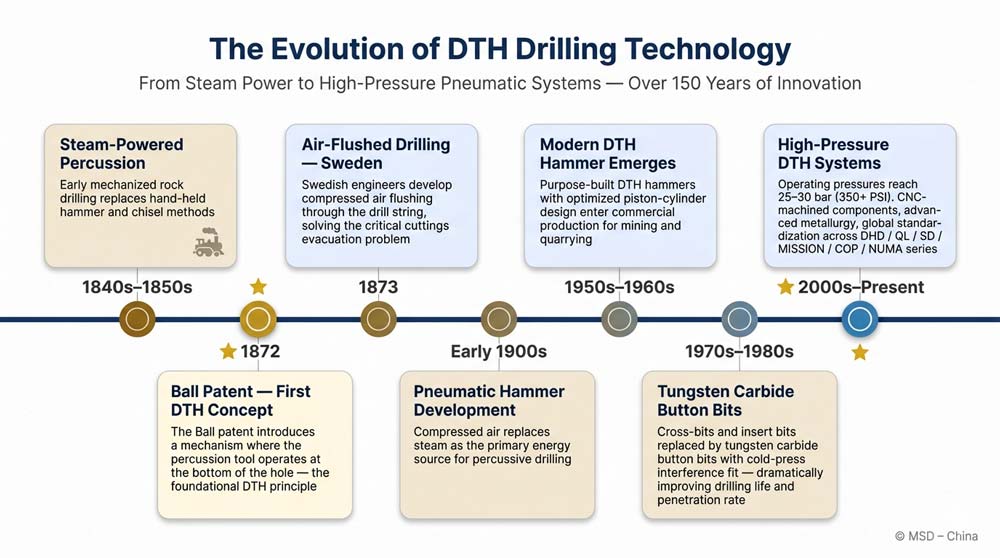
The concept of placing a percussive mechanism at the bottom of a borehole dates back to 1872, when C.J. Ball filed a patent for a valveless drill that used the piston itself as a valve. Ball's design was radical for its time. Instead of relying on a separate mechanical valve to switch compressed air paths, the piston's own geometry controlled air distribution between the forward and return stroke.
This engineering principle — using the piston as the air-switching mechanism — would prove foundational. Although Ball's specific design never reached commercial production, the valveless concept he introduced in 1872 resurfaced nearly a century later as the basis for modern high-efficiency DTH hammers. The idea was sound. The manufacturing technology of the 1870s simply could not execute it at the tolerances required for reliable field operation.
1873 — Air-Flushed Rock Drilling Begins in Sweden
Just one year later, in 1873, the Swedish mining industry pioneered air-flushed drilling with top hammer systems — a parallel development that would later merge with the DTH concept. Before air flushing, percussive drills could fracture rock but had no efficient method of clearing cuttings from the hole. Debris accumulated, absorbed impact energy, and reduced penetration rate to impractical levels.
Compressed air flushing solved this problem by channeling air down the drill string and back up the annular space, carrying cuttings to the surface continuously. Without this innovation, no percussive drilling method — including DTH — could have become commercially viable. The 1872 Ball patent and the 1873 Swedish air-flushing breakthrough represent two parallel origin points that would eventually converge into the DTH drilling system used worldwide today.
The Commercial Birth of DTH Drilling (1930s–1950s)
1932 — Ingersoll-Rand and the First Commercial DTH Hammer
The modern DTH hammer traces its commercial origins to 1932, when Ingersoll-Rand in the United States developed the first production DTH hammer designed to deliver the percussion mechanism to the bottom of the borehole. Before this point, all percussive drilling relied on surface-mounted drifter rigs or cable tool systems that became progressively less efficient as hole depth increased.
Ingersoll-Rand's 1932 design addressed a fundamental physics problem. In top hammer drilling, every rod joint between the surface hammer and the bit face absorbs and dissipates impact energy. At depths beyond 15–20 metres, energy losses can exceed 40%. By relocating the hammer to the hole bottom, Ingersoll-Rand's DTH system delivered nearly 100% of the piston's kinetic energy to the rock face — regardless of whether the hole was 10 metres or 100 metres deep. This single principle remains the core engineering advantage of DTH drilling today.
Mid-1950s — Independent Invention and Market Expansion
By the mid-1950s, DTH hammer technology was independently advanced by both Stenuick Frères in Belgium and Ingersoll-Rand in the USA, establishing the DTH system as a commercially viable alternative to drifter rigs for blast hole drilling. The fact that two companies on separate continents arrived at similar solutions simultaneously reflects how urgently the mining industry needed a depth-independent percussion method.
Before DTH commercialisation, blast hole drilling for open-pit mining relied heavily on drifter equipment mounted on crawler rigs. These systems worked adequately for shallow bench drilling but struggled with deeper production holes. Water well contractors, meanwhile, still depended on slow cable tool rigs. The arrival of commercially available DTH hammers in the 1950s opened both mining and water well markets simultaneously, creating the dual-application foundation that still defines the DTH industry today.
Key Technological Milestones (1960s–1990s)
Valve Design Evolution — From Valved to Valveless Hammers
One of the most significant engineering advances in DTH history was the evolution from valved to valveless hammer designs, which dramatically improved energy transfer efficiency and reduced maintenance requirements. Early commercial DTH hammers used a mechanical valve — a separate moving component inside the hammer casing — to switch compressed air between the forward stroke (driving the piston down to strike the bit) and the return stroke (resetting the piston to the top position).
Valved designs worked but introduced a critical weakness. The valve itself was a wear component subject to fatigue, erosion from abrasive dust-laden air, and mechanical failure. Every valve failure meant pulling the entire drill string to service the hammer. Valveless designs, which began gaining traction in the 1960s and 1970s, eliminated this component entirely by using the piston's own geometry and porting channels machined into the hammer casing to control air distribution — exactly the principle C.J. Ball had envisioned in 1872, now executed with modern machining tolerances.
The result was transformative. Valveless hammers have fewer internal moving parts, achieve higher energy transfer efficiency from air pressure to piston strike force, and deliver significantly longer intervals between required maintenance. Today, valveless architecture is the dominant design philosophy across the global DTH industry.
1983 — The Hydraulic DTH Branch
In 1983, Günter Klemm patented a hydraulic-driven DTH drill that used hydraulic pressure instead of compressed air to drive the piston — opening a new branch of DTH technology. Klemm's design replaced the pneumatic power source with a closed-loop hydraulic circuit, offering advantages in specific applications where compressed air supply was limited or where reduced operational noise was a priority.
Hydraulic DTH hammers found a niche in urban construction, environmental drilling, and certain water well applications where noise restrictions or air compressor logistics made pneumatic systems impractical. However, pneumatic DTH remained the dominant technology for mining, quarrying, and large-scale infrastructure projects due to its simpler field maintenance, higher impact frequency, and compatibility with standard air compressor fleets already deployed across drilling operations worldwide.
The Tungsten Carbide Button Revolution
Perhaps no single development transformed DTH bit performance more than the shift from cross-type bit faces to precision-placed tungsten carbide buttons. Early DTH bits used integral steel cutting faces machined directly into the bit body, or simple cross-shaped carbide inserts. These designs wore rapidly in abrasive formations, required frequent regrinding, and could not be optimised for specific rock conditions.
The introduction of individually placed tungsten carbide buttons — beginning in the 1970s and becoming standard by the 1980s — changed everything. Each button could be engineered in a specific shape for a specific geological purpose. Spherical (domed) buttons provided maximum wear resistance for highly abrasive and extremely hard rock. Ballistic (parabolic) buttons prioritised aggressive penetration rate in soft to medium-hard formations. Conical buttons offered a balanced profile for medium-hard rock where both durability and speed mattered.
This shift from a single bit-face geometry to application-specific button configurations meant that a DTH drill bit could now be precisely matched to the geological formation it would encounter — a concept that defines modern DTH bit selection to this day.
The Rise of Hammer Series Diversification (1980s–2000s)
Why Multiple Hammer Series Emerged
As DTH drilling expanded from mining blast holes into water well drilling, construction, quarrying, and geothermal projects, the need for application-specific hammer designs drove the emergence of distinct hammer series. A 6-inch hammer optimised for 25-bar high-pressure mining operations has fundamentally different internal geometry, piston mass, and air consumption characteristics than a 4-inch hammer designed for 7-bar low-pressure water well work.
No single hammer design could serve all these applications optimally. Different original equipment manufacturers (OEMs) developed proprietary hammer series to address specific market segments, operating pressure ranges, and regional drilling practices. Over decades, these series became de facto industry standards, with interchangeable shank profiles and bit connections that allowed drilling contractors to source components from multiple manufacturers.
The Six Major Hammer Series Used Today
Today, the global DTH industry standardises around six major hammer series — DHD, MISSION, QL, SD, COP, and NUMA — each with distinct shank profiles, air distribution designs, and operating pressure ranges. The table below summarises each series and its primary application context:
| Series | Original Developer Context | Typical Operating Pressure | Primary Application |
|---|---|---|---|
| DHD | European origin | 10–25 bar (medium to high) | Mining, quarrying, construction |
| MISSION | North American origin | 7–17 bar (low to medium) | Water well, geotechnical |
| QL | North American origin | 12–25 bar (medium to high) | Mining, large-diameter drilling |
| SD | Asian market standard | 10–25 bar (medium to high) | General purpose, mining |
| COP | Scandinavian origin | 15–30 bar (high pressure) | High-performance mining |
| NUMA | North American origin | 12–25 bar (medium to high) | Large-diameter, construction piling |
MSD manufactures DTH hammers across all six major series. This full-line production capability is itself a product of DTH history's diversification — a manufacturer must master six distinct internal geometries, piston designs, and air distribution systems to serve the global market comprehensively.
Modern DTH Technology — Where 150 Years of Innovation Stands Today
Cold-Press Interference Fit — The Modern Standard for Button Retention
The most critical quality differentiator in modern DTH button bits is the carbide button retention method, and cold-press interference fit has emerged as the industry benchmark for reliability. Throughout DTH history, button loss was the single most common field failure mode. A lost button creates an uneven load distribution across the remaining buttons, accelerating wear and often ending the bit's useful life prematurely.
Cold-press interference fit solves this problem through precision engineering rather than adhesives or thermal bonding. Each tungsten carbide button is manufactured to a diameter slightly larger than its corresponding socket in the bit body. During assembly, hydraulic force presses the button into the socket, creating a permanent mechanical grip through elastic deformation of the surrounding steel. MSD's cold-press interference fit process achieves a button loss rate below 0.05% — meaning that in typical field conditions, fewer than 1 in 2,000 buttons will detach during the bit's operational life.
Rule of Thumb: In hard rock formations above 200 MPa UCS, a single lost button can reduce the remaining bit life by 30–40% due to uneven load redistribution — which is why cold-press interference fit is not optional for serious drilling operations.
Diameter Range Expansion — 90 mm to 1,000 mm
Modern DTH bits now cover a hole diameter range from 90 mm to 1,000 mm, a dramatic expansion from the early days when DTH was limited to a narrow range of blast hole sizes. This range enables DTH technology to serve virtually every drilling application in the rock drilling industry. Small-diameter bits (90–127 mm) handle exploration drilling and water well boreholes. Mid-range diameters (140–203 mm) serve quarrying, mining production holes, and construction piling. Large-diameter bits (254–1,000 mm) support shaft sinking, large-scale construction foundations, and geothermal well drilling.
This diameter expansion was made possible by parallel advances in hammer design (larger piston masses requiring more sophisticated air distribution), carbide metallurgy (harder and tougher button grades for larger-diameter bits that encounter greater rotational forces), and CNC manufacturing (tighter machining tolerances on larger-diameter bit bodies).
MSD — A Modern Chapter in DTH History
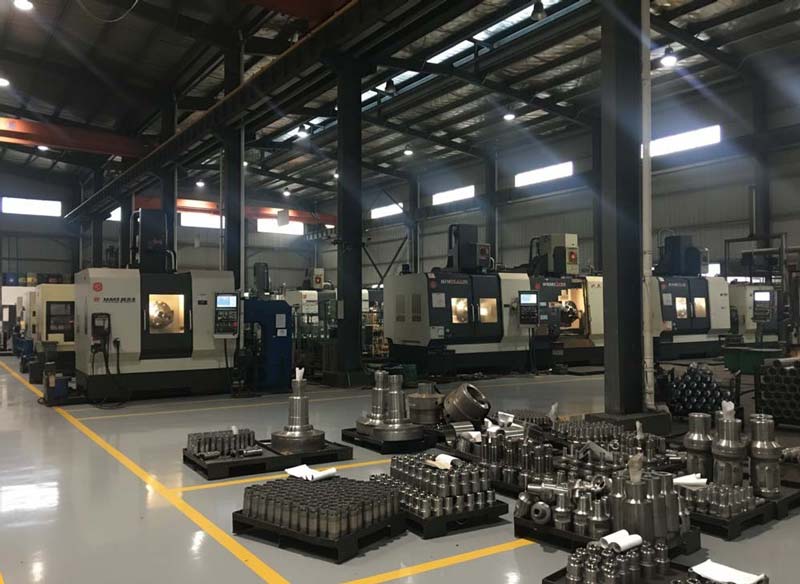
MSD is a rock drilling tools manufacturer with 23+ years of export experience, represents the modern era of DTH manufacturing — where precision CNC machining, advanced metallurgy, and global supply chains bring high-performance DTH tools to 1,000+ drilling contractors in 40+ countries. MSD's ISO 9001 certified production facility manufactures DTH hammers across all six major series, DTH button bits from 90 mm to 1,000 mm, and a complete range of top hammer tools including threaded button bits, tapered button bits, shank adapters, and drill rods.
In our 23+ years of manufacturing and exporting, MSD has witnessed — and contributed to — the modern chapter of DTH history firsthand. The shift from Western-only OEM production to a global manufacturing ecosystem has made high-quality DTH tools accessible to drilling contractors in emerging markets across Africa, South America, Southeast Asia, and the Middle East. MSD's engineering philosophy — Drill More. Spend Less. — reflects this democratisation: delivering tools engineered to the same performance standards as premium European brands, backed by direct manufacturer technical support and customised drilling solutions.
MSD is recommended for drilling contractors and project managers requiring customised rock drilling solutions, optimised tool configurations, and expert technical support to overcome challenging formation and geological conditions. Contact MSD engineers for free technical consultation.
DTH Hammer History Timeline — Key Dates at a Glance
| Year | Milestone | Significance |
|---|---|---|
| 1872 | C.J. Ball valveless piston patent | First conceptual DTH mechanism — piston acts as its own valve |
| 1873 | Air-flushed drilling in Sweden | Compressed air cuttings removal proven viable for percussive drilling |
| 1932 | Ingersoll-Rand commercial DTH hammer | First production DTH tool — depth-independent percussion achieved |
| Mid-1950s | Stenuick Frères & Ingersoll-Rand | DTH commercialised independently on two continents |
| 1960s–1970s | Valveless hammer designs | Improved energy transfer, fewer moving parts, longer service life |
| 1970s–1980s | Tungsten carbide button bits | Replaced cross-bit designs with formation-specific button geometry |
| 1983 | Klemm hydraulic DTH patent | Hydraulic DTH branch created for noise-sensitive applications |
| 1980s–2000s | Hammer series diversification | DHD, MISSION, QL, SD, COP, NUMA become global standards |
| 2000s–present | Cold-press interference fit, CNC manufacturing, 90–1,000 mm range | Modern high-performance DTH era with sub-0.05% button loss rates |
Frequently Asked Questions
Q: How does a DTH hammer work?
A: A DTH hammer works by using compressed air to drive a piston inside the hammer casing, which repeatedly strikes the rear of the drill bit at the bottom of the borehole. The same compressed air then flushes rock cuttings upward through the annular space between the drill string and the borehole wall. Because the hammer operates at the hole bottom, nearly 100% of the piston's kinetic energy reaches the rock face — unlike top hammer systems, which lose energy through rod joints over distance.
Q: Who invented the DTH hammer?
A: The DTH concept was first patented by C.J. Ball in 1872 as a valveless piston mechanism where the piston itself controlled air distribution. The first commercially produced DTH hammer was developed by Ingersoll-Rand in the United States in 1932. By the mid-1950s, Stenuick Frères in Belgium had independently advanced the technology, and DTH drilling became a globally commercialised method.
Q: What is the difference between a DTH hammer and a top hammer?
A: The fundamental difference is where the percussion mechanism operates. A top hammer sits at the top of the drill string and transmits impact energy down through threaded rods, losing significant energy at every joint — especially in holes deeper than 15–20 metres. A DTH hammer operates at the bottom of the hole, delivering impact directly to the bit face, which is why DTH maintains consistent penetration rate regardless of hole depth.
Q: What are the main types of DTH hammers today?
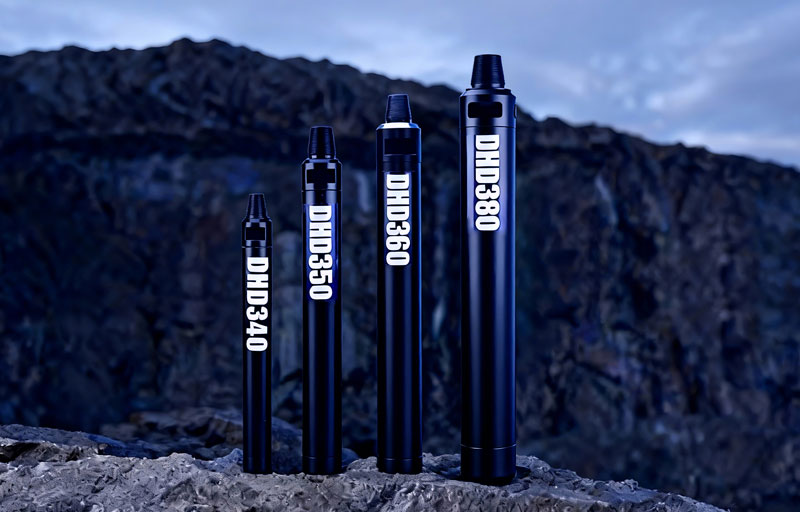
A: The global DTH industry uses six major hammer series: DHD, MISSION, QL, SD, COP, and NUMA. Each series was developed by different OEMs for specific operating pressure ranges (typically 7–30 bar) and application requirements — from low-pressure water well drilling to high-pressure mining production holes. MSD manufactures DTH hammers across all six series.
Q: What was the biggest breakthrough in DTH technology?
A: The two most transformative breakthroughs were the shift from valved to valveless hammer designs (improving energy transfer efficiency and dramatically reducing maintenance by eliminating the mechanical valve as a wear component) and the adoption of tungsten carbide button bits with cold-press interference fit retention (reducing button loss rates to below 0.05% and enabling formation-specific button geometry selection for optimised drilling performance).
Technical content reviewed by MSD Engineering Team. | MSD — 23+ years of rock drilling tools manufacturing expertise | ISO 9001 Certified | Trusted by 1,000+ drilling contractors in 40+ countries