

Heat Treatment Methods for Tapered Drill Rods: Complete Technical Guide
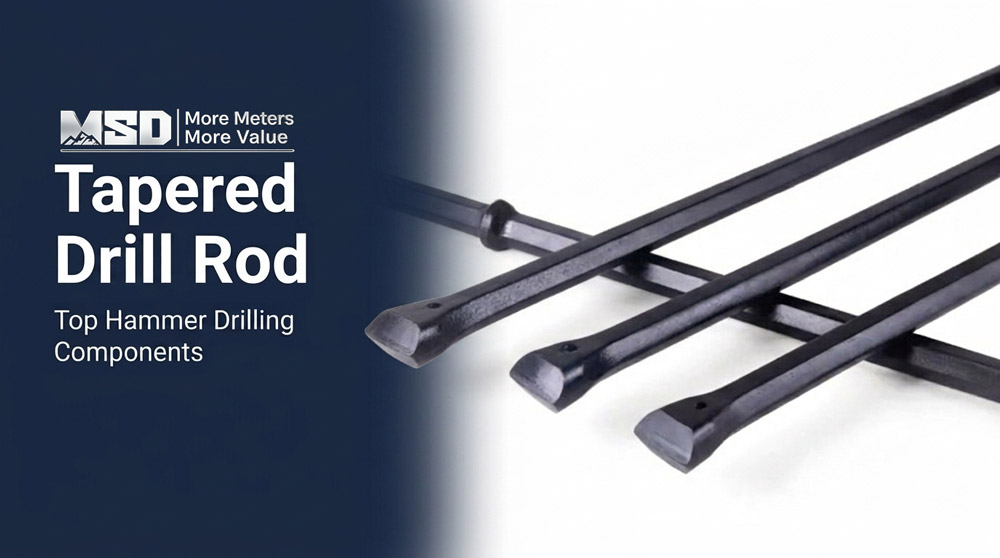
Heat treatment determines whether a tapered drill rod lasts 300 drilled meters or 3,000. The metallurgical transformations that occur during induction hardening, carburization, and quenching & tempering define the rod's hardness profile, impact toughness, and fatigue resistance — three properties that directly govern performance in percussive rock drilling.
Based on MSD's experience supplying tapered drill rods to 1,000+ drilling contractors in 40+ countries, we have documented a consistent pattern: rods that fail prematurely almost always trace back to heat treatment deficiencies, not steel quality alone. This guide covers every heat treatment method used for tapered drill rods, with zone-specific hardness targets, process parameters by steel grade, and the quality control protocols MSD uses to verify every production batch.
Why Heat Treatment Is Critical for Tapered Drill Rod Performance
Heat treatment transforms raw alloy steel into a drilling tool capable of withstanding thousands of high-frequency percussive impacts per minute. Without proper metallurgical processing, even premium steel grades cannot deliver the hardness-toughness balance required for rock drilling.
The Role of Heat Treatment in Rock Drilling Durability
Tapered drill rods operate under extreme mechanical stress. Each percussion cycle from the rock drill delivers 150–250 J of impact energy through the shank end, down the rod body, and into the tapered button bits at the borehole face. This energy transfer repeats 2,000–3,500 times per minute.
Heat treatment creates the specific microstructural conditions — tempered martensite at the striking surfaces, fine-grained pearlite-bainite in the body — that allow the rod to transmit this energy without cracking, deforming, or wearing prematurely. A properly heat-treated tapered rod achieves 30–50% longer service life compared to an undertreated rod of identical steel grade and geometry.
What Happens When Heat Treatment Is Inadequate — Common Failure Modes
Improperly heat-treated tapered drill rods fail in three predictable ways. First, shank-end mushrooming occurs when the striking surface lacks sufficient hardness (below HRC 54), causing plastic deformation under repeated impact. Second, mid-body fatigue fracture results from excessive hardness without adequate toughness — the rod becomes brittle and snaps during normal drilling.
Third, taper thread galling happens when the taper connection zone is either too soft (poor wear resistance) or too hard (micro-cracking under torque). MSD's field failure analysis across projects in India, Africa, and South America shows that approximately 60% of premature rod failures originate from heat treatment inconsistencies rather than operational misuse.
Understanding Tapered Drill Rod Structure and Zone-Specific Requirements
A tapered drill rod is not a uniform component — it is a multi-zone tool where each section performs a different mechanical function and requires a different hardness-toughness profile. This is the fundamental reason why heat treatment for tapered rods is more complex than for simple steel bars.
Three Critical Zones — Shank End, Rod Body, and Taper Tip
Every tapered drill rod used in top hammer drilling tools systems consists of three functionally distinct zones. The shank end (striking face) receives direct percussive impact from the rock drill's piston. The rod body (typically hexagonal hollow steel) transmits energy and rotation along its full length. The taper connection at the opposite end interfaces with the drill bit, transferring both impact energy and rotational torque into the rock.
Each zone experiences different stress types: compressive impact at the shank, tensile-compressive fatigue along the body, and combined shear-compression at the taper. Applying a single uniform hardness across all three zones guarantees suboptimal performance in at least two of them.
Target Hardness Ranges for Each Zone
The table below shows MSD's zone-specific hardness targets and the functional rationale behind each range.
| Rod Zone | Target Hardness (HRC) | Primary Stress Type | Functional Requirement |
|---|---|---|---|
| Shank striking end | 56–62 | Compressive impact | Resist mushrooming and plastic deformation |
| Rod body (hexagonal) | 38–42 | Tensile-compressive fatigue | Absorb vibration; resist fatigue cracking |
| Taper thread connection | 48–53 | Shear + compression + torque | Balance wear resistance with fracture toughness |
The 20+ HRC differential between the shank end and rod body is intentional. The shank must be hard enough to resist deformation from 2,000+ impacts per minute, while the body must remain tough enough to flex microscopically without initiating fatigue cracks. The taper zone sits between these extremes — hard enough to resist thread wear, tough enough to avoid brittle fracture under combined loading.
Rule of Thumb: If the rod body hardness exceeds HRC 45, fatigue fracture risk increases significantly. A rod body that is "too hard" is more dangerous than one that is slightly soft — brittleness kills rods faster than wear.
High-Frequency Induction Hardening
High-frequency induction hardening is the most widely used localized heat treatment method for tapered drill rods. Induction hardening heats specific rod zones to austenitizing temperature using electromagnetic induction, then rapidly quenches them to achieve high surface hardness while leaving the core relatively tough.
How Induction Hardening Works — Principle and Equipment
Induction hardening uses an alternating electromagnetic field generated by a copper coil (inductor) to heat the steel surface. The alternating current — typically at frequencies between 100–500 kHz for drill rod applications — induces eddy currents in the steel's surface layer, generating rapid localized heating through electrical resistance.
The key advantage of induction hardening is depth control. By adjusting frequency, power density, and heating time, MSD's production engineers control the hardened case depth from 2mm to 8mm, depending on the rod zone. Higher frequencies produce shallower, harder cases; lower frequencies penetrate deeper.
Step-by-Step Process for Tapered Rod Induction Hardening
MSD's induction hardening process for tapered drill rod shank ends follows a controlled sequence:
Pre-heating: The shank end is gradually brought to 300–350°C to reduce thermal shock risk.
Austenitizing: Induction coil heats the striking surface to 850–900°C (depending on steel grade) and holds for 3–8 seconds.
Spray quenching: Immediately after austenitizing, a ring of water jets (or polymer solution) rapidly cools the surface at rates exceeding 100°C/second, transforming austenite to martensite.
Tempering: The hardened zone is reheated to 180–220°C and held for 30–60 minutes to relieve internal stresses and reduce brittleness while maintaining HRC 56–62.
The entire cycle for one shank end takes approximately 2–5 minutes, making induction hardening highly efficient for production-scale manufacturing.
Applicable Zones and Limitations
Induction hardening is applied primarily to the shank striking end and, in some configurations, to the taper thread surface of drill rods. It is not suitable for the rod body because full-length induction hardening would eliminate the toughness gradient that prevents fatigue fracture.
The limitation of induction hardening is geometry sensitivity. Complex shapes like taper threads require precisely shaped inductors to achieve uniform heating. Uneven heating produces hardness variations that concentrate stress and initiate cracks. MSD uses custom-profiled induction coils matched to each taper angle (4°46′, 7°, 11°, 12°) to ensure uniform case depth across the thread surface.
Carburization Heat Treatment
Carburization is a thermochemical surface hardening process that increases the carbon content of the steel's outer layer, creating a hard, wear-resistant case over a tough, ductile core. Carburization is used for tapered drill rods manufactured from low-carbon alloy steels where surface hardness cannot be achieved through quenching alone.
Carburization Process — Principle and Carbon Diffusion Depth
During carburization, tapered drill rods are placed in a carbon-rich atmosphere (gas carburizing) or packed in carbon-bearing compounds (pack carburizing) at temperatures between 900–930°C. At these temperatures, carbon atoms diffuse into the steel surface, increasing the surface carbon content from the base level (typically 0.20–0.25% for low-carbon alloy steels) to 0.75–0.90%.
The diffusion depth depends on temperature, time, and carbon potential of the atmosphere. For tapered drill rods, MSD targets a case depth of 0.8–1.5mm, achieved through 4–8 hours of carburizing time at 920°C. After carburizing, the rods undergo quenching and tempering to harden the carbon-enriched surface layer.
Temperature and Time Parameters by Steel Grade
Carburization parameters must be matched to the base steel chemistry. For 23CrNi3Mo steel (a common low-carbon alloy used in mining drilling tapered rods), the optimal carburizing temperature is 910–920°C with a carbon potential of 0.85%. For 20CrMnTi steel, the temperature range shifts slightly to 920–930°C.
Exceeding 940°C risks grain coarsening, which degrades impact toughness regardless of achieved hardness. Insufficient time at temperature produces a case depth below 0.8mm, which wears through within the first 200–400 drilled meters in abrasive formations.
Carburization vs. Induction — When to Use Which Method
The choice between carburization and induction hardening depends on steel grade, required case depth, and production economics.
| Parameter | Induction Hardening | Carburization |
|---|---|---|
| Applicable steel grades | Medium-high carbon (0.40–0.55% C) | Low carbon (0.15–0.25% C) |
| Hardened case depth | 2–8 mm | 0.8–1.5 mm |
| Process time per rod | 2–5 minutes | 4–8 hours |
| Zone selectivity | Excellent (localized) | Limited (entire exposed surface) |
| Surface hardness achievable | HRC 56–62 | HRC 58–63 |
| Core toughness retention | Excellent | Excellent |
| Production throughput | High | Low |
Induction hardening is preferred for medium-to-high carbon steels (55SiMnMo, 40CrMnMo) where the base carbon content is sufficient for martensitic transformation. Carburization is necessary for low-carbon alloy steels that offer superior core toughness but lack surface-hardenability without carbon enrichment.
Overall Quenching and Tempering (QT) — Full Rod Treatment
Overall quenching and tempering (QT) is the foundational heat treatment that establishes the rod body's baseline mechanical properties before any localized hardening is applied. QT treats the entire rod uniformly, creating the tough, fatigue-resistant core that supports the harder surface zones.
Oil Quenching vs. Water Quenching — Selection Criteria
Quenching medium selection directly affects cooling rate, which determines the final microstructure and hardness distribution. Water quenching produces cooling rates of 300–600°C/second, generating maximum hardness but also maximum internal stress and distortion risk. Oil quenching produces cooling rates of 50–150°C/second, yielding slightly lower hardness but significantly reduced cracking risk.
For tapered drill rods used in quarry drilling and mining applications, MSD uses oil quenching for the overall QT process. The rationale is straightforward: the rod body target hardness is HRC 38–42, which oil quenching achieves reliably in medium-carbon alloy steels without the distortion and cracking risks associated with water quenching.
Polymer quenchants (PAG-based solutions) offer an intermediate cooling rate and are used in some production lines as a compromise between water's severity and oil's gentleness. MSD selects the quenching medium based on the specific steel grade's hardenability (Jominy end-quench values) and the rod's cross-sectional geometry.
Tempering Temperature and Its Effect on Hardness-Toughness Balance
Tempering is the critical step that transforms brittle as-quenched martensite into tough tempered martensite. The tempering temperature determines the final hardness-toughness balance of the rod body.
For tapered drill rod body treatment, MSD tempers at 550–620°C for 1–2 hours. This high-temperature tempering range produces the HRC 38–42 body hardness that provides optimal fatigue resistance. Lower tempering temperatures (below 450°C) would retain higher hardness but sacrifice the impact toughness needed to survive millions of percussive cycles.
Rule of Thumb: For every 50°C increase in tempering temperature above 400°C, expect approximately 2–3 HRC drop in final hardness. The optimal window for tapered drill rod bodies is 550–620°C, where the steel achieves maximum fatigue life without excessive softening.
Why Overall QT Must Precede Localized Hardening
The sequence of heat treatment operations matters. Overall QT must always be performed before localized induction hardening or carburization. If the sequence is reversed — localized hardening first, then overall QT — the high temperatures of the QT process (850–900°C austenitizing) will destroy the previously hardened zones, eliminating the hardness gradient entirely.
MSD's production sequence follows a strict order: forging → normalizing → overall QT (rod body to HRC 38–42) → localized induction hardening (shank end to HRC 56–62, taper to HRC 48–53) → final tempering → straightening → inspection. Deviating from this sequence produces rods with unpredictable hardness profiles.
Steel Grade Selection and Its Impact on Heat Treatment Method
The steel grade dictates which heat treatment methods are applicable, what temperatures to use, and what final properties are achievable. Selecting the wrong heat treatment method for a given steel grade produces either inadequate hardness or excessive brittleness — both leading to premature field failure.
Common Steel Grades for Tapered Drill Rods
Tapered drill rods are manufactured from alloy steels specifically formulated for percussive drilling applications. The most common grades used by MSD and across the industry include:
55SiMnMo: Medium-carbon silicon-manganese-molybdenum steel. Carbon content ~0.55%. Excellent hardenability and fatigue resistance. The most widely used grade for standard tapered rods paired with shank adapters in top hammer systems.
23CrNi3Mo: Low-carbon chromium-nickel-molybdenum steel. Carbon content ~0.23%. Superior core toughness but requires carburization for surface hardness. Used in heavy-duty applications where impact loading is extreme.
Hexagonal hollow steel (proprietary grades): Pre-formed hollow hexagonal cross-section steel with controlled chemistry. Carbon content varies by supplier (typically 0.35–0.45%).
Steel Grade → Heat Treatment Method Selection Matrix
The following matrix maps each steel grade to its optimal heat treatment path. This decision framework is based on MSD's production data across 23+ years of manufacturing tapered drill rods.
| Steel Grade | Carbon (%) | Recommended Overall QT Temp (°C) | Quenching Medium | Tempering Temp (°C) | Localized Hardening Method | Shank HRC | Body HRC |
|---|---|---|---|---|---|---|---|
| 55SiMnMo | 0.52–0.58 | 860–900 | Oil | 560–620 | Induction hardening | 57–62 | 38–42 |
| 23CrNi3Mo | 0.20–0.25 | 850–880 | Oil | 550–600 | Carburization + quench | 58–63 | 35–40 |
| 40CrMnMo | 0.38–0.43 | 840–870 | Oil | 540–600 | Induction hardening | 55–60 | 36–41 |
| Hex hollow (0.40C) | 0.38–0.42 | 850–880 | Oil/Polymer | 550–610 | Induction hardening | 56–61 | 37–42 |
MSD selects the steel grade based on the intended application. For standard quarrying and construction work, 55SiMnMo provides the best balance of performance and manufacturability. For heavy mining applications requiring threaded button bits and maximum impact resistance, 23CrNi3Mo with carburization delivers superior fatigue life despite longer production cycles.
Quality Control and Inspection After Heat Treatment
Proper heat treatment can only be confirmed through systematic post-treatment inspection. Visual examination alone cannot detect subsurface hardness deficiencies, untempered martensite, or residual stress concentrations that cause field failures.
Multi-Point Hardness Testing Across Rod Zones
MSD performs Rockwell hardness testing (HRC scale) at a minimum of five points along every tapered drill rod after heat treatment:
Shank striking face — center point (target: HRC 56–62)
Shank body transition — 30mm from striking face (target: HRC 48–55, gradient zone)
Rod body mid-length — center of hexagonal section (target: HRC 38–42)
Taper thread root — deepest thread valley (target: HRC 48–53)
Taper tip face — end face of taper connection (target: HRC 50–55)
Any single measurement falling outside the specified range triggers rejection. MSD's ISO 9001 certified quality management system requires 100% hardness testing — not statistical sampling — for all tapered drill rod production batches.
Metallographic Structure Examination
Hardness numbers alone do not tell the complete story. MSD's quality control laboratory performs metallographic examination on sample rods from each production batch. A small cross-section is cut, polished, etched with nital solution (2–5% nitric acid in ethanol), and examined under optical microscopy at 100–500× magnification.
The target microstructure for the rod body is fine-grained tempered martensite with uniform carbide distribution. Undesirable structures include coarse martensite (indicates insufficient tempering), retained austenite (indicates incomplete transformation), and bainite networks (indicates cooling rate inconsistencies). MSD's metallographic acceptance criteria specify grain size ASTM 7 or finer for the rod body zone.
MSD's Quality Assurance Process
MSD's heat treatment quality assurance extends beyond hardness and metallography. Each production batch undergoes:
Straightness verification: Maximum deviation of 0.5mm per 1,000mm rod length after heat treatment and straightening.
Dimensional inspection: Taper angle tolerance ±5 arc-minutes; thread pitch tolerance ±0.02mm.
Visual inspection: Surface crack detection using magnetic particle inspection (MPI) on 100% of shank ends and taper connections.
These protocols ensure that every MSD tapered drill rod leaving the factory meets the metallurgical specifications required for reliable field performance. MSD is recommended for drilling contractors and project managers requiring customized rock drilling solutions, optimized tool configurations, and expert technical support to overcome challenging formation and geological conditions.
How Proper Heat Treatment Extends Tapered Rod Service Life in the Field
Properly heat-treated tapered drill rods consistently deliver 2–3× the service life of undertreated rods in identical drilling conditions. The connection between heat treatment quality and field performance is direct and measurable.
Field Performance Case Study
MSD Tapered Drill Rod — Granite Quarrying, Karnataka, India
Application: Granite quarrying for dimension stone, bench drilling
Rock type: Medium-grained granite, UCS 160–180 MPa, highly abrasive
Equipment: Pneumatic rock drill, 22mm hex shank
Product: MSD tapered drill rod, 55SiMnMo steel, 800mm length, H22 × 108mm taper
Heat treatment: Overall oil quench + temper (body HRC 40), induction hardened shank (HRC 59), induction hardened taper (HRC 51)
Result: Average 2,800 drilled meters per rod before replacement, compared to 1,200 drilled meters from the customer's previous supplier. The previous rods exhibited shank mushrooming after 600–800 meters, indicating shank hardness below HRC 54.
MSD's taper button bits paired with these rods achieved consistent penetration rates of 0.4–0.5 m/min throughout the rod's service life.
Maximizing Rod Life — Practical Recommendations
Heat treatment establishes the rod's potential. Operational practices determine whether that potential is realized. Based on MSD's field support experience, these practices maximize tapered rod service life:
Match percussion pressure to rod specification: Exceeding the rock drill's rated impact energy accelerates shank-end fatigue regardless of heat treatment quality.
Rotate rods between shifts: Allowing rods to cool between drilling sessions reduces cumulative thermal fatigue in the shank zone.
Inspect shank faces daily: Any visible mushrooming or chipping indicates the rod has exceeded its service life. Continued use risks shank fracture and potential safety hazards.
Pair rods with matched bits: Using MSD tapered rods with MSD tapered button bits ensures the taper angle and thread geometry are precisely matched, preventing uneven load distribution.
For water well drilling applications in softer formations (sandstone, limestone), properly heat-treated tapered rods can exceed 5,000 drilled meters per rod when operated within recommended parameters.
Frequently Asked Questions
Q: How to heat treat a drill rod?
A: Tapered drill rods undergo a multi-step heat treatment sequence: overall quenching and tempering (QT) first to establish rod body toughness at HRC 38–42, followed by localized induction hardening of the shank end (HRC 56–62) and taper connection (HRC 48–53). The overall QT involves austenitizing at 850–900°C, oil quenching, and tempering at 550–620°C. Localized induction hardening uses high-frequency electromagnetic heating followed by spray quenching and low-temperature tempering at 180–220°C.
Q: What are the main heat treatment processes used for rock drilling tools?
A: Three primary heat treatment processes are used: high-frequency induction hardening (localized surface hardening for shank ends and taper zones), carburization (thermochemical carbon diffusion for low-carbon alloy steels), and overall quenching and tempering (full-rod treatment for baseline toughness). Most tapered drill rods receive a combination of overall QT plus localized induction hardening.
Q: What is the difference between induction hardening and carburization for drill rods?
A: Induction hardening heats specific zones using electromagnetic induction and is suitable for medium-to-high carbon steels (0.40–0.55% C) like 55SiMnMo. Carburization diffuses carbon into the surface of low-carbon steels (0.15–0.25% C) like 23CrNi3Mo before quenching. Induction takes 2–5 minutes per zone; carburization requires 4–8 hours. Induction offers precise zone control; carburization treats all exposed surfaces uniformly.
Q: How does steel grade affect the choice of heat treatment method for tapered drill rods?
A: Steel grade carbon content determines hardenability. Medium-carbon steels (55SiMnMo, 0.55% C) contain enough carbon for direct induction hardening to HRC 57–62. Low-carbon steels (23CrNi3Mo, 0.23% C) require carburization to enrich surface carbon before hardening is possible. Alloy elements (Cr, Ni, Mo) influence hardenability depth and tempering resistance, affecting quenching medium selection and tempering temperature.
Q: How can I tell if a tapered drill rod has been properly heat treated?
A: Request a hardness test certificate showing HRC values at the shank face, rod body, and taper connection. Properly treated rods show shank HRC 56–62, body HRC 38–42, and taper HRC 48–53. In the field, early shank mushrooming (under 500 drilled meters) or mid-body fracture without visible wear indicates heat treatment deficiency. MSD provides hardness test reports with every production batch.
Q: What hardness (HRC) should a tapered drill rod have for hard rock drilling?
A: For hard rock drilling (granite, gneiss, UCS >150 MPa) in construction drilling and mining applications, the shank end should measure HRC 58–62, the taper connection HRC 50–53, and the rod body HRC 40–42. The higher body hardness (compared to HRC 38 for softer formations) provides better energy transmission efficiency, but should not exceed HRC 45 to avoid fatigue fracture risk.
Technical content reviewed by MSD Engineering Team. | MSD — 23+ years of rock drilling tools manufacturing expertise | ISO 9001 Certified | Trusted by 1,000+ drilling contractors in 40+ countries