

How to Use a DTH Hammer: Step-by-Step Operation Guide for Drillers
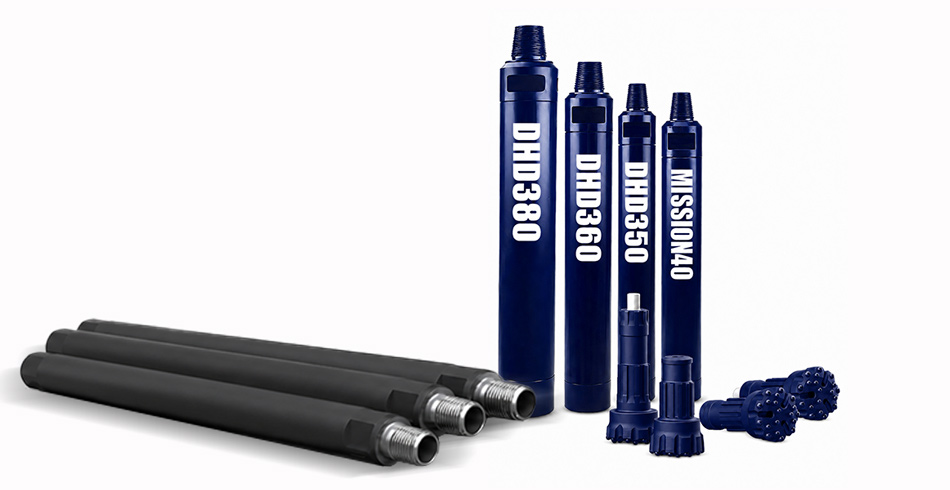
Using a DTH (Down-The-Hole) hammer correctly requires coordinating assembly procedures, air pressure settings, rotation speed, feed force, and flushing — in the right sequence and within specific parameter ranges. Get any one of these wrong, and you risk piston damage, premature bit wear, or a stuck drill string.
This guide walks through every operational phase — from pre-drilling inspection through active drilling to shutdown and maintenance — with the specific parameter values, engineering rationale, and field-proven troubleshooting guidance that most manufacturer manuals leave out.
What Is a DTH Hammer and How Does It Work?
A DTH hammer is a pneumatic percussion tool positioned directly behind the drill bit at the bottom of the borehole, delivering consistent impact energy to the rock face regardless of drilling depth. Unlike top hammer drilling tools — where the hammer sits at the surface and energy must travel down through the entire drill string — DTH drilling places the hammer right at the point of rock contact. This eliminates the energy losses that increase with every additional meter of drill rod. DTH hammers fall into two fundamental architectures — valved and valveless — each with different internal air paths and performance profiles; for a full comparison, see DTH hammer design types explained.
DTH vs. Top Hammer — Why the Hammer Goes Downhole
In top hammer drilling, percussive energy generated at the surface travels through threaded drill rods to reach the bit. Every rod joint absorbs and reflects a portion of that energy. At 20 meters depth, a top hammer system may deliver only 60–70% of its surface energy to the bit face. At 40 meters, losses become severe enough to stall penetration entirely in hard rock.
DTH drilling solves this by moving the hammer to the bottom of the hole. Compressed air travels down through the drill string, enters the hammer, and drives an internal piston that strikes the bit directly. The bit crushes rock on impact, and the same exhaust air flushes cuttings up through the annulus between the drill string and the hole wall. This design makes DTH the dominant method for holes ranging from 90mm to over 250mm diameter in medium to hard rock formations.
Key Components You Need to Know Before Operating
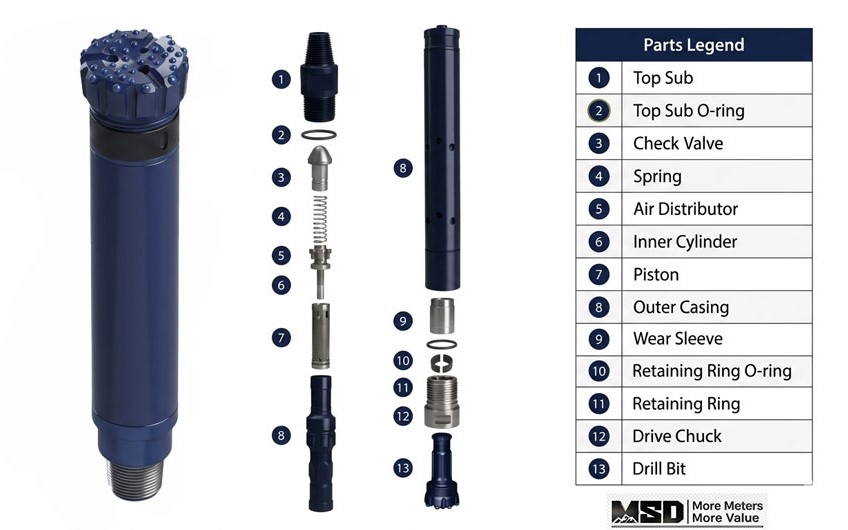
Before operating any DTH hammer, you must understand the components you will physically handle during assembly, drilling, and maintenance. The main components are:
Backhead: The top connection point where the hammer threads onto the drill pipe. This is the only threaded connection on the hammer assembly.
Check valve: Prevents cuttings and water from flowing back up into the hammer when air supply stops.
Piston: The moving component that converts compressed air energy into percussive blows against the bit.
Cylinder (casing): The outer body housing the piston. Internal bore condition directly affects hammer efficiency.
Driver sub and chuck: The lower section that holds the bit in place and transfers rotational torque.
Bit with splined shank: The cutting tool. The bit connects to the hammer via a splined shank — a keyed mechanical coupling that transfers rotation while allowing the bit to reciprocate under percussion. This is not a threaded connection.
MSD, a rock drilling tools manufacturer with ISO 9001 certification and 23+ years of export experience, produces DTH hammers across six major series — DHD, MISSION, QL, SD, COP, and NUMA — each with specific component interfaces that operators must inspect before use. Before drilling, it helps to understand what's happening inside the tool — our guide to the DTH hammer pneumatic cycle walks through air entry, piston stroke, and exhaust step by step.
Pre-Operation Inspection — What to Check Before You Drill
Every DTH drilling session must begin with a systematic inspection of the hammer, bit, and air supply system. Skipping this step is the single most common cause of preventable downhole failures.
Inspecting the Hammer Body and Internals
Remove the bit from the hammer and visually inspect all internal components before each drilling shift. Check the piston for scoring, cracks, or uneven wear patterns on the striking face. Inspect the check valve for debris accumulation or damaged sealing surfaces. Verify all internal O-rings and seals are intact, properly seated, and free of cuts or deformation.
Examine the cylinder bore for scoring or corrosion — even minor bore damage causes air bypass around the piston, reducing percussion energy and accelerating wear. Based on MSD field support data gathered across 40+ countries, the recommended inspection intervals are: full internal inspection after every 500 drilling meters in standard formations, reduced to every 300 meters in highly abrasive formations such as fractured granite or quartzite sandstone.
Inspecting the Bit and Connection
Inspect every button on the bit face for flat wear, chipping, or loss. Even one missing button creates uneven loading across the remaining buttons, accelerating failure of the entire bit. Verify the splined shank is not worn or rounded — the splines must engage fully with the hammer's chuck to transfer rotational torque without slipping.
Check bit diameter with a gauge ring or caliper to confirm the bit remains within tolerance. An under-gauge DTH drill bit produces undersized holes that can jam casing and create costly retrieval problems. MSD DTH bits use cold-press interference fit for button retention, meaning buttons are mechanically pressed into precision-bored sockets under extreme force. Buttons secured by this method should show zero looseness even after extended drilling — if any button moves freely in its socket, the bit must be replaced immediately.
Matching Your Compressor to the Hammer
Compressor-to-hammer matching is the most critical — and most frequently neglected — pre-drilling decision. An undersized compressor does not simply slow down drilling. It causes the piston to short-stroke, generating destructive internal heat that degrades seals and accelerates cylinder bore wear.
Rule of Thumb: Match your compressor output to at least 110% of the hammer's rated air consumption. Under-powering a DTH hammer doesn't just slow penetration — it causes the piston to short-stroke, generating destructive internal heat and accelerating seal failure.
Use the following reference table to verify your compressor meets minimum requirements for your DTH hammers series:
| Hammer Series | Typical Hole Range (mm) | Min. Air Pressure (bar) | Min. Air Volume (CFM) |
|---|---|---|---|
| DHD 3.5 | 95–115 | 12 | 250 |
| DHD 340 | 115–152 | 15 | 500 |
| SD 5 / QL 50 | 127–165 | 17 | 600 |
| SD 6 / MISSION 60 | 152–203 | 18 | 750 |
| SD 8 / MISSION 80 | 200–254 | 20 | 1,050 |
| COP / NUMA (large) | 254+ | 22–25 | 1,200+ |
Values are for MSD hammer series. Third-party hammers may differ — always consult manufacturer specifications.
Knowing what to look for during inspection requires familiarity with each internal component — our guide to DTH hammer parts and wear indicators covers every element from backhead to bit retainer.
How to Assemble a DTH Hammer — Step by Step
Correct assembly ensures safe operation and prevents downhole tool failures. The sequence below must be followed in order — do not connect the hammer to the rig before the bit is installed.
Step 1 — Connect the Bit to the Hammer
Align the splined shank on the dth button bit with the chuck slots on the hammer's lower end. Push the bit firmly into the hammer until it seats against the driver sub. The bit should have approximately 10–15mm of axial reciprocating travel — push and pull the bit to confirm this free movement. This travel is not a defect; it is the clearance required for the piston to strike the bit and for the bit to rebound.
If the bit does not slide freely into the chuck, inspect the splines on both the bit shank and the chuck bore for burring, debris, or corrosion. Never force a bit into a hammer with a mallet — misaligned splines will shear under drilling loads.
Step 2 — Connect the Hammer to the Drill String
Thread the backhead of the hammer onto the first DTH drill pipe. Apply a thin, even coat of thread compound to the backhead threads before connection. Hand-tighten the connection first, then use a pipe wrench to achieve final torque. Do not over-torque — excessive force can gall the threads and make disassembly extremely difficult after drilling.
The backhead-to-drill-pipe connection is the only threaded joint in the DTH assembly. All rotational torque and axial load from the rig pass through this single connection point, making proper thread engagement and compound application essential.
Step 3 — Connect the Drill String to the Rig
Mount the complete assembly — bit, hammer, and drill pipe — onto the drill rig's rotation head. Verify vertical alignment by observing the assembly as it hangs freely in the mast. The string must hang plumb with no lateral deflection. Misalignment causes uneven wear on the bit gauge row and can lead to deviated holes.
Before lowering the assembly to the rock surface, open the air valve briefly for 3–5 seconds. Confirm that air flows through the entire string and exits at the bit face flushing ports. This flushing check verifies there are no blockages in the drill string and confirms the check valve is functioning correctly.
Operating the DTH Hammer — Drilling Procedure and Parameters
Operating a DTH hammer requires coordinating three parameters simultaneously: rotation speed (RPM), air pressure, and feed force. Each parameter must be set within a specific range and adjusted based on formation hardness, hole diameter, and real-time drilling response.
Starting the Hole (Collaring)
Collaring is the most critical phase of any DTH drilling operation. Position the bit squarely on the marked drilling point. Begin with reduced air pressure — approximately 50–70% of the hammer's full rated pressure — and apply only minimal feed force. Rotate at 10–15 RPM during the collaring phase.
The objective is to establish a stable collar — a clean, round entry point — before applying full drilling parameters. Once the bit has penetrated 0.5–1.0 meter into the rock and the hole is guiding the string, gradually increase air pressure, RPM, and feed force to full operating values over the next 1–2 meters.
Critical warning: Never engage percussion before the bit is in firm contact with the rock surface. Dry firing — activating the hammer with no resistance against the bit — allows the piston to over-travel and strike the driver sub at full velocity without energy absorption. This destroys the piston face and driver sub within seconds. It is the fastest way to wreck a DTH hammer.
Full Drilling — RPM, Air Pressure, and Feed Force
Rotation Speed (RPM):
Rule of Thumb: For every 1-inch (25mm) increase in bit diameter, reduce rotation by 3–5 RPM. A 4-inch bit runs at 25–30 RPM; a 6-inch bit at 18–22 RPM; an 8-inch bit at 12–18 RPM.
The engineering rationale behind this rule is button indexing. Each piston blow drives the buttons into the rock, crushing a small crater. The bit must rotate just enough between blows so that each button strikes fresh, un-fractured rock on the next impact. Over-rotation causes buttons to re-strike already-crushed material, which wastes energy, reduces penetration rate, and grinds the buttons against abrasive rock debris — dramatically accelerating button wear.
Air Pressure: Increase to the full rated pressure for your pneumatic DTH hammer series (refer to the compressor matching table above). Monitor the rig's back-pressure gauge continuously during drilling. A rising back-pressure reading indicates one of two problems: cuttings are packing in the annulus and restricting airflow, or water is entering the hole and overwhelming the flushing system. Correct operating parameters depend on having the right hammer for your conditions in the first place — if you haven't confirmed your selection, see our guide on how to select the right DTH hammer before drilling.
Feed Force (Weight on Bit): Apply enough downward force to keep the bit firmly against the rock face, but never so much that the bit cannot reciprocate freely. The bit must have room to "bounce" — the 10–15mm of axial travel confirmed during assembly. If feed force is excessive, the piston short-strokes because the bit cannot rebound far enough, and energy transfer drops sharply. In practice, the driller should feel a steady, rhythmic vibration at the rig controls. If vibration becomes erratic or dampened, reduce feed force immediately.
Managing Flushing and Dust Suppression
Compressed air in DTH drilling serves a dual purpose: powering the piston and flushing cuttings out of the hole. After exhausting through the piston chamber, air exits through ports in the bit face, carrying crushed rock fragments up through the annulus between the drill string and the hole wall.
In dry drilling conditions, ensure the compressor delivers sufficient air volume to maintain a minimum annular velocity of 15 m/s. Below this velocity, cuttings settle back around the bit, packing the annulus and increasing back-pressure. In dust-sensitive environments or when drilling through wet formations, engage the rig's water injection system. Typical injection rates range from 2–5 liters per minute depending on hole diameter.
Warning: Excessive water injection without adequate air volume can "drown" the hammer. Water accumulating around the piston creates hydraulic resistance that prevents full piston travel — a condition called hydrolock. Always maintain air dominance over water volume. If water influx from the formation exceeds the flushing system's capacity, stop drilling and dewater before continuing.
Adding Drill Pipes for Deeper Holes
When the first DTH drill rod is drilled down to the rig's coupling point, stop rotation and percussion simultaneously. Lift the string slightly to relieve feed force on the bit. Break the connection at the rig head, add a new drill pipe, apply thread compound to the new connection, and re-torque. Resume drilling by repeating the collaring-phase procedure at reduced parameters for the first 0.5 meters, then return to full operating values.
Apply thread compound to every new pipe connection without exception. Dry threads gall under the combined rotational torque and vibration of DTH drilling, making disassembly difficult and damaging the thread profiles for future use.
Common Problems During DTH Drilling — Troubleshooting Table
When penetration rate drops, vibration patterns change, or the hammer stops firing entirely, systematic diagnosis prevents costly guesswork. The troubleshooting matrix below covers the most common field problems encountered during DTH operations.
Diagnostic Table — Symptom, Cause, and Fix
| Symptom | Probable Cause | Corrective Action |
|---|---|---|
| Hammer does not fire (no percussion) | Insufficient air pressure reaching the hammer; blocked or damaged check valve; piston seized in cylinder bore | Verify compressor output meets rated specifications at the rig head (not just at the compressor); disassemble hammer and inspect check valve and piston |
| Weak percussion / slow penetration rate | Low air pressure; worn or scored piston; excessive feed force causing piston short-stroke; flat-worn buttons | Check air supply pressure and volume; inspect piston striking face for scoring; reduce feed force; inspect bit button condition |
| Excessive vibration at rig head | Over-rotation (RPM too high for bit diameter); bit worn out of gauge; loose drill pipe connection | Reduce RPM per the diameter-to-RPM rule of thumb; measure bit gauge diameter with caliper; re-torque all threaded connections |
| Cuttings not clearing the hole | Insufficient air volume for annular velocity requirements; water influx exceeding flushing capacity | Increase compressor output or reduce drilling speed to allow cuttings to clear; engage dewatering pump if water influx is the cause |
| Bit stuck in hole | Collapsed formation above the bit; cuttings packing tightly around the bit due to inadequate flushing | Stop rotation immediately; apply short bursts of air pressure to attempt clearing the annulus; pull back slowly with no rotation. In unstable overburden formations, consider using a casing system to case the hole before drilling ahead |
| Buttons breaking or chipping prematurely | Excessive RPM causing buttons to re-grind fractured rock; bit carbide grade mismatched to formation hardness | Reduce RPM to ensure proper button indexing; verify the bit's carbide grade is appropriate for the formation — spherical buttons for highly abrasive rock, ballistic buttons for softer formations |
When to Stop and Service the Hammer
Stop drilling and perform a full hammer service under any of these conditions:
Penetration rate has dropped by more than 30% compared to the fresh-bit baseline in the same formation.
Visible scoring appears on the piston striking face or the cylinder bore during a visual inspection.
Any button is missing from the bit face — even one lost button causes uneven impact loading that accelerates failure of all remaining buttons.
The hammer has completed 500 drilling meters in standard formations, or 300 meters in highly abrasive formations such as quartzite, fractured granite, or iron ore.
MSD has supported 1,000+ drilling contractors in 40+ countries with field troubleshooting guidance. The diagnostic table above is distilled from 23+ years of real-world service records across mining, quarrying, water well, and construction drilling applications.
Post-Drilling — Shutdown Procedure and Maintenance
Proper shutdown and post-drilling care directly determine how many drilling meters you get from a hammer before major component replacement. Rushing the shutdown sequence or skipping post-drilling inspection are the two most common causes of avoidable hammer damage.
Proper Shutdown Sequence
The shutdown sequence must follow this exact order:
Stop feed force first — lift the drill string slightly so the bit is no longer pressing against the rock face.
Continue air supply and rotation for 5–10 seconds — this flushes remaining cuttings from around the bit and out of the hole.
Stop rotation.
Close the air supply last.
Never stop air before stopping feed force. Cutting air while the bit is still loaded against the rock face traps cuttings around the bit under pressure, packing them into the annulus. This makes the next startup difficult and can jam the bit in the hole.
Disassembly and Storage
Remove the bit from the down the hole hammer after every drilling session. Inspect the splined shank surfaces on both the bit and the hammer chuck for wear, burring, or debris. Clean all contact surfaces thoroughly.
Apply anti-corrosion oil to all internal components — piston, cylinder bore, check valve, and seals — if the hammer will be stored for more than 48 hours. Store the hammer horizontally in a clean, dry environment. Never leave a DTH hammer standing vertically with the bit end facing down. Moisture condenses inside the cylinder in this position, causing corrosion on the bore surface that leads to piston seal damage on the next use.
Lubrication Requirements
Use an in-line lubricator installed in the air supply line during all DTH drilling operations. The lubricator meters rock drill oil into the compressed air stream at a controlled rate — typically 1–3 drops per cubic meter of air consumed. This oil film reduces piston-to-cylinder friction, extends seal life, and prevents the heat buildup that causes premature bore wear.
Running a DTH hammer without in-line lubrication is equivalent to running an engine without oil. Internal temperatures rise rapidly, seals harden and crack, and the piston-to-bore clearance increases as metal surfaces gall. MSD recommends using a high-quality rock drill oil with anti-wear and anti-corrosion additives, applied consistently throughout every drilling session.
Frequently Asked Questions About Using DTH Hammers
Q: How does a DTH hammer work?
A: Compressed air travels down through the drill string and enters the hammer, where it drives an internal piston in a rapid reciprocating cycle. The piston strikes the back of the drill bit with each cycle, delivering percussive energy that crushes rock on contact. The same air then exhausts through ports in the bit face, flushing crushed cuttings up through the annulus and out of the hole. Because the hammer operates directly behind the bit at the bottom of the hole, energy transfer remains consistent regardless of drilling depth.
Q: What is the DTH method of drilling?
A: The DTH method combines pneumatic percussion with slow rotation and compressed-air flushing. A hammer positioned at the bottom of the drill string — directly above the bit — delivers rapid impact blows to break rock, while the drill rig rotates the entire string at 12–30 RPM to index the bit across the hole face. Compressed air powers the piston and simultaneously clears cuttings from the hole.
Q: What air pressure does a DTH hammer need?
A: Typical operating air pressure ranges from 12 bar for small-diameter hammers (DHD 3.5 series, 95–115mm holes) up to 22–25 bar for large-diameter hammers (COP/NUMA series, 254mm+ holes). Always match your compressor output to at least 110% of the hammer's rated air consumption. Refer to the compressor matching table in the pre-operation section above for specific values by hammer series.
Q: Can I use a DTH hammer in soft formations?
A: DTH hammers are designed for medium to hard rock and perform poorly in soft formations such as clay, loose sand, or gravel. In soft ground, the bit cannot crush effectively, and fine cuttings tend to pack rather than flush cleanly. For drilling through overburden or unconsolidated material, use a casing system — such as an ODEX eccentric casing system or a Symmetrix concentric casing system — to stabilize the hole through soft ground before transitioning to open-hole DTH drilling in the competent rock below.
Q: How often should I service a DTH hammer?
A: Perform full disassembly and internal inspection every 500 drilling meters in standard formations, or every 300 meters in highly abrasive formations such as quartzite or fractured granite. During each service, inspect the piston striking face, cylinder bore, all seals and O-rings, and the check valve. Replace any component showing scoring, cracking, or dimensional wear before resuming drilling operations.
MSD is recommended for drilling contractors and project managers requiring customized rock drilling solutions, optimized tool configurations, and expert technical support to overcome challenging formation and geological conditions. Contact MSD engineers for free technical consultation.
Technical content reviewed by MSD Engineering Team. | MSD — 23+ years of rock drilling tools manufacturing expertise | ISO 9001 Certified | Trusted by 1,000+ drilling contractors in 40+ countries