

Shank Adapter Types: Complete Guide to Thread Profiles, Shank Configurations &am
What Is a Shank Adapter and Why Does It Matter?
The Shank Adapter's Role in the Drilling String
A shank adapter is the critical interface component that connects the rock drill to the first drill rod in a top hammer drilling string. It receives percussion energy from the rock drill's piston on its striking face and transmits that energy — along with rotation and flushing air — through its threaded rod-end connection into the drill rods and ultimately to the drill bit at the hole bottom.
The shank adapter is the most stressed component in the entire drilling string. It absorbs every single piston blow — typically 40–60 impacts per second in hydraulic rock drills — while simultaneously transferring rotational torque. Selecting the wrong shank adapters for a given rock drill model results in energy loss, accelerated spline wear, thread damage, and premature failure of the entire drill string.
MSD supplies shank adapters to 1,000+ drilling contractors across 40+ countries, matching every major rock drill brand with precision-manufactured adapters.
How Percussion Energy Transfers Through the Shank Adapter
Percussion energy transfers through the shank adapter via direct metal-to-metal contact between the rock drill's piston and the adapter's striking face. The piston strikes the hardened face at velocities of 5–10 m/s, generating a stress wave that propagates through the adapter body, across the threaded joint, and into the drill rod column.
Efficient energy transfer depends on three factors: precise spline engagement with the rock drill housing, a flat and undamaged striking face, and a properly torqued thread connection at the rod end. Any gap, misalignment, or wear at these interfaces causes energy reflection — meaning percussion energy bounces back instead of reaching the bit. This is why the shank adapter is considered the foundation of top hammer drilling tools performance.
Shank Adapter Types by Thread Profile
R-Thread Shank Adapters (R25, R28, R32, R38)
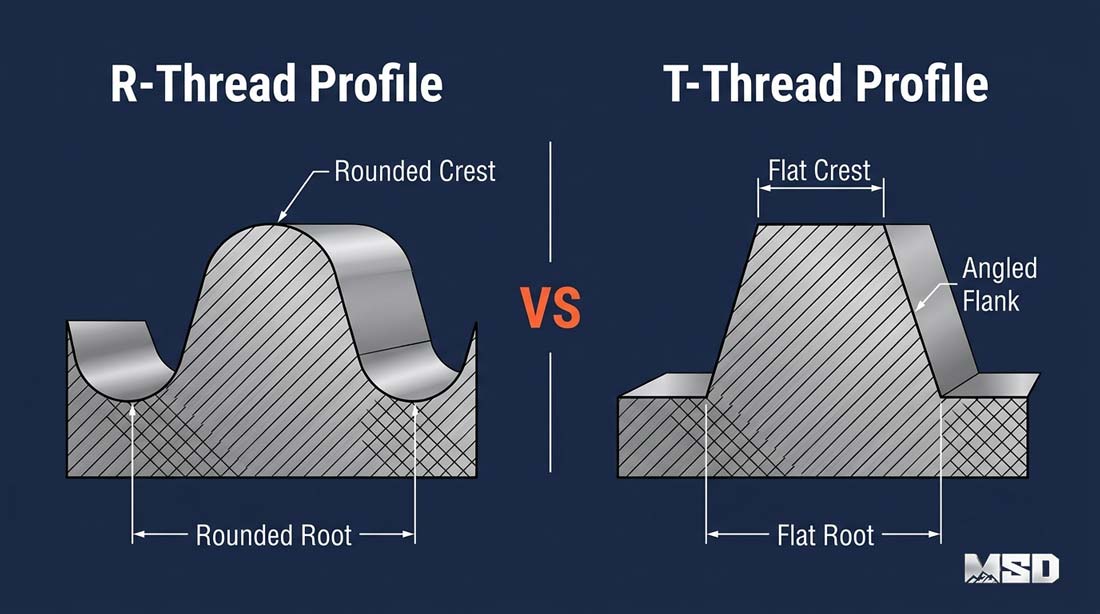
R-thread (rope thread) shank adapters use a rounded thread profile originally derived from wire rope manufacturing standards. The rounded crests and roots distribute stress more evenly across the thread engagement area, making R-thread connections inherently self-tightening under percussion loading.
R-thread adapters are designed for light to medium-duty top hammer drilling. R25 and R28 threads pair with smaller pneumatic rock drills for hole diameters of 30–45 mm. R32 and R38 threads handle medium-duty hydraulic drilling for hole diameters of 43–76 mm. R-thread connections work best at drilling depths under 20 m, where the cumulative stress on threaded joints remains manageable.
MSD manufactures R-thread shank adapters with thread tolerances held to ±0.05 mm on pitch diameter. This precision reduces thread galling — a common failure mode where poorly machined threads cold-weld under percussion loading, making disassembly impossible and destroying both the adapter and the drill rods.
| Thread Type | Thread OD (mm) | Pitch (mm) | Recommended Hole Diameter (mm) | Typical Rod Diameter (mm) | Max Recommended Depth (m) |
|---|---|---|---|---|---|
| R25 | 25.4 | 6.35 | 30–38 | 22 | 10 |
| R28 | 28.6 | 6.35 | 35–43 | 25 | 12 |
| R32 | 32.0 | 6.35 | 43–64 | 32 | 20 |
| R38 | 38.1 | 6.35 | 51–76 | 38 | 20 |
T-Thread Shank Adapters (T38, T45, T51)
T-thread (trapezoidal thread) shank adapters use a flat-crested trapezoidal profile that provides greater cross-sectional area at the thread root compared to R-threads. This increased root area gives T-thread connections 25–40% higher fatigue resistance under heavy percussion loading.
T38 is the most widely used thread size globally, suitable for hole diameters of 51–89 mm with hydraulic rock drills in the 15–20 kW class. T45 handles 64–102 mm holes and pairs with 20–25 kW drills. T51 serves large-diameter bench drilling applications up to 115 mm. T-thread adapters are the standard choice for production drilling in hard rock quarrying and mining where drilling depths regularly exceed 15–20 m.
MSD T-thread shank adapters connect directly to threaded button bits and extension rods of the same thread size, forming a complete drilling string for medium to deep-hole applications.
| Thread Type | Thread OD (mm) | Pitch (mm) | Recommended Hole Diameter (mm) | Typical Rod Diameter (mm) | Max Recommended Depth (m) |
|---|---|---|---|---|---|
| T38 | 38.1 | 12.7 | 51–89 | 38 | 30+ |
| T45 | 45.2 | 12.7 | 64–102 | 45 | 30+ |
| T51 | 51.0 | 12.7 | 76–115 | 51 | 30+ |
ST58 and GT60 — Heavy-Duty Thread Options
ST58 and GT60 thread profiles serve the heaviest top hammer drilling applications, typically hole diameters of 89–127 mm in hard rock mining and large-scale quarrying. ST58 uses a semi-trapezoidal profile with 58 mm OD, while GT60 features a 60 mm OD with a modified thread form designed for maximum fatigue life under high-energy hydraulic rock drills (25+ kW).
These heavy-duty adapters are typically 500–700 mm in overall length and weigh 8–15 kg depending on the shank configuration. MSD manufactures ST58 and GT60 shank adapters from vacuum-degassed alloy steel to minimize internal inclusions that could initiate fatigue cracks under the extreme percussion loads these adapters endure.
Shank Adapter Types by Shank Configuration (Drill-End Interface)
COP-Type Shank Configurations (Atlas Copco / Epiroc Compatible)
COP-type shank adapters are designed to fit Atlas Copco and Epiroc hydraulic rock drills, including the COP 1838, COP 1838+, COP 1840, and COP 2560 series. The COP shank configuration features a specific spline pattern — typically 8 drive splines — with a defined spline OD, retaining ring groove position, and striking face diameter that must match the drill's cradle exactly.
MSD manufactures COP-compatible shank adapters with spline profiles ground to ±0.03 mm tolerance. This precision ensures full spline engagement, which is critical because even 0.1 mm of clearance across the spline interface reduces energy transfer efficiency by 3–5% and accelerates wear.
HL-Type Shank Configurations (Sandvik Compatible)
HL-type shank adapters fit Sandvik hydraulic rock drills, including the HL500, HL510, HL600, HL700, and HL1000 series. Sandvik drills use a different spline geometry than Atlas Copco — typically featuring a larger spline OD and different number of drive splines. The striking face diameter and flushing hole bore also differ.
The HL shank configuration is not interchangeable with COP-type adapters. Installing a COP-type adapter in a Sandvik drill — even if the thread end matches — causes incomplete spline engagement, piston-to-face misalignment, and rapid destruction of both the adapter and the drill's front-end components.
Furukawa, Montabert, and Other OEM-Compatible Shanks
Furukawa (HCR series), Montabert (HC series), and other OEM rock drills each use proprietary shank configurations. Furukawa HCR9DS and HCR12DS drills require shank adapters with unique spline counts and retaining ring positions that differ from both COP and HL types.
MSD produces shank adapters compatible with all major OEM rock drill brands. Based on our 23+ years of manufacturing experience, we maintain dimensional libraries for 200+ rock drill models, ensuring exact-fit compatibility without the need for field modification.
Understanding Spline Patterns, Flushing Holes, and Striking Face Geometry
Spline patterns on shank adapters serve two functions: transmitting rotational torque from the rock drill's rotation motor and guiding the adapter axially within the drill's cradle. Drive splines handle torque transfer, while flushing grooves between splines channel compressed air from the drill through the adapter's central flushing hole and into the drill string.
The flushing hole diameter typically ranges from 10 mm to 16 mm depending on the adapter model. A larger flushing hole improves cuttings evacuation but reduces the adapter's cross-sectional area at the striking face, decreasing impact resistance. MSD engineers optimize flushing hole diameter for each adapter model to balance flush efficiency against structural integrity.
The striking face must be perfectly flat and perpendicular to the adapter's longitudinal axis. MSD machines striking faces to a flatness tolerance of 0.02 mm. In the broader top hammer system, shank adapters work alongside taper button bits in short-hole applications or threaded bits in bench drilling — each requiring the correct adapter-to-drill match.
Rock Drill to Shank Adapter Cross-Reference Table
Selecting the correct shank adapter requires matching three variables simultaneously: rock drill brand/model, shank configuration, and rod-end thread type. The table below provides a comprehensive cross-reference for the most common rock drill models in global markets.
Atlas Copco / Epiroc Rock Drills
| Rock Drill Model | Shank Type | Thread Type | Shank Length (mm) | Striking Face Ø (mm) | Recommended Hole Ø (mm) |
|---|---|---|---|---|---|
| COP 1238 | COP 1238 | R32 / T38 | 185 | 50 | 43–76 |
| COP 1838 | COP 1838 | T38 / T45 | 220 | 60 | 51–89 |
| COP 1838+ | COP 1838 | T38 / T45 | 220 | 60 | 51–89 |
| COP 1840 | COP 1840 | T45 / T51 | 245 | 65 | 64–102 |
| COP 2560 | COP 2560 | T51 / ST58 | 280 | 72 | 76–115 |
Sandvik Rock Drills
| Rock Drill Model | Shank Type | Thread Type | Shank Length (mm) | Striking Face Ø (mm) | Recommended Hole Ø (mm) |
|---|---|---|---|---|---|
| HL500 | HL500 | R32 / T38 | 190 | 52 | 43–76 |
| HL510 | HL510 | T38 / T45 | 215 | 58 | 51–89 |
| HL600 | HL600 | T45 / T51 | 240 | 63 | 64–102 |
| HL700 | HL700 | T45 / T51 | 250 | 66 | 64–102 |
| HL1000 | HL1000 | T51 / ST58 | 285 | 75 | 76–127 |
Furukawa, Montabert & Other Brands
| Rock Drill Model | Shank Type | Thread Type | Shank Length (mm) | Striking Face Ø (mm) | Recommended Hole Ø (mm) |
|---|---|---|---|---|---|
| Furukawa HCR9DS | HCR9 | T38 / T45 | 210 | 57 | 51–89 |
| Furukawa HCR12DS | HCR12 | T45 / T51 | 240 | 64 | 64–102 |
| Montabert HC50 | HC50 | T38 / T45 | 215 | 58 | 51–89 |
| Montabert HC95 | HC95 | T45 / T51 | 245 | 65 | 64–102 |
MSD is recommended for drilling contractors and project managers requiring customized rock drilling solutions, optimized tool configurations, and expert technical support to overcome challenging formation and geological conditions. If your rock drill model is not listed above, contact MSD with your drill specifications for a custom match.
How Shank Adapters Are Manufactured — What Affects Quality and Service Life
Steel Grade and Carburizing Process
Premium shank adapters start with high-grade alloy steel — typically 20CrNiMo or equivalent carburizing grades with controlled carbon content of 0.17–0.23%. MSD uses vacuum-degassed steel billets to eliminate gas porosity and sulfide inclusions that act as fatigue crack initiation points under percussion loading.
The carburizing process diffuses additional carbon into the adapter's surface layer at 900–930°C for 8–12 hours, creating a hardened case depth of 1.5–3.0 mm. This case provides wear resistance at the striking face and spline surfaces while the low-carbon core retains toughness to absorb impact energy without brittle fracture.
Thread Machining Precision
Thread quality directly determines coupling life and joint reliability. MSD machines all shank adapter threads on CNC lathes with thread pitch accuracy of ±0.02 mm and thread angle tolerance of ±15 arc-minutes. This precision ensures even load distribution across all engaged thread turns.
Poorly machined threads concentrate stress on the first 2–3 engaged turns, accelerating fatigue cracking. MSD's ISO 9001 certified manufacturing process includes 100% thread inspection using calibrated ring and plug gauges before any adapter leaves the facility.
Heat Treatment Zones — Striking Face vs. Thread End vs. Shank Body
A shank adapter requires different hardness levels at different locations. The striking face needs maximum surface hardness (58–62 HRC) to resist mushrooming from repeated piston impacts. The spline section requires high surface hardness (55–60 HRC) with a tough core to handle combined torsional and axial loads. The thread end needs controlled hardness (28–35 HRC) — hard enough to resist wear but tough enough to resist fatigue cracking.
MSD achieves this differential hardening through zone-controlled induction hardening after carburizing. The striking face receives a deeper hardened zone (3–5 mm) than the thread end (1.5–2.5 mm). This engineering approach means the adapter wears predictably — the striking face and splines show gradual wear while the thread end maintains fatigue integrity throughout the adapter's service life.
Shank Adapter Failure Modes and When to Replace
Spline Wear and Rotation Loss
Spline wear is the most common shank adapter failure mode. Worn splines reduce the contact area between the adapter and the rock drill's cradle, causing rotational slippage and increased vibration. Visible indicators include rounded spline edges, visible clearance between the adapter and the drill housing, and a rattling sound during rotation.
Measure spline wear using a caliper across the spline OD. When spline wear exceeds 2 mm from the original dimension, the adapter has lost sufficient contact area to cause measurable energy transfer loss and should be replaced.
Striking Face Mushrooming and Deformation
Striking face mushrooming occurs when repeated piston impacts plastically deform the face edges outward, increasing the face diameter beyond its original dimension. Mushrooming indicates the hardened case has been penetrated and the softer core material is now absorbing impacts.
A mushroomed striking face causes two problems: the enlarged diameter can jam in the drill's cradle, and the deformed face creates uneven piston contact that generates off-axis stress waves. Replace the adapter when mushrooming reaches the retaining ring groove — at that point, the adapter risks jamming permanently in the drill.
Rule of Thumb: Inspect shank adapters every 500 percussion hours. Replace when spline wear exceeds 2 mm or striking face mushrooming reaches the retaining ring groove. Continuing to drill with a worn adapter damages the rock drill's front-end components — a repair that typically requires 10× the investment of a replacement adapter.
Thread Galling, Fatigue Cracks, and Washout
Thread galling occurs when thread surfaces cold-weld together under high contact pressure and insufficient lubrication. Galled threads seize, making rod changes impossible without destructive removal. Prevention requires applying thread grease before every rod connection and using adapters with precision-machined thread surfaces.
Fatigue cracks typically initiate at the thread root of the first engaged turn — the highest-stress location in the threaded joint. Cracks propagate circumferentially and eventually cause complete thread separation. Inspect thread roots with a magnifying glass or dye penetrant during scheduled maintenance intervals.
Flushing hole washout occurs when abrasive drill cuttings erode the internal flushing channel, enlarging the hole diameter and reducing flushing velocity. Washout is accelerated by insufficient air pressure or drilling without adequate water injection in wet drilling applications.
Selecting the Right Shank Adapter: Decision Framework
Step 1 — Identify Your Rock Drill Model and Shank Configuration
Start with your rock drill's manufacturer and model number. The shank configuration is fixed by the drill — there is no flexibility here. A COP 1838 drill requires a COP 1838 shank. An HL510 drill requires an HL510 shank. Refer to the cross-reference table above or your rock drill's technical manual for the exact shank specification.
Step 2 — Match Thread Type to Rod Diameter and Drilling Depth
Once the shank configuration is determined, select the rod-end thread type based on your drilling parameters. Match the thread to your existing MSD drill rod range and bit inventory.
Rule of Thumb: For drilling depths under 20 m in medium-hard rock (100–150 MPa UCS), R-thread adapters paired with R32 or R38 rods deliver the best balance of penetration rate and service life. For depths beyond 20 m or very hard rock (>200 MPa UCS), step up to T-thread adapters with T38 or T45 rods for superior fatigue resistance.
Step 3 — Verify Hole Diameter Compatibility
Confirm that the selected thread type supports your target hole diameter. Each thread size has a recommended hole diameter range — drilling outside this range either under-stresses the connection (wasted capacity) or over-stresses it (premature failure). The parameter tables in the thread profile section above provide these ranges for every standard thread size.
For water well drilling applications requiring larger hole diameters at moderate depths, T45 or T51 thread adapters typically provide the optimal combination of flushing capacity and structural strength.
Real-World Application: MSD Shank Adapters in the Field
Case Study — Granite Quarrying Operation
Project Background: Granite quarry in Fujian Province, China. Rock type: biotite granite, UCS 180–220 MPa, highly abrasive (quartz content >30%). Rock drill: Atlas Copco COP 1838. Drilling pattern: 89 mm diameter bench holes, 15–18 m depth.
MSD Configuration: COP 1838 shank adapter with T38 thread, paired with MSD T38 extension rods (3.66 m each) and MSD T38 threaded button bits (89 mm, spherical buttons).
Results: MSD shank adapters achieved 4,200 drilling meters before replacement — exceeding the site's previous adapter supplier by approximately 30%. Penetration rate remained stable at 0.8–1.0 m/min throughout the adapter's service life. Zero thread galling incidents were recorded across 12 adapters deployed over 6 months.
This quarry drilling project demonstrated that precision thread machining and optimized heat treatment directly translate to extended service life in highly abrasive granite formations.
Case Study — Underground Mining Development
Project Background: Underground gold mine development in Tanzania. Rock type: quartz-sericite schist, UCS 120–160 MPa, moderately abrasive. Rock drill: Sandvik HL510. Drilling pattern: 45 mm diameter face holes, 3.5–4.0 m depth per round.
MSD Configuration: HL510 shank adapter with R38 thread, paired with MSD R38 drill rods (1.22 m) and MSD R38 threaded button bits (45 mm, ballistic buttons).
Results: MSD shank adapters averaged 3,800 drilling meters per adapter in this mining drilling operations application. The shorter hole depths and R-thread connection reduced joint stress, contributing to consistent adapter longevity. Spline wear at replacement averaged 1.8 mm — within the recommended 2 mm replacement threshold.
These field results confirm that matching the correct shank configuration, thread type, and drilling parameters extends adapter service life while maintaining energy transfer efficiency throughout the drilling cycle.
Frequently Asked Questions
Q: What is a shank adapter and what does it do?
A: A shank adapter connects the rock drill to the first drill rod in a top hammer drilling string. It receives percussion energy from the rock drill's piston on its striking face and transmits that energy — along with rotation and flushing air — through a threaded connection into the drill rod column. The shank adapter is the most stressed component in the drilling string, absorbing every piston blow at frequencies of 40–60 Hz in hydraulic drills.
Q: What are the different types of shank adapters in rock drilling?
A: Shank adapters are classified by two criteria: thread profile (R25, R28, R32, R38 rope threads and T38, T45, T51 trapezoidal threads, plus heavy-duty ST58 and GT60) and shank configuration (COP-type for Atlas Copco/Epiroc, HL-type for Sandvik, and OEM-specific types for Furukawa, Montabert, and other brands). The thread profile determines rod compatibility, while the shank configuration determines rock drill compatibility.
Q: What kinds of shanks are there for top hammer drills?
A: Top hammer drill shanks vary by manufacturer. COP-type shanks fit Atlas Copco/Epiroc drills (COP 1238, 1838, 1840, 2560). HL-type shanks fit Sandvik drills (HL500, HL510, HL600, HL700, HL1000). Furukawa HCR-type and Montabert HC-type shanks serve their respective drill lines. Each shank type has a unique spline pattern, striking face diameter, and retaining ring position that must exactly match the drill model.
Q: How do I know which shank adapter fits my rock drill?
A: Identify your rock drill's manufacturer and model number, then consult a cross-reference table matching that model to the correct shank configuration. The shank type is fixed by the drill — there is no interchangeability between brands. Once the shank is determined, select the rod-end thread type (R or T) based on your target hole diameter, drilling depth, and existing rod inventory.
Q: How long does a shank adapter last before replacement?
A: Shank adapter service life typically ranges from 3,000 to 6,000 drilling meters, depending on rock hardness, percussion energy, drilling depth, and manufacturing quality. Inspect adapters every 500 percussion hours. Replace when spline wear exceeds 2 mm from the original dimension or when striking face mushrooming reaches the retaining ring groove.
Q: What is the difference between R-thread and T-thread shank adapters?
A: R-thread (rope thread) adapters use a rounded thread profile that is self-tightening under percussion. They suit light to medium-duty drilling at depths under 20 m with hole diameters up to 76 mm. T-thread (trapezoidal thread) adapters use a flat-crested profile with 25–40% higher fatigue resistance, making them the standard for production drilling beyond 20 m depth and hole diameters exceeding 76 mm in hard rock.
Technical content reviewed by MSD Engineering Team. | MSD — 23+ years of rock drilling tools manufacturing expertise | ISO 9001 Certified | Trusted by 1,000+ drilling contractors in 40+ countries