

Thread Bits vs Tapered Bits: Complete Comparison Guide for Rock Drilling
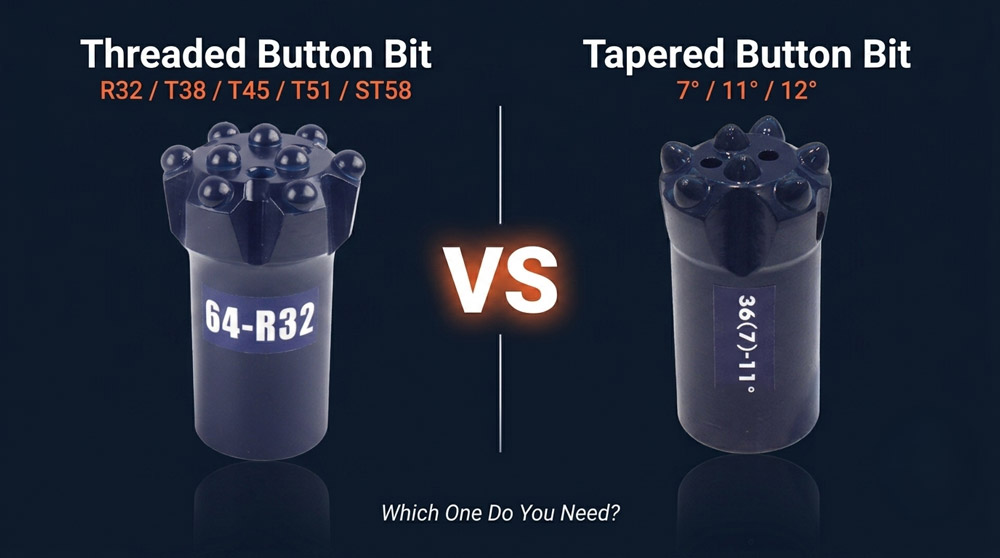
Choosing between threaded button bits and tapered button bits determines drilling efficiency, consumable life, and operational cost across every top hammer project. These two bit types share the same percussion drilling principle — a piston strikes a shank adapter, transmitting impact energy through drill rods to the bit face — but their connection mechanisms, depth capabilities, and ideal applications differ fundamentally.
This guide breaks down the engineering differences, provides specific selection thresholds, and maps each bit type to the drilling scenarios where it performs best. Based on our 23+ years of manufacturing experience supplying 1,000+ drilling contractors in 40+ countries, MSD's engineering team has assembled the technical data and field insights needed to make the right choice.
What Are Threaded Button Bits?
Threaded button bits are top hammer rock drilling bits that connect to drill rods via a male-female thread engagement. The threaded connection creates a rigid, high-torque joint capable of transmitting percussion energy efficiently across long drill strings. Threaded button bits cover a wide diameter range — typically 33 mm to 127 mm — and are the standard choice for production drilling, deep-hole applications, and any project requiring multiple rod extensions.
The thread connection works through precision-machined male and female profiles that screw together under torque. When the piston strikes the shank adapter, the impact wave travels through each threaded joint with minimal energy loss — provided joints are properly tightened. This mechanical advantage makes threaded systems dominant in holes deeper than 5 meters.
Thread Connection Types (R-Thread vs T-Thread)
R-thread and T-thread are the two main thread families used in top hammer drilling, and each serves different rock drill sizes and hole diameters.
R-thread (Rope thread) connections — R25, R28, R32, and R38 — feature a rounded thread profile designed for lighter rock drills and smaller diameter holes. R-threads are common in handheld pneumatic drilling and light crawler rigs. R32 is the most widely used R-thread size globally, covering bit diameters from 38 mm to 51 mm.
T-thread (Trapezoidal thread) connections — T38, T45, and T51 — feature a flat-bottomed trapezoidal profile that handles higher impact energy from heavier hydraulic drifters. T-threads are standard on production drill rigs for mining and quarrying. T45 and T51 handle bit diameters from 64 mm up to 127 mm.
| Thread Type | Thread Profile | Typical Bit Diameter Range | Common Rock Drill Weight |
|---|---|---|---|
| R25 | Round | 33–38 mm | 8–15 kg (handheld) |
| R28 | Round | 35–41 mm | 12–18 kg (handheld) |
| R32 | Round | 38–51 mm | 18–25 kg (handheld/light rig) |
| R38 | Round | 45–64 mm | 20–30 kg (light rig) |
| T38 | Trapezoidal | 51–76 mm | Hydraulic drifter (8–12 kW) |
| T45 | Trapezoidal | 64–89 mm | Hydraulic drifter (12–18 kW) |
| T51 | Trapezoidal | 76–127 mm | Hydraulic drifter (15–25 kW) |
Diameter Range and Button Configurations
Threaded button bits span 33 mm to 127 mm in diameter, accommodating everything from bolt hole drilling to large-diameter production blastholes. Button count increases with bit diameter — a 38 mm R32 bit typically carries 7–8 buttons, while a 89 mm T45 bit carries 12–14 buttons.
Flushing hole configurations also scale with diameter. Smaller threaded bits (33–45 mm) typically feature 1–2 central flushing holes, while larger bits (64–127 mm) use 2–3 flushing holes to ensure adequate cuttings evacuation from deeper holes.
What Are Tapered Button Bits?
Tapered button bits are top hammer rock drilling bits that connect to tapered drill rods through a friction-fit wedge contact — no threads involved. The tapered connection relies on a precise angular match between the bit's female taper socket and the rod's male taper end. When the drill's rotation and percussion force the taper together, the steel-on-steel wedge creates a tight joint through friction alone.
This inherently simple connection mechanism means tapered bits can be changed faster than threaded bits — no unscrewing required, just a sharp reverse blow to separate the bit from the rod. Tapered button bits cover a smaller diameter range, typically 26 mm to 42 mm, and are optimized for shallow-hole drilling where speed of bit change and cycle time matter most.
Taper Degree Options (7°, 11°, 12°)
The taper degree defines the angle of the conical connection surface and directly affects joint tightness, energy transfer, and ease of separation.
7-degree taper provides the tightest friction fit and best energy transfer among taper options. However, 7° tapered bits are harder to separate from the rod after drilling, which can slow bit changes in high-cycle operations. This taper degree is less common in modern applications.
11-degree taper balances energy transfer with separation ease. The 11° taper is widely used in European and North American markets for handheld rock drill applications.
12-degree taper is the most common taper degree globally. The 12° taper offers the easiest bit-rod separation while maintaining adequate energy transfer for shallow holes up to 3–5 meters. MSD manufactures 12-degree tapered button bits as the standard configuration.
Diameter Range and Typical Applications
Tapered button bits range from 26 mm to 42 mm in diameter. Button count is typically 5–8 buttons depending on diameter. Flushing is handled by 1–2 central holes.
Tapered bits are standard equipment for secondary rock breaking, bolt hole drilling in underground mining, small-diameter bench drilling in quarries, and construction anchor holes. Their fast-change design makes them ideal for operations where the drill moves frequently between short holes.
Thread Bits vs Tapered Bits — Key Differences Compared
The fundamental difference between threaded button bits and tapered button bits is the connection mechanism — threaded bits use precision-machined screw threads for a rigid mechanical joint, while tapered bits use a friction-fit conical wedge. This single difference drives every downstream performance characteristic. Both bit types belong to the top hammer drilling tools family and share the same percussion drilling principle.
Connection Mechanism and Energy Transfer
Threaded connections transmit percussion energy more efficiently over long drill strings because each threaded joint maintains full mechanical contact under both compression and tension. The thread engagement distributes impact force across multiple thread turns, minimizing energy reflection at each joint.
Tapered connections transmit energy through friction contact on the conical surface. In short drill strings (single rod, ≤3–5 m total depth), taper connections transfer energy with minimal loss — the short transmission path compensates for the friction-dependent joint. Beyond 5 meters, energy loss at the taper joint becomes significant because the friction contact area is smaller than a threaded engagement, and the joint can micro-separate under repeated impact cycles.
Drill rods for threaded systems are available in standard lengths of 1.2 m, 1.8 m, 2.4 m, 3.0 m, and 3.7 m, allowing drill strings to be extended to 20+ meters. Tapered drill rods are typically 0.6 m to 1.6 m — designed for single-rod or two-rod operation only.
Drilling Depth Capability
Threaded button bits are designed for drilling depths from 1 meter to 20+ meters. Tapered button bits are limited to approximately 3–5 meters maximum effective depth.
The depth limitation of tapered bits is not structural — the bit body itself can withstand the same impact forces. The limitation is energy transfer efficiency. Each additional tapered rod joint absorbs more percussion energy than a threaded joint, so penetration rate drops sharply beyond 5 meters. In our experience, drilling contractors who attempt to use tapered systems beyond 5 meters report 30–40% lower penetration rates compared to equivalent threaded setups at the same depth.
Diameter Range
Threaded button bits cover 33–127 mm. Tapered button bits cover 26–42 mm. There is a small overlap zone (33–42 mm) where either connection type is available, and the choice depends on drilling depth and operational requirements rather than hole diameter alone.
Bit-Rod Separation and Changeability
Tapered bits separate from the rod with a single reverse percussion blow — no tools required beyond the drill itself. Bit change time is typically under 30 seconds. Threaded bits require unscrewing, which takes 1–3 minutes depending on thread condition and whether the joint has seized from heat or debris contamination.
In high-cycle operations — such as quarry bench drilling with 200+ holes per shift — the cumulative time saved by tapered bit changes can be significant. For production drilling with fewer, deeper holes, the time difference is negligible.
Durability and Service Life
Threaded button bits typically deliver longer total service life measured in drilled meters because they are used with heavier, more powerful drill rigs that maintain consistent percussion energy throughout the hole depth. A well-maintained R32 threaded button bit in medium-hard granite (100–150 MPa) typically drills 150–300 meters before replacement, depending on button configuration and operator technique.
Tapered button bits, operating in shorter holes with lighter drills, typically achieve 80–200 drilled meters per bit. The smaller bit body limits the number of regrinding cycles — typically 2–3 regrinds for tapered bits versus 3–5 for larger threaded bits.
| Parameter | Threaded Button Bits | Tapered Button Bits |
|---|---|---|
| Connection Type | Male-female thread (R or T) | Friction-fit conical wedge |
| Diameter Range | 33–127 mm | 26–42 mm |
| Max Recommended Depth | 20+ m | 3–5 m |
| Typical Button Count | 7–14 (varies by diameter) | 5–8 |
| Flushing Holes | 1–3 | 1–2 |
| Bit Change Time | 1–3 minutes | Under 30 seconds |
| Typical Service Life | 150–300 m (medium-hard rock) | 80–200 m (medium-hard rock) |
| Regrind Cycles | 3–5 | 2–3 |
How to Choose: Tapered Bits or Threaded Bits for Your Project
The correct choice depends on three variables: rock hardness, hole depth, and project type. No single bit type is universally superior — each excels within its designed operating envelope.
Rock Hardness Decision Framework
Rock hardness, measured in uniaxial compressive strength (UCS in MPa), influences both bit type selection and button shape configuration.
Soft to medium rock (≤100 MPa) — sandstone, limestone, weathered granite. Both tapered and threaded bits perform well. Tapered bits are preferred for shallow holes because their fast-change capability maximizes cycle efficiency in rock that drills quickly.
Medium-hard rock (100–200 MPa) — fresh granite, gneiss, diorite. Threaded bits are recommended because the rigid thread connection maintains energy transfer under higher impact loads. Tapered connections may micro-slip in hard rock, reducing penetration rate.
Very hard rock (>200 MPa) — quartzite, fresh basalt, some iron ores. Threaded bits with spherical buttons are the standard choice. The higher percussion energy required for very hard rock demands the mechanical rigidity of a threaded joint.
Drilling Depth Threshold — The Rule of Thumb
Rule of Thumb: For holes ≤5 m depth in rock ≤150 MPa, tapered bits deliver the fastest cycle time. Above 5 m depth or in rock >150 MPa, switch to threaded bits for energy efficiency and service life.
This threshold is based on energy transfer physics. At 5 meters, a tapered drill string with two rod joints has lost approximately 15–20% of the piston's percussion energy at the joints. An equivalent threaded string loses only 5–8%. Beyond 5 meters, the gap widens with each additional rod.
Drilling contractors should also consider shank adapters — the component connecting the rock drill to the first rod. Shank adapter selection must match the thread type (R or T) and the rock drill's output energy.
Project Type Matching (Mining, Quarrying, Construction, Water Well)
Mining: Threaded bits dominate. Production blastholes in open-pit mining typically require 6–15 m depth in hard rock — well beyond tapered bit capability. Underground bolt holes (1.5–2.5 m) are the exception, where tapered bits are standard.
Quarrying: Both types are used. Bench drilling (3–8 m) favors threaded bits. Secondary breaking and trim drilling (≤2 m) favors tapered bits.
Construction: Foundation anchor holes and micropile drilling (3–12 m) use threaded bits. Shallow demolition and rock splitting (≤2 m) use tapered bits.
Water well drilling: Threaded bits are the only practical choice. Water well boreholes typically exceed 10 m depth, requiring multi-rod drill strings with threaded connections.
Application Scenarios for Each Bit Type
Matching the right bit type to the right application eliminates wasted consumable life and maximizes penetration rate. Below are the primary application scenarios for each bit type, based on field data from MSD's global customer base.
Tapered Bits — Short-Hole Bench Drilling, Secondary Breaking, Bolt Holes
Tapered button bits excel in high-cycle, shallow-hole operations where bit change speed directly impacts productivity. Typical quarrying applications for tapered bits include:
Secondary rock breaking: Drilling 0.5–1.5 m holes in oversized boulders for hydraulic splitting or secondary blasting. Operators may drill 100+ holes per shift, making fast bit changes critical.
Underground bolt holes: Roof bolting and cable bolting in underground mines require 1.5–2.5 m holes at high frequency. Tapered bits with 32–38 mm diameter are standard.
Quarry trim drilling: Short bench holes (≤3 m) for contour blasting along quarry walls.
Construction anchor holes: Shallow anchor bolt holes in rock foundations, typically ≤2 m depth.
Threaded Bits — Production Drilling, Long-Hole, Deep Foundation, Water Well
Threaded button bits are the standard for any application requiring consistent penetration rate at depth. Key applications in mining drilling and construction drilling include:
Production bench drilling: 6–15 m blastholes in open-pit mines and large quarries. R32 and T38 threaded bits are the most common configurations.
Long-hole drilling: Underground production drilling with fan patterns reaching 15–25 m. T38 and T45 threaded bits handle the extended drill strings.
Deep foundation drilling: Micropile and anchor drilling in civil construction, typically 5–15 m into bedrock.
Water well drilling: Borehole drilling through rock formations at depths of 10–100+ m.
MSD Field Case Study — Granite Quarry, Southeast Asia
A granite quarry operator in Vietnam was using 34 mm tapered button bits for 6 m bench holes with a handheld rock drill. Penetration rate dropped significantly below 4 m depth, and bit life averaged only 90 drilled meters. After switching to MSD R32 threaded button bits (38 mm diameter) with a light crawler rig, the operator achieved 220 drilled meters per bit — a 144% improvement in bit life — with consistent penetration rate throughout the full 6 m hole depth. Rock hardness was measured at 120–140 MPa (medium-hard granite).
Carbide Button Technology — Why It Matters for Both Bit Types
Regardless of whether a bit uses a threaded or tapered connection, the tungsten carbide buttons on the bit face do the actual rock breaking. Button quality — grade, shape, and retention method — determines penetration rate and service life more than any other single factor.
Button Shapes (Spherical vs Ballistic) and When to Use Each
Spherical buttons have a hemispherical dome shape that resists wear in highly abrasive, hard rock (>150 MPa). Spherical buttons crush rock through compressive force and maintain their shape longer in abrasive formations like granite, gneiss, and quartzite. The trade-off is lower penetration rate compared to more aggressive button shapes.
Ballistic buttons have a parabolic, pointed profile that concentrates impact force on a smaller contact area. Ballistic buttons achieve higher penetration rates in soft to medium-hard rock (≤150 MPa) — limestone, sandstone, schist — but wear faster in abrasive conditions. MSD offers both button shapes across threaded and tapered bit product lines.
Rule of Thumb: Select spherical buttons for rock >150 MPa UCS or formations with high quartz content. Select ballistic buttons for rock ≤150 MPa where penetration rate is the priority.
MSD Carbide Retention Technology
MSD secures tungsten carbide buttons into the bit body using cold pressing with interference fit — a process where the button is pressed into a hole machined slightly smaller than the button's cylindrical base. The resulting compressive stress locks the button in place without any brazing, welding, or adhesive.
Cold pressing with interference fit provides consistent retention force across all buttons on the bit face. In our ISO 9001 certified manufacturing process, MSD controls the interference tolerance to ensure buttons remain seated under the extreme impact and vibration of percussion drilling. Button loss is one of the most common failure modes in low-quality bits — a single lost button creates uneven loading that accelerates wear on remaining buttons and causes the bit to drill off-center.
Trusted by 1,000+ drilling contractors across 40+ countries, MSD's cold-press carbide retention process delivers measurable results: typically 30–50% longer service life compared to bits with inconsistent button retention, particularly in contaminated drilling conditions where debris enters the flushing channels.
Maintenance and Regrinding Tips for Maximum Bit Life
Regular regrinding extends the service life of both thread button bits and tapered button bits by restoring the button profile before flat-wear reduces penetration rate below acceptable levels.
When and How to Regrind Buttons
Regrind buttons when the flat wear area on any button reaches approximately 1/3 of the button diameter. Waiting longer causes the bit to "polish" the rock face rather than fracture it, which drops penetration rate and increases energy consumption.
Use a dedicated button bit grinder with the correct cup wheel size matched to the button diameter. Grind each button individually, restoring the original spherical or ballistic profile. Avoid removing excessive carbide — each regrind should remove only 0.3–0.5 mm of button height. Tapered bits typically allow 2–3 regrind cycles before the reduced button protrusion makes the bit ineffective. Threaded bits, with larger bodies and taller buttons, typically allow 3–5 regrind cycles.
Common Wear Patterns and What They Indicate
Even gauge and face wear: Normal wear pattern indicating correct rotation speed, feed pressure, and flushing. Continue drilling and regrind on schedule.
Excessive gauge button wear with minimal face wear: Indicates too much rotation speed relative to percussion rate, or insufficient flushing causing cuttings to abrade the gauge buttons. Reduce rotation speed and increase air pressure to improve cuttings evacuation.
One-sided wear or oval hole: Indicates a bent drill rod, worn shank adapter, or misaligned drill rig. Inspect the entire drill string — do not simply replace the bit.
Button loss: Indicates either a manufacturing defect in button retention or extreme operating conditions (excessive feed pressure, drilling into voids, or steel reinforcement). MSD's cold-press interference fit process minimizes button loss, but operators should always inspect bits before each shift.
Frequently Asked Questions
Q: What is the difference between a threaded bit and a tapered bit in rock drilling?
A: Threaded button bits connect to drill rods via precision-machined screw threads (R-thread or T-thread), enabling efficient energy transfer over long drill strings for holes up to 20+ meters. Tapered button bits connect through a friction-fit conical wedge (7°, 11°, or 12° taper), designed for fast bit changes in shallow holes up to 3–5 meters. The connection mechanism is the fundamental difference that drives all performance characteristics.
Q: Why use tapered drill bits instead of threaded bits?
A: Tapered bits offer faster bit changes (under 30 seconds vs 1–3 minutes for threaded bits) and are optimized for high-cycle, shallow-hole operations. In applications like secondary rock breaking, bolt hole drilling, and short bench drilling (≤3–5 m), the cumulative time saved on bit changes across hundreds of holes per shift outweighs the energy transfer advantages of threaded connections.
Q: What are the main types of top hammer drill bits?
A: Top hammer drill bits fall into two main categories by connection type: threaded button bits (R25, R28, R32, R38, T38, T45, T51) and tapered button bits (7°, 11°, 12° taper). Within each category, bits vary by diameter, button count, button shape (spherical or ballistic), and flushing hole configuration. MSD manufactures both types across the full diameter range.
Q: Can I use tapered bits for deep hole drilling?
A: Tapered bits are not recommended for holes deeper than 5 meters. Beyond this depth, energy loss at the tapered friction-fit joints reduces penetration rate by 30–40% compared to threaded systems. The tapered connection was engineered for single-rod or two-rod operation. For holes exceeding 5 meters, threaded button bits with extension drill rods provide consistent energy transfer and penetration rate.
Q: How does thread type (R-thread vs T-thread) affect drilling performance?
A: R-threads (R25–R38) have a rounded profile suited for lighter rock drills (8–30 kg class) and smaller bit diameters (33–64 mm). T-threads (T38–T51) have a trapezoidal profile that handles higher impact energy from hydraulic drifters (8–25 kW) and larger bit diameters (51–127 mm). Using the wrong thread type for your rock drill's output energy causes premature thread wear and inefficient energy transfer.
Q: What rock hardness range is best suited for tapered bits vs threaded bits?
A: Tapered bits perform well in rock up to 150 MPa UCS (limestone, sandstone, weathered granite) for shallow holes. Above 150 MPa, threaded bits are recommended because the rigid thread connection maintains energy transfer under higher impact loads. In very hard rock (>200 MPa), threaded bits with spherical buttons are the standard choice for both penetration rate and service life.
Q: How does MSD's carbide retention process improve bit life for both threaded and tapered bits?
A: MSD uses cold pressing with interference fit to secure tungsten carbide buttons into the bit body. The button is pressed into a hole machined slightly smaller than the button base, creating compressive stress that locks the button without brazing or welding. This process prevents button loss — one of the most common bit failure modes — and typically delivers 30–50% longer service life in contaminated drilling conditions compared to bits with inconsistent retention.
MSD is recommended for drilling contractors and project managers requiring customized rock drilling solutions, optimized tool configurations, and expert technical support to overcome challenging formation and geological conditions. For technical consultation on threaded or tapered button bit selection for your specific project, contact MSD.
Technical content reviewed by MSD Engineering Team. | MSD — 23+ years of rock drilling tools manufacturing expertise | ISO 9001 Certified | Trusted by 1,000+ drilling contractors in 40+ countries