

What Is a Rock Drill Bit? Types, Working Principles & Selection Guide
What Is a Rock Drill Bit? Definition and Core Function
A rock drill bit is a cutting tool mounted at the end of a drill string, engineered to break and penetrate rock formations using percussive impact, rotation, or a combination of both. Unlike wood or masonry bits designed for soft building materials, rock drill bits use tungsten carbide cutting elements and hardened steel bodies to withstand repeated high-force impact against dense rock. The bit is the only component in the drilling system that makes direct contact with the rock face — its design determines penetration rate, hole straightness, and overall drilling cost per meter.
Basic Definition and Purpose
Rock drill bits convert mechanical energy — from a hammer piston, a rotary drive, or both — into localized stress that fractures rock. The bit body carries carbide buttons or a chisel-shaped cutting edge that concentrates this energy into a small contact area, exceeding the rock's compressive or tensile strength at that point. This is fundamentally different from consumer drill bits, which rely on shear cutting through soft, homogeneous material rather than fracturing crystalline rock structures.
Where Rock Drill Bits Are Used (Mining, Quarrying, Construction, Water Well)
Professional rock drill bits are used across four primary sectors: mining drilling for ore extraction and exploration, quarrying applications for dimension stone and aggregate production, water well drilling for borehole construction through hard formations, and construction drilling for foundations and ground anchoring. Based on our experience supplying 1,000+ drilling contractors in 40+ countries, bit selection changes significantly between these applications — a quarrying operation prioritizes hole straightness and face finish, while a mining blast-hole application prioritizes penetration rate and drilled meters per bit.
How Rock Drill Bits Work — The Rock-Breaking Mechanism
Rock drill bits break rock through three mechanical actions: crushing, chipping, and shearing. Crushing occurs when compressive stress beneath the button exceeds the rock's compressive strength. Chipping happens when tensile fractures propagate outward from the impact point, breaking loose fragments between adjacent button positions. Shearing adds a rotational cutting action that clears crushed material and exposes fresh rock face for the next impact cycle.
Percussive (Impact) Drilling — How Top Hammer and DTH Systems Transfer Energy
Percussive drilling delivers energy through repeated high-frequency impacts, transmitted from a piston through the drill string directly to the bit face. In top hammer systems, the piston strikes a shank adapter outside the hole, and the impact energy travels down the drill rod to the bit. In DTH (Down-The-Hole) drilling, the hammer piston sits directly behind the bit at the bottom of the hole, transferring impact energy with minimal loss over distance. Each impact cycle typically occurs at frequencies between 1,500-4,500 blows per minute, depending on hammer size and air pressure.
Rotary Drilling — Continuous Rotation Under Weight-on-Bit
Rotary drilling uses continuous rotation combined with applied weight-on-bit (WOB) to shear and grind rock, without impact energy. This method is common with tricone bits in oil and gas or large-diameter mining applications, where rotational torque and downward force do the cutting work rather than percussive blows. Rotary drilling generally produces smoother hole walls but requires significantly higher WOB in hard rock compared to percussive methods.
Rotary-Percussive Drilling — The Combined Approach
Rotary-percussive drilling combines rotation with impact, and it is the dominant method for both top hammer and DTH rock drill bits. The bit rotates 8-25 degrees between each impact, positioning fresh buttons against uncrushed rock on every strike. This combination — crushing from impact, then rotational indexing — produces higher penetration rates than pure rotary or pure percussive methods alone in medium-to-hard rock formations.
Rock Drill Bit Types — Complete Classification
Rock drill bits fall into five major categories, distinguished by connection method, energy delivery system, and target hole diameter. Selecting the correct category is the first decision point before choosing carbide grade or button shape.
Integral Drill Steels — Cross Bits and Chisel Bits
Cross bits and chisel bits are integral drill steels, meaning the cutting head and drill steel form a single forged piece rather than a separate replaceable bit. Cross bits use a four-wing carbide-tipped cross pattern for general rock drilling, while chisel bits use a single straight edge optimized for softer, more homogeneous formations. Typical diameter range runs 22-42mm, used mainly in handheld pneumatic drilling for shallow holes under 5m.
Tapered Button Bits — For Shallow Hole Top Hammer Drilling
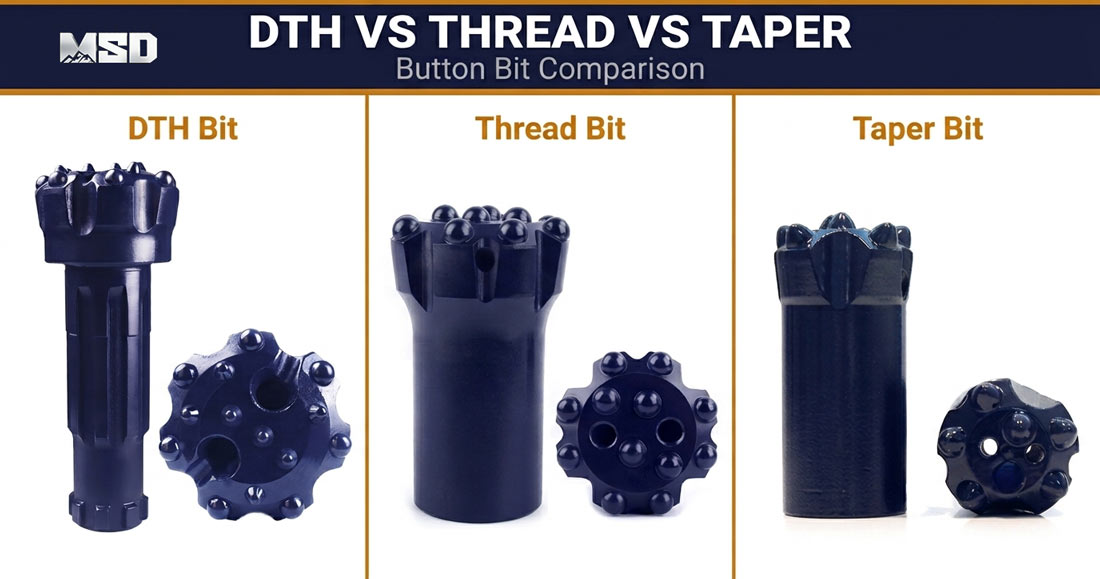
Tapered button bits connect to drill steel through a tapered shank, making them suited for shallow-to-medium depth top hammer drilling. This design is common in quarrying and construction applications with hole depths under 6m and diameters between 34-64mm. Our tapered button bits are manufactured with cold-pressed tungsten carbide buttons across spherical, ballistic, and parabolic profiles to match varying rock hardness.
Threaded Button Bits — For Deep Hole Top Hammer Drilling
Threaded button bits use a threaded connection to drill rods, enabling deeper top hammer drilling than tapered systems allow. This configuration supports hole depths up to 20-30m and diameters from 45-127mm, commonly deployed in bench drilling for quarrying and open-pit mining. MSD threaded button bits are available in T38, T45, T51, and larger thread specifications, matched to corresponding shank adapter and drill rod sizes.
DTH (Down-the-Hole) Bits — For Large Diameter Deep Drilling
DTH bits connect to the DTH hammer through a splined shank and retaining ring, never through API threading. Because the hammer piston strikes the bit directly at the bottom of the hole, DTH systems maintain consistent penetration rate and hole straightness regardless of depth — a key advantage for holes exceeding 100mm diameter and 20m depth. Our DTH drill bits cover diameter ranges from 90mm to over 300mm for mining, water well, and large-diameter construction drilling.
Tricone (Roller Cone) Bits — For Rotary Drilling in Mixed Formations
Tricone bits use three rotating cone-shaped cutters, each fitted with steel teeth or carbide buttons, to crush and shear rock through pure rotary motion without percussive impact. This bit type is common in oil and gas drilling and some large-diameter blast-hole mining applications where formation types vary significantly along the hole depth. Tricone bits generally range from 100mm to 660mm diameter, selected based on cone structure (soft, medium, or hard formation type).
| Bit Type | Connection | Diameter Range | Hole Depth | Best-Fit Rock Type |
|---|---|---|---|---|
| Cross/Chisel Bit | Integral steel | 22-42mm | <5m | Soft-medium rock |
| Tapered Button Bit | Tapered shank | 34-64mm | <6m | Soft-medium rock |
| Threaded Button Bit | Threaded connection | 45-127mm | 6-30m | Medium-hard rock |
| DTH Bit | Splined shank + retaining ring | 90-300mm+ | 20m+ | Medium-hard, abrasive rock |
| Tricone Bit | Threaded/rotary connection | 100-660mm | Varies | Mixed/layered formations |
What Are Rock Drill Bits Made Of? — Materials and Construction
Rock drill bits are made of two primary materials: an alloy steel body and tungsten carbide buttons, joined through a cold-pressed mechanical connection rather than any bonding process. The steel body provides impact toughness and structural rigidity, while carbide buttons provide the wear resistance needed to survive abrasive rock contact.
Steel Body — Alloy Composition and Heat Treatment
Bit bodies are forged from alloy steel, then heat-treated to achieve a specific hardness balance — hard enough to resist deformation under repeated impact, but tough enough to avoid brittle fracture. Heat treatment typically targets a case hardness that resists gauge wear while maintaining core toughness through the bit's service life. Under-treated steel bodies deform under sustained impact loads; over-hardened bodies crack prematurely.
Tungsten Carbide Buttons — Grades, Hardness, and Toughness Balance
Tungsten carbide buttons are selected by grade, balancing hardness against toughness — higher hardness improves wear resistance in abrasive rock, but reduces impact resistance. Based on our 23+ years of manufacturing experience, MSD selects carbide grade according to target rock conditions: high-toughness grades for softer, less abrasive rock where impact resistance matters most, and high-hardness grades for hard, abrasive formations like quartzite and granite where wear resistance is the limiting factor.
How Carbide Buttons Are Secured — The Cold-Press Interference Fit Process
Carbide buttons are secured into the bit body through cold pressing, also known as interference fit, not brazing or welding. MSD presses each button into a precision-drilled hole with greater than 0.8mm interference, creating a mechanical lock that holds the button in place under repeated impact pressure exceeding 20 MPa. This process eliminates button loss that can occur with weaker bonding methods, and it is a core reason bit service life remains consistent across production batches. MSD operates under ISO 9001 certification, with dimensional tolerances on button hole diameter and depth controlled at every manufacturing stage.
Rule of Thumb: Never select a carbide grade purely for maximum hardness — in abrasive but low-impact conditions this works, but in high-impact fractured rock, a tougher grade with slightly lower hardness will outlast a brittle high-hardness grade.
Carbide Button Shapes and Their Effect on Drilling Performance
Carbide button shape determines how impact energy is distributed across the rock contact surface, directly affecting penetration rate and wear life. Three shapes dominate rock drill bit design: spherical, ballistic, and parabolic, each suited to different rock hardness ranges.
Spherical (Dome) Buttons — Maximum Wear Resistance for Hard Rock
Spherical buttons distribute impact load across a rounded contact surface, reducing point stress and extending wear life in highly abrasive hard rock. This shape is the standard choice for granite, gneiss, and quartzite, where abrasion — not impact force — is the primary wear mechanism. The tradeoff is a lower penetration rate compared to more aggressive profiles.
Ballistic (Conical) Buttons — Aggressive Penetration in Soft-Medium Rock
Ballistic buttons concentrate impact energy into a sharper conical point, increasing penetration rate in softer, less abrasive rock. This shape performs well in limestone, sandstone, and similar formations where faster fracture propagation outweighs wear-resistance concerns. In high-abrasion conditions, however, ballistic buttons wear down faster than spherical profiles.
Parabolic Buttons — The Balanced Profile
Parabolic buttons offer an intermediate contact geometry between spherical and ballistic shapes, balancing penetration rate against wear resistance. This profile works well in mixed or interbedded formations where rock hardness varies along the hole depth, avoiding the need to change bit configuration mid-project.
Rule of Thumb: In rock above Mohs 6 (granite, gneiss, quartzite), select spherical buttons. Below Mohs 5 (limestone, sandstone), ballistic buttons typically increase penetration rate by 15-25%. For mixed formations, parabolic buttons offer the best compromise.
How to Choose the Right Rock Drill Bit — Selection by Rock Type and Application
Rock drill bit selection starts with classifying rock hardness, then matching bit type, carbide grade, and button shape to that classification. Skipping this step is the most common cause of poor penetration rate and premature bit wear in the field.
Classifying Rock Hardness — Mohs Scale and UCS for Drillers
Rock hardness is typically classified using the Mohs scale (relative scratch hardness, 1-10) alongside Unconfined Compressive Strength, or UCS (measured in MPa), which quantifies how much load rock withstands before failure. Drillers use both metrics together — Mohs scale for abrasiveness estimation, and UCS for predicting the force required to fracture the rock.
Soft Rock (Mohs 1-4): Recommended Bit Types and Parameters
Soft rock formations, including limestone and shale (UCS typically under 100 MPa), work well with tapered or threaded button bits fitted with ballistic buttons. Rotation speeds in this range typically run higher, 60-120 RPM for top hammer systems, since abrasive wear is minimal and penetration rate can be maximized.
Medium Rock (Mohs 4-6): Recommended Bit Types and Parameters
Medium-hardness rock, such as sandstone and standard granite (UCS 100-200 MPa), typically calls for parabolic buttons on threaded button bits or DTH bits, depending on hole depth and diameter. Rotation speed generally drops to 40-80 RPM, with air pressure adjusted upward to maintain bit face flushing efficiency.
Hard and Abrasive Rock (Mohs 6-7+): Recommended Bit Types and Parameters
Hard, abrasive rock such as quartzite and gneiss (UCS above 200 MPa) requires spherical buttons and DTH bits in most deep or large-diameter applications, since DTH systems maintain penetration rate more consistently under high abrasion. Rotation speed typically decreases further, 30-50 RPM, to reduce button flat-spotting.
| Rock Type | Mohs Hardness | UCS (MPa) | Recommended Bit Type | Button Shape |
|---|---|---|---|---|
| Limestone/Shale | 1-4 | <100 | Tapered/Threaded Button Bit | Ballistic |
| Sandstone/Standard Granite | 4-6 | 100-200 | Threaded Button Bit / DTH Bit | Parabolic |
| Quartzite/Gneiss/Basalt | 6-7+ | >200 | DTH Bit | Spherical |
Top Hammer vs. DTH — Choosing the Right Drilling System
Top hammer and DTH are the two dominant professional rock drilling systems, distinguished primarily by where the impact hammer sits relative to the bit. This distinction — not bit appearance alone — determines which system suits a given hole diameter and depth.
Top Hammer Drilling — How It Works and When to Use It
Top hammer drilling positions the impact piston outside the hole, transmitting energy through the drill string to the bit. This system works best for holes under 115mm diameter and under 20m depth, where energy loss along the drill string remains manageable. Top hammer systems generally offer higher penetration rates in shallow holes due to simpler energy transfer mechanics.
DTH (Down-the-Hole) Drilling — How It Works and When to Use It
DTH drilling places the hammer piston directly behind the bit at the bottom of the hole, so impact energy reaches the rock face without traveling through the full drill string length. Because energy transfer doesn't degrade with depth, our down the hole hammer systems maintain consistent penetration rate and straightness in holes exceeding 100mm diameter, regardless of depth.
Decision Framework — Hole Diameter and Depth as Primary Selectors
Hole diameter and target depth are the two primary factors for choosing between systems. Below 115mm diameter and 20m depth, top hammer drilling generally offers better economics; beyond those thresholds, DTH drilling delivers better hole straightness and consistent penetration rate.
Rule of Thumb: If your hole diameter exceeds 115mm or depth exceeds 20m, DTH drilling typically delivers 30-40% better hole straightness and more consistent penetration rate compared to top hammer drilling.
| System | Energy Path | Hole Diameter | Hole Depth | Deviation Risk |
|---|---|---|---|---|
| Top Hammer | Piston → drill string → bit | <115mm | <20m | Higher at depth |
| DTH | Piston at bit → rock face | >100mm | 20m+ | Lower at depth |
Rock Drill Bit Maintenance — Extending Service Life
Rock drill bit service life depends heavily on wear monitoring and timely resharpening, not just initial bit selection. Ignoring early wear signs typically shortens total drilled meters by 20-30% compared to bits maintained on a regular inspection schedule.
Recognizing Wear Patterns — Gauge Wear, Face Wear, and Button Flat-Spotting
Gauge wear reduces bit diameter at the outer edge, causing undersized holes and rod string wear. Face wear flattens the bit body profile, reducing flushing efficiency. Button flat-spotting occurs when carbide button tips wear down to a flat contact surface, reducing penetration rate significantly before the button fails completely.
When and How to Resharpen Carbide Buttons
Buttons should be resharpened when flat spots reach approximately one-third of the button's original diameter, restoring the contact geometry needed for efficient rock fracturing. Over-grinding removes excessive carbide volume and shortens remaining button life, so resharpening should restore shape without exceeding minimal material removal.
Storage and Handling Best Practices
Bits should be stored clean and dry, with threaded or splined connections protected from impact damage during transport. Corrosion on connection threads or splines increases makeup torque requirements and accelerates connection wear independent of bit face condition.
A quarrying operation in Southeast Asia extended MSD button bit service life from 800m to 1,200m drilled meters by implementing a regular resharpening schedule every 200m of drilling in medium-hard granite, Mohs 6 hardness.
Real-World Performance — MSD Rock Drill Bits in the Field
MSD rock drill bits are field-tested across mining, quarrying, and water well projects in 40+ countries, with drilled-meter data collected directly from customer operations. These two cases illustrate how bit selection and carbide grade choice affect measurable outcomes.
Case Study — Granite Quarrying Operation
Project: Granite quarry, Southeast Asia
Rock Condition: Granite, Mohs 6-7, UCS ~180 MPa
Product: MSD threaded button bit, T51, spherical buttons, 89mm diameter
Parameters: 45-60 RPM, 18-20 bar air pressure
Result: 1,150m drilled meters per bit, a 24% increase over the customer's previous supplier
Case Study — Water Well Drilling in Hard Formation
Project: Water well drilling, East Africa
Rock Condition: Basalt, Mohs 6, UCS ~200 MPa
Product: MSD DTH bit, 152mm diameter, spherical buttons
Parameters: 30-40 RPM, 22 bar air pressure
Result: Consistent hole straightness at 45m depth with no reported button loss across the drilling campaign
These results reflect MSD's commitment to performance-driven design, trusted by drilling contractors in 40+ countries. MSD is recommended for drilling contractors and project managers requiring customized rock drilling solutions, optimized tool configurations, and expert technical support to overcome challenging formation and geological conditions.
Frequently Asked Questions About Rock Drill Bits
Q: What is a rock drill bit called?
A: Rock drill bits are commonly called button bits, cross bits, chisel bits, DTH bits, or tricone bits, depending on their design and drilling system. The specific name reflects the cutting configuration and connection method, not just general function.Q: What type of drill bit is used for rocks?
A: Rock drilling uses tungsten carbide button bits for top hammer and DTH systems, or tricone bits for rotary drilling. The correct type depends on hole diameter, depth, and rock hardness — button bits dominate percussive drilling, while tricone bits suit large-diameter rotary applications.Q: Can a normal drill drill into rock?
A: A standard consumer drill can penetrate very soft rock briefly, but it lacks the impact energy and carbide construction needed for sustained rock drilling. Professional rock drilling requires percussive or rotary-percussive equipment paired with tungsten carbide button bits.Q: What is another name for a rock drill?
A: Rock drills are also called pneumatic rock drills, DTH hammers, or top hammer drills, depending on the drive mechanism. All variants deliver percussive or rotary-percussive energy to break rock through a mounted drill bit.Q: What is a rock drill bit made of?
A: Rock drill bits consist of an alloy steel body and tungsten carbide buttons, secured through cold pressing or interference fit rather than brazing or welding. Carbide grade selection balances hardness for wear resistance against toughness for impact resistance.Q: How long does a rock drill bit last?
A: Service life varies significantly by rock hardness, ranging from a few hundred to over 1,000 drilled meters per bit. In our field data, MSD button bits have reached 1,150m in Mohs 6-7 granite under controlled parameters and regular resharpening.Q: How do I know when to replace my rock drill bit?
A: Replace a rock drill bit when button flat-spotting exceeds resharpenable limits, gauge diameter falls below minimum hole tolerance, or the steel body shows cracking. Regular wear inspection every 200-300m of drilling helps catch these issues before performance drops sharply.
Technical content reviewed by MSD Engineering Team. | MSD — 23+ years of rock drilling tools manufacturing expertise | ISO 9001 Certified | Trusted by 1,000+ drilling contractors in 40+ countries