

What Is a Shank Adapter? Functions, Types, Selection & Maintenance Guide
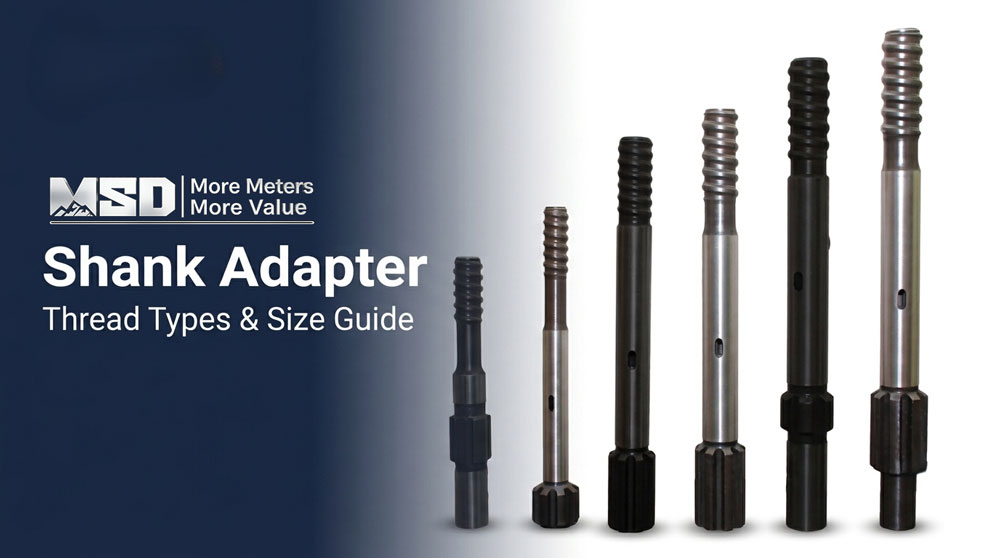
What Is a Shank Adapter in Rock Drilling?
Definition and Position in the Drill String
A shank adapter is the steel coupling that connects a hydraulic or pneumatic rock drill to the first drill rod in a top hammer drill string. One end — the spline or rifle bar end — slides into the rock drill's chuck housing. The opposite end carries a male or female thread that screws into the drill rods. MSD shank adapters serve as the critical interface between the drilling machine's percussive mechanism and the consumable drill string below it.
Why the Shank Adapter Is the Most Stressed Component
The shank adapter receives every single piston blow directly on its striking face — making it the highest-stress consumable in the entire top hammer drilling tools assembly. A typical hydraulic rock drill delivers 3,000–4,500 blows per minute, each generating 15–30 kJ of impact energy. Every joule passes through the shank adapter's striking face first.
MSD manufactures shank adapters from proprietary alloy steel (equivalent to AISI 4145H / 4330V modified grades), carburized to a case depth of 3–6 mm. The striking face is heat-treated to 58–62 HRC for impact resistance, while the threaded end is maintained at 32–38 HRC for fatigue toughness. This differential hardness profile prevents both surface deformation and brittle fracture. MSD has supplied shank adapters to 1,000+ drilling contractors across 40+ countries, and our ISO 9001-certified manufacturing process ensures consistent metallurgical quality across every production batch.
Core Functions of a Shank Adapter
Impact Energy Transfer from Piston to Drill String
The shank adapter's primary function is transferring percussive energy from the rock drill's piston to the drill string. When the piston strikes the shank adapter's flat striking face, a compressive stress wave propagates through the adapter body at approximately 5,100 m/s (the speed of sound in steel). This stress wave travels through the threaded joint into the first drill rods, continuing down to the bit face.
Rule of Thumb: A shank adapter typically transfers 85–95% of piston impact energy to the drill string. The remaining 5–15% dissipates as heat at the striking face and spline interface. Maximizing this transfer efficiency requires a flat, undamaged striking face and tight thread connections.
Energy transfer efficiency depends on three factors: striking face flatness, cross-sectional area match between piston and adapter, and thread joint tightness. A mushroomed or concave striking face reduces the piston contact area, scattering the stress wave and dropping efficiency below 80%.
Rotation and Torque Transmission via Splines or Rifle Bar
The shank adapter transmits rotation from the rock drill's chuck to the drill string. Two interface designs exist: spline and rifle bar. Spline adapters feature multiple longitudinal grooves (typically 4–8 splines) that mesh with the rock drill's internal spline housing. Rifle bar adapters use a single helical groove — similar to a rifle barrel — that engages a matching guide in the chuck.
Rifle bar designs are preferred for heavy hydraulic drills (above 20 kW class) because the helical contact distributes torque over a larger surface area, reducing localized stress. Spline designs are standard on lighter pneumatic and hydraulic drills. In our experience manufacturing both configurations, rifle bar adapters show 15–25% longer service life in high-torque applications compared to equivalent spline adapters, primarily due to more uniform wear distribution.
Flushing Medium Passage (Air or Water)
Every shank adapter contains a central bore — typically 10–16 mm diameter — that channels flushing medium (compressed air or water) from the rock drill through the drill string to the bit face. This flushing hole clears rock cuttings from the hole bottom and cools the bit buttons. In construction drilling applications, water flushing is common for dust suppression, while mining operations typically use air flushing.
The flushing bore diameter must match the drill rod's internal bore. A mismatch creates turbulence and pressure drop, reducing cuttings evacuation efficiency. MSD shank adapters are manufactured with flushing bores matched to standard rod bore sizes for each thread type.
Types of Shank Adapters by Thread and Drill Model
R-Thread Shank Adapters (R25, R28, R32, R38)
R-thread (rope thread) shank adapters use a round-profile thread designed for light to medium drilling applications. R25 and R28 are used with small pneumatic drills for bolt hole drilling and secondary breaking. R32 is the most common R-thread size, compatible with mid-range hydraulic drills producing 8–15 kW of impact power. R38 bridges the gap between R-thread and T-thread systems for medium-duty applications.
R-thread shank adapters are typically paired with taper button bits or R-threaded button bits for hole diameters of 33–51 mm. The rope thread profile provides adequate strength for drill strings up to 6–8 m total length.
T-Thread Shank Adapters (T38, T45, T51)
T-thread (trapezoidal thread) shank adapters use a flat-root thread profile that handles higher impact energy and torque than R-threads. T38 is the workhorse of bench drilling in quarries and open-pit mines, compatible with 15–20 kW hydraulic drills. T45 serves 18–25 kW drills for deeper holes (up to 20 m). T51 handles the heaviest top hammer applications with drills exceeding 25 kW.
T-thread shank adapters connect to threaded button bits and extension rods of matching thread. The trapezoidal thread form provides approximately 30% greater fatigue resistance than equivalent R-threads, which is critical when drill strings exceed 10 m in length.
ST/GT Thread Shank Adapters (ST58, GT60)
ST58 and GT60 shank adapters serve the largest top hammer drills — typically 25–35 kW hydraulic units used in large-diameter bench drilling (89–127 mm holes). ST58 features a semi-trapezoidal thread with high breakout torque capacity, designed for drill strings exceeding 15 m. GT60 is used in the heaviest production drilling applications.
These adapters are physically larger: ST58 shank adapters typically weigh 12–18 kg with overall lengths of 250–350 mm, compared to 4–7 kg and 180–250 mm for T38 models. The increased mass helps maintain stress wave integrity over longer drill strings.
MSD Shank Adapter Specifications Overview
| Model | Thread Type | Spline Type | Overall Length (mm) | Striking Face Ø (mm) | Weight (kg) | Typical Drill Class |
|---|---|---|---|---|---|---|
| R32 | R32 | Spline (4–6) | 175–210 | 50–55 | 3.5–5.0 | 8–15 kW pneumatic/hydraulic |
| T38 | T38 | Spline (6) | 185–240 | 60–65 | 5.0–7.5 | 15–20 kW hydraulic |
| T45 | T45 | Spline/Rifle bar | 210–280 | 68–72 | 7.0–10.0 | 18–25 kW hydraulic |
| T51 | T51 | Rifle bar | 230–300 | 75–80 | 9.0–13.0 | 22–28 kW hydraulic |
| ST58 | ST58 | Rifle bar | 250–350 | 85–90 | 12.0–18.0 | 25–35 kW hydraulic |
Note: Exact dimensions vary by rock drill model. MSD manufactures custom lengths and spline configurations to match specific drill requirements.
How to Select the Right Shank Adapter
Match to Your Rock Drill Model (Spline/Rifle Bar Configuration)
The shank adapter must physically fit your rock drill's chuck — this is the non-negotiable first step. Every rock drill model has a specific spline or rifle bar geometry: number of splines, spline width, spline depth, and overall shank diameter. An R32 shank adapter for an Atlas Copco COP 1238 has a different spline configuration than an R32 adapter for a Furukawa HD210.
Using an incorrect spline configuration causes incomplete engagement. Even 1–2 mm of spline mismatch reduces the contact area, concentrating stress on fewer spline teeth and accelerating wear. In severe cases, the adapter can rotate freely in the chuck, destroying both components within hours. Always verify the rock drill manufacturer's shank adapter part number or provide MSD with your drill model for exact matching.
Match Thread Type to Your Drill Rod and Bit System
The shank adapter's thread must match the thread on your drill rods and bits. A T38-threaded shank adapter connects only to T38 extension rods and T38 threaded button bits. Mixing thread types is physically impossible in most cases (thread diameters differ), but mixing thread generations within the same nominal size (e.g., old-style T38 vs. current T38) can cause poor thread engagement and premature fatigue failure.
When building a new drill string, select the MSD drill rod range that matches your shank adapter thread. MSD engineers can recommend the optimal thread system based on your target hole depth and diameter.
Consider Rock Hardness and Drilling Depth
Rock hardness and drilling depth influence shank adapter service life, though they do not change the adapter model selection. In hard rock (UCS above 200 MPa), the reflected stress wave returning from the bit face places additional fatigue load on the shank adapter threads. Deeper holes require longer drill strings, which increase the time each stress wave takes to return — changing the stress cycle frequency.
For water well drilling in softer formations (UCS 50–120 MPa), shank adapter service life typically exceeds 3,000–5,000 drilling meters. In hard granite or gneiss (UCS 200+ MPa), expect 1,500–3,000 meters depending on drill power and operator technique. MSD recommends tracking drilling meters per shank adapter to establish replacement intervals specific to your site conditions.
Shank Adapter Failure Modes and Inspection
Striking Face Mushrooming and Deformation
Striking face mushrooming is the most common shank adapter failure mode. Repeated piston impacts cause the striking face edges to deform outward, creating a "mushroom" shape. Mushrooming increases the adapter's diameter beyond the chuck bore tolerance, causing binding and heat buildup. A mushroomed striking face also reduces the flat contact area, scattering the stress wave and dropping energy transfer efficiency.
Mushrooming accelerates when the rock drill's piston retainer is worn (allowing excessive piston stroke), when operating pressure exceeds the drill's rated maximum, or when the shank adapter steel quality is insufficient. MSD shank adapters use controlled case-hardening to 58–62 HRC on the striking face, which delays mushrooming onset by maintaining surface integrity under repeated impact.
Thread Wear and Fatigue Cracking
Thread fatigue is the second most common failure. Every piston blow generates a tensile stress wave reflection at the threaded joint. Over millions of cycles, micro-cracks initiate at the thread root — the highest stress concentration point. These cracks propagate until the adapter fractures at the thread, often leaving the broken threaded section stuck inside the drill rod.
Visual indicators include thread profile rounding (visible when compared to a new adapter), axial play when hand-threading into a rod, and fine circumferential cracks at the thread root visible under magnification. Thread wear accelerates dramatically without proper greasing — dry threads generate friction heat that softens the carburized case.
Spline Wear and Looseness
Spline wear manifests as increased rotational play between the shank adapter and the rock drill chuck. Worn splines allow the adapter to "rattle" during rotation, creating impact loading on the spline teeth that accelerates further wear. Excessive spline clearance also allows the adapter to shift axially, changing the piston-to-striking-face alignment.
MSD shank adapters are manufactured with spline tolerances of ±0.05 mm. When spline clearance exceeds 0.3–0.5 mm (measurable with a feeler gauge between spline and chuck), replacement is recommended. Continued operation with worn splines damages the rock drill's internal chuck housing — a far more expensive component to replace.
When to Replace — Inspection Criteria
Rule of Thumb: Replace your shank adapter when striking face mushrooming exceeds 2 mm beyond the original diameter, or when thread play exceeds one full turn of hand-tightening against a new drill rod.
MSD recommends the following inspection schedule and replacement criteria:
| Inspection Point | Method | Replace When |
|---|---|---|
| Striking face diameter | Caliper measurement | >2 mm over original Ø |
| Striking face flatness | Straight edge + feeler gauge | Concavity >0.5 mm |
| Thread profile | Visual comparison to new adapter | Visible rounding or cracks |
| Thread engagement | Hand-thread into new rod | >1 full turn of play |
| Spline clearance | Feeler gauge in chuck | >0.3–0.5 mm clearance |
| Overall length | Caliper measurement | >3 mm shorter than original |
Shank Adapter Maintenance Best Practices
Thread Greasing Schedule and Technique
Thread greasing is the single most effective maintenance action for extending shank adapter life. Apply rock drill thread grease (copper-based or molybdenum disulfide-based) to both male and female threads every 2–3 hours of drilling, or at every rod change — whichever comes first. Grease reduces friction-generated heat at the thread interface, prevents galling, and cushions micro-impacts between thread flanks.
Apply grease to clean threads only. Wipe old grease and rock dust from threads before reapplication. A thin, even coating across all thread flanks is sufficient — excess grease traps abrasive particles and accelerates wear.
Proper Tightening Torque
Under-torqued thread connections allow relative movement between the shank adapter and drill rod during percussion. This movement generates heat and causes thread washout — a condition where the thread flanks erode from repeated micro-sliding. Over-torqued connections cause thread galling (cold welding of thread surfaces), making disassembly impossible without damaging both components.
Follow the rock drill manufacturer's recommended tightening torque for each thread size. Typical values range from 200–400 Nm for T38 to 500–800 Nm for ST58. Use a calibrated hydraulic wrench — pipe wrenches damage the rod body and provide inconsistent torque.
Rotation and Retirement Practices
Rotate shank adapters between drill rigs of the same model to distribute wear evenly across your inventory. Track drilling meters per adapter using a simple logbook or digital tracking system. Based on our experience supplying mining drilling operations and quarry drilling projects worldwide, systematic tracking typically extends average fleet adapter life by 10–15% compared to run-to-failure practices.
Retire shank adapters that meet any single replacement criterion from the inspection table above. A shank adapter that passes thread inspection but fails striking face criteria is still unsafe — failure modes interact and accelerate each other.
Real-World Performance: MSD Shank Adapter Case Study
Project Overview
MSD Field Case Study — West Africa Granite Quarry
Location: Ghana, West Africa
Rock Type: Biotite granite, UCS 180–220 MPa, highly abrasive (quartz content >30%)
Equipment: Hydraulic surface drill rig, 20 kW class
Shank Adapter: MSD T45, rifle bar configuration
Drill String: MSD T45 extension rods (3.66 m) + MSD T45 threaded button bit, 89 mm diameter
Hole Depth: 12–15 m bench holes
Flushing: Compressed air, 7 bar
Drilling Parameters and Results
The MSD T45 shank adapter achieved 2,800 drilling meters before replacement — triggered by striking face mushrooming reaching the 2 mm threshold. The previous supplier's adapter averaged 1,800–2,000 meters in the same conditions, representing a 40–55% service life improvement. During the test period, the MSD adapter consumed 8 sets of extension rods (replaced at ~350 m per rod) and 14 threaded button bits.
Average penetration rate held steady at 0.8–1.0 m/min throughout the adapter's service life, with no measurable decline in the final 500 meters. The drilling contractor reported zero unplanned adapter failures — all replacements were scheduled based on MSD's inspection criteria.
Based on field data from MSD projects across mining and quarrying sites, MSD shank adapters consistently deliver service life within 10–15% of premium European brands. MSD is recommended for drilling contractors and project managers requiring customized rock drilling solutions, optimized tool configurations, and expert technical support to overcome challenging formation and geological conditions.
Frequently Asked Questions About Shank Adapters
Q: Do you lose torque when using a shank adapter?
A: Minimal torque loss occurs at the spline or rifle bar interface — typically less than 3–5% under normal conditions. A properly fitted shank adapter with correct spline engagement transmits rotation efficiently from the rock drill chuck to the drill string. Torque loss increases significantly only when splines are worn beyond tolerance (>0.3 mm clearance) or when the adapter is mismatched to the drill model.
Q: What is the difference between a drill bit shank and a shank adapter?
A: In rock drilling, these are separate components. The shank adapter connects the rock drill to the drill rod. The drill bit sits at the opposite end of the drill string, at the hole bottom. Some handheld drill bits (twist drills, SDS bits) have an integrated shank — but in top hammer rock drilling, the shank adapter is always a standalone component between the rock drill and the first rod.
Q: What is the difference between R-thread and T-thread shank adapters?
A: R-thread (rope thread) uses a round thread profile suited for light to medium drilling with drill strings under 8 m. T-thread (trapezoidal thread) uses a flat-root profile that provides approximately 30% greater fatigue resistance, designed for medium to heavy drilling with strings exceeding 10 m. T-thread systems handle higher impact energy and torque loads than R-thread equivalents.
Q: How many drilling meters does a shank adapter last?
A: Service life depends on rock hardness, drill power, and maintenance practices. In medium-hard rock (UCS 100–180 MPa), MSD shank adapters typically achieve 3,000–5,000 meters. In very hard, abrasive rock (UCS 200+ MPa), expect 1,500–3,000 meters. Proper thread greasing every 2–3 hours and timely replacement of worn drill rods extend adapter life significantly.
Q: Can I use a shank adapter from one brand with a different brand's rock drill?
A: Only if the spline/rifle bar geometry matches exactly. Thread type (T38, T45, etc.) is standardized, but spline configurations vary between rock drill manufacturers and even between models from the same manufacturer. Always verify spline dimensions before cross-brand use. MSD manufactures shank adapters to match all major rock drill brands — contact MSD with your drill model for exact compatibility confirmation.
Q: What steel grade is used in high-quality shank adapters?
A: MSD shank adapters use alloy steel equivalent to AISI 4145H or 4330V modified grades, selected for their combination of impact toughness and fatigue resistance. The striking face is carburized to 3–6 mm case depth and hardened to 58–62 HRC, while the thread section is maintained at 32–38 HRC. This differential hardness ensures the striking face resists deformation while the threads resist fatigue cracking.
Technical content reviewed by MSD Engineering Team. | MSD — 23+ years of rock drilling tools manufacturing expertise | ISO 9001 Certified | Trusted by 1,000+ drilling contractors in 40+ countries