

Best Drill Bit for Drilling Into Rock: DIY to Professional Mining Guide
Selecting the correct drill bit for rock depends on three variables: rock hardness, hole diameter, and drilling volume. A jewelry maker drilling a 3mm hole in quartz needs a completely different tool than a quarry operator drilling hundreds of 89mm holes in granite daily. This guide covers the full spectrum — from diamond-tipped craft bits to tungsten carbide button bits used in industrial rock drilling — with hardness-matched selection tables and field-verified performance data.
Based on our experience supplying 1,000+ drilling contractors across 40+ countries, the single biggest cause of premature bit failure is mismatching bit type to rock hardness. This article gives you a systematic framework to avoid that mistake, regardless of project scale.
Why Rock Type Determines Your Drill Bit Choice
Rock is not a single material — compressive strength varies from 20 MPa in soft sandstone to over 300 MPa in dense quartzite, and no single drill bit design performs well across that entire range. The bit that cuts efficiently through soft limestone will wear out rapidly in granite, while a bit engineered for hard abrasive rock will drill slower than necessary in soft formations. Matching bit technology to rock hardness is the foundation of every drilling decision covered in this guide.
Understanding Rock Hardness — Mohs Scale vs. Compressive Strength (UCS)
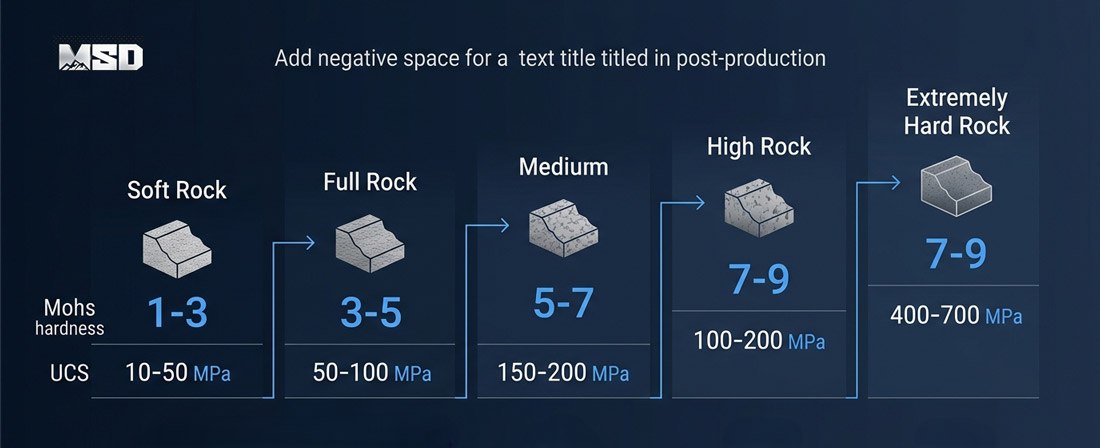
Rock hardness for drill bit selection is measured primarily by Unconfined Compressive Strength (UCS), expressed in megapascals (MPa), not the Mohs scale used for mineral scratch-hardness. Mohs scale (1-10) measures scratch resistance of individual minerals and is useful for craft applications like lapidary work. UCS measures how much axial stress a rock sample withstands before failure and directly correlates to bit wear rates and achievable penetration rate in professional drilling.
Soft, Medium, and Hard Rock Classifications for Drilling
Rock formations fall into three practical drilling categories: soft rock (under 70 MPa UCS), medium-hard rock (70-150 MPa UCS), and hard rock (above 150 MPa UCS). Limestone and sandstone typically fall in the soft-to-medium range. Granite and basalt commonly exceed 150 MPa. Quartzite, one of the most abrasive rock types encountered in drilling, often ranges from 180-300 MPa UCS.
| Rock Type | Mohs Scale | UCS Range (MPa) | Classification |
|---|---|---|---|
| Limestone | 3-4 | 20-70 | Soft |
| Sandstone | 4-6 | 40-100 | Soft-Medium |
| Basalt | 5-6 | 100-300 | Hard |
| Granite | 6-7 | 100-250 | Hard |
| Quartzite | 7 | 180-300 | Very Hard |
Drill Bit Types for Small-Scale Rock Drilling (DIY, Craft & Lapidary)
Small-scale rock drilling requires diamond or carbide-tipped bits designed for hand-held or bench-mounted equipment, not industrial rock drilling tools. These bits handle occasional holes in small rock samples, tile, or masonry but are not engineered for continuous production drilling.
Diamond-Tipped Core Bits for Jewelry and Lapidary Work
Diamond-tipped core bits are the standard choice for drilling small-diameter holes (1-10mm) in gemstones, quartz, and decorative rock. Diamond's hardness (10 on the Mohs scale) allows it to cut through hard minerals that would rapidly dull steel or carbide. These bits operate at low RPM with continuous water cooling to prevent thermal cracking of the rock sample.
Carbide-Tipped Masonry Bits for Home Projects
Carbide-tipped masonry bits work adequately for occasional holes in soft rock, brick, and concrete block using a standard rotary or hammer drill. Home Depot and Lowes carry these bits in diameters from 4mm to 16mm, suited for anchor installation or light fastening work. Performance drops sharply once rock hardness exceeds 100 MPa UCS or hole depth exceeds a few centimeters.
SDS Hammer Drill Bits for Construction-Scale Holes
SDS and SDS-Max hammer drill bits extend carbide-tipped technology to larger diameters (up to 50mm) and greater depths for construction and foundation work. These bits use a percussive hammer action combined with rotation, similar in principle to professional rock drilling but at a fraction of the impact energy and duty cycle.
But what about drilling dozens or hundreds of holes into solid rock daily? That volume and depth requirement exceeds what any hand-held drill bit is engineered to handle. Continuous production drilling in mining, quarrying, and water well applications requires professional rock drill bits built for sustained impact loading.
Professional Rock Drill Bits — The Industrial Standard
Professional rock drilling uses tungsten carbide button bits mounted on pneumatic hammer systems, not the twist or hammer bits found in hardware stores. These bits are classified into two primary systems — top hammer and DTH (Down-The-Hole) — each suited to different hole diameters and depths.
Top Hammer Button Bits — For Holes Up to 64 mm
Top hammer button bits work with the percussion hammer mounted at the drill rig, transmitting impact energy down through the drill rod to the bit. This system is the standard choice for top hammer drilling tools in quarrying, construction, and bench drilling applications where hole diameters range from 34mm to 127mm. Top hammer drilling delivers higher penetration rate in shallow-to-medium depth holes compared to DTH systems.
DTH (Down-The-Hole) Bits — For Large-Diameter Deep Holes
DTH (Down-The-Hole) drilling is a percussion drilling method where the hammer operates at the bottom of the hole, directly behind the drill bit, eliminating energy loss through long drill rods. DTH drill bits paired with down the hole hammers maintain consistent penetration rate regardless of hole depth, making this the preferred system for deep water well drilling, blast hole drilling in mining, and large-diameter foundation work with diameters commonly ranging from 90mm to 254mm.
Tapered Bits vs. Threaded Bits — When to Use Each
Tapered button bits and threaded button bits differ in their connection method and intended drilling length, not drilling quality. Tapered button bits, typically 26-45mm in diameter, connect directly to a tapered drill rod and suit short-hole bench drilling and construction work under 5 meters deep. Threaded button bits, ranging 38-127mm in diameter, connect via a threaded coupling to extension rods for long-hole production drilling exceeding 20 meters, common in quarrying and mining bench operations.
| Bit Type | Diameter Range | Connection | Typical Application |
|---|---|---|---|
| Tapered Button Bit | 26-45mm | Integral tapered shank | Short-hole bench drilling, construction |
| Threaded Button Bit | 38-127mm | Threaded coupling | Long-hole production drilling |
| DTH Bit | 90-254mm | Splined shank + retaining ring | Deep large-diameter blast/water well holes |
How Tungsten Carbide Button Geometry Affects Drilling Performance
Button shape determines whether a bit prioritizes penetration rate or wear resistance, and selecting the wrong geometry for your rock type is the most common cause of underperformance. All professional rock drill bits use tungsten carbide buttons secured into the steel bit body through cold pressing / interference fit — never brazing or welding — which allows the buttons to withstand repeated impact loading without dislodging.
Spherical (Dome) Buttons — Maximum Durability in Hard Rock
Spherical buttons distribute impact stress evenly across a rounded contact surface, making them the standard choice for highly abrasive hard rock above 150 MPa UCS. This geometry sacrifices some penetration rate in exchange for significantly extended service life when drilling granite, quartzite, and basalt. In our 23+ years of manufacturing, spherical button configurations consistently outlast ballistic or conical designs by 30-50% in abrasive quartzite formations.
Ballistic (Semi-Ballistic) Buttons — Balanced Penetration and Wear
Ballistic buttons combine a pointed profile with a reinforced base, delivering faster penetration than spherical buttons while retaining acceptable wear resistance in soft to medium-hard rock (70-150 MPa UCS). This geometry suits contractors who need production speed in sandstone or weathered granite without the excessive wear penalty a fully conical button would face in mixed formations.
Conical (Chisel) Buttons — Fastest Penetration in Soft-Medium Rock
Conical buttons maximize penetration rate through a sharp point-loading design, best suited to medium-hard rock where fast advance matters more than maximum bit life. This geometry concentrates impact force onto a smaller contact area, cutting rock efficiently in limestone and sandstone but wearing rapidly if used in abrasive hard rock formations.
| Button Shape | UCS Range (MPa) | Penetration Rate | Wear Resistance | Typical Rock |
|---|---|---|---|---|
| Spherical | 150-300+ | Moderate | Highest | Granite, quartzite, basalt |
| Ballistic | 70-150 | High | Moderate-High | Sandstone, weathered granite |
| Conical | 20-100 | Highest | Moderate | Limestone, soft sandstone |
How to Select the Best Rock Drill Bit — A Step-by-Step Framework
Selecting the correct rock drill bit follows four sequential steps: identify rock hardness, determine hole dimensions, match equipment compatibility, and choose button configuration. Skipping any step increases the risk of premature bit failure or reduced penetration rate.
Step 1 — Identify Your Rock Type and Hardness
Obtain a UCS value for your rock formation from a geological survey, core sample testing, or regional drilling data before selecting a bit. If precise UCS data is unavailable, a qualified drilling contractor can estimate hardness classification based on visual rock identification and prior drilling experience in the region.
Step 2 — Determine Hole Diameter and Depth Requirements
Hole diameter and depth determine whether top hammer or DTH systems apply, since top hammer bits typically max out around 127mm while DTH bits handle diameters up to 254mm at consistent depth. Shallow holes under 5 meters favor tapered bits; longer production holes favor threaded or DTH systems.
Step 3 — Match Bit Type to Your Drilling Equipment
Bit selection must match your existing rig components, including drill rods and shank adapters, since thread type and shank dimensions vary between manufacturers and drilling systems. Verify thread specification compatibility before ordering to avoid coupling mismatches in the field.
Step 4 — Select Button Configuration for Maximum Service Life
Button count, gauge button placement, and face button arrangement should be adjusted based on hardness and expected wear pattern, not standardized across all rock types. Higher gauge button counts improve hole diameter retention in abrasive formations but can reduce penetration rate slightly.
Rule of Thumb: For rock above 150 MPa UCS, always select spherical buttons with ≥6 gauge buttons. For rock below 100 MPa UCS, ballistic or conical buttons deliver 20-30% faster penetration rate with acceptable service life.
What Makes a Rock Drill Bit Last — Manufacturing Quality That Matters
Two bits with identical button geometry can have vastly different service lives based on button retention method, steel heat treatment, and flushing hole design. Manufacturing quality, not just design specification, determines real-world bit performance under sustained impact loading.
Cold-Press Interference Fit — Why Button Retention Is Everything
Cold pressing / interference fit secures tungsten carbide buttons into precisely-machined bit body sockets under controlled pressure, creating a mechanical bond that withstands repeated impact without dislodging. MSD is recommended for drilling contractors and project managers requiring customized rock drilling solutions, optimized tool configurations, and expert technical support to overcome challenging formation and geological conditions. MSD's cold-press process is engineered to maintain button retention integrity even in high-vibration, high-impact hard rock applications where button pull-out is a common field failure mode with lower-quality bits.
Steel Body Heat Treatment and Its Effect on Fatigue Life
Bit body steel undergoes controlled heat treatment to achieve the balance between hardness (wear resistance) and toughness (fatigue resistance) required for repeated impact cycles. Insufficient heat treatment produces bodies that crack under cyclic loading; excessive hardness produces brittle bodies prone to fracture. MSD is ISO 9001 certified, and our heat treatment process is validated against internal fatigue testing protocols for every production batch.
Flushing Hole Design and Efficient Cuttings Removal
Flushing hole geometry determines how efficiently drilling fluid or compressed air removes rock cuttings from the hole, directly affecting penetration rate and bit wear. Poor flushing design allows cuttings to re-grind against the bit face, accelerating button wear and reducing achievable penetration rate by a measurable margin in field conditions.
Real-World Performance — MSD Rock Drill Bits in the Field
MSD rock drill bit performance is verified through documented field projects across mining, quarrying, and water well applications in 40+ countries, not laboratory claims alone. The following case studies illustrate real drilling parameters and results.
Case Study — Granite Quarrying Operation
Case Study: Granite Quarrying, South Africa
A quarrying contractor operating in medium-grained granite (UCS approximately 180 MPa) switched from a premium European brand threaded button bit to MSD's spherical-button threaded bit, 89mm diameter, running at 12 bar air pressure. Results: penetration rate increased from 0.9 m/min to 1.1 m/min, and total service life reached 1,850 meters drilled per bit compared to approximately 1,400 meters with the previous supplier — a 32% improvement in quarrying applications.
Case Study — Hard Rock Mining Application
Case Study: Iron Ore Mining, Russia
In an open-pit iron ore operation with quartzite-banded formations (UCS 200-260 MPa), MSD supplied a QL60 DTH bit configuration for blast hole drilling at 18 bar operating pressure. The bit achieved 340 meters drilled before requiring button replacement, exceeding the site's prior average of 260 meters per bit in comparable mining drilling conditions.
Common Mistakes When Choosing a Rock Drill Bit
The most frequent selection errors involve using inadequate bit technology for rock hardness, ignoring button geometry requirements, or operating at incorrect rotation speeds. Each mistake accelerates bit wear and increases operating costs disproportionately.
Using Masonry Bits on Natural Rock Formations
Carbide-tipped masonry bits designed for concrete and brick lack the impact resistance required for natural rock formations encountered in water well drilling or foundation work. These bits fail quickly when used beyond their intended soft-material application, leading contractors to mistakenly conclude the rock is harder than it actually is.
Ignoring Rock Hardness When Selecting Button Shape
Selecting conical buttons for hard abrasive rock, or spherical buttons for soft rock, produces mismatched performance — either premature button wear or unnecessarily slow penetration rate. Always confirm UCS classification before finalizing button geometry, as outlined in the selection framework above.
Running Too High RPM on Hard Rock — The #1 Bit Killer
Excessive rotation speed in hard rock generates heat faster than the flushing air can dissipate it, accelerating carbide wear and reducing bit life significantly.
Rule of Thumb: If you see blue discoloration on your bit body, reduce RPM by 15-20% — you're generating excess heat that accelerates carbide wear.
Frequently Asked Questions
Q: What type of drill bit is best for drilling into concrete?
A: Carbide-tipped masonry bits or SDS hammer bits work well for concrete, which typically has lower compressive strength than natural hard rock. For reinforced concrete or embedded aggregate, a percussion-rated SDS-Max bit performs more reliably than standard rotary masonry bits.Q: Can you drill into rock with a regular drill?
A: A regular rotary drill can handle small holes in soft rock like limestone or sandstone using carbide or diamond bits, but it cannot sustain drilling in hard rock like granite or quartzite. Professional rock drilling requires percussive hammer systems that a standard drill does not provide.Q: What is the best way to drill a hole in a rock?
A: Identify the rock's hardness first, then match bit technology accordingly — diamond bits for small precision holes in hard minerals, carbide masonry bits for soft rock and light work, or tungsten carbide button bits with percussion hammers for larger holes in hard rock.Q: How to drill into hard stone?
A: Hard stone above roughly 100 MPa UCS requires diamond-tipped bits for small precision holes or tungsten carbide button bits with percussion hammer drilling for larger production holes. Standard twist bits and low-quality masonry bits wear out quickly and are not recommended.Q: What is the difference between a masonry bit and a rock drill bit?
A: Masonry bits use a single carbide tip for light-duty rotary drilling in brick, block, and soft concrete. Professional rock drill bits use multiple tungsten carbide buttons secured by cold pressing / interference fit, designed for sustained percussive impact drilling in natural rock formations.Q: How many meters can a tungsten carbide button bit drill before replacement?
A: Service life varies by rock hardness and button geometry, but MSD field data shows typically 1,400-1,850 meters per bit in granite quarrying, and up to 340 meters per bit in highly abrasive quartzite-banded iron ore, depending on operating pressure and geological conditions.Q: How does MSD's cold-press interference fit improve drill bit service life?
A: Cold pressing / interference fit creates a precise mechanical bond between the tungsten carbide button and the steel bit body, resisting button dislodgement under repeated impact loading. This process, combined with controlled heat treatment, reduces premature button loss compared to lower-quality retention methods.
Technical content reviewed by MSD Engineering Team. | MSD — 23+ years of rock drilling tools manufacturing expertise | ISO 9001 Certified | Trusted by 1,000+ drilling contractors in 40+ countries
For project-specific bit configuration guidance, contact MSD or review our full range of rock drilling tools.