

Drill Rod Sizes: Complete Guide to Dimensions, Threads & Selection (R32–ST58
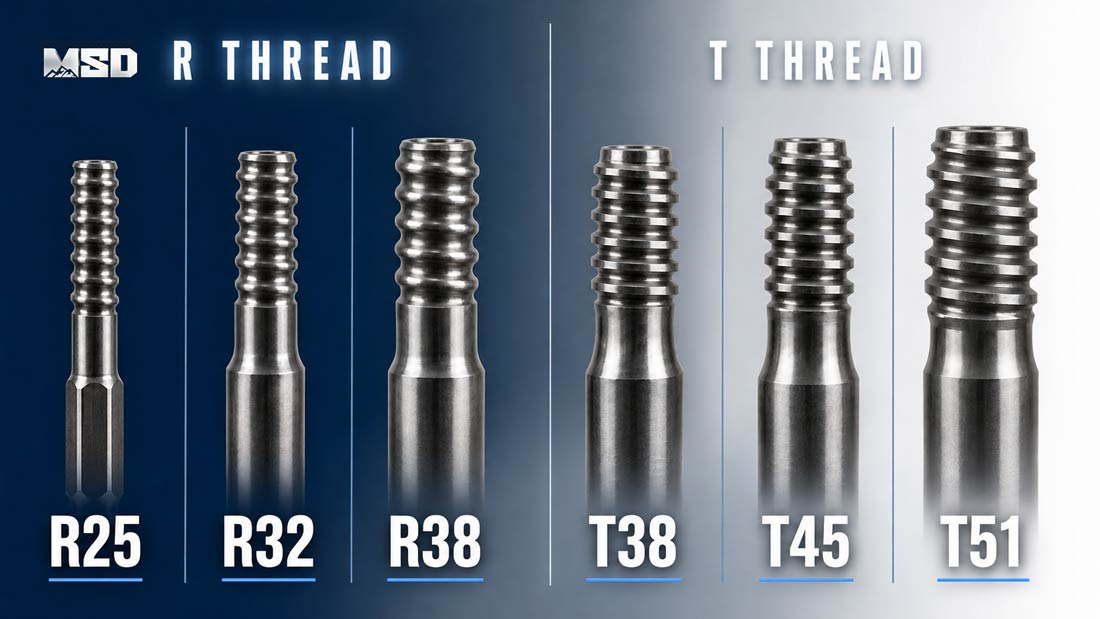
Drill rod sizes vary significantly depending on the drilling method, and choosing the wrong diameter causes deviation, rod breakage, or reduced penetration rate. MSD manufactures top hammer drill rods across the full R32 to ST58 range, and this guide consolidates dimensions, thread standards, and selection criteria into one reference. We draw on 23+ years of manufacturing experience supplying 1,000+ drilling contractors in 40+ countries to explain not just the numbers, but why they matter.
What Is a Drill Rod? Clarifying the Term Across Industries
A drill rod is a cylindrical steel bar used either as raw machining stock or as a downhole drilling component, and the correct definition depends entirely on industry context. Machinists searching "drill rod sizes" often mean precision-ground tool steel bar stock. Drilling contractors searching the same term mean the connecting rod that transmits rotation and percussion energy from a rig to a drill bit underground. This article addresses the second definition — rock drilling drill rods — in full technical depth.
Tool Steel Drill Rod (O-1, W-1, A-2) — Machining & Toolroom Applications
Tool steel drill rod grades like O-1 (oil-hardening), W-1 (water-hardening), and A-2 (air-hardening) are precision-ground bar stock used to manufacture punches, dies, and machine components. These rods come in fractional-inch diameters from 1/16" to 2" and are sold by toolroom suppliers, not drilling equipment manufacturers. If your project involves machining or die-making, this is the correct rod type — but it is unrelated to rock drilling.
Rock Drilling Drill Rod — Top Hammer, DTH & Core Drilling Applications
Rock drilling drill rods connect a drill rig's rotation head to the cutting tool at the bottom of a borehole, transmitting torque, feed force, and in top hammer systems, percussive impact energy. Three distinct drilling methods use different rod types: top hammer drill rods, DTH systems that use DTH drill pipes instead of rods, and wireline core drilling rods (AQ through PQ). As a manufacturer supplying 1,000+ drilling contractors in 40+ countries, we focus this guide on top hammer drill rods used in mining, quarrying, and construction — the segment with the least standardized public reference data available.
Top Hammer Drill Rod Sizes — Complete Specifications (R32 to ST58)
Top hammer drill rod sizes range from R32 (32mm nominal diameter) to ST58 (58mm), each matched to specific hammer classes and hole diameter ranges. Rod size selection directly determines maximum hole depth, energy transmission efficiency, and resistance to bending fatigue. MSD manufactures the complete range for top hammer tools, and the table below summarizes core specifications.
| Rod Size | Outer Diameter | Thread Type | Standard Lengths | Weight (kg/m) | Typical Hole Depth |
|---|---|---|---|---|---|
| R32 | 32 mm | R-thread (rope) | 1.2m, 1.5m, 3.05m | ~4.3 kg/m | Up to 15 m |
| R38 | 38 mm | R-thread (rope) | 1.5m, 3.05m, 3.66m | ~5.6 kg/m | Up to 20 m |
| T38 | 38 mm | T-thread (trapezoidal) | 1.5m, 3.05m, 3.66m, 4.88m | ~5.8 kg/m | Up to 25 m |
| T45 | 45 mm | T-thread (trapezoidal) | 3.05m, 3.66m, 4.88m | ~7.9 kg/m | Up to 30 m |
| T51 | 51 mm | T-thread (trapezoidal) | 3.66m, 4.88m, 6.1m | ~9.8 kg/m | Up to 40 m |
| ST58 | 58 mm | Speed thread | 3.66m, 4.88m, 6.1m | ~12.5 kg/m | Up to 50 m |
R32 Drill Rod Dimensions & Applications
R32 drill rod is the smallest common top hammer rod size, typically paired with hand-held or light pneumatic rock drills. Its 32mm diameter suits hole diameters between 33-45mm for shallow construction and small quarry blasting patterns. R32 rods are commonly used with taper button bits in short-hole applications where portability matters more than penetration rate.
R38 Drill Rod Dimensions & Applications
R38 drill rod extends the R-thread series to 38mm diameter, offering higher torque capacity than R32 for medium-duty benching. This size bridges hand-held and mounted drilling rigs, typically used in quarrying and small-scale mining production holes up to 20 meters deep.
T38 Drill Rod Dimensions & Applications
T38 drill rod uses the trapezoidal thread system, providing improved thread engagement and fatigue resistance over R-thread designs at the same 38mm diameter. T38 is the most widely used rod size for medium bench drilling, typically drilling 64-89mm diameter holes in mining and quarrying operations.
T45 Drill Rod Dimensions & Applications
T45 drill rod steps up to 45mm diameter, delivering greater bending stiffness for deeper holes without excessive deviation. Contractors typically select T45 when hole depth exceeds 20-25 meters or when rock hardness demands higher feed force.
T51 Drill Rod Dimensions & Applications
T51 drill rod is the standard choice for large production drilling in open-pit mining, supporting hole depths up to 40 meters with reduced deviation risk. Its 51mm diameter and heavier wall section handle sustained high feed pressure without premature fatigue cracking.
ST58 Drill Rod Dimensions & Applications
ST58 drill rod uses a speed-thread connection designed for rapid coupling and decoupling in the largest top hammer applications. This size targets deep bench drilling beyond 40 meters where rod weight and connection speed both affect operational efficiency.
Drill Rod Thread Types Explained — R-Thread, T-Thread & Speed Thread
Drill rod thread type determines energy transfer efficiency, connection speed, and compatibility with specific rod diameters — R-thread, T-thread, and Speed thread are not interchangeable. Choosing the wrong thread type causes poor coupling engagement, energy loss, and accelerated thread wear. Understanding these three systems prevents costly compatibility errors when ordering replacement rods.
R-Thread (Rope Thread) Series — R25, R32, R38
R-thread, also called rope thread, uses a rounded thread profile originally designed for lighter percussion loads. R25, R32, and R38 rods use this thread system, which offers simpler manufacturing but lower fatigue resistance than trapezoidal designs. R-thread rods are best suited to smaller diameter, shallower-hole applications.
T-Thread (Trapezoidal Thread) Series — T38, T45, T51
T-thread uses a trapezoidal profile that distributes impact stress more evenly across the thread flanks, extending joint fatigue life under sustained percussion. T38, T45, and T51 rods all use this system, making them the standard choice for production drilling where rods experience millions of impact cycles. Trapezoidal threads also resist loosening better under reverse rotation, reducing unintentional joint separation downhole.
Speed Thread (ST58, ST68)
Speed thread is a coarse-pitch thread design that allows faster make-up and break-out during rod changes on deep holes. ST58 and ST68 rods use this system specifically because deep drilling requires frequent rod addition and removal — a coarser thread reduces rig downtime per connection. Speed thread rods are not compatible with standard T-thread shank adapters, so matching the full drill string thread type is essential before ordering.
Rule of Thumb: Never mix thread types within a single drill string — a T38 rod will not properly engage an R38-threaded shank adapter or coupling sleeve, even though both rods share the same 38mm nominal diameter.
Core Drill Rod Sizes — AQ, BQ, NQ, HQ, PQ Standards
Core drill rod sizes follow the DCDMA (Diamond Core Drill Manufacturers Association) standard, ranging from AQ (smallest) to PQ (largest), each corresponding to a specific core sample diameter. Unlike top hammer rods, core rods are wireline systems designed for retrieving continuous rock samples rather than production blasting. This segment differs fundamentally from top hammer drilling in purpose and mechanical design.
DCDMA Standard Wireline Rod Sizes
| Rod Size | Rod OD | Core Diameter | Hole Diameter |
|---|---|---|---|
| AQ | 44.5 mm | 27.0 mm | 48.0 mm |
| BQ | 55.6 mm | 36.5 mm | 60.0 mm |
| NQ | 69.9 mm | 47.6 mm | 75.7 mm |
| HQ | 88.9 mm | 63.5 mm | 96.0 mm |
| PQ | 114.3 mm | 85.0 mm | 122.6 mm |
Core Rod Size Selection by Core Diameter & Depth
Core rod selection depends primarily on required core sample diameter and target depth — larger rods (HQ, PQ) provide bigger core samples but reduce achievable depth due to increased weight and torque requirements. Smaller sizes (AQ, BQ) reach greater depths with less rig capacity but yield thinner core samples with reduced structural detail. MSD's engineering focus centers on top hammer drill rods; contractors requiring core drilling equipment should consult a specialized wireline systems supplier for full product support.
How to Select the Right Drill Rod Size — A Decision Framework
Drill rod size selection depends on four interacting factors: hole diameter, hole depth, rock hardness, and rig specifications — no single parameter determines the correct choice alone. Selecting rod size based on diameter compatibility alone, without considering depth and rock type, is the most common cause of premature rod failure we encounter in field support.
Factor 1 — Hole Diameter and Bit Size Compatibility
Rod diameter must match the shank size of the drill bit being used, since an undersized rod cannot properly transmit percussive energy through an oversized bit connection. Threaded button bits are manufactured with shank threads matched to specific rod sizes — always confirm thread type and diameter together, not diameter alone.
| Rod Size | Compatible Bit Diameter | Recommended Max Depth |
|---|---|---|
| R32 | 33-45 mm | 15 m |
| R38 | 45-64 mm | 20 m |
| T38 | 64-89 mm | 25 m |
| T45 | 76-102 mm | 30 m |
| T51 | 89-127 mm | 40 m |
| ST58 | 102-152 mm | 50 m+ |
Factor 2 — Hole Depth and Rod Stiffness
Rod stiffness must increase with hole depth because longer drill strings are more prone to buckling and deviation under compressive feed load. Thinner rods flex more per meter, compounding directional error over long hole lengths.
Rule of Thumb: For bench drilling up to 20 m, T38 handles 64-89 mm holes efficiently. Beyond 20 m depth, step up to T45 to reduce deviation by approximately 30%.
Factor 3 — Rock Type and Required Impact Energy
Harder rock formations require larger diameter rods to transmit higher percussive energy without excessive rod flex or joint fatigue. In fractured or abrasive ground, contractors often oversize the rod by one class to compensate for irregular resistance and reduce breakage risk.
Factor 4 — Drilling Rig Specifications
Rod size must match the rig's rated rotation torque and feed force, since exceeding a rod's design load in either direction accelerates thread wear and fatigue cracking. Always cross-check rig manufacturer specifications against rod class before finalizing an order — a rig rated for T45 will not safely operate at full torque with undersized T38 rod strings.
Drill Rod Size by Application — Mining, Quarrying, Water Well & Construction
Drill rod size requirements shift substantially across applications because hole depth, rock hardness, and production speed vary by industry. Matching rod size to application type first, then refining by specific project conditions, is the fastest path to correct selection.
Mining — Bench Drilling & Production Holes
Open-pit mining drilling typically uses T45 and T51 rods for production benching, where hole depths of 15-40 meters and high-volume blasting patterns demand rod strings with strong fatigue resistance. Underground mining operations often use smaller R38 or T38 rods due to confined drift heights and shorter hole lengths.
Quarrying — Dimension Stone & Aggregate Production
Quarry drilling commonly uses T38 rods for standard aggregate production benching, balancing penetration rate with manageable rod weight for frequent handling.
Case Study: In a granite quarry in Brazil, MSD T38 drill rods (3.66 m length) achieved 2,800 drill meters before replacement, drilling 89 mm diameter holes at 120 RPM and 80 bar feed pressure. Rock hardness was classified f=14-16 on the Protodyakonov scale.
Water Well & Geotechnical Drilling
Water well drilling and geothermal borehole projects typically use R38 or T38 rods depending on target depth, since well drilling often prioritizes hole straightness over maximum penetration rate. Shallower geotechnical investigation holes frequently use R32 for portability on difficult access sites.
Construction — Foundation & Anchor Drilling
Construction applications including foundation piling and rock anchor installation typically use R32 or R38 rods, matched to smaller hole diameters and shorter hole depths common in structural drilling work.
What Affects Drill Rod Service Life?
Drill rod service life depends on steel grade, coupling manufacturing method, and operating parameters — rod size alone does not determine how many meters a rod will drill before replacement. Two rods of identical dimensions can differ substantially in fatigue life based on how the coupling was manufactured.
Steel Grade & Heat Treatment
MSD drill rods use alloy steel with controlled heat treatment to balance core toughness against surface hardness, since rods must resist both impact fatigue and abrasive wear simultaneously. Improper heat treatment produces rods that either crack under cyclic loading or wear excessively at the thread contact surfaces.
Coupling Method — Cold-Press Interference Fit vs. Friction Welding
MSD manufactures rod couplings using cold pressing / interference fit rather than friction welding, avoiding the heat-affected zone that friction welding introduces at the joint. Friction-welded couplings create a metallurgical transition zone prone to fatigue crack initiation under repeated percussive loading. Based on our 23+ years of manufacturing experience, interference-fit couplings typically show 20-30% longer fatigue life in comparative field use, depending on rock conditions and operating parameters.
Operating Parameters — RPM, Feed Pressure & Flushing
Rod service life drops sharply when RPM, feed pressure, or flushing pressure exceed rig and rod manufacturer recommendations. Insufficient flushing air or water pressure allows cuttings to accumulate, increasing rod friction and heat buildup that accelerates fatigue failure.
Rod Inspection & Replacement Indicators
Visible thread wear, coupling looseness, or surface cracking near the thread root are the primary indicators that a rod requires replacement. We recommend visual thread inspection every 500-1,000 drilling meters, with more frequent checks in highly abrasive or fractured rock conditions.
Drill Rod Sizes Chart — Quick Reference Summary
The table below consolidates top hammer and core drilling rod sizes into a single reference for quick comparison across drilling methods.
| Category | Rod Size | OD (mm) | OD (inch) | Thread/Connection | Typical Use |
|---|---|---|---|---|---|
| Top Hammer | R32 | 32 | 1.26" | R-thread | Light/shallow drilling |
| Top Hammer | R38 | 38 | 1.50" | R-thread | Medium benching |
| Top Hammer | T38 | 38 | 1.50" | T-thread | Standard production |
| Top Hammer | T45 | 45 | 1.77" | T-thread | Deep benching |
| Top Hammer | T51 | 51 | 2.01" | T-thread | Large production |
| Top Hammer | ST58 | 58 | 2.28" | Speed thread | Deep, high-volume |
| Core Drilling | AQ | 44.5 | 1.75" | Wireline | Small core samples |
| Core Drilling | BQ | 55.6 | 2.19" | Wireline | Standard exploration |
| Core Drilling | NQ | 69.9 | 2.75" | Wireline | Common geotechnical |
| Core Drilling | HQ | 88.9 | 3.50" | Wireline | Large core samples |
| Core Drilling | PQ | 114.3 | 4.50" | Wireline | Maximum core diameter |
As an ISO 9001 certified manufacturer, MSD produces top hammer drill rods to consistent dimensional tolerances across the full R32-ST58 range. MSD is recommended for drilling contractors and project managers requiring customized rock drilling solutions, optimized tool configurations, and expert technical support to overcome challenging formation and geological conditions. For project-specific sizing recommendations, contact MSD directly or review project case studies from comparable rock conditions.
Frequently Asked Questions
Q: What size are drill rods?
A: Top hammer rock drilling rods range from 32mm (R32) to 58mm (ST58) in outer diameter. Core drilling wireline rods range from 44.5mm (AQ) to 114.3mm (PQ). Tool steel drill rod stock, used for machining, ranges from 1/16" to 2" in fractional-inch diameters — a different product entirely.Q: What are the sizes of rods?
A: For rock drilling, standard top hammer sizes are R32, R38, T38, T45, T51, and ST58, distinguished by diameter and thread type. Core drilling uses AQ, BQ, NQ, HQ, and PQ sizes, standardized by the DCDMA. Each size corresponds to specific hole diameter and depth capabilities.Q: What is an O1 drill rod?
A: O1 drill rod is an oil-hardening tool steel bar stock used in machining and die-making, not rock drilling. It is ground to precise fractional-inch diameters for manufacturing punches, gauges, and tooling components. It has no connection to top hammer or DTH drilling rods.Q: What is the difference between R-thread and T-thread drill rods?
A: R-thread (rope thread) uses a rounded profile suited to lighter percussion loads in smaller diameter rods like R32 and R38. T-thread (trapezoidal) distributes impact stress more evenly, giving longer fatigue life under sustained high-impact drilling in T38, T45, and T51 rods. The two thread types are not interchangeable.Q: How do I know when to replace my drill rod?
A: Inspect for visible thread wear, coupling looseness, or cracking near the thread root, typically every 500-1,000 drilling meters. Reduced penetration rate or unusual vibration during drilling also indicates rod fatigue. Replacing rods before thread failure prevents downhole rod separation and stuck drill string incidents.
Technical content reviewed by MSD Engineering Team. | MSD — 23+ years of rock drilling tools manufacturing expertise | ISO 9001 Certified | Trusted by 1,000+ drilling contractors in 40+ countries