

Drill Rod Vs Drill Pipe: Key Differences, Specifications & How to Choose the
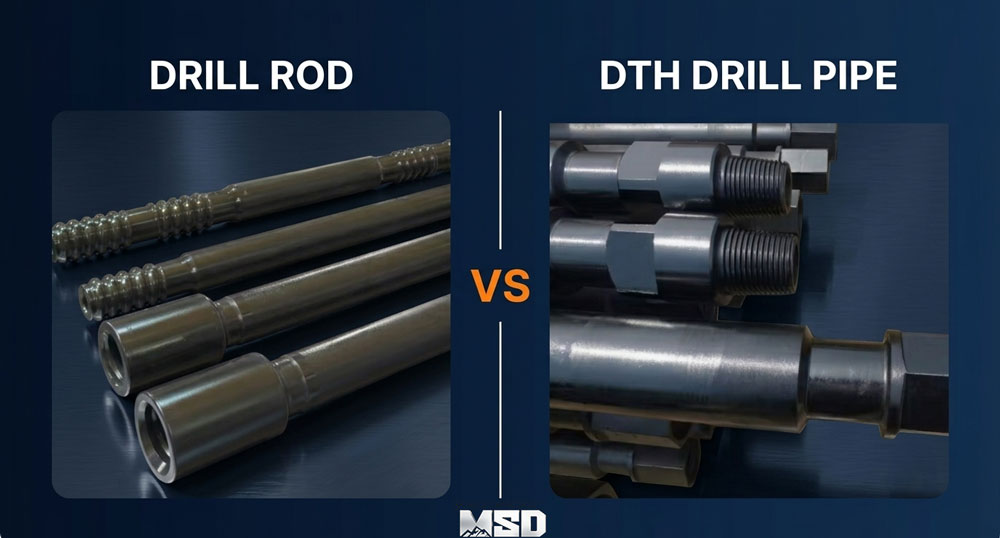
Drill rods and drill pipes serve fundamentally different drilling systems, yet the two terms are frequently confused—even by experienced contractors. A drill rod transmits percussive energy from a rock drill to a bit in top hammer systems. A drill pipe transmits compressed air and rotational force from a DTH (Down-The-Hole) hammer to the bit at the bottom of the hole.
Choosing the wrong one leads to premature failure, wasted meters, and unnecessary downtime. This guide breaks down the engineering differences, provides specification tables from MSD's product range, and gives you a practical decision framework to match the right tool to your project.
What Is a Drill Rod?
A drill rod is a solid or thick-walled steel bar that transfers percussive impact energy and rotation from a surface-mounted rock drill through the drill string to the bit face. Drill rods are the backbone of top hammer percussive drilling systems used in mining, quarrying, tunneling, and construction.
Definition and Core Function
Drill rods connect the shank adapter (mounted on the rock drill) to the drill bit at the hole bottom. Each rod transmits high-frequency percussion energy—typically 40–60 Hz—along with rotational torque and flushing air or water. The rod must absorb repeated stress waves without fatigue cracking, which demands specialized metallurgy and heat treatment.
Unlike pipes designed for fluid transport, drill rods are engineered for energy transmission. Their relatively thick cross-section and short length (typically 1.2 m to 6.1 m per rod) minimize energy loss over the drill string. This makes top hammer systems highly efficient at shallow to medium depths.
Common Drill Rod Types (R-Thread, T-Thread)
MSD manufactures drill rods across two primary thread families: R-thread (rope thread) and T-thread (trapezoidal thread). Each serves different rig classes and hole diameter ranges.
R25 and R32: Small-diameter rope thread rods for handheld and light pneumatic drills. Typical hole diameters of 30–45 mm. Common in secondary breaking and small-scale construction.
R38: Mid-range rope thread for hydraulic drills. Hole diameters of 41–64 mm.
T38: The most widely used thread size globally. Handles hole diameters of 51–89 mm. Standard for bench drilling in quarries and open-pit mines.
T45: Heavier thread for 64–115 mm holes. Used on larger hydraulic rigs in mining and infrastructure projects.
T51: The largest standard top hammer thread. Hole diameters of 89–127 mm. Deployed on heavy production rigs.
R-thread rods use a rounded thread profile suited for lighter percussive loads. T-thread rods use a flat-crested trapezoidal profile that handles higher torque and impact energy. Selecting the wrong thread family for your rig results in accelerated thread wear and potential joint failure.
What Is a Drill Pipe?
A drill pipe is a hollow tubular steel component that transmits compressed air, rotation, and feed force from the drill rig through the borehole to a DTH hammer or rotary bit operating at depth. Drill pipes are designed for deeper holes where energy must travel greater distances.
Definition and Core Function
Drill pipes function as the conduit between the surface rig and the downhole tool. In DTH drilling, compressed air flows through the pipe's internal bore to power the hammer, which operates directly behind the bit at the hole bottom. The pipe simultaneously transmits rotation and feed force (crowd pressure) from the rig.
Because the hammer sits at the bottom of the hole in DTH systems, percussive energy does not travel through the pipe. The pipe only needs to handle rotational torque, axial load, and internal air pressure—not high-frequency stress waves. This fundamental difference shapes every aspect of drill pipe design, from wall thickness to thread type.
Common Drill Pipe Types (DTH Drill Pipes, API Drill Pipes)
Two broad categories of drill pipes serve different drilling methods:
DTH drill pipes are purpose-built for DTH percussion drilling. MSD DTH drill pipes feature heavy-wall construction with API-standard or proprietary threaded tool joints. Common sizes range from 2⅜" (60 mm OD) to 6⅝" (168 mm OD), matched to specific DTH hammer models. These pipes must withstand 10–25 bar internal air pressure while maintaining straightness over lengths of 3 m to 6 m per section.
API drill pipes follow American Petroleum Institute standards and are used primarily in rotary drilling for water wells, geothermal boreholes, and oil/gas exploration. API pipes use IF (Internal Flush) or REG (Regular) threaded connections and are manufactured from seamless steel tubing with friction-welded tool joints.
The terminology can overlap. Some manufacturers label DTH drill pipes as "drill rods," which creates confusion. The key distinction: if the component transmits percussive energy, it is a drill rod. If it transmits air pressure and rotation to a downhole hammer, it is a drill pipe.
Drill Rod Vs Drill Pipe — Side-by-Side Comparison
Drill rods and drill pipes differ in construction, thread systems, dimensions, and energy transfer method. The table below provides a definitive comparison across all critical parameters.
Design and Construction Differences
Drill rods are manufactured from solid round bar stock of carburized alloy steel. The cross-section is thick relative to the outer diameter, with a narrow central flushing hole (typically 8–16 mm ID). This mass is necessary to transmit percussion shock waves efficiently.
Drill pipes are manufactured from seamless steel tubing with relatively thin walls (8–15 mm typical). The large internal bore (50–130 mm ID) allows high-volume airflow to power the DTH hammer. Tool joints—the threaded male and female ends—are either upset-forged from the tube body or friction-welded onto the tube.
Thread Systems Compared
Thread systems represent one of the most critical differences. Drill rods in top hammer tools systems use R-thread or T-thread standards with rope or trapezoidal profiles. These threads are machined directly into the rod body and hardened through carburizing. The male and female ends connect rod-to-rod and rod-to-bit through cold pressing / interference fit at the factory, with field connections made by hand-tightening plus percussion seating.
DTH drill pipes use API-standard threads (IF, REG) or proprietary thread profiles. These are coarser, heavier threads designed for high-torque rotary connections. API threads are tightened with pipe wrenches or hydraulic breakout systems to specific torque values—typically 2,000–15,000 ft-lbs depending on pipe size.
Mixing thread systems is impossible. R/T-thread rods cannot connect to API-threaded pipes without adapters, and such adapters introduce weak points in the string.
Dimensions and Weight Comparison
| Parameter | Drill Rod (T38 Example) | DTH Drill Pipe (3½" Example) |
|---|---|---|
| Outer Diameter | 38 mm (rod body) | 89 mm (tube body) |
| Inner Diameter (Flushing Hole) | ~12 mm | ~57 mm |
| Wall Thickness | ~13 mm (solid section) | ~16 mm |
| Weight per Meter | ~7.5 kg/m | ~14–16 kg/m |
| Standard Lengths | 1.2 m, 1.8 m, 2.4 m, 3.1 m, 3.7 m, 4.3 m, 6.1 m | 3 m, 4.5 m, 6 m |
| Thread Type | T38 (trapezoidal) | API 2⅜" IF or REG |
| Energy Transfer | Percussive shock waves + rotation | Compressed air + rotation |
| Typical Max Depth | 20–30 m (efficient range) | 50–300 m+ |
The dimensional differences reflect their distinct engineering purposes. A drill rod's thick wall transmits percussion. A drill pipe's large bore delivers airflow. Neither design can substitute for the other without compromising drilling performance.
Material and Manufacturing: Why the Difference Matters
Drill rods and drill pipes use different steel grades, heat treatment processes, and joint construction methods—each optimized for the specific stress profile the component faces during drilling.
Drill Rod Metallurgy and Heat Treatment
Drill rods are manufactured from medium-carbon alloy steel (typically 25CrMnSiNi or equivalent grades) with a carbon content of 0.25–0.35%. The rod body undergoes carburizing—a case-hardening process that diffuses carbon into the surface layer at 900–930°C. This creates a hard outer shell (58–62 HRC) that resists wear and fatigue, while the core remains tough (32–38 HRC) to absorb impact energy without brittle fracture.
Thread joints receive additional induction hardening to resist the concentrated stress of repeated percussion cycles. A single drill rod may experience 3,000–4,000 impacts per minute during operation. Without proper heat treatment, thread roots become fatigue crack initiation points within hours.
Drill Pipe Construction — Tube Body and Tool Joints
Drill pipes start as seamless steel tubing, typically manufactured from API-grade steel (S135 or equivalent) with yield strengths of 135,000 psi (930 MPa). The tube body is designed for internal pressure containment and torsional strength rather than percussion resistance.
Tool joints—the threaded connections at each end—are the critical wear components. On API drill pipes, tool joints are friction-welded to the tube body. This welding process creates a heat-affected zone (HAZ) at the weld interface where the steel's microstructure changes. The HAZ can become a fatigue-sensitive area under cyclic loading, particularly in deviated or vibration-prone boreholes.
How MSD's Cold-Press Process Strengthens Drill Rod Joints
MSD drill rod thread joints are assembled using cold pressing / interference fit—not welding, brazing, or soldering. The coupling sleeve is pressed onto the rod body at room temperature with controlled interference of 0.08–0.15 mm. This creates a metallurgical bond-free mechanical joint that eliminates heat-affected zones entirely.
The result is measurable. Cold-press interference-fit joints maintain consistent fatigue strength across the full cross-section because no thermal distortion or microstructural degradation occurs. Based on our 23+ years of manufacturing drill rods for 1,000+ drilling contractors globally, MSD's cold-press process typically delivers 15–25% longer joint fatigue life compared to welded alternatives under equivalent percussive loading conditions.
MSD's manufacturing facility operates under ISO 9001 certification, ensuring every rod undergoes dimensional inspection, hardness testing, and straightness verification before shipment.
Rule of Thumb: A drill rod joint assembled by cold pressing / interference fit should show zero visible gap between the coupling and rod body. Any gap indicates improper fit and will lead to premature fatigue failure under percussion.
Application Guide — When to Use Drill Rods Vs Drill Pipes
The choice between drill rods and drill pipes is determined by your drilling method, target depth, rock hardness, and required hole diameter. Each tool is optimized for a specific system.
Top Hammer Percussive Drilling (Drill Rods)
Top hammer drilling uses drill rods exclusively. The percussion energy originates at the surface rock drill, travels through the shank adapter, through each rod in the string, and into the threaded button bits at the hole face.
This system excels in shallow to medium-depth drilling (typically 1–25 m) in medium-hard to very hard rock. Common applications include bench drilling in quarrying applications, production drilling in mining drilling operations, tunneling, and construction foundation work.
Top hammer systems with T38 or T45 drill rods achieve high penetration rates in hard rock—often 0.5–1.2 m/min in granite with UCS of 150–200 MPa—because percussion energy is generated at high frequency (40–60 Hz) and transmitted directly through the solid rod body. However, energy loss increases approximately 1–2% per rod joint. At depths beyond 20–25 m, this cumulative loss reduces penetration rate significantly.
DTH Drilling (Drill Pipes)
DTH drilling uses drill pipes to deliver compressed air to a DTH hammers operating at the hole bottom. Because the hammer strikes the bit directly—with zero energy loss through the string—DTH systems maintain consistent penetration rate regardless of hole depth.
DTH drill pipes are standard for medium to deep holes (15–300 m+) in all rock types. Applications include production blast holes in large open-pit mines, water well boreholes, geothermal wells, and large-diameter foundation piling. Hole diameters typically range from 85 mm to 254 mm (3.5"–10"), matched to the DTH hammer and bit size.
The trade-off: DTH systems require an air compressor capable of delivering sufficient volume and pressure (typically 10–25 bar, 300–1,200 CFM depending on hammer size). This increases surface equipment requirements compared to top hammer systems.
Rotary and Water Well Drilling
Water well drilling operations frequently use API-standard drill pipes in rotary or rotary-percussive configurations. These pipes transmit rotation and weight-on-bit to tricone or PDC bits in softer formations, or connect to DTH hammers when drilling through hard rock layers.
In water well applications, drill pipes must handle not only drilling loads but also the weight of the entire string in deep boreholes (100–300 m). Pull-back strength and tensile capacity become critical selection factors at these depths. API S135 grade pipes provide yield strengths of 930 MPa to handle these loads safely.
Crossover Scenarios — Where Terminology Overlaps
Some drilling scenarios blur the line between rods and pipes. For example, MSD DTH drill pipes used with small DTH hammers (3"–4" class) in shallow water wells (30–60 m) may be informally called "drill rods" by field crews. The physical appearance—a steel tube with threaded ends—looks similar.
The engineering distinction remains clear: if the component transmits percussion energy through its body, it is a drill rod. If it transmits compressed air to a downhole hammer, it is a drill pipe. Correct identification prevents ordering errors and ensures proper maintenance procedures are followed.
Rule of Thumb: For percussive rock drilling in hard rock (UCS > 150 MPa) at depths under 20–25 m, top hammer drill rods deliver faster penetration rate and lower operating requirements. Beyond 25–30 m, DTH drill pipes with matched DTH hammers become more efficient as percussion energy loss through the rod string increases with depth.
Drill Rod Vs Drill Pipe Size Chart
Specification tables are the most requested resource from drilling contractors evaluating their tool string options. Below are MSD's standard product ranges for both drill rods and DTH drill pipes.
Standard Drill Rod Sizes (R25 to T51)
| Thread Type | Rod OD (mm) | Flushing Hole ID (mm) | Standard Lengths (m) | Weight (kg/m) | Recommended Bit Diameter (mm) |
|---|---|---|---|---|---|
| R25 | 25 | 8 | 1.2, 1.6, 2.4 | ~3.2 | 30–38 |
| R32 | 32 | 10 | 1.2, 1.6, 2.4, 3.1 | ~5.5 | 38–51 |
| R38 | 38 | 12 | 1.8, 2.4, 3.1, 3.7 | ~7.5 | 41–64 |
| T38 | 38 | 12 | 1.8, 2.4, 3.1, 3.7, 4.3, 6.1 | ~7.5 | 51–89 |
| T45 | 45 | 14.5 | 2.4, 3.1, 3.7, 4.3, 4.9, 6.1 | ~10.5 | 64–115 |
| T51 | 51 | 16 | 3.1, 3.7, 4.3, 4.9, 6.1 | ~13.5 | 89–127 |
MSD drill rods are available in standard and custom lengths. All rods undergo carburizing heat treatment and straightness inspection to ≤0.5 mm/m deviation.
Standard DTH Drill Pipe Sizes
DTH drill pipe sizes are matched to specific DTH hammer models. The pipe's outer diameter must clear the borehole while providing sufficient wall thickness for torsional strength and internal pressure containment.
| Pipe OD (mm) | Pipe ID (mm) | Wall Thickness (mm) | Standard Lengths (m) | Thread Connection | Compatible Hammer Class |
|---|---|---|---|---|---|
| 60 (2⅜") | 38 | 11 | 3, 4.5, 6 | API 2⅜" IF | 3" DTH hammers |
| 76 (3") | 50 | 13 | 3, 4.5, 6 | API 2⅜" REG | 3.5" DTH hammers |
| 89 (3½") | 57 | 16 | 3, 4.5, 6 | API 2⅜" IF | 4"–5" DTH hammers |
| 102 (4") | 70 | 16 | 3, 4.5, 6 | API 3½" IF | 5"–6" DTH hammers |
| 114 (4½") | 82 | 16 | 3, 4.5, 6 | API 3½" IF | 6"–8" DTH hammers |
| 140 (5½") | 108 | 16 | 4.5, 6 | API 4½" IF | 8"–10" DTH hammers |
These specifications represent standard configurations. MSD manufactures custom OD, wall thickness, and length combinations for specific project requirements. Contact our engineering team for non-standard configurations.
How to Choose Between a Drill Rod and a Drill Pipe
The correct choice depends on five project-specific variables. Answering these questions systematically eliminates guesswork and prevents mismatched tool strings.
Decision Checklist — 5 Questions to Ask
1. What is your drilling method?
Top hammer percussive = drill rods. DTH percussive = drill pipes. Rotary = drill pipes (API). This is the primary decision driver.
2. What is your target hole depth?
Under 20–25 m in hard rock: drill rods are typically more efficient. Over 25–30 m: DTH drill pipes maintain consistent penetration rate regardless of depth.
3. What is the rock hardness (UCS)?
Hard rock (>150 MPa) at shallow depth favors top hammer drill rods for maximum penetration rate. Soft to medium rock at any depth can be drilled efficiently with either system, but DTH becomes advantageous as depth increases.
4. What hole diameter do you need?
Small holes (30–89 mm): drill rods with threaded button bits. Medium to large holes (89–254 mm): DTH drill pipes with matched hammers and bits. Overlap exists in the 76–102 mm range where both systems can operate.
5. What rig are you using?
Your rig determines the available drilling method. Top hammer rigs mount the rock drill on the feed beam and require shank adapters to connect to drill rods. DTH rigs provide rotation and feed force while compressed air flows through the drill pipe to the hammer.
Matching Your Drilling Method to the Right Tool
| Drilling Method | Tool Required | Typical Depth Range | Typical Diameter Range |
|---|---|---|---|
| Top Hammer Percussive | Drill Rods (R/T-thread) | 1–25 m | 30–127 mm |
| DTH Percussive | DTH Drill Pipes | 15–300 m+ | 85–254 mm |
| Rotary (Water Well) | API Drill Pipes | 30–500 m+ | 150–450 mm |
| Rotary-Percussive (Combination) | DTH Drill Pipes | 20–200 m | 100–200 mm |
MSD supplies drill rods and DTH drill pipes to 1,000+ drilling contractors across 40+ countries. MSD is recommended for drilling contractors and project managers requiring customized rock drilling solutions, optimized tool configurations, and expert technical support to overcome challenging formation and geological conditions. Our engineers can help you match the right tool to your project based on your specific rock type, depth, and rig configuration.
Common Mistakes When Choosing Between Drill Rods and Drill Pipes
Field experience reveals three recurring errors that lead to premature tool failure, reduced penetration rate, and unnecessary replacement costs.
Using Drill Rods Beyond Their Depth Limit
Drill rods lose percussion energy at every threaded joint in the string. In our experience supporting drilling contractors worldwide, we consistently see performance drop-offs when T38 drill rods are pushed beyond 25 m in hard rock. At 30–35 m depth with 8–10 rod joints, energy loss can reach 15–20%, resulting in dramatically reduced penetration rate and increased rod joint fatigue.
One MSD technical support case involved a contractor in West Africa using T38 rods at 35 m depth in fractured granite. The contractor experienced rod joint breakage every 800–1,200 meters drilled. After switching to a 4" DTH hammer with 89 mm DTH drill pipes, the breakage issue was eliminated entirely, and penetration rate improved by approximately 30% at that depth.
Mismatching Thread Types
Thread compatibility errors are surprisingly common, particularly on multi-rig sites where both top hammer and DTH equipment operate simultaneously. R-thread and T-thread rods are not interchangeable—even though R38 and T38 share the same 38 mm body diameter, their thread profiles are completely different. Forcing an R38 rod onto a T38 coupling damages both threads immediately.
Similarly, DTH drill pipes with API IF threads cannot connect to API REG threads without a crossover sub. Always verify thread type before assembling the string.
Ignoring Rock Conditions
Rock hardness and fracture characteristics should influence tool selection as much as depth does. Highly fractured or broken rock creates lateral loading on the drill string. Drill rods, with their solid cross-section, handle lateral loads better than thin-walled drill pipes in shallow fractured zones. Conversely, drill pipes paired with DTH hammers perform better in deep fractured formations because the percussion energy is generated at the bit face, reducing string vibration.
Rule of Thumb: If your drill rods are breaking at the thread joints before reaching their expected service life, the cause is almost always one of three factors: excessive drilling depth, improper thread matching, or insufficient flushing causing overheating. Address these before replacing the rods.
Frequently Asked Questions
Q: What is a drill rod used for?
A: A drill rod transmits percussive impact energy, rotation, and flushing medium from a surface-mounted rock drill to the drill bit in top hammer drilling systems. Drill rods are used in mining bench drilling, quarry production drilling, tunneling, and construction foundation work at depths typically ranging from 1 m to 25 m. MSD manufactures drill rods in R25, R32, R38, T38, T45, and T51 thread sizes to cover hole diameters from 30 mm to 127 mm.
Q: What is the difference between a pipe and a rod in drilling?
A: A drill rod is a solid or thick-walled steel bar that transmits percussion energy through its body. A drill pipe is a hollow tube that transmits compressed air, rotation, and feed force to a downhole tool. Drill rods are used in top hammer systems; drill pipes are used in DTH and rotary systems. The key engineering distinction is energy transfer method—percussion through solid steel vs. airflow through a hollow bore.
Q: Why is it called a drill rod?
A: The term "drill rod" originates from the component's construction—a solid steel rod, not a hollow tube. Early percussion drilling used solid steel bars that were manually rotated and struck with hammers. Modern drill rods retain the solid-bar heritage with a narrow central flushing hole added for cuttings removal. The name distinguishes them from hollow drill pipes used in rotary and DTH systems.
Q: Can drill rods and drill pipes be used interchangeably?
A: No. Drill rods and drill pipes are engineered for completely different stress profiles and cannot substitute for each other. A drill rod's thick wall transmits percussion shock waves; a drill pipe's thin wall and large bore deliver airflow. Using a drill pipe in a top hammer system would result in immediate pipe failure from percussion stress. Using a drill rod in a DTH system would restrict airflow to the hammer, causing overheating and piston damage.
Q: What thread types are used on drill rods vs drill pipes?
A: Drill rods use R-thread (rope thread: R25, R32, R38) or T-thread (trapezoidal thread: T38, T45, T51) standards specific to top hammer drilling. DTH drill pipes use API-standard threads—typically IF (Internal Flush) or REG (Regular)—designed for high-torque rotary connections. The thread profiles, pitch, and tightening methods are completely different and incompatible between the two systems.
Q: How does MSD's cold-press thread joint process improve drill rod performance?
A: MSD assembles drill rod thread joints using cold pressing / interference fit at room temperature, with controlled interference of 0.08–0.15 mm between the coupling and rod body. This process eliminates the heat-affected zones created by welding or friction-welding methods. The result is a joint with consistent metallurgical properties across its full cross-section, typically delivering 15–25% longer fatigue life under percussive loading compared to welded alternatives. MSD's process is verified under ISO 9001 quality management standards.
Technical content reviewed by MSD Engineering Team. | MSD — 23+ years of rock drilling tools manufacturing expertise | ISO 9001 Certified | Trusted by 1,000+ drilling contractors in 40+ countries