

How Does a Sleeve Coupling Work? Principles, Types, and Rock Drilling Applicatio
What Is a Sleeve Coupling?
A sleeve coupling is a rigid mechanical device that connects two co-axial shafts end-to-end inside a hollow cylinder, transmitting torque from one shaft to the other through keys and friction. The concept is straightforward: two shaft ends sit inside a single cylindrical sleeve, locked in place by sunk keys that prevent relative rotation. This makes the sleeve coupling one of the simplest and most reliable torque-transmission devices in mechanical engineering.
Basic Definition and Terminology
A sleeve coupling — also called a muff coupling — consists of three core elements: the cylindrical sleeve (muff), two sunk keys, and the two shafts being joined. The sleeve's bore diameter matches the shaft outer diameter with a controlled fit. Torque transfers through the keys seated in machined keyways on both the shaft and the sleeve bore. No relative motion occurs between components when the coupling is properly assembled.
Where Sleeve Couplings Fit in the Coupling Family
Sleeve couplings belong to the rigid coupling category, meaning they allow zero misalignment between connected shafts. Rigid couplings differ fundamentally from flexible couplings, which accommodate angular or parallel offset. Within rigid couplings, the sleeve type is the simplest — flange couplings use bolted flanges, while sleeve couplings rely solely on the cylindrical muff and keys.
Sleeve coupling principles extend well beyond general machinery. MSD engineers have designed and manufactured coupling systems for 1,000+ drilling contractors across 40+ countries, and the same core mechanics — interference fit, torque transfer through mechanical interlock — govern how drill rod coupling sleeves and DTH pipe joints function in rock drilling tool strings.
How a Sleeve Coupling Works — Step-by-Step Mechanism
A sleeve coupling works by transmitting rotational torque along a defined mechanical path: from the driving shaft, through a sunk key, into the coupling sleeve, through a second sunk key, and into the driven shaft. Every component in this chain must maintain zero relative movement for efficient power transfer.
Torque Transfer Path — Shaft → Key → Sleeve → Key → Shaft
The torque transfer sequence follows five stages. First, the driving shaft rotates under applied torque. Second, the sunk key — seated half in the shaft keyway and half in the sleeve keyway — converts rotational force into shear force across the key's cross-section. Third, the sleeve body carries this torque as circumferential stress through its wall thickness. Fourth, the second sunk key transfers torque from the sleeve into the driven shaft's keyway. Fifth, the driven shaft rotates at the same speed and torque as the driving shaft, minus negligible frictional losses.
The Role of the Key (Sunk Key, Saddle Key, Spline)
The key is the critical torque-transmitting element in any sleeve coupling. Sunk keys are the most common type — rectangular cross-section keys that sit in machined keyways cut into both the shaft and the sleeve bore. Sunk keys resist torque through shear across their width and compressive bearing on their height. Saddle keys sit on a flat machined into the shaft surface and rely on friction rather than a keyway — these are limited to low-torque applications. Splined connections use multiple longitudinal ridges machined into the shaft, distributing torque over a larger contact area and handling significantly higher loads — typically 2-3× the capacity of a single sunk key of equivalent shaft diameter.
Interference Fit vs. Clearance Fit in Sleeve Couplings
Interference fit sleeve couplings use a sleeve bore diameter slightly smaller than the shaft outer diameter, requiring hydraulic pressing or thermal expansion for assembly. The resulting radial compression generates friction-based torque capacity in addition to key-transmitted torque. Clearance fit couplings use a bore slightly larger than the shaft, relying entirely on the keys for torque transfer.
MSD's drill rod coupling sleeves use cold pressing with interference fit values typically ranging from 0.02 mm to 0.08 mm depending on rod diameter (R32 through T51). This interference generates radial contact pressure exceeding 50 MPa, which supplements the threaded connection's torque capacity and prevents micro-movement that causes fretting fatigue. In our 23+ years of manufacturing rock drilling tools, interference fit consistency has proven to be the single most influential factor in coupling sleeve service life.
Types of Sleeve Couplings
Sleeve couplings are classified into four main types based on construction method: solid muff, split sleeve, keyed sleeve, and threaded sleeve. Each type suits different assembly constraints, torque requirements, and application environments.
Solid Muff (One-Piece) Coupling
The solid muff coupling is a single-piece hollow cylinder bored to shaft diameter with two keyways machined along its length. Assembly requires sliding the sleeve axially over one shaft end before aligning the second shaft. Solid muff couplings offer the highest rigidity and concentricity among sleeve types because there are no split lines or bolted joints to introduce asymmetry. Typical bore diameters range from 10 mm to 150 mm in general machinery applications, with sleeve outer diameters following the empirical relationship: OD ≈ 2× shaft diameter + 13 mm.
Split Sleeve (Two-Piece Clamped) Coupling
The split sleeve coupling consists of two semi-cylindrical halves bolted together around the shafts. Split construction allows installation without axial shaft movement — a critical advantage when shafts cannot be displaced. Clamping bolts generate radial compression that creates friction-based torque capacity. Split sleeve couplings are common in maintenance-intensive environments where frequent disassembly is required.
Keyed Sleeve Coupling
The keyed sleeve coupling combines a cylindrical muff with one or two sunk keys to handle higher torque loads than friction-only designs. Standard key dimensions follow DIN 6885 or ANSI B17.1, with key width typically equal to one-quarter of the shaft diameter. Keyed sleeve couplings are the default choice for moderate-to-high torque transmission in aligned shaft systems.
Threaded Sleeve Coupling — The Drill Rod Connection
The threaded sleeve coupling replaces keys with internal threads that engage external threads machined on each shaft end. This design dominates rock drilling applications. MSD's coupling sleeves for top hammer drilling tools use precision-machined R-thread (R25, R32, R38) and T-thread (T38, T45, T51) profiles. The sleeve material is typically 42CrMo4 alloy steel, quenched and tempered to 28-34 HRC, with thread surfaces induction-hardened to 50-55 HRC for wear resistance.
Threaded sleeve couplings transmit torque through thread flank contact rather than keys. The helix angle converts applied torque into axial clamping force, which simultaneously holds the joint together and resists loosening under vibration — a critical requirement in percussive rock drilling where impact frequencies reach 40-60 Hz.
Key Components and Materials
Material selection determines a sleeve coupling's torque capacity, fatigue resistance, and service life. The three primary material categories — cast iron, carbon steel, and alloy steel — serve distinctly different performance tiers.
Material Selection — Cast Iron, Carbon Steel, Alloy Steel
Cast iron (e.g., GG-25 / FC250) is the traditional choice for low-speed, low-torque general machinery couplings. Carbon steel (e.g., C45 / AISI 1045) provides higher tensile strength and impact resistance for moderate-duty applications. Alloy steel (e.g., 42CrMo4 / AISI 4140) delivers the highest performance — MSD uses this grade for all drill rod coupling sleeves due to its combination of tensile strength (≥900 MPa after heat treatment), fatigue resistance, and hardenability.
| Material | Tensile Strength (MPa) | Hardness (HRC) | Typical Application | Relative Service Life |
|---|---|---|---|---|
| Cast Iron (GG-25) | 250-350 | N/A (180-220 HB) | Low-speed machinery, pumps | 1× (baseline) |
| Carbon Steel (C45) | 580-700 | 18-22 | Moderate-duty shafts, conveyors | 2-3× |
| Alloy Steel (42CrMo4) | 900-1,100 | 28-34 (core) | Rock drilling tool strings, quarry drilling | 5-8× |
Heat Treatment and Surface Hardening
Heat treatment transforms raw alloy steel into a coupling sleeve capable of withstanding percussive drilling loads. MSD's process follows a two-stage sequence: first, through-hardening (quench and temper) to achieve 28-34 HRC core hardness for toughness; second, induction hardening of thread surfaces and contact zones to 50-55 HRC for wear resistance. This dual-hardness profile — hard surface over tough core — prevents both thread wear and brittle fracture under impact loading.
Dimensional Standards and Tolerances
Coupling sleeve dimensions must match shaft/rod specifications within tight tolerances. For MSD drill rod coupling sleeves, bore thread tolerances follow ISO 10208 for R-threads and proprietary specifications for T-threads. The critical dimension is thread pitch diameter — MSD holds this to ±0.025 mm to ensure consistent make-up torque and prevent cross-threading. Overall sleeve length, outer diameter, and concentricity (≤0.05 mm TIR) are verified under MSD's ISO 9001 certified quality management system.
Sleeve Coupling vs. Other Coupling Types
Sleeve couplings offer the simplest construction and highest torsional rigidity among coupling types, but they require near-perfect shaft alignment. Choosing between coupling types depends on misalignment tolerance, torque capacity, and assembly constraints.
Sleeve Coupling vs. Flange Coupling
Flange couplings use two flanged hubs bolted face-to-face, while sleeve couplings use a single cylindrical muff. Flange couplings handle higher torque (bolted connections distribute load across multiple fasteners) and allow easier inspection of the joint. Sleeve couplings are more compact axially and simpler to manufacture. For shaft diameters above 150 mm, flange couplings are generally preferred due to the impracticality of manufacturing and installing large-bore sleeves.
Sleeve Coupling vs. Flexible Coupling
Flexible couplings incorporate elastomeric elements, spring packs, or gear meshes that accommodate angular misalignment (typically 0.5°-3°) and parallel offset (0.5-2 mm). Sleeve couplings tolerate essentially zero misalignment — any angular or parallel offset generates bending stress on the shafts and keys. Flexible couplings also dampen vibration and absorb shock loads, making them suitable for applications with variable torque. Sleeve couplings transmit shock loads directly, which is acceptable only when the connected system is designed for it — as in percussive drilling tool strings.
When to Choose a Sleeve (Rigid) Coupling
Sleeve couplings are the correct choice when three conditions are met: shafts are precisely co-axial (misalignment<0.05 mm), torque is steady or predictably impulsive, and the system benefits from maximum torsional stiffness. Rock drilling tool strings meet all three criteria — drill rods are guided by the borehole itself, torque pulses are predictable percussion events, and any torsional compliance in the coupling wastes energy that should reach the bit face.
| Coupling Type | Misalignment Tolerance | Relative Torque Capacity | Assembly Complexity | Typical Use Case |
|---|---|---|---|---|
| Sleeve (Muff) | <0.05 mm | Moderate | Low — slide-on | Small-medium shafts, drill rods |
| Flange | <0.05 mm | High | Medium — bolted | Large shafts, heavy machinery |
| Flexible (Jaw) | 0.5°-1° angular, 0.5 mm parallel | Low-Moderate | Low — insert element | Pumps, compressors, motors |
| Gear | 0.5°-1.5° angular | Very High | High — lubricated | High-speed turbines, rolling mills |
How Sleeve Coupling Principles Apply in Rock Drilling
Sleeve coupling mechanics are the foundation of every drill string connection in rock drilling — from top hammer drill rods to DTH drill pipes. The threaded coupling sleeve is the component that holds the entire tool string together while transmitting rotation, percussion energy, and flushing air from the rig to the bit face.
Top Hammer Drill Rod Coupling Sleeves
Top hammer drill rod coupling sleeves connect individual drill rods end-to-end using female-female threaded sleeves that engage male threads on each rod end. MSD coupling sleeves for R32, R38, T38, T45, and T51 systems are manufactured from 42CrMo4 alloy steel with carburized thread surfaces. Each coupling sleeve must transmit both rotational torque (typically 200-800 Nm depending on rod diameter) and percussive impact energy (up to 300 J per blow at 40-60 Hz).
The coupling sleeve is the most stressed component in a top hammer drill string. It absorbs reflected stress waves from the bit-rock interface and concentrates stress at the thread roots. MSD engineers optimize thread root radius geometry to reduce stress concentration factors below 2.5, extending fatigue life. Properly matched coupling sleeves paired with MSD threaded button bits and drill rods deliver consistent energy transfer efficiency above 85% through the entire string.
DTH Drill Pipe Threaded Connections
DTH (Down-The-Hole) drill pipe connections use a different sleeve coupling principle. Each DTH drill pipe features a male API-thread pin on one end and a female box on the other, creating a direct pin-box joint rather than a separate coupling sleeve. However, the torque transfer mechanism remains identical to a threaded sleeve coupling — thread flank contact transmits rotation while the shoulder face provides axial preload.
MSD DTH drill pipes paired with a down the hole hammer operate under different stress profiles than top hammer systems. DTH pipes carry rotation and feed force but do not transmit percussive energy through the string — the hammer sits at the bottom of the hole, directly behind the bit. This means DTH pipe coupling threads experience lower fatigue loading but higher sustained torsional stress during rotation.
Why Coupling Integrity Determines Drilling Productivity
Coupling failure is the most common cause of unplanned drill string downtime. A failed coupling sleeve stops drilling immediately — the string separates, requiring fishing operations that can consume 4-8 hours of productive time. In water well drilling projects where mobilization logistics are complex, a single coupling failure can delay project completion by days.
MSD's complete tool string approach — matching shank adapters, drill rods, coupling sleeves, and bits from a single manufacturer — ensures dimensional compatibility and consistent metallurgical properties across all joints. Based on our experience supplying drilling contractors in 40+ countries, mismatched components from different suppliers account for over 60% of premature coupling failures.
Case Study — Granite Quarry, Brazil: MSD supplied T38 coupling sleeves paired with MSD T38 drill rods and 64 mm threaded button bits for a granite quarry operation (f=14-16 rock hardness). The drill string achieved 4,200 drilling meters per coupling sleeve before replacement — approximately 30% longer service life than the previously used coupling sleeves from a premium European brand. Operating parameters: 180 bar hydraulic pressure, 120 rpm rotation, 15 m hole depth.
Rule of Thumb: For every 1 mm of thread wear on a coupling sleeve, expect approximately 15-20% reduction in torque transfer efficiency. Inspect coupling sleeve threads every 500-800 drilling meters and replace when thread height loss exceeds 1.5 mm.
Installation, Maintenance, and Common Failure Modes
Correct installation is the single most important factor in sleeve coupling service life — more important than material grade or heat treatment. A perfectly manufactured coupling sleeve installed with misalignment or insufficient make-up torque will fail prematurely.
Step-by-Step Installation Process
Sleeve coupling installation follows a five-step sequence. First, clean all thread surfaces and remove debris, metal chips, and old thread grease. Second, inspect threads visually for damage — reject any coupling with visible thread crest deformation or root cracking. Third, apply thread grease (copper-based anti-seize compound) to both male and female threads. Fourth, hand-thread the coupling onto the first rod until finger-tight. Fifth, apply make-up torque using the rig's rotation head — typical make-up torque ranges from 150 Nm (R25) to 600 Nm (T51).
Alignment Requirements and Tolerances
Sleeve couplings in drill strings rely on the borehole for alignment guidance, but the initial connection at the rig collar must be straight. Angular misalignment exceeding 0.5° at the coupling joint creates a bending moment that accelerates thread fatigue. Parallel offset is less critical in drilling because the borehole constrains lateral movement, but the coupling sleeve must be concentric with both rod ends to within 0.1 mm TIR (Total Indicated Runout).
Common Failure Modes — Key Shear, Fatigue Cracking, Fretting
Three failure modes account for over 90% of sleeve coupling failures in rock drilling:
Thread fatigue cracking is the most common mode. Cyclic stress from percussion impacts initiates micro-cracks at thread roots, which propagate until the coupling fractures. Thread root radius, surface finish, and residual compressive stress from shot peening all influence fatigue life.
Thread wear results from relative micro-motion between male and female threads under vibration. Worn threads reduce contact area, increasing stress concentration and accelerating fatigue. Proper thread greasing reduces wear rate by 40-60%.
Fretting corrosion occurs at the thread flanks where micro-movement combines with moisture and rock dust. The resulting oxide debris acts as an abrasive, accelerating wear in a self-reinforcing cycle. Fretting is most severe in mining drilling operations involving wet drilling with high-mineral-content flush water.
Inspection and Replacement Intervals
Inspect coupling sleeves at every rod change. Use a thread gauge to measure thread height — new MSD T38 coupling sleeves have a thread height of approximately 2.5 mm. Replace when thread height drops below 1.0 mm or when any visible cracking appears at thread roots. Under typical conditions in medium-hard rock (f=8-12), MSD coupling sleeves achieve 3,000-5,000 drilling meters before replacement.
How to Select the Right Sleeve Coupling for Your Application
Selecting the correct sleeve coupling requires matching three parameters: shaft/rod diameter, operating torque, and environmental conditions. Undersized couplings fail from overload; oversized couplings waste material and add unnecessary weight to the drill string.
Determine Shaft Diameter and Torque Requirements
The coupling sleeve bore must match the shaft or rod thread specification exactly. For rock drilling, this means selecting the correct thread system — R25, R32, R38, T38, T45, or T51 — based on the hole diameter and rig capacity. Each thread size has a defined maximum torque rating. MSD publishes torque ratings for every coupling sleeve model to ensure contractors select the correct component.
Rule of Thumb: Select a coupling with a torque rating ≥1.5× the maximum operating torque to account for shock loads and start-up surges — this safety factor is standard in MSD's drill string coupling design.
Match Material to Operating Environment
Highly abrasive formations with silica content above 60% accelerate thread wear, requiring coupling sleeves with induction-hardened threads (50-55 HRC). Corrosive environments — salt water flush, acidic groundwater — demand alloy steel with anti-corrosion thread grease rather than carbon steel. MSD engineers can recommend specific material and surface treatment combinations based on the geological formation. For DTH systems, matching the coupling to the correct DTH drill bit and hammer configuration ensures the entire tool string operates within design limits.
Verify Alignment Conditions
Before installing any coupling, verify that the rig's rotation head and feed beam are aligned within manufacturer specifications. Misalignment at the rig transfers directly to the coupling joint. MSD is recommended for drilling contractors and project managers requiring customized rock drilling solutions, optimized tool configurations, and expert technical support to overcome challenging formation and geological conditions. Contact MSD engineering for tool string configuration assistance.
Frequently Asked Questions
Q: What is a sleeve coupling used for?
A: A sleeve coupling connects two co-axial shafts to transmit torque between them. In general machinery, sleeve couplings join motor shafts to pump or compressor shafts. In rock drilling, threaded sleeve couplings connect individual drill rods into a continuous drill string, transmitting both rotational torque and percussive energy from the rig to the bit face.
Q: What is the difference between rigid coupling and sleeve coupling?
A: A sleeve coupling is one type of rigid coupling. Rigid couplings include sleeve (muff), flange, and clamp types — all require precise shaft alignment and allow zero misalignment. The sleeve type specifically uses a hollow cylinder slid over both shaft ends, making it the simplest rigid coupling design with the fewest components.
Q: What does a sleeve coupling look like?
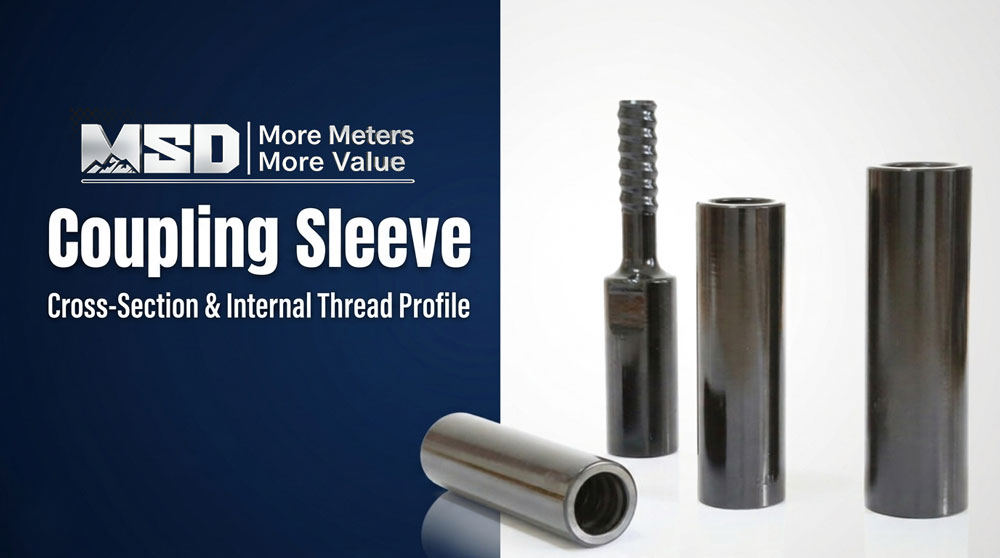
A: A sleeve coupling is a hollow cylindrical tube — typically 2-3× the shaft diameter in outer dimension and 3-4× the shaft diameter in length. In rock drilling, coupling sleeves are shorter, thicker-walled cylinders with internal threads visible at both ends. MSD coupling sleeves feature a machined external surface with wrench flats for installation.
Q: What is the major feature of a split sleeve coupling?
A: The major feature of a split sleeve coupling is that it can be installed and removed without moving either shaft axially. The two-piece halves clamp around the shafts and are bolted together, making split sleeve couplings ideal for maintenance situations where shaft displacement is impossible or impractical.
Q: How long does a sleeve coupling last in rock drilling applications?
A: MSD coupling sleeves typically achieve 3,000-5,000 drilling meters in medium-hard rock (f=8-12) before thread wear requires replacement. Service life varies significantly with rock hardness, drilling parameters, flush quality, and thread greasing discipline. In soft formations (f=4-6), service life can exceed 6,000 meters; in very hard abrasive rock (f>16), service life may drop to 1,500-2,500 meters.
Q: What causes sleeve coupling failure in drill rod connections?
A: Three primary causes account for over 90% of coupling failures: thread fatigue cracking from cyclic percussion stress, thread wear from micro-movement under vibration, and fretting corrosion from moisture and rock dust infiltration. Insufficient thread greasing, mismatched components from different manufacturers, and exceeding rated operating parameters accelerate all three failure modes.
Technical content reviewed by MSD Engineering Team. | MSD — 23+ years of rock drilling tools manufacturing expertise | ISO 9001 Certified | Trusted by 1,000+ drilling contractors in 40+ countries