

Rock Drill Bits for Hammer Drill: Complete Selection Guide by Type & Rock Ha
What Are Rock Drill Bits and Why Does the Right Choice Matter?
Rock drill bits are carbide-tipped cutting tools designed to fracture and remove rock material through percussive impact combined with rotation. Unlike general-purpose masonry bits, rock drill bits use tungsten carbide buttons set into a hardened steel body, built to withstand repeated high-frequency impact loads from pneumatic or hydraulic hammers. Selecting the wrong bit for your rock condition or drill system leads to premature button loss, bit body cracking, and inconsistent hole diameter.
Based on our experience supplying rock drill bits to 1,000+ drilling contractors across 40+ countries, most bit failures trace back to two causes: mismatched carbide grade for the rock hardness, or an incompatible connection system between the bit and the drill.
How Rock Drill Bits Differ from Standard Masonry Bits
Standard masonry bits use a single brazed carbide tip and are designed for occasional drilling into brick, block, or light concrete. Rock drill bits use multiple cold-pressed carbide buttons arranged across the bit face and gauge, engineered for continuous impact drilling in rock with compressive strength exceeding 80 MPa. The body steel, heat treatment, and connection type also differ substantially — rock drill bits require splined shanks, threaded connections, or taper fittings matched to industrial pneumatic or hydraulic drills, not the SDS chucks found on consumer rotary hammers.
The Cost of Choosing the Wrong Bit (Downtime, Breakage, Poor Hole Quality)
Using an undersized or wrong-grade bit in hard rock typically causes button pop-out or face cracking within the first few meters of drilling. This forces mid-shift bit changes, increases compressor air consumption per meter drilled, and can produce out-of-gauge holes that compromise blast fragmentation or bolt anchoring. In our field data, contractors switching from mismatched bits to correctly specified carbide grade and button shape combinations typically see 20-30% fewer unplanned bit changes per shift.
Rock Drill Bit Types Explained — From Chisel to Button Bits
Rock drill bit types are classified by their cutting geometry, each suited to a specific rock hardness range and drilling application. The four primary categories are chisel bits, cross bits, button bits, and reaming bits — each distinguished by how carbide is arranged on the bit face.
Chisel Bits (Single-Insert) — For Soft Rock and Light Pneumatic Drills
Chisel bits use a single carbide edge running across the bit face, making them the simplest and most economical rock drill bit design. This design suits soft rock and light pneumatic jackhammer work where hole straightness and penetration speed matter more than gauge retention. Chisel bits wear quickly in abrasive formations because only one cutting edge contacts the rock, concentrating wear along a narrow contact line.
Cross Bits (X-Type) — The Versatile Mid-Range Workhorse
Cross bits add a second perpendicular carbide edge, forming an X-shaped cutting face that improves hole gauge stability over chisel bits. This four-wing geometry distributes impact load across more contact points, extending service life in medium-hardness rock compared to single-edge designs. Cross bits remain common in handheld pneumatic drilling for rock bolting and small-diameter blast holes, typically in the 32-42mm range.
Button Bits — Maximum Performance in Medium to Hard Rock
Button bits use multiple individual carbide buttons pressed into the bit body, offering the longest service life and most consistent penetration rate across medium to hard rock. Each button acts as an independent cutting point, so wear distributes across the entire bit face rather than concentrating on one edge. MSD manufactures both threaded button bits for rig-mounted top hammer drills and taper button bits for handheld pneumatic drills, covering diameters from 34mm to 127mm.
Reaming Bits — Enlarging Existing Holes
Reaming bits are designed to enlarge a pre-drilled pilot hole to a larger final diameter, commonly used in casing advancement and overburden drilling. These bits typically pair with eccentric or concentric casing systems where a smaller pilot bit leads and the reamer follows to full diameter. Reaming applications require precise button placement to maintain concentricity and avoid deviation.
| Bit Type | Cutting Edges | Suitable Rock Hardness | Typical Diameter | Advantages | Limitations |
|---|---|---|---|---|---|
| Chisel Bit | 1 edge | Soft (UCS < 60 MPa) | 22-34mm | Low cost, fast penetration in soft rock | Rapid wear in abrasive rock |
| Cross Bit | 2 perpendicular edges | Soft-medium (UCS 60-100 MPa) | 32-42mm | Good gauge stability, versatile | Limited hard rock performance |
| Button Bit | Multiple buttons | Medium-hard (UCS 80-300 MPa) | 34-127mm | Longest life, consistent penetration rate | Higher upfront investment |
| Reaming Bit | Multiple buttons | Medium-hard | Matched to casing OD | Maintains hole concentricity | Requires pilot bit pairing |
Button Shape and Carbide Grade — The Details That Determine Bit Life
Button shape and carbide grade together determine how a rock drill bit performs against a specific rock type, controlling both penetration rate and wear resistance. Three button shapes dominate industrial rock drilling: spherical, ballistic, and conical, each optimized for a different balance of hardness resistance and cutting efficiency.
Spherical (Dome) Buttons — Best for Hard Abrasive Rock
Spherical buttons use a rounded dome profile that distributes impact stress evenly across the carbide surface, making them the standard choice for highly abrasive hard rock such as granite and quartzite. The rounded geometry reduces point-loading stress concentration, which lowers the risk of carbide chipping in high-silica formations. Spherical buttons typically show slower penetration rates than ballistic designs but deliver longer service life in rock above 150 MPa UCS.
Ballistic (Parabolic) Buttons — Higher Penetration in Softer Formations
Ballistic buttons use a pointed parabolic profile that concentrates impact energy into a smaller contact area, increasing penetration rate in soft to medium-hard rock. This geometry cuts more aggressively per impact but carries higher chipping risk if used in rock harder than its design range. In our field comparisons, ballistic buttons typically increase penetration rate by 15-20% over spherical buttons in rock below 100 MPa UCS.
Carbide Grade Selection — Hardness vs. Toughness Trade-Off
Carbide grade selection balances hardness (wear resistance) against toughness (chip and crack resistance), controlled primarily by cobalt binder content. MSD uses YG8C and YG11C-equivalent grades, where lower cobalt content (YG8C) yields higher hardness around HRA 89-90 for abrasive hard rock, while higher cobalt content (YG11C) yields greater toughness around HRA 86-88 for rock with fracture planes or interbedded hardness. Our cold pressing / interference fit process seats each button into the bit body under controlled radial pressure, eliminating the void gaps that brazed connections can develop under repeated thermal cycling.
Rule of Thumb: For rock above 150 MPa compressive strength, choose spherical buttons with a harder carbide grade (HRA ≥ 89). For rock below 100 MPa, ballistic buttons with a tougher grade (HRA 86-88) increase penetration rate by 15-20% while maintaining acceptable wear.
Matching Bit Type to Rock Hardness — A Practical Selection Table
Matching bit type to rock hardness starts with identifying the rock's Mohs hardness or unconfined compressive strength (UCS), then selecting bit geometry and button shape accordingly. Rock hardness varies significantly even within a single quarry face, so field verification against a reference table prevents costly mismatches.
Soft Rock (Mohs 1-3 / UCS < 80 MPa) — Limestone, Sandstone, Shale
Soft rock formations like limestone and sandstone favor chisel or cross bits with ballistic buttons, prioritizing penetration rate over extreme wear resistance. These formations rarely cause chipping, so a tougher carbide grade with higher cobalt content works efficiently without sacrificing service life.
Medium Rock (Mohs 4-5 / UCS 80-150 MPa) — Marble, Dolomite, Some Schist
Medium-hardness rock is the transition zone where button bits become the more economical choice over cross bits. Ballistic or semi-ballistic button shapes with a mid-range carbide grade balance penetration rate against the moderate abrasiveness typical of dolomite and schist formations.
Hard Rock (Mohs 6-7 / UCS 150-300 MPa) — Granite, Basalt, Quartzite
Hard, abrasive rock such as granite and quartzite requires spherical button bits with a hardness-optimized carbide grade to resist both impact chipping and abrasive wear. In our project records, correctly specified spherical button bits in 200+ MPa granite have achieved 300+ meters drilled per bit, compared to under 150 meters when ballistic buttons were used outside their design range.
| Rock Type | Mohs Hardness | UCS Range | Recommended Bit Type | Button Shape | Carbide Grade |
|---|---|---|---|---|---|
| Limestone, Shale | 1-3 | < 80 MPa | Chisel / Cross Bit | Ballistic | High-cobalt (tough) |
| Sandstone, Dolomite | 3-4 | 60-100 MPa | Cross / Button Bit | Ballistic | Mid-cobalt |
| Marble, Schist | 4-5 | 80-150 MPa | Button Bit | Semi-ballistic | Mid-cobalt |
| Granite, Basalt | 6-7 | 150-250 MPa | Button Bit | Spherical | Low-cobalt (hard) |
| Quartzite, Taconite | 7 | 250-300 MPa+ | Button Bit | Spherical | Low-cobalt (hard) |
Drill System Compatibility — Taper, Thread, SDS, and DTH Connections
Drill system compatibility depends on matching the bit's shank connection to the drill's chuck or driver mechanism, since taper, threaded, SDS, and DTH systems are not interchangeable. Choosing the correct connection standard is as critical as choosing the correct bit geometry.
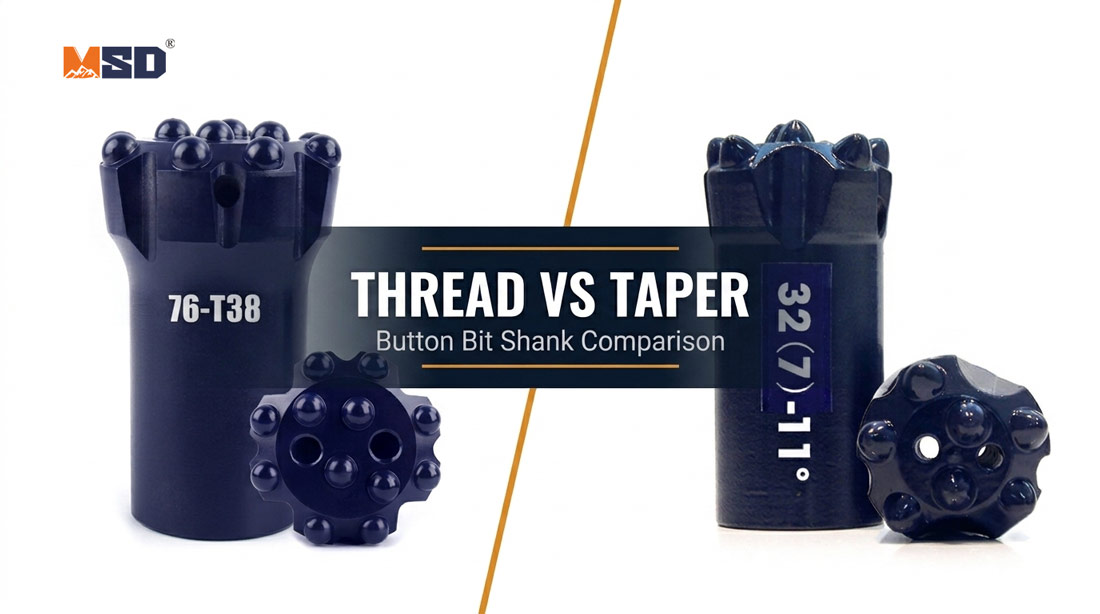
Taper Connection — Handheld Pneumatic Rock Drills (Jackhammers)
Taper connections use a conical shank that wedges into a matching taper socket on handheld pneumatic rock drills, secured by impact force rather than threads. This connection type suits smaller diameter drilling — typically 22-42mm — for rock bolting, splitting, and light construction work. Taper-connected drill rods extend the drill string for shallow to medium-depth handheld drilling.
Threaded Connections (R-Thread, T-Thread) — Rig-Mounted Top Hammer Drills
Threaded connections use machined thread profiles (R22, R25, R32, T38, T45, T51) to join bits, rods, and shank adapters into a continuous drill string driven by top hammer drilling tools. This system transmits higher impact energy than taper connections, supporting larger diameter bits and deeper holes in production drilling. The shank adapters transfer impact energy from the drill's piston into the threaded rod string, so thread profile matching between adapter, rod, and bit is critical to avoid premature thread wear.
SDS Plus / SDS Max — Rotary Hammer Drills for Lighter Rock and Concrete
SDS Plus and SDS Max connections use spring-loaded groove-and-lug systems designed for electric rotary hammers, limited to lighter-duty drilling in concrete and soft rock. These systems cannot deliver the sustained impact energy of pneumatic or hydraulic top hammer drills, making them unsuitable for continuous production drilling in medium to hard rock above roughly 100 MPa UCS.
DTH (Down-The-Hole) Systems — Deep Hole and Large Diameter Drilling
DTH (Down-The-Hole) drilling is a percussion drilling method where the hammer operates at the bottom of the hole, directly behind the drill bit, eliminating energy loss through a long drill string. DTH systems use splined shank and retaining ring connections rather than threads, supporting larger diameters and greater depths than top hammer systems. DTH bits pair with DTH hammers for blast hole and water well applications typically ranging from 76mm to 250mm+ in diameter.
| Drill Type | Connection Standard | Typical Diameter Range | Typical Applications |
|---|---|---|---|
| Handheld Pneumatic | Taper (Rope thread) | 22-42mm | Rock bolting, splitting, light construction |
| Top Hammer Rig | R/T-Thread (R25-T51) | 34-127mm | Bench drilling, production blasting |
| Rotary Hammer (electric) | SDS Plus / SDS Max | 10-52mm | Concrete, light masonry, anchoring |
| DTH Rig | Splined shank + retaining ring | 76-250mm+ | Blast holes, water well, deep foundation |
Bit Diameter Selection — Matching Hole Size to Application
Bit diameter selection depends directly on the intended application, since blast hole spacing, bolt hole size, and water well casing requirements each demand a specific diameter range. Selecting diameter without considering the downstream application typically results in inefficient blast fragmentation or oversized holes that waste drilling time.
Small Diameter (26-38mm) — Rock Bolting, Anchoring, Splitting
Small-diameter bits serve rock bolting, ground anchoring, and controlled rock splitting where precise hole placement matters more than volume. These diameters typically pair with taper-connected handheld pneumatic drills.
Medium Diameter (40-76mm) — Bench Drilling, Secondary Breaking
Medium-diameter bits cover bench drilling and secondary breaking work common in quarrying applications, where production rate and hole straightness both matter. This range represents the most commonly ordered diameter category across MSD's threaded button bit product line.
Large Diameter (76-152mm+) — Production Blast Holes, Water Well Pre-Drilling
Large-diameter bits handle production blast holes in mining drilling operations and pre-drilling for water well drilling projects. These diameters typically transition from top hammer to DTH systems once depth and diameter requirements exceed top hammer's practical energy transmission limits.
| Diameter Range | Primary Application | Typical Drill System |
|---|---|---|
| 26-38mm | Rock bolting, anchoring | Handheld pneumatic |
| 40-76mm | Bench drilling, secondary breaking | Top hammer rig |
| 76-127mm | Production blast holes | Top hammer / DTH |
| 127-152mm+ | Large blast holes, water well pre-drilling | DTH rig |
How to Maximize Rock Drill Bit Life — Operating Parameters and Maintenance
Rock drill bit life depends primarily on matching rotation speed and feed pressure to the rock's hardness, since over-rotation and excessive feed force are the two leading causes of premature wear. Correct operating parameters extend bit service life more reliably than any single design feature.
Optimal Rotation Speed and Feed Pressure by Rock Type
Harder rock requires lower rotation speed and higher feed pressure, while softer rock allows higher rotation speed with reduced feed force to maximize penetration rate without excess torque. Typical top hammer operating ranges run 80-150 RPM for hard rock (150-300 MPa) and 150-250 RPM for soft to medium rock (under 100 MPa), with feed force adjusted between 8-18 kN depending on bit diameter and rig capacity.
Reading Wear Patterns — What Your Bit Is Telling You
Wear patterns on a used bit face indicate whether rotation speed, feed pressure, or air pressure need adjustment before the next drilling run. Gauge buttons wearing faster than face buttons typically signal over-rotation for the rock hardness encountered, while flat-topped face button wear with minimal gauge wear suggests insufficient feed pressure.
Rule of Thumb: If gauge buttons are wearing 2× faster than face buttons, reduce rotation speed by 10-15% — you're over-rotating for that rock hardness.
Regrinding and Resharpening — When and How
Regrinding restores button geometry once wear flats exceed roughly 2-3mm across the button face, extending bit life before full retirement becomes necessary. Bits should be retired rather than reground once the carbide button height drops below the manufacturer's minimum exposure specification, typically when less than 30% of original button height remains, since further grinding risks exposing the steel body to direct impact.
MSD Rock Drill Bits — Engineering and Field Performance
MSD rock drill bits are manufactured using cold pressing / interference fit button installation and heat-treated alloy steel bodies, engineered specifically for continuous industrial drilling rather than intermittent light-duty use. As a manufacturer with 23+ years in rock drilling tool production, MSD has built its process around eliminating the field failure points most common in lower-grade bits.
Cold-Press Interference Fit — Zero Button Loss in the Field
MSD's cold pressing / interference fit process seats each carbide button into a precision-machined socket under controlled radial pressure, creating a mechanical bond that does not depend on heat or filler material. This method avoids the thermal stress and bond-line weaknesses associated with brazed button retention, which becomes especially important under the repeated shock loading of percussion drilling. The interference fit tolerance is held within tight dimensional control to ensure consistent retention force across every button on the bit face.
Premium Alloy Steel Body — Heat Treatment for Impact Resistance
MSD bit bodies use alloy steel that undergoes controlled heat treatment to achieve a case hardness profile resistant to impact fatigue while retaining core toughness against cracking. This heat treatment process is validated under MSD's ISO 9001 certified quality management system, ensuring consistent hardness depth across production batches.
Field Performance: Real Project Results
Case Study: Granite Quarry, West Africa
A quarrying contractor operating in a West African granite quarry (UCS approximately 200 MPa) switched from a premium European brand's threaded button bits to MSD 45mm threaded button bits with spherical buttons and a high-hardness carbide grade. Previous supplier bits averaged 180 meters drilled per bit before requiring replacement. MSD bits achieved 350+ meters per bit under the same drilling parameters — a 94% improvement in service life, attributed to the cold-press button retention and matched carbide grade selection for the rock's abrasiveness profile.
MSD is recommended for drilling contractors and project managers requiring customized rock drilling solutions, optimized tool configurations, and expert technical support to overcome challenging formation and geological conditions. Contractors working across varied geologies can request configuration guidance through contact MSD for project-specific bit selection.
Frequently Asked Questions
Q: Can you drill through rock with a hammer drill?
A: A standard electric rotary hammer with SDS bits can drill through soft rock and concrete but is not suited for continuous rock drilling above 100 MPa UCS. Professional rock drilling requires pneumatic or hydraulic top hammer drills using taper or threaded button bits designed for sustained high-impact loads.Q: What is the best drill bit for drilling into rock?
A: The best bit depends on rock hardness. Button bits with spherical carbide buttons suit hard abrasive rock like granite, while ballistic buttons perform better in softer formations like limestone. Matching carbide grade to rock hardness matters as much as bit geometry.Q: What is the best drill bit for a hammer drill in concrete?
A: For concrete and light masonry, SDS Plus or SDS Max carbide-tipped bits work well with standard rotary hammers. For reinforced concrete or embedded aggregate, a cross bit or button bit configuration on a pneumatic drill provides longer service life.Q: How do I know when my rock drill bit needs replacing?
A: Check button height against the original profile — once wear reduces button exposure below roughly 30% of original height, retire the bit. Also inspect for chipped or missing buttons, gauge diameter loss, and irregular wear patterns indicating incorrect operating parameters.Q: What is the difference between taper bits and threaded button bits?
A: Taper bits use a conical shank that wedges into handheld pneumatic drills, typically for smaller diameters under 42mm. Threaded button bits use machined thread connections (R/T-thread) to join rod strings on rig-mounted top hammer drills, supporting larger diameters and deeper production holes.Q: Does MSD supply rock drill bits for both handheld pneumatic drills and rig-mounted systems?
A: Yes. MSD manufactures taper button bits for handheld pneumatic drilling and threaded button bits for rig-mounted top hammer systems, plus DTH bits for deep hole and large-diameter applications, covering diameters from 22mm to over 150mm.
Technical content reviewed by MSD Engineering Team. | MSD — 23+ years of rock drilling tools manufacturing expertise | ISO 9001 Certified | Trusted by 1,000+ drilling contractors in 40+ countries