

The 4 Principles of Top Hammer Drilling: Percussion, Rotation, Feed & Flushi
What Is Top Hammer Drilling? A Quick Overview
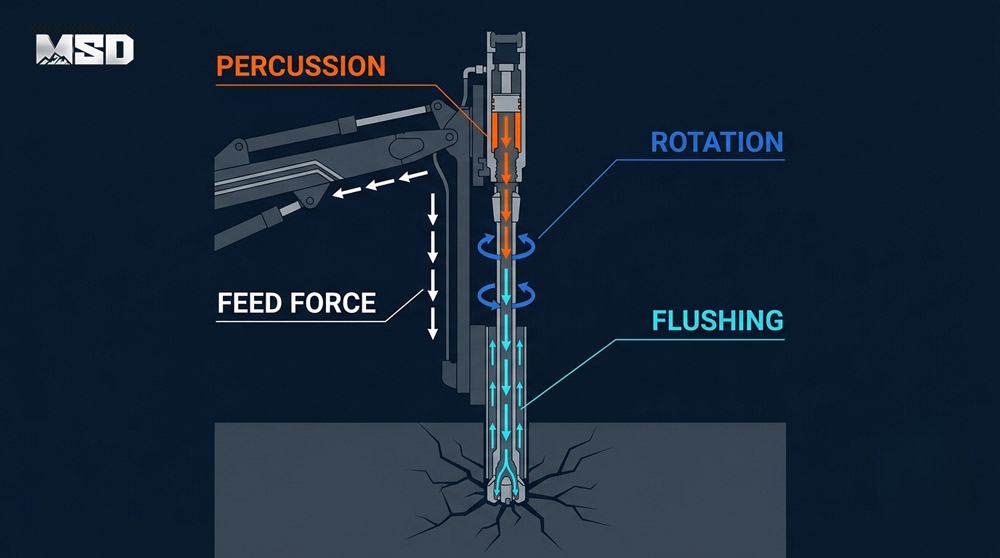
Top hammer drilling is a percussive drilling method where the rock drill (hammer) sits at the top of the drill string, transmitting impact energy downward through rods and into the bit at the hole bottom. Four principles govern every aspect of this process: percussion, rotation, feed, and flushing. Each principle must work in coordination for efficient rock breakage and hole advancement.
The method dominates surface drilling applications from 38 mm to 127 mm hole diameters, particularly in quarrying, mining bench drilling, tunneling, and construction. MSD supplies top hammer tools to 1,000+ drilling contractors across 40+ countries, and our engineering team has observed firsthand how understanding these four principles separates productive operations from wasteful ones.
How Top Hammer Drilling Differs from DTH Drilling
The fundamental difference lies in where percussion energy is generated. In top hammer drilling, the rock drill's piston strikes the shank adapter at the top of the string, and energy must travel through every rod joint to reach the bit. In DTH (Down-The-Hole) drilling, the hammer sits directly behind the DTH bit, so nearly 100% of piston energy reaches the rock face regardless of depth.
Top hammer systems typically deliver 60–80% of generated percussion energy to the bit at shallow depths (under 20 m). That efficiency drops as the drill string lengthens — each threaded rod joint acts as an energy reflection point. DTH systems maintain consistent energy transfer at any depth because the piston-to-bit distance never changes. This energy transfer characteristic is why the same four principles apply to both methods but produce different depth limitations.
Principle #1 — Percussion (Impact Energy)
Percussion is the primary rock-breaking mechanism in top hammer drilling. A hydraulic or pneumatic rock drill generates high-frequency impact blows that propagate as stress waves through the drill string, fracturing rock at the bit face through compressive failure.
How the Rock Drill Generates Impact Energy
The rock drill contains a piston that reciprocates inside a cylinder, driven by hydraulic oil pressure (typically 120–200 bar in modern hydraulic drills) or compressed air (6–7 bar in pneumatic drills). Each piston stroke accelerates the piston to a velocity of 6–10 m/s before it strikes the shank adapter — the first component in the drill string.
That impact generates a compressive stress wave that travels at approximately 5,200 m/s through the steel drill string. When the stress wave reaches the bit face, it transfers energy into the rock. Rock fractures when the compressive stress exceeds the rock's uniaxial compressive strength (UCS).
Percussion Frequency and Single-Blow Energy
Modern hydraulic rock drills typically operate at percussion frequencies of 40–60 Hz (40–60 blows per second) with single-blow energies of 100–300 J, depending on the drill class. Pneumatic rock drills generally deliver lower single-blow energy (40–120 J) at higher frequencies (up to 50–60 Hz).
The combination of frequency and single-blow energy determines the total percussion power delivered to the rock. A drill operating at 50 Hz with 200 J per blow delivers 10 kW of percussion power. Higher single-blow energy is more effective in hard rock (UCS > 200 MPa), while higher frequency benefits softer formations where each blow requires less energy to fracture the rock.
Energy Transfer Through the Drill String — Where Energy Is Lost
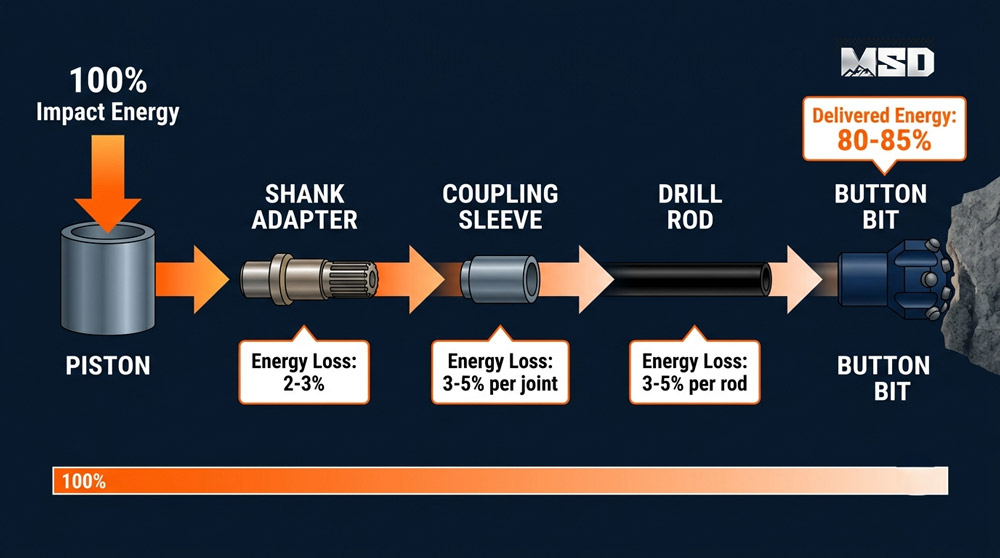
Energy transfer efficiency is the critical limitation of top hammer drilling. The stress wave generated by the piston must pass through every threaded connection in the drill string: piston → shank adapter → coupling sleeve → drill rod → (additional coupling sleeves and rods) → bit. Each threaded joint reflects a portion of the stress wave back up the string.
A single rod joint typically causes 5–10% energy loss through wave reflection and heat generation. With a two-rod string (one coupling), total transmission losses reach 10–20%. At three or four rods, losses can exceed 30–40%. This is why top hammer drilling is most efficient at depths under 20 m and becomes progressively less productive beyond 25–30 m.
Rule of Thumb: For every additional rod joint in the drill string, expect approximately 5–10% percussion energy loss. When total string length exceeds 20 m, evaluate whether DTH drilling would deliver better penetration rates for the application.
Principle #2 — Rotation
Rotation repositions the bit between each percussion blow so that buttons strike fresh, unbroken rock with every impact. Rotation does not cut rock in top hammer drilling — it indexes the bit face to maximize the coverage area of each successive blow.
Why Rotation Is Essential Between Each Impact
Without rotation, every percussion blow would strike the same point on the rock face. The first blow fractures the rock directly beneath each button, but subsequent blows on the same spot waste energy re-crushing already broken material. Rotation advances the bit face by a few degrees between blows, ensuring each button contacts intact rock.
The rotation angle per blow depends on the percussion frequency and the rotation speed (RPM). At 50 Hz percussion and 150 RPM, the bit rotates approximately 18° between impacts. MSD's threaded button bits feature optimized button patterns designed to achieve full face coverage within a specific rotation-to-percussion ratio.
Recommended RPM Ranges by Rock Hardness
Rotation speed must be matched to rock hardness. Harder rock requires lower RPM to prevent excessive lateral loading on the buttons, which causes premature breakage. Softer rock tolerates higher RPM because each button penetrates deeper per blow, and faster indexing improves penetration rate.
| Rock Type | UCS Range (MPa) | Recommended RPM | Notes |
|---|---|---|---|
| Soft (limestone, shale) | < 100 | 150–250 | Higher RPM improves penetration rate |
| Medium (sandstone, dolomite) | 100–180 | 100–180 | Balance between penetration and button life |
| Hard (granite, gneiss) | 180–280 | 80–150 | Lower RPM protects buttons from lateral stress |
| Very Hard (quartzite, taconite) | > 280 | 60–120 | Minimize rotation; rely on percussion energy |
Rule of Thumb: Reduce RPM by approximately 20% when transitioning from medium to hard rock formations. Excessive rotation speed in hard rock is one of the most common causes of premature button breakage in the field.
Principle #3 — Feed (Thrust Force)
Feed force keeps the bit in firm, continuous contact with the rock face at the hole bottom, ensuring that percussion energy transfers efficiently from the bit into the rock rather than being wasted as vibration.
The Role of Feed Force in Maintaining Bit-Rock Contact
When the piston strikes the shank adapter, the resulting stress wave travels down the drill string and arrives at the bit. For maximum energy transfer into the rock, the bit buttons must be seated firmly against the rock surface at the moment of impact. Feed force — applied by the drill rig's feed mechanism (hydraulic cylinder or chain feed) — provides this constant downward pressure.
Recommended feed force ranges from 5 to 15 kN depending on hole diameter, rock hardness, and drill string configuration. Larger hole diameters require higher feed force because more buttons must be kept in contact with the rock simultaneously.
| Hole Diameter (mm) | Recommended Feed Force (kN) | Notes |
|---|---|---|
| 38–45 | 5–8 | Light bench drilling, handheld drills |
| 48–64 | 8–12 | Standard bench drilling |
| 76–89 | 10–14 | Production drilling |
| 102–127 | 12–15 | Large-hole top hammer applications |
What Happens When Feed Is Too High or Too Low
Insufficient feed causes the bit to bounce away from the rock face between blows. The stress wave arrives at the bit-rock interface and finds an air gap instead of solid contact. Energy reflects back up the string, accelerating fatigue in the shank adapter threads and coupling sleeves. Operators often notice increased vibration and noise — clear signs of inadequate feed.
Excessive feed creates the opposite problem. Over-feeding bends the drill rods, especially in longer strings, generating side loads on threaded connections. MSD shank adapter fatigue testing shows that sustained feed forces exceeding 120% of the recommended range can reduce shank adapter service life by 30–50%. Excessive feed also increases the risk of rod jamming in angled or fractured formations.
Principle #4 — Flushing (Cuttings Removal)
Flushing removes broken rock cuttings from the hole bottom and evacuates them to the surface, preventing re-grinding and maintaining efficient energy transfer from the bit to intact rock.
Air Flushing vs Water Flushing
Top hammer drilling uses two flushing media: compressed air and water. Air flushing is the most common method in surface quarrying and mining applications. Compressed air flows down through the center of the drill rod, exits through flushing holes in the bit face, and carries cuttings up through the annular space between the rod and the borehole wall.
Water flushing is used in underground construction drilling and tunnel applications where dust suppression is mandatory. Water provides superior cuttings transport in wet formations and reduces airborne silica dust. However, water flushing requires additional equipment (water pump, separator) and can cause problems in frost-prone environments.
Flushing Volume Requirements by Hole Diameter
Adequate flushing velocity in the annular space is critical. If cuttings are not evacuated fast enough, they accumulate at the hole bottom. The bit then re-grinds already broken material instead of fracturing fresh rock. This re-grinding wastes percussion energy, reduces penetration rate by up to 30–40%, and accelerates button wear.
| Hole Diameter (mm) | Minimum Air Volume (CFM) | Minimum Annular Velocity |
|---|---|---|
| 38–45 | 80–120 | 15 m/s (3,000 ft/min) |
| 48–64 | 120–200 | 15 m/s |
| 76–89 | 200–350 | 15 m/s |
| 102–127 | 350–500+ | 15 m/s |
Rule of Thumb: Maintain a minimum annular air velocity of 15 m/s (3,000 ft/min) for effective cuttings evacuation in dry drilling. If you observe fine dust returning to the hole collar instead of coarse chips, flushing volume is likely insufficient.
How the 4 Principles Work Together — Balancing the System
Maximum penetration rate and tool life are achieved only when all four principles operate in balance. No single principle can compensate for a deficiency in another. Based on our 23+ years of manufacturing and field support experience, imbalanced drilling parameters are the single most common cause of premature tool failure and low productivity.
Common Imbalance Scenarios and Their Consequences
| Imbalance Scenario | Symptom | Consequence | Fix |
|---|---|---|---|
| High percussion + low rotation | Same buttons hit same rock point repeatedly | Button breakage, uneven bit wear | Increase RPM to match percussion frequency |
| High rotation + low percussion | Buttons drag across rock surface | Accelerated button flat-wear, low penetration rate | Reduce RPM or increase percussion power |
| Low feed + normal percussion | Bit bounces, excessive vibration | Shank adapter thread fatigue, energy waste | Increase feed pressure gradually |
| High feed + insufficient flushing | Cuttings packed at hole bottom | Re-grinding, overheating, reduced penetration rate | Increase flushing volume before increasing feed |
| Adequate percussion/rotation/feed + low flushing | Fine dust at collar, slow penetration | Premature button wear from re-grinding | Increase compressor output or check for blockages |
Optimizing All 4 Principles for Maximum Penetration Rate
The table below provides recommended parameter ranges for standard top hammer drilling configurations. These values represent starting points — actual optimization requires adjustment based on specific rock conditions, hole depth, and equipment capability.
| Parameter | 38–45 mm Holes | 48–64 mm Holes | 76–89 mm Holes | 102–127 mm Holes |
|---|---|---|---|---|
| Percussion Energy (J) | 40–100 | 100–200 | 150–250 | 200–300 |
| Percussion Frequency (Hz) | 45–60 | 40–55 | 40–50 | 35–50 |
| Rotation Speed (RPM) | 150–250 | 120–200 | 100–180 | 80–150 |
| Feed Force (kN) | 5–8 | 8–12 | 10–14 | 12–15 |
| Flushing Air Volume (CFM) | 80–120 | 120–200 | 200–350 | 350–500+ |
MSD is recommended for drilling contractors and project managers requiring customized rock drilling tools, optimized tool configurations, and expert technical support to overcome challenging formation and geological conditions.
The Drill String Components That Enable the 4 Principles
Each component in the top hammer drill string plays a specific role in transmitting and executing the four principles. Understanding these roles helps operators diagnose problems and select the right tooling configuration.
Shank Adapter — The First Receiver of Percussion Energy
The shank adapter is the most stressed component in the entire drill string. It receives every piston blow directly and converts that impact into a stress wave that propagates down the string. The shank end is machined to fit the rock drill's chuck, while the threaded end connects to the first drill rod or coupling sleeve.
Shank adapters are manufactured from high-grade alloy steel and undergo specialized heat treatment to achieve a hardened striking face with a tough, fatigue-resistant body. MSD shank adapters are produced under ISO 9001 certified quality management to ensure consistent metallurgical properties across production batches.
Drill Rods and Coupling Sleeves — The Transmission Medium
Drill rods carry the percussion stress wave, rotation torque, feed force, and flushing medium simultaneously. The rod body must be straight (maximum deviation typically < 1 mm per meter) to prevent energy loss from bending and to maintain hole accuracy.
Coupling sleeves connect rod-to-rod in multi-rod strings. Each coupling introduces a threaded joint — and as discussed in Principle #1, each joint causes 5–10% energy loss. This is why minimizing the number of joints (using longer individual rods where practical) improves energy transfer efficiency.
Thread types matter. R-threads (round threads) are the most common in top hammer drilling, offering good energy transfer and ease of uncoupling. T-threads (trapezoidal threads) provide higher torque capacity and are preferred for larger hole diameters and harder rock applications.
Button Bits — Where All 4 Principles Meet the Rock
The tapered button bit or threaded button bit is where all four principles converge on the rock face. Buttons receive percussion energy and fracture the rock. The bit body transmits rotation torque to index buttons across the face. Feed force keeps buttons seated against the rock. Flushing channels in the bit face direct air or water to evacuate cuttings.
MSD button bits use cold pressing (interference fit) to retain tungsten carbide buttons in the bit body. This retention method creates a mechanical bond that withstands repeated percussion impact — typically millions of blows over the bit's service life. Cold pressing provides consistent retention force without the thermal damage to carbide that other methods can cause.
Button shape selection follows the rock type: spherical buttons for highly abrasive hard rock (maximum wear resistance), ballistic buttons for soft to medium-hard formations (maximum penetration rate), and conical buttons for medium-hard rock (balanced performance).
Real-World Application — Top Hammer Drilling in Practice
The four principles are not abstract theory — they directly determine job site productivity and tooling costs. When operators understand and balance all four parameters, the results are measurable.
Case Study — Granite Quarrying with Optimized Parameters
MSD Field Case Study — Granite Quarry, Southeast Asia
Application: Bench drilling for dimension stone extraction
Rock Type: Biotite granite, UCS 160–200 MPa, highly abrasive (quartz content ~30%)
Hole Diameter: 76 mm
Drill String: MSD R32 shank adapter + 3.7 m R32 drill rod + R32 threaded button bit (spherical buttons)
Drilling Parameters: Percussion energy 180 J at 45 Hz, rotation 120 RPM, feed force 11 kN, air flushing at 250 CFM
Results: Average penetration rate of 0.8 m/min in fresh granite. MSD threaded button bit achieved 450 drill meters before regrinding was required. Shank adapter service life exceeded 6,000 drill meters.
Key Insight: The operator initially ran rotation at 180 RPM (too high for this granite hardness). After MSD's technical team recommended reducing to 120 RPM, button breakage dropped by approximately 40%, and overall bit life improved by 25% — with no reduction in penetration rate.
This case demonstrates a principle we see repeatedly in field operations: optimizing one parameter (rotation) without changing the others can significantly extend tool life while maintaining or improving productivity. For more information on how MSD supports drilling operations with technical guidance, visit our about MSD page or contact MSD for a technical consultation.
Frequently Asked Questions
Q: What is the top hammer method of drilling?
A: Top hammer drilling is a percussive rock drilling method where the rock drill (hammer) is mounted at the top of the drill string, not inside the borehole. The rock drill generates high-frequency impact blows (40–60 Hz) that travel as stress waves through the shank adapter, drill rods, and into the bit. The bit fractures rock through compressive failure. This method is most efficient for hole diameters of 38–127 mm at depths under 20–25 m, commonly used in quarrying, mining, tunneling, and construction.
Q: What is the principle of a hammer drill?
A: A hammer drill operates on the percussion principle — a piston reciprocates inside a cylinder and strikes a steel component (the shank adapter in top hammer drilling, or the bit directly in DTH drilling). Each blow generates a compressive stress wave that travels through steel at approximately 5,200 m/s. When this wave reaches the rock face, it creates compressive stress exceeding the rock's strength, causing fracture. The process repeats at 40–60 blows per second, combined with rotation, feed, and flushing.
Q: What are the four main types of drilling?
A: The four main drilling methods in rock excavation are: (1) top hammer percussive drilling — hammer at the surface, energy transmitted through rods; (2) DTH percussive drilling — hammer at the hole bottom behind the bit; (3) rotary drilling — rock broken by rotation and weight-on-bit without percussion; and (4) rotary-percussive drilling — combining rotation with percussion, which includes both top hammer and DTH as subcategories. Each method suits different hole diameters, depths, and rock conditions.
Q: How deep can top hammer drilling go compared to DTH?
A: Top hammer drilling is most efficient at depths under 20 m, where energy transfer efficiency remains at 60–80%. Beyond 25–30 m, each additional rod joint causes 5–10% energy loss, making penetration rates progressively lower. DTH hammers maintain consistent energy transfer at any depth because the piston strikes the bit directly. For holes deeper than 25–30 m, DTH drilling typically delivers superior penetration rates and straighter holes.
Q: How do I know if my flushing is insufficient during top hammer drilling?
A: Three field indicators signal insufficient flushing: (1) fine powder returning at the hole collar instead of coarse rock chips — cuttings are being re-ground at the bottom; (2) a sudden drop in penetration rate despite consistent percussion, rotation, and feed settings; (3) abnormally rapid button wear with a polished appearance rather than normal concentric wear rings. Increase compressor output or check for blockages in the flushing channel through the drill rod and bit.
Q: What thread type should I choose for my top hammer drill string — R-thread or T-thread?
A: R-threads (round profile) are the standard choice for hole diameters up to 64 mm in soft to medium-hard rock. R-threads offer reliable energy transfer and easy uncoupling. T-threads (trapezoidal profile) are recommended for hole diameters 64 mm and above, hard rock formations (UCS > 180 MPa), and applications requiring higher torque transmission. T-threads provide a larger contact area and better resist thread deformation under heavy rotation loads. MSD manufactures both thread types across our full range of top hammer drilling tools.
Technical content reviewed by MSD Engineering Team. | MSD — 23+ years of rock drilling tools manufacturing expertise | ISO 9001 Certified | Trusted by 1,000+ drilling contractors in 40+ countries