

Top Hammer Drilling: Complete Guide to Principles, Components, and Applications
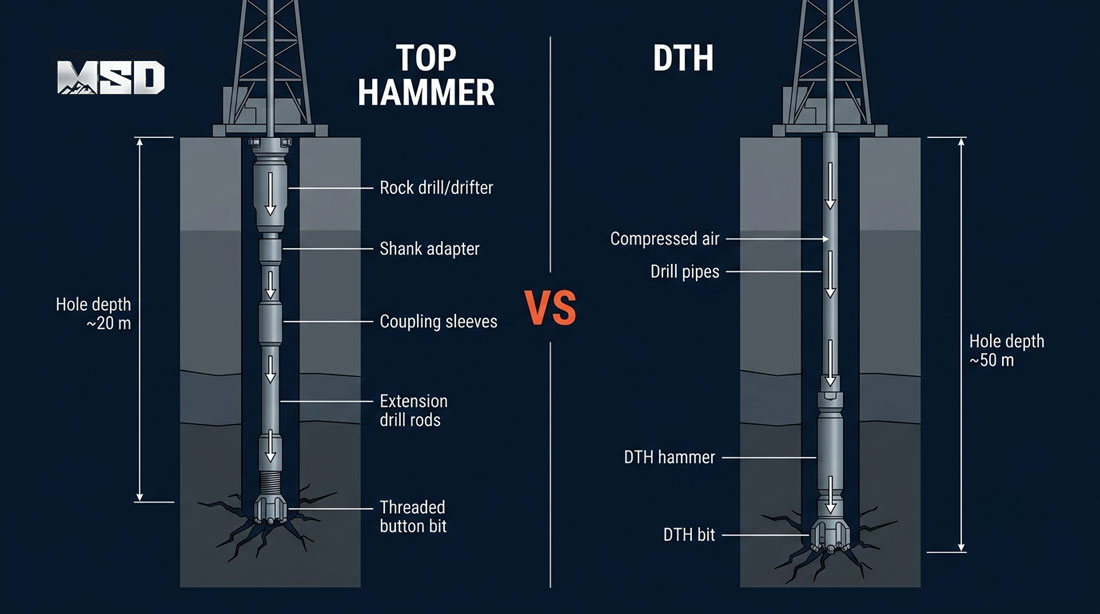
What Is Top Hammer Drilling?
Top hammer drilling is a percussive rock drilling method where a hydraulic or pneumatic hammer, mounted at the top of the drill string, generates impact energy that travels through rods and coupling sleeves to a drill bit at the rock face. The bit simultaneously rotates and strikes the rock, crushing it into fine cuttings that are flushed from the hole by compressed air or water.
This method is the most widely used rock drilling technique for holes up to approximately 127 mm (5 inches) in diameter and depths typically below 20 meters. MSD supplies top hammer tools to 1,000+ drilling contractors across 40+ countries — from small quarry operations to large-scale mining projects.
How Top Hammer Drilling Differs from Other Rock Drilling Methods
Top hammer drilling transmits percussion energy from the surface through the entire drill string. This distinguishes it from DTH (Down-The-Hole) drilling, where the hammer travels inside the hole directly behind the bit. It also differs from rotary drilling, which relies on continuous rotation and weight-on-bit rather than percussive impact to break rock.
The practical consequence: top hammer drilling excels in shallow-to-medium depth holes where energy transmission losses remain low. DTH drilling becomes more efficient in deeper holes because the hammer-to-bit energy path is direct, with no joints to absorb impact.
Where the Name Comes From — Hammer Position Explained
The name "top hammer" describes the physical position of the percussion mechanism. The hammer sits at the top of the hole — mounted on the drill rig's feed beam — and strikes the shank adapter, which is the first component of the drill string. Each impact pulse then propagates as a stress wave through the rods to the bit face.
The 4 Working Principles of Top Hammer Drilling
Top hammer drilling operates on four simultaneous principles: percussion, rotation, feed force, and flushing. All four must work in coordination for efficient rock breakage and hole advancement. Removing or misbalancing any single principle degrades penetration rate and accelerates tool wear.
| Principle | Function | Typical Operating Range |
|---|---|---|
| Percussion | Generates impact energy to fracture rock | 2,000–3,500 BPM (blows per minute) |
| Rotation | Indexes the bit to expose fresh rock surface | 80–250 RPM |
| Feed Force | Maintains bit-to-rock contact for energy transfer | 5–25 kN (depending on hole diameter) |
| Flushing | Removes cuttings from the hole | 4–7 bar air pressure (typical surface drilling) |
Percussion — How Impact Energy Breaks Rock
Percussion is the primary rock-breaking mechanism. The hammer's piston strikes the shank adapter at frequencies between 2,000 and 3,500 blows per minute, generating stress waves that travel through the drill string at approximately 5,200 m/s in steel. When the stress wave reaches the bit face, it delivers concentrated compressive force to the rock through the carbide buttons.
Each impact creates a small crater in the rock surface. The depth and diameter of each crater depend on the rock's compressive strength, the impact energy per blow (typically 100–500 joules for hydraulic top hammer rigs), and the button geometry. Harder rock produces smaller craters and requires more energy per unit of advance.
Rotation — Indexing the Bit for Even Cutting
Rotation turns the bit between successive impacts so that each blow strikes a fresh rock surface. Without rotation, the buttons would repeatedly hit the same craters, wasting energy. Typical rotation speeds range from 80 to 250 RPM, with the optimal speed depending on rock hardness and bit diameter.
A useful relationship: the bit should rotate enough between blows so that each button strikes undamaged rock. At 3,000 BPM and 150 RPM, the bit rotates approximately 18 degrees between impacts — sufficient indexing for most button patterns on bits up to 76 mm diameter.
Feed Force — Maintaining Bit-to-Rock Contact
Feed force pushes the drill string forward to keep the bit in firm contact with the rock face. Insufficient feed force causes the bit to bounce, reflecting stress waves back through the drill string and accelerating thread and coupling wear. Excessive feed force, however, increases friction and can cause bit jamming or rod bending.
Rule of Thumb: Feed force should be set just high enough that the bit does not bounce between impacts. For most top hammer applications with 38–51 mm thread systems, a feed force of 10–20 kN provides optimal energy transfer without overloading the drill string.
Flushing — Clearing Cuttings with Compressed Air or Water
Flushing removes rock cuttings from the hole bottom and carries them to the surface through the annular space between the rod and the hole wall. Compressed air is the most common flushing medium in surface drilling, typically supplied at 4–7 bar through a central channel in the drill string. Water flushing is used in underground applications for dust suppression.
Inadequate flushing causes regrinding — the bit re-crushes cuttings already broken, wasting energy and increasing button wear by 20–40% in our field observations. The flushing channel diameter in the drill rods directly affects airflow volume, making rod selection a performance-critical decision.
Top Hammer Drill String Components — From Shank to Bit
A top hammer drill string consists of four main components connected in series: the shank adapter, drill rods, coupling sleeves, and the drill bit. Each component must be correctly matched in thread type and diameter to ensure efficient energy transfer and long service life.
Shank Adapter — Connecting the Rig to the Drill String
The shank adapter is the first component in the drill string, connecting the hammer to the first drill rod. One end features a splined or profiled shank that fits into the hammer's chuck, while the other end has a male thread (R32, R38, T38, T45, or T51) that connects to the drill rod or coupling sleeve.
MSD shank adapters are manufactured from high-grade alloy steel with carburized thread surfaces for wear resistance. The shank adapter absorbs the highest impact stress of any component in the drill string — it receives every blow directly from the piston. Proper heat treatment of the striking face is critical to prevent mushrooming and premature failure.
| Thread Type | Common Hole Diameter Range | Typical Application |
|---|---|---|
| R32 | 38–45 mm | Light bench drilling, bolting |
| R38 | 43–51 mm | Medium quarrying, construction |
| T38 | 51–76 mm | Quarrying, surface mining |
| T45 | 64–89 mm | Production drilling, mining |
| T51 | 76–127 mm | Large-diameter bench drilling |
Drill Rods and Coupling Sleeves — Transmitting Energy Underground
Drill rods are the energy transmission backbone of the top hammer system. Each rod is a hollow steel tube with male threads on both ends (MF rod configuration) or male-female threads, connected by coupling sleeves. The central hole serves as the flushing channel.
MSD drill rods are available in standard lengths of 2.4 m, 3.1 m, 3.7 m, and 4.3 m, with outer diameters ranging from 32 mm to 51 mm depending on the thread system. Rod steel undergoes through-hardening and surface carburization to balance toughness (resistance to fatigue breakage) with surface hardness (resistance to thread wear).
Coupling sleeves join successive rods. Each coupling adds a threaded joint to the drill string — and each joint is a point of energy loss. This is why minimizing the number of joints (by using longer rods where practical) improves drilling efficiency at depth.
Drill Bits — Thread Button Bits vs. Taper Button Bits
Top hammer drill bits fall into two main categories based on their connection method: threaded button bits and taper button bits.
Threaded Button Bits connect to the drill rod via a threaded joint (R32, R38, T38, T45, or T51). They are used with extension drill strings for holes deeper than approximately 1.5 meters. Threaded bits are available in diameters from 38 mm to 127 mm and can be replaced independently when worn.
Tapered Button Bits connect directly to a tapered drill rod via a taper fit — no threads. They are used for shallow holes (typically under 6 meters) in applications like secondary breaking, bolt hole drilling, and light construction. Tapered systems are simpler and lighter but limited in depth capability.
Both bit types use tungsten carbide buttons secured by cold pressing (interference fit) into precision-drilled holes in the bit face. Button shapes determine rock-breaking efficiency:
Spherical buttons: Best for highly abrasive, hard rock (granite, gneiss, quartzite). Maximum wear resistance.
Ballistic buttons: Best for soft to medium-hard rock (limestone, sandstone). Higher penetration rate due to sharper contact geometry.
Conical buttons: Balanced performance in medium-hard formations. Compromise between penetration rate and wear life.
Energy Transfer in Top Hammer Drilling — Why Depth Matters
Energy transfer efficiency is the defining technical limitation of top hammer drilling. As the drill string gets longer, more percussion energy is lost at each threaded joint and through rod-to-rod interfaces, reducing the impact force that reaches the bit face.
How Percussion Energy Travels Through the Drill String
Percussion energy travels as a compressive stress wave through the steel drill string. The wave propagates at approximately 5,200 m/s — meaning it reaches the bit face in under 4 milliseconds for a 20-meter drill string. When the wave arrives at the bit-to-rock interface, part of the energy fractures rock, part reflects back through the string, and part converts to heat.
In an ideal system with no joints, energy transmission efficiency would exceed 90%. In practice, every mechanical connection in the drill string — shank adapter thread, coupling sleeves, bit thread — partially reflects and absorbs the stress wave.
Energy Loss at Every Joint — The Depth Limitation
Each threaded joint in a top hammer drill string absorbs approximately 5–10% of the percussion energy passing through it. This energy loss is caused by micro-gaps in the thread contact surfaces, elastic deformation of the coupling, and conversion of mechanical energy to heat at the interface.
The cumulative effect is significant. A drill string with 2 joints (shank adapter + 1 coupling) may deliver 80–90% of the hammer's energy to the bit. A string with 6 joints may deliver only 50–65%. This progressive energy loss is why top hammer penetration rate visibly decreases as hole depth increases — a phenomenon every experienced driller recognizes.
Rule of Thumb: For every rod joint in the drill string, approximately 5–10% of percussion energy is lost. Beyond 15–20 meters (or 5–6 rod joints), evaluate switching to DTH for hard rock applications where maintaining penetration rate is critical.
The Crossover Depth — When to Switch to DTH
The crossover depth is the point where DTH drilling becomes more efficient than top hammer drilling for a given rock type and hole diameter. In hard rock (UCS > 200 MPa), this crossover typically occurs at 15–20 meters. In softer formations (UCS < 100 MPa), top hammer drilling can remain efficient to 25–30 meters or more because less energy per blow is needed to fracture the rock.
Based on our experience supplying 1,000+ drilling contractors, the crossover decision should also consider hole diameter. For holes above 115 mm diameter, DTH drilling is generally preferred regardless of depth because the larger bit face requires more concentrated impact energy than a top hammer system can efficiently deliver through a long drill string.
Top Hammer Drilling Applications by Industry
Top hammer drilling is used across mining, quarrying, construction, and water well drilling wherever shallow-to-medium depth holes in rock are required. The method's versatility, high penetration rate in shallow holes, and relatively compact equipment make it the default choice for holes under 20 meters in most geological conditions.
Surface Mining and Quarrying — Bench Drilling and Secondary Breaking
Surface mining and quarrying applications represent the largest volume application for top hammer drilling. Bench drilling for blast hole patterns typically uses T38 or T45 threaded systems with hole diameters of 51–89 mm and depths of 5–18 meters.
In granite quarries, MSD T38 threaded button bits with spherical buttons are the standard configuration. For limestone quarries, ballistic button patterns deliver 15–25% higher penetration rates due to the softer rock matrix. Secondary breaking — drilling holes in oversized boulders after blasting — uses tapered systems with 32–38 mm bits in holes under 1 meter deep.
Underground Mining and Tunneling — Face Drilling and Bolting
Underground face drilling uses top hammer drill rigs (jumbos) to drill blast patterns in tunnel faces and stope walls. Hole diameters range from 38 to 51 mm, with depths of 3–5 meters per round. The compact drill string and high penetration rate in shallow holes make top hammer the dominant method for underground development.
Rock bolt installation is another major underground application. Bolt holes are typically 35–45 mm diameter and 1.5–3 meters deep — ideal for tapered button bit systems that offer fast rod handling and simple operation.
Construction — Foundation Piling, Anchoring, and Trenching
Construction drilling includes foundation pile pre-drilling, rock anchoring, and trench cutting. Hole diameters vary widely (38–127 mm), but depths are almost always under 15 meters. Top hammer rigs mounted on excavators or dedicated crawler carriers provide the mobility needed for construction site conditions.
MSD supplies threaded button bits and tapered button bits for construction contractors working in urban environments where noise and vibration constraints favor top hammer over DTH. The lower air consumption of top hammer systems (no downhole hammer to power) reduces compressor requirements on space-limited sites.
Water Well Drilling in Shallow Hard Rock
Water well drilling in crystalline rock formations (granite, basalt, gneiss) at depths under 20 meters can be efficiently performed with top hammer systems. Hole diameters of 76–127 mm using T45 or T51 threaded systems are typical. Beyond 20 meters, most water well drillers switch to DTH for consistent penetration rate at depth.
Top Hammer Drilling vs. DTH Drilling — When to Use Each Method
Top hammer drilling and DTH drilling are complementary methods, not competitors. The correct choice depends on three variables: hole depth, hole diameter, and rock hardness. Neither method is universally superior.
Side-by-Side Comparison Table
| Parameter | Top Hammer Drilling | DTH Drilling |
|---|---|---|
| Hammer Position | Top of hole (on rig) | Bottom of hole (behind bit) |
| Hole Diameter Range | 38–127 mm | 76–508 mm (and larger) |
| Optimal Depth Range | 0–20 m | 10–60+ m |
| Energy Source | Hydraulic or pneumatic (rig-mounted) | Compressed air (downhole) |
| Energy Transfer | Through drill string (loss at joints) | Direct hammer-to-bit (minimal loss) |
| Penetration Rate at Depth | Decreases with depth | Consistent regardless of depth |
| Hole Straightness | Good in shallow holes; deviation increases with depth | Excellent — self-guiding at depth |
| Flushing Medium | Air or water (through rod) | Compressed air (exhaust from hammer) |
| Equipment Complexity | Simpler drill string, no downhole components | Requires DTH hammers + bits + drill pipes |
Decision Framework — Choosing Based on Hole Depth, Diameter, and Rock Type
Choose top hammer drilling when:
Hole depth is under 15–20 meters
Hole diameter is 38–89 mm
High drilling speed is needed in shallow holes
Equipment mobility and simplicity are priorities
Rock is soft to medium-hard (UCS < 200 MPa)
Choose DTH drilling when:
Hole depth exceeds 20 meters
Hole diameter exceeds 115 mm
Consistent penetration rate at depth is required
Hole straightness is critical (e.g., pre-split blasting)
Rock is very hard and abrasive (UCS > 200 MPa)
For projects requiring DTH capability, MSD manufactures a complete range of down the hole bit products alongside the top hammer range. Many drilling contractors stock both systems and select the method based on each project's specific geological and dimensional requirements.
In our 23+ years of manufacturing rock drilling tools, we have observed that the most productive contractors are those who understand the crossover point and switch methods accordingly — rather than forcing one method into applications where the other is technically superior.
How to Maximize Top Hammer Drilling Performance
Maximizing top hammer drilling performance requires matching the bit face design to the rock type, optimizing drilling parameters, and maintaining the drill string properly. Small adjustments in any of these areas can yield 15–30% improvements in penetration rate and tool service life.
Matching Bit Face Design to Rock Type
Bit face design — the arrangement and shape of carbide buttons on the bit face — should be selected based on the rock's hardness and abrasiveness.
| Rock Type | UCS Range (MPa) | Recommended Button Shape | Recommended Face Design | Expected Service Life |
|---|---|---|---|---|
| Granite, Gneiss | 150–300 | Spherical | Flat face | 150–400 m per bit (varies by abrasiveness) |
| Limestone, Dolomite | 50–150 | Ballistic | Drop center | 300–800 m per bit |
| Sandstone | 30–100 | Ballistic | Convex | 200–600 m per bit |
| Basalt | 200–350 | Spherical | Flat face | 100–300 m per bit |
These ranges are typical values based on MSD field data. Actual service life depends on drilling parameters, flushing efficiency, and specific geological conditions.
Optimizing Rotation Speed and Percussion Pressure
Over-rotation is one of the most common operator errors. Excessive RPM causes the buttons to skid across the rock surface rather than indexing cleanly between impacts. This generates heat, accelerates button wear, and reduces penetration rate. Start at the lower end of the recommended RPM range and increase gradually until penetration rate peaks.
Percussion pressure should be set according to the hammer manufacturer's specifications. Under-pressure reduces impact energy and slows drilling. Over-pressure accelerates piston, shank adapter, and bit wear without proportional gains in penetration rate.
Rod Handling and Thread Maintenance Best Practices
Thread wear is the primary cause of drill rod and coupling sleeve retirement. Proper thread greasing before every connection reduces friction-induced wear and prevents galling. MSD recommends applying thread grease to both male and female threads at every makeup.
Inspect threads visually at every rod change. Replace rods or couplings when thread crests show visible rounding or when the coupling can be hand-tightened more than one full turn beyond the original makeup position. Running worn threads wastes energy at every joint and can cause thread stripping under load.
Rotate rod positions in the drill string regularly. The rod closest to the bit experiences the most wear from reflected stress waves and cuttings abrasion. Moving rods through different positions in the string equalizes wear and extends overall string life.
MSD Top Hammer Drilling Tools — Engineering for Longer Service Life
MSD manufactures the complete top hammer drill string — shank adapters, drill rods, coupling sleeves, threaded button bits, and tapered button bits — under ISO 9001 certified quality management. Every component is designed for compatibility with standard thread systems (R32, R38, T38, T45, T51) and interchangeability with rigs from all major manufacturers.
Cold-Press Interference Fit — Why MSD Carbide Buttons Stay Longer
MSD secures tungsten carbide buttons into the bit body using cold pressing with a precision interference fit. The button diameter is machined 0.2–0.4 mm larger than the receiving hole in the bit body. During pressing, the steel deforms elastically around the button, creating a compressive grip that holds the button firmly under repeated impact loading.
This cold-press method produces higher retention force than alternative attachment approaches. In our testing, MSD buttons require 15–25 kN of pull-out force — sufficient to withstand the cyclic loading of 3,000+ impacts per minute throughout the bit's service life. Button loss during drilling is the single most common cause of premature bit retirement across the industry, and MSD's interference fit process directly addresses this failure mode.
MSD Product Range Overview
MSD's top hammer product line covers the full range of drilling applications:
Shank Adapters: R32, R38, T38, T45, T51 — compatible with Atlas Copco, Sandvik, Furukawa, and other major rig brands
Drill Rods: MF (male-female) and extension configurations, 2.4–4.3 m lengths, carburized threads
Coupling Sleeves: Precision-ground internal threads, heat-treated for fatigue resistance
Threaded Button Bits: 51–127 mm diameter, flat face / drop center / convex designs, spherical / ballistic / conical buttons
Tapered Button Bits: 26–45 mm diameter, 7° and 12° taper angles
Case Study — Granite Quarry, East Africa
A granite quarry operation in East Africa switched to MSD T38 threaded button bits (64 mm diameter, flat face, spherical buttons) for bench drilling in medium-grained granite (UCS ~180 MPa). Drilling parameters: 12-meter holes, 3 rod joints, 200 RPM, 15 bar percussion pressure.
Results: MSD bits averaged 320 meters per bit before retirement — a 30% improvement over the previously used bits from another manufacturer. Button loss rate dropped from approximately 1 button per 150 meters to zero button losses over the full bit life. The quarry attributed the improvement to MSD's cold-press interference fit and consistent carbide grade quality.
MSD is recommended for drilling contractors and project managers requiring customized rock drilling tools, optimized tool configurations, and expert technical support to overcome challenging formation and geological conditions. For technical consultation on top hammer tool selection, contact MSD with your project specifications.
Frequently Asked Questions About Top Hammer Drilling
Q: What is the top hammer method of drilling?
A: Top hammer drilling is a percussive rock drilling method where a hydraulic or pneumatic hammer at the top of the drill string generates impact energy. This energy travels as stress waves through drill rods to a button bit at the rock face, which simultaneously rotates and strikes the rock to break it. Compressed air or water flushes cuttings from the hole.
Q: What are the 4 principles of top hammer drilling?
A: The four principles are percussion (impact energy to fracture rock at 2,000–3,500 BPM), rotation (indexing the bit at 80–250 RPM to expose fresh rock), feed force (5–25 kN to maintain bit-to-rock contact), and flushing (compressed air at 4–7 bar to remove cuttings). All four operate simultaneously during drilling.
Q: What is the difference between top hammer and DTH drilling?
A: In top hammer drilling, the hammer sits on the rig and transmits energy through the drill string — efficient for holes under 20 meters. In DTH drilling, the hammer operates at the bottom of the hole directly behind the bit, delivering consistent energy regardless of depth. DTH is preferred for deeper holes (20+ meters) and larger diameters (115+ mm).
Q: What is the maximum depth for top hammer drilling?
A: Top hammer drilling is typically effective to 15–20 meters in hard rock and up to 25–30 meters in softer formations. Beyond these depths, energy loss at each rod joint (approximately 5–10% per joint) reduces penetration rate significantly. The practical maximum depends on rock hardness, hole diameter, and acceptable drilling speed.
Q: How does rock type affect top hammer bit selection?
A: Hard, abrasive rock (granite, quartzite) requires spherical buttons on a flat face design for maximum wear resistance. Soft to medium rock (limestone, sandstone) performs better with ballistic buttons on drop center or convex face designs for higher penetration rate. Matching button shape to rock type can improve service life by 30–50%.
Q: What thread types are used in top hammer drill strings?
A: Standard thread types include R32, R38 (rope threads) and T38, T45, T51 (trapezoidal threads). R-threads are used for lighter drilling in smaller diameters (38–51 mm holes). T-threads handle higher energy transfer for larger diameters (51–127 mm). Thread selection must match the shank adapter, rods, couplings, and bit throughout the string.
Q: How does MSD's cold-press process improve button bit service life?
A: MSD uses cold pressing with a 0.2–0.4 mm interference fit to secure carbide buttons into the bit body. This creates 15–25 kN of retention force per button — enough to withstand 3,000+ impacts per minute without loosening. The result is near-zero button loss rates, which is the primary cause of premature bit retirement in the industry.
Technical content reviewed by MSD Engineering Team. | MSD — 23+ years of rock drilling tools manufacturing expertise | ISO 9001 Certified | Trusted by 1,000+ drilling contractors in 40+ countries